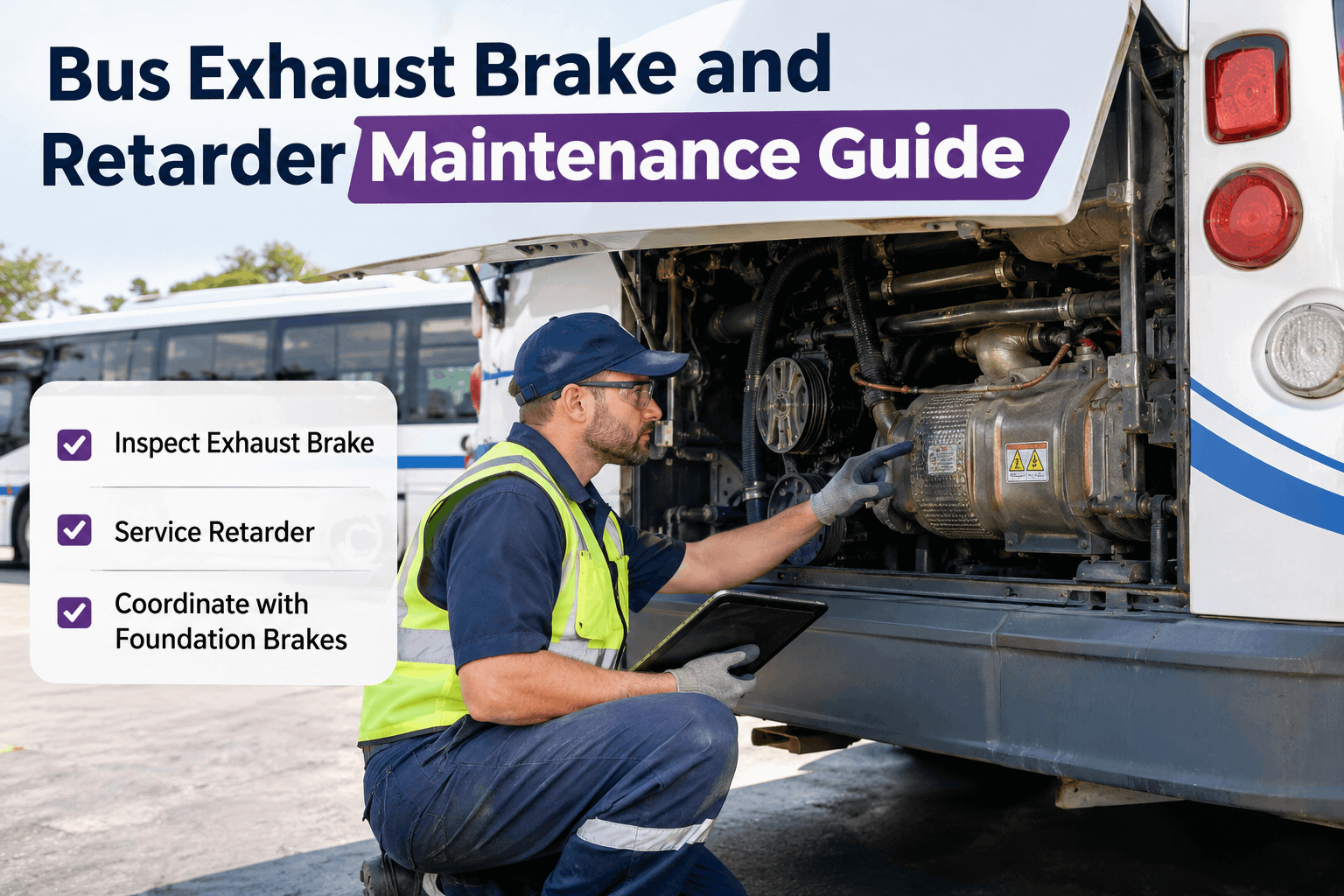
A coach comes back from a mountain route with the foundation brakes smoked months early, and the driver swears he barely touched the pedal. He is probably right: the retarder that should have done most of the slowing quietly stopped pulling its weight. Bus exhaust brake and retarder service protects the brakes you can see, and you can book a quick demo to see it tracked with the foundation brakes.
The Retarder Does the Work. The Foundation Brakes Pay If It Doesn't.
An exhaust brake, engine brake, or hydraulic retarder is a secondary brake that slows the bus without the service brakes. Working right, it can handle the large majority of everyday braking, so your foundation linings last far longer. Let it fade and that load lands straight back on the pads.
How braking load splits when the retarder is working
A retarder is not a replacement for the service brakes; it carries the routine slowing so the foundation brakes are saved for real stops and emergencies. Keep it serviced and the savings are real; ignore it and they vanish.
A Working Retarder Multiplies Foundation Brake Life
This is why the retarder matters to your budget, not just your drivers. Studies of transit buses found foundation brake life stretched well beyond baseline when a retarder carried the load: engine and exhaust brakes added a modest multiple, while hydraulic and electric retarders pushed brake life several times longer. When the auxiliary brake fades, every bit of that saving disappears into premature reline cost.
Relative foundation brake life by auxiliary brake type
Representative ranges from transit-bus retarder evaluations; actual gains depend on route grade and service type. The pattern holds: the harder your routes, the more a healthy retarder saves. You can start tracking that free.
Different Auxiliary Brakes, Different Service Needs
Not every bus brakes the same way, and the service each system needs is different. Classify what each unit carries before you build its schedule.
Swipe sideways to see all columns.
A common real-world fault is an exhaust brake that feels weak because the transmission is not downshifting to let it work, not because the brake itself failed. Catching that calls for logging the complaint and the fix together, which a maintenance platform demo shows in practice.
Coordinate Auxiliary and Foundation Brake Service
The two systems are linked, so inspect them as one job. A fading retarder shows up first as foundation brakes wearing faster than the route should cause, so reading those two signals together is how you catch the real problem early.
Test retarder effectiveness
Confirm it actually slows the bus through its stages, not just that the light comes on.
Measure foundation wear
Faster-than-expected lining wear on a graded route is the first sign the retarder is slipping.
Check the control link
Many faults are a weak downshift or a bad control stage, not the brake itself.
Log both against the bus
Record retarder service and foundation wear together so the pattern is visible next time.
Logged side by side, a jump in foundation wear points straight at the auxiliary brake instead of sending a tech chasing the wrong part. You can see that linkage in a demo.
Your Auxiliary-Brake Service Checklist
Build this into each bus's PM. CRITICAL items affect safe stopping; PLAN items protect the brake-saving payoff and the record.
- CRITICALRetarder actually slows the bus. Road or dyno test through its stages; a brake that only signals on is not working.A dead retarder quietly doubles the load on the service brakes.
- CRITICALFoundation brakes within spec. Measure lining and check for heat glazing; a retarder never excuses worn service brakes.The auxiliary brake supplements, it does not replace, the foundation brakes.
- CRITICALControls and warning indicators work. Verify the dash control, stages, and any fault lamp so the driver knows its state.A driver relying on a dead retarder is a downgrade waiting to happen.
- PLANFluid and cooling for hydraulic units. Check retarder fluid and cooling capacity; heat is what kills braking performance.Overheating fades the retarder exactly when a long downgrade needs it.
- PLANDownshift logic on exhaust brakes. Confirm the transmission downshifts so the engine brake can work.A weak engine brake is often a shift fault, not the brake itself.
- PLANLog service and foundation wear together. Record both against the unit so the trend is readable.A spike in lining wear is your earliest retarder warning.
Loaded into BusCMMS, this becomes a recurring task that ties auxiliary-brake service to foundation wear on the same unit. You can see it built in a demo.
Tie the Two Brake Systems Into One Record
A generic tool treats the retarder and the foundation brakes as unrelated line items. BusCMMS keeps them on the same unit record, so a jump in lining wear sits right next to the retarder's service history and the cause is obvious. Auxiliary-brake checks ride on the PM schedule, a failed check becomes a work order, and the full history supports your safety and warranty records.
Aux and foundation together
Retarder service and lining wear logged on the same bus, so the pattern shows.
Scheduled checks
Auxiliary-brake inspection rides on the recurring PM, never skipped.
Fault to work order
A weak retarder or worn lining becomes a scheduled repair, not a note.
Records for safety
Full brake history per unit, ready for inspection and warranty claims.
"We kept burning through brake jobs on our mountain coaches and blamed the drivers. Turned out two retarders were barely working, so the pads were doing all of it. Once we tracked the retarder service next to the lining wear, the bad units jumped right off the page."
Fleet maintenance manager, charter coach operator (41 coaches)
What to Remember About Retarder Service
- 1The retarder protects the foundation brakes. Working right, it carries most everyday braking and multiplies lining life.
- 2It is a supplement, not a substitute. Service brakes still have to pass spec; the retarder never excuses worn linings.
- 3Fast lining wear is the warning. Foundation brakes wearing early on a graded route point at a fading retarder.
- 4Track the two together. Logged side by side, the cause of premature brake wear is obvious.
The retarder is the cheapest brake on the bus to maintain and the most expensive to ignore, because its failure shows up as someone else's repair bill. Service it on schedule, track it against the foundation brakes, and the savings it was bought for actually show up.
Exhaust Brake and Retarder FAQs
What is the difference between an exhaust brake and a retarder?
An exhaust brake restricts the exhaust to boost engine braking, while a retarder is usually a hydraulic transmission or electric driveline unit that adds far more braking resistance. All are secondary brakes that slow the bus without the service brakes.
Does a retarder really save brake wear?
Yes, substantially. A working retarder can handle the large majority of everyday braking, and transit-bus studies found foundation brake life stretched several times longer with hydraulic or electric retarders carrying the load.
Can a retarder replace the service brakes?
No. A retarder supplements the foundation brakes and cannot legally or safely replace them. The service brakes must still meet spec; the retarder just carries routine slowing so they are saved for hard stops.
How do I know my retarder is failing?
Often the first sign is foundation brakes wearing faster than the route should cause. Weak slowing through the stages, overheating on downgrades, or a transmission that will not downshift for the engine brake are other clues.
Can BusCMMS track retarder and brake service?
Yes. You schedule auxiliary-brake checks on the PM, log retarder service and foundation wear against the same bus, and turn a weak retarder or worn lining into a work order, with the full history kept per unit.