A mid-sized transit agency in Pennsylvania woke up to a nightmare in January 2026: their CMMS was locked by ransomware. Every maintenance record, driver file, asset inventory, and compliance document — inaccessible. Attackers demanded $450,000 for the decryption key. The agency had no offline backups. The breach had entered through an unpatched telematics device connected to the CMMS network. Within 18 minutes of initial access, attackers had full system control. The agency paid the ransom. Recovery took six weeks. Three months later, auditors discovered data had been exfiltrated — driver records, passenger route data, vehicle maintenance histories. The incident cost $2.4 million in total impact: ransom, recovery, legal, regulatory fines, reputation damage. This guide covers the cybersecurity threats facing bus fleets in 2026, the specific vulnerabilities in CMMS and telematics systems, and the protection strategies that prevent the Pennsylvania scenario from happening to your fleet.
Fleet Cybersecurity 2026
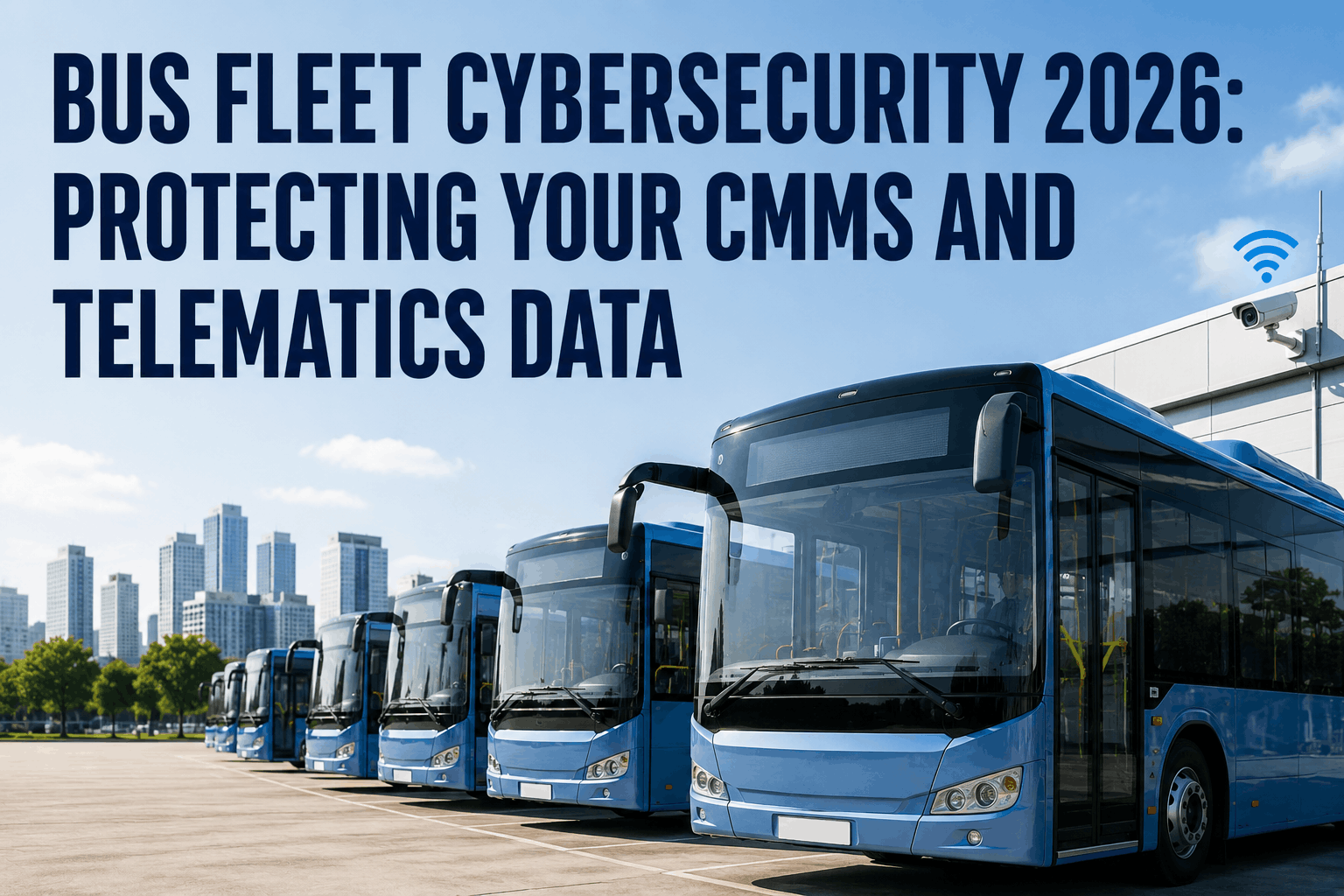
Bus Fleet Cybersecurity 2026: Protecting Your CMMS and Telematics Data
Cybersecurity threats to bus fleets are rising 47% year over year. Learn how to secure CMMS data, telematics systems, driver information, and compliance documents against ransomware, GPS spoofing, data breaches, and remote attacks — with practical security controls for fleets of all sizes.
The 2026 Cyber Threat Landscape
494
Fleet cyber incidents documented in 2025
2×
Ransomware attacks doubled vs. 2024
18 min
Average time from breach to full access
$2.4M
Average cost per cyber incident
Bus fleets operate uniquely complex attack surfaces. Every bus is a connected device. Every telematics unit is a network endpoint. Every CMMS portal is a potential breach point. The Pennsylvania transit agency's situation was not uncommon — in 2025, 67% of documented fleet cyber attacks targeted telematics and cloud infrastructure. Ransomware now represents 44% of all fleet cybersecurity incidents, double the 2024 rate. The attackers are patient: average time from initial breach to full system control is just 18 minutes.
The five attack vectors targeting bus fleets in 2026 are: (1) Ransomware through unpatched telematics devices, (2) GPS spoofing to mask vehicle movement and route data, (3) CMMS credential theft and unauthorized data access, (4) Remote ECU (Electronic Control Unit) manipulation through OBD ports, (5) Data exfiltration from cloud-connected compliance systems. All five attack vectors are active against bus fleets today. All five are preventable with proper security controls.
Five Critical Attack Vectors and Prevention Strategies
How it happens: Telematics units run firmware with default passwords and unpatched vulnerabilities. Attackers gain access through unsecured APIs or outdated software versions. Once inside, they pivot to the CMMS network.
Prevention: Change all default passwords on telematics devices; schedule automatic firmware updates; isolate telematics traffic on separate network segment; monitor telematics API access logs; deploy intrusion detection on vehicle networks.
How it happens: Attackers feed false GPS coordinates to fleet tracking systems, masking actual vehicle locations. Used for cargo theft, route manipulation, or operational disruption.
Prevention: Use multi-sensor GPS validation (crosscheck against cellular triangulation); deploy GPS signal authentication; alert on impossible movement patterns; verify location data consistency across telematics sources.
How it happens: Weak passwords, credential reuse, or phishing gives attackers CMMS portal access. Once inside, they access maintenance records, driver files, and compliance documents — or deploy ransomware.
Prevention: Enforce multi-factor authentication (MFA) on all CMMS logins; use strong password policies (16+ characters); implement single sign-on (SSO); audit access logs for suspicious login patterns; require re-authentication for sensitive operations.
How it happens: Unsecured OBD (On-Board Diagnostic) ports allow remote access to vehicle control systems. Attackers can disable brakes, cut fuel, or lock drivers out.
Prevention: Physically secure OBD ports (use locking covers); disable remote diagnostic features if not required; segment vehicle networks; require authentication for all ECU commands; monitor for unauthorized CAN bus messages.
How it happens: Attackers steal compliance documents, driver records, route data, and maintenance histories from improperly secured cloud platforms. Used for identity theft, ransom, or competitive intelligence.
Prevention: Encrypt all data at rest and in transit (AES-256); maintain offline backups tested quarterly; restrict cloud API access with IP whitelisting; deploy data loss prevention (DLP) tools; audit cloud access logs.
Cybersecurity Is No Longer Optional — It's Operational Survival.
The Pennsylvania incident cost $2.4 million. It was preventable with offline backups, MFA, network segmentation, and telematics isolation. BusCMMS includes enterprise-grade security by default — encryption, MFA, audit logs, immutable backups, role-based access control.
Cybersecurity for bus fleets is not about advanced technology — it's about disciplined execution of fundamental controls. The six controls below reduce breach risk by 85–90%. Most require minimal investment but are consistently overlooked in fleet operations.
1
Implement Multi-Factor Authentication (MFA) Everywhere
Every CMMS login, every telematics portal, every cloud service must require MFA. SMS codes are better than nothing, but authenticator apps (Google Authenticator, Microsoft Authenticator) are stronger. Cost: $0–$500/year. Effort: 2–3 hours setup. Effectiveness: Blocks 99.9% of credential-based attacks.
2
Network Segmentation: Isolate Telematics from CMMS
Your telematics devices, GPS trackers, and ELDs should NOT have direct access to your CMMS network. Use a separate, restricted network segment. If a telematics device is compromised, it cannot pivot to your maintenance records. Cost: $2K–$5K (network configuration). Effort: 1–2 weeks. Effectiveness: Prevents lateral movement attacks.
3
Maintain Tested Offline Backups
Ransomware encrypts online backups. You must maintain offline (disconnected) copies of CMMS data, driver records, and compliance documents. Test recovery quarterly. Cost: $3K–$8K (storage + procedures). Effort: 4 hours setup + 1 hour quarterly testing. Effectiveness: Ensures recovery without ransom payment.
4
Encrypt All Data (At Rest and In Transit)
CMMS data, maintenance records, driver files — encrypt using AES-256. Transit encryption uses HTTPS/TLS for all external connections. Cloud CMMS providers should do this by default. Cost: $0 (usually included in CMMS subscription). Effort: Minimal (typically pre-configured). Effectiveness: Makes stolen data unreadable.
5
Audit Logging & Access Monitoring
Every login, every data access, every configuration change must be logged with timestamp and user ID. Review logs monthly for suspicious patterns (unusual access times, multiple failed logins, access from unexpected locations). Cost: $500–$2K/year. Effectiveness: Detects breach activity in progress.
6
Incident Response Plan with Quarterly Testing
Document what happens if you detect a breach: who to notify, what systems to isolate, how to restore from backups, who handles law enforcement contact, insurance notification, and driver notification. Test the plan quarterly. Cost: $2K–$5K (development). Effectiveness: Reduces incident damage by 40–60%.
"We thought cybersecurity was an IT problem that didn't apply to fleet operations. Then we got hit with ransomware through our telematics provider. Our CMMS locked down. We had no backups. We were forced to pay $450,000 and still lost six weeks of operations. After recovery, we implemented network segmentation, MFA, offline backups, and audit logging. Our insurance company cut our cyber liability premium by 30% once we showed those controls in place. More importantly, we now sleep at night knowing our fleet data is protected. Cybersecurity wasn't expensive — it was cheap compared to what we paid to learn it the hard way."
— IT Director, Pennsylvania transit agency
Your Fleet Data Is Your Operations. Protect It Like Your Life Depends On It.
BusCMMS includes enterprise-grade security by default: AES-256 encryption, MFA, role-based access control, immutable backups, detailed audit logging, and compliance-ready documentation. No additional security configuration required. Secure from day one.
Is ransomware really a threat to small bus fleets, or just large transit agencies?
Ransomware attacks small fleets more frequently than large ones. Small fleets often have weaker security and fewer resources to defend. Attackers specifically target mid-size fleets (20–100 buses) because security is poor but operations are valuable enough to justify negotiation.
What is the real cost of a ransomware attack on a bus fleet?
Pennsylvania incident: $2.4M total (ransom $450K + recovery $600K + lost operations $800K + legal/regulatory $550K). Smaller fleet (20 buses): $300K–$600K. The average is 6–8 weeks of operational disruption. Never pay ransom without law enforcement consultation.
If we use a cloud CMMS instead of on-premise, is cybersecurity automatically better?
Cloud CMMS providers handle infrastructure security (servers, data center, network) but YOU remain responsible for access security (passwords, MFA, API keys). Cloud is generally safer than on-premise if provider implements encryption and regular security updates. Verify SLA for incident response time.
Should we keep telematics disconnected from the CMMS to prevent attacks?
No — disconnecting breaks integration that provides valuable maintenance insights. Instead, use network segmentation: separate telematics on isolated network segment with restricted API access to CMMS. One-way data flow (telematics → CMMS) is safer than bi-directional.
How often should we test backup recovery procedures?
Quarterly testing is best practice. Perform full recovery test (restore from backup to separate test environment) at least twice per year. Document recovery time and completeness. If recovery fails, your backup is useless during actual incident.
What should we do if we detect a breach in progress?
Isolate affected systems from network immediately, do NOT shut down (preserve forensic evidence), notify cybersecurity incident response team, contact law enforcement (FBI if federal funding involved), preserve audit logs, notify insurance carrier. Do not attempt to negotiate with attackers without law enforcement guidance.
Is cyber liability insurance enough protection, or do we need technical controls too?
Both are required. Insurance covers financial losses but does NOT prevent breaches or operational disruption. Technical controls (MFA, encryption, backups) prevent incidents. Together, they provide protection. Most insurers require basic controls (MFA, backups) to issue cyber liability policies.
The Pennsylvania ransomware attack was not a sophisticated zero-day exploit. It was telematics device with a default password connected to an unprotected CMMS, with no offline backups, and no audit logging. Preventable with six fundamental controls and zero advanced technology. Your fleet data is your operations. Your CMMS is your compliance defense. Protect both with discipline, not just wishful thinking.