A school district transportation director in Phoenix decided to go paperless in March 2026 -- after FMCSA final rule FMCSA-2025-0115 explicitly authorized electronic DVIRs and removed the last regulatory reason to stay on paper. Her fleet: 47 buses, 53 CDL drivers, 400+ individual compliance dates. Her paper system: three binders, one spreadsheet, one wall calendar. Her compliance rate before BusCMMS: four recordkeeping violations in the prior FMCSA audit, $38,000 in penalties, 22 staff-hours per month in manual tracking. Three months after going digital: zero violations at the follow-up review, 1.5 staff-hours per month, and a compliance dashboard her superintendent checks every Monday morning. The difference was not more effort. It was a system that makes compliance the default outcome rather than the result of manual vigilance. This guide shows you how to build that system for your USA bus fleet -- covering every FMCSA-required document category, the alert architecture that prevents gaps, the paper-to-digital cost comparison, and the week-by-week setup process your fleet can replicate regardless of size.
Build your digital compliance system today -- free trial, no credit card
Bus Fleet Digital Compliance System: Complete Setup Guide for 2026
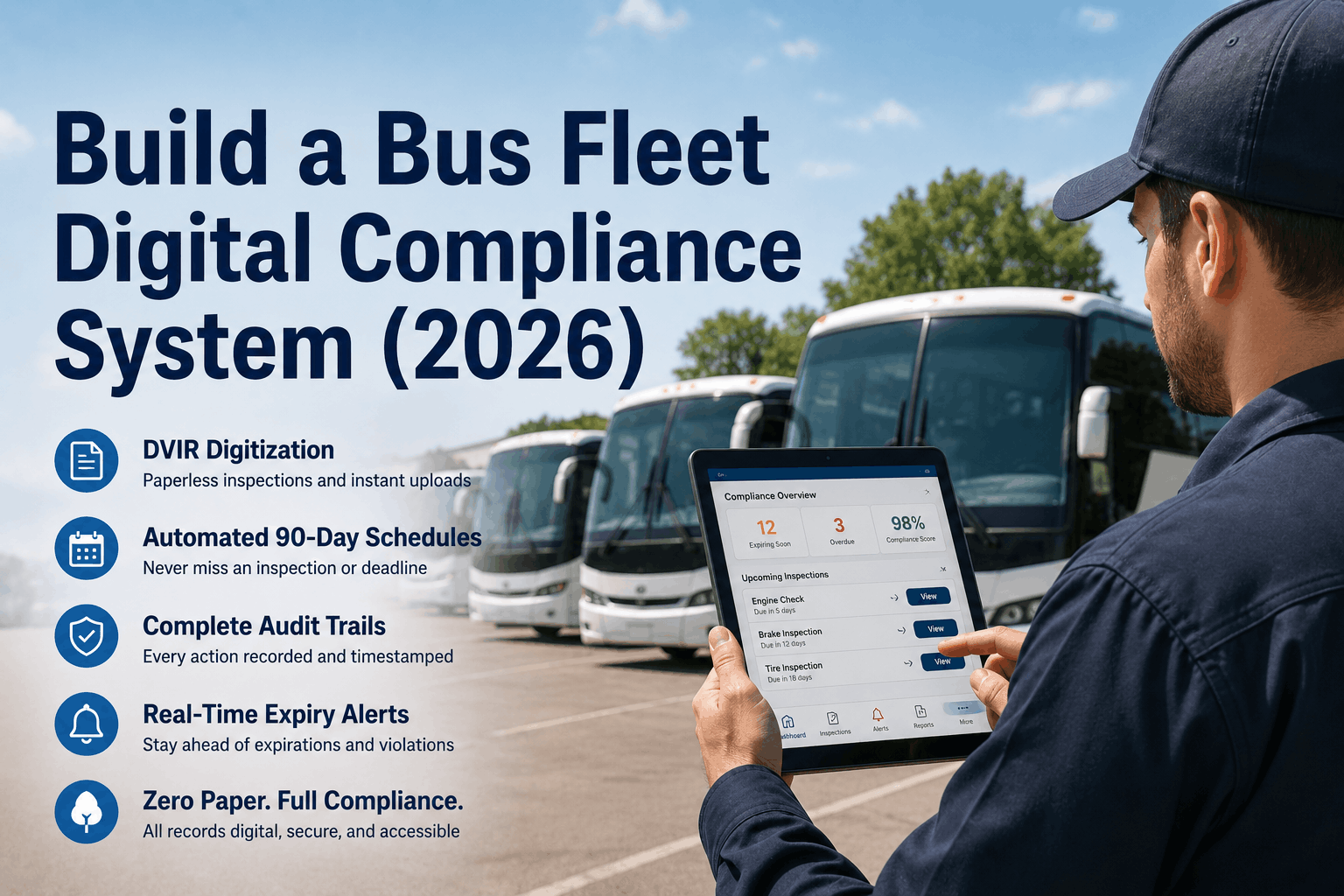
Step-by-step guide covering DVIR digitization, FMCSA-authorized eDVIR setup, automated 90-day inspection scheduling, real-time expiry alerts, and complete audit trail architecture -- zero paper required.
The cost difference between paper and digital compliance is not just the fine when something expires -- it is the cumulative staff time, audit risk, recordkeeping penalties, and operational disruption that paper compliance produces every month, every year, for as long as the system runs. Below is a five-metric comparison using documented industry data from FMCSA, carrier audit reports, and fleet management research through 2025-2026. Schedule a demo to see BusCMMS replace every row in this table automatically.
Most bus fleets that fail at digital compliance transitions do so because they try to change everything at once: new software, new workflow, new training, while simultaneously maintaining the paper system as a backup. This two-week framework eliminates that problem by front-loading the infrastructure (records migration and alert configuration) before touching driver workflow, so the system is ready before a single paper process is discontinued. Sign up free to access the BusCMMS onboarding workflow that follows this exact sequence.
Inventory every bus file and every driver file. Record every expiry date for every document category. This step typically reveals 2-4 compliance gaps per bus and 1-3 per driver that the paper system missed entirely. Document every gap before beginning digitization -- fixing gaps before they exist in the digital system prevents carrying forward vulnerabilities. Flag any bus or driver with currently expired documents as dispatch priority before proceeding.
Import your vehicle and driver roster into BusCMMS via CSV. Scan and upload all existing compliance documents. Enter every expiry date -- the system immediately calculates 90/60/30/7-day alert windows and flags any document currently in the warning window or expired. Configure who receives alerts at each threshold. Set dispatch lockout rules for expired vehicle documents (annual inspection, registration, insurance) and driver documents (medical certificate, CDL). By end of Day 5, your complete compliance calendar is visible on one dashboard for the first time.
Under FMCSA final rule FMCSA-2025-0115 (effective March 23, 2026), electronic DVIRs are fully authorized. Install the BusCMMS driver app on 5-10 driver smartphones. Configure the FMCSA-compliant school bus DVIR template (pre-loaded in BusCMMS, covering all 11 required components plus stop arm, crossing gate, emergency exits, and child check). Run the pilot for 3 days. Monitor 3-signature chain completion rates (driver, mechanic, next driver). Identify any training gaps before full rollout. Track average completion time -- most drivers complete BusCMMS DVIR in 2-5 minutes versus 10-15 for paper.
Deploy digital DVIR to all drivers fleet-wide. Run a 30-minute training session covering app installation, guided walk-around sequence, photo capture for defects, and the 3-signature chain. Train maintenance staff on digital work order workflow -- when a driver reports a defect, the work order creates automatically and routes to the technician without any dispatch or management coordination. Paper DVIRs are discontinued for all buses running the digital system. Retain 90-day paper archive for compliance retention requirements during the transition period.
Run a simulated DOT audit: request a full 30-day record export (DVIRs, work orders, inspection reports) and time the response. Target: under 5 minutes. If any document category is missing or incomplete, identify and resolve before the next dispatch cycle. Configure the monthly compliance report for automated delivery to your superintendent or transportation director on the first of each month -- covering PM compliance, DVIR completion rate, document expiry status, and fleet availability. From this point forward, the system maintains itself: every inspection creates a record, every expiry triggers an alert, and every DOT audit request is answered in seconds. Sign up free and follow this exact sequence starting today.
The difference between paper and digital compliance is not a difference in what needs to be tracked -- it is a difference in who does the tracking. Paper systems require a human to remember, schedule, file, and retrieve every compliance item. BusCMMS makes compliance the automatic output of daily operations. Every inspection, every work order, every DVIR, and every document upload creates a permanent timestamped record and updates the compliance calendar automatically. Here is the comparison across the 11 categories your fleet must track.
The compliance categories that generate bus fleet violations are not covered by general fleet management software or general CMMS platforms. A general CMMS like OxMaint manages work orders and preventive maintenance across multiple asset types -- but it has no concept of a 90-day school bus emergency exit inspection requirement, no pre-loaded FMCSA 49 CFR 396.11 bus DVIR template, and no mechanism for tracking driver medical certificates integrated with CDL status alerts. Building bus compliance on a general CMMS requires manual configuration of every bus-specific regulatory category, with no baseline to start from and no validation that the configuration actually meets FMCSA requirements. See BusCMMS bus-specific compliance against a general platform in a live demo.
90-Day Emergency Exit Inspection -- Only in BusCMMS
The 90-day emergency exit inspection requirement under 49 CFR 396.3 is specific to school buses. It is not tracked by Samsara, Motive, OxMaint, or any general fleet platform without manual configuration. BusCMMS auto-schedules every 90-day emergency exit inspection for every school bus in the fleet, with alerts at 30, 14, and 7 days before each deadline and dispatch lockout when the inspection is overdue.
FMCSA Bus DVIR with 3-Signature Chain Enforcement
FMCSA requires a 3-signature chain for any defect-noted DVIR: driver signature at inspection, mechanic certification of repair, and next-driver acknowledgment before redispatch. Paper breaks this chain regularly. General digital DVIR tools do not enforce it. BusCMMS enforces the full chain digitally -- the bus cannot be dispatched until all three signatures are captured and the repair is certified. A single broken link creates an audit violation worth $1,270 per day.
CNG Cylinder Lifecycle Tracking for Mixed Fleets
Transit agencies and school districts adding CNG buses to diesel fleets face a compliance category no general platform tracks: CNG fuel cylinder expiration dates and annual certified inspection scheduling. Cylinders holding gas at 3,600 PSI have 15-20 year lifespans -- at least one USA transit agency was found operating expired cylinders because no system tracked the dates. BusCMMS tracks cylinder expiry per bus with 90/60/30-day alerts and bus-level dispatch lockout on expiration.
Complete Compliance Stack in One System
Fleets using Zonar for inspection records, a separate CMMS for work orders, a spreadsheet for expiry tracking, and paper DVIRs run four systems to accomplish what BusCMMS provides in one. Each handoff between systems creates a potential compliance gap. BusCMMS provides digital DVIR, automated scheduling, expiry alerts, work order automation, PM scheduling, and monthly compliance reporting in a single platform built exclusively for bus fleet operations in the USA.
"Four recordkeeping violations in our 2023 FMCSA audit. $38,000 in penalties. We went digital with BusCMMS in early 2026. The follow-up compliance review in Q2 found zero violations. Our compliance manager went from 18 hours a month of manual tracking to about 90 minutes of reviewing the dashboard. When our state transportation department asked for three years of inspection records during a school bus safety audit in April, I pulled everything they needed in four minutes. They had never seen a school district produce records that fast. The system does not make us try harder at compliance. It makes compliance the automatic result of normal operations."
The 93% audit violation rate among paper-based bus fleets is not a failure of effort or knowledge. Fleet managers using paper systems know what needs to be tracked. They are working hard to track it. The failure is structural: a paper system has no alarm when a document is about to expire, no enforcement when a signature is missing, no audit trail when a record is lost, and no reporting mechanism that shows leadership what the compliance posture actually is. BusCMMS converts that structural failure into structural success. Records exist the moment they are created. Every expiry triggers an alert before it becomes a violation. Every DVIR signature is enforced. Every audit request is answered in seconds. The 7% of fleets that consistently pass DOT audits clean are not exceptional -- they have a system that makes compliance the path of least resistance.
Building a bus fleet digital compliance system in 2026 is a 14-day process that permanently eliminates the compliance vulnerabilities paper creates. FMCSA final rule FMCSA-2025-0115 removed the last legal barrier to going paperless. BusCMMS provides the infrastructure: pre-loaded bus FMCSA templates, digital DVIR, automated 90-day scheduling, real-time expiry alerts, 3-signature chain enforcement, and complete audit trail. The paper system your fleet currently operates costs 18+ staff-hours per month, produces incomplete records for 66% of audit requests, and exposes your fleet to $1,584-per-day recordkeeping penalties. The BusCMMS digital system costs 1.5 staff-hours per month and produces every requested record in 30 seconds.
Zero Paper. Zero Compliance Gaps. Zero Hours Searching for Records.
Pre-loaded FMCSA bus templates. Automated 90-day inspection scheduling. Real-time expiry alerts. Digital DVIR in 2-5 minutes. Complete audit trail. One-click export. Built for USA bus fleets in 2026.