Running a charter or hire bus operation in 2026 means juggling more compliance requirements than ever — new medical certification verification rules, English language proficiency enforcement, MC number elimination, tighter CSA scoring, and the same DOT inspections that can ground your entire fleet with one missed form. A single out-of-service violation during peak charter season doesn't just cost you the $5,000–$16,000 fine — it costs you the contract, the reputation, and the rebooking. This checklist keeps you audit-ready.
2026 Compliance Checklist
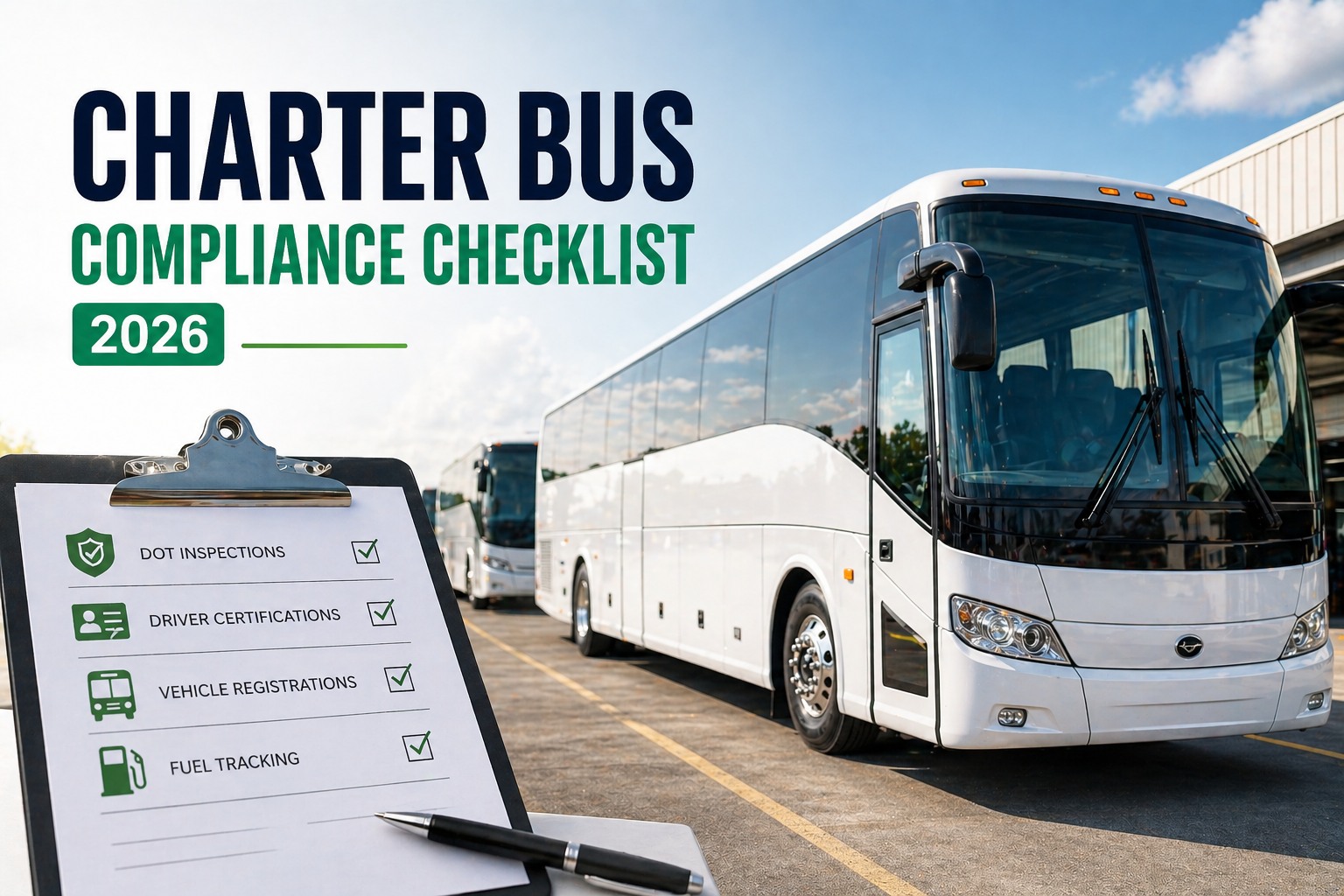
Bus Fleet Maintenance for Hire & Charter Operators: 2026 Compliance Checklist
DOT inspections, driver certifications, vehicle registrations, fuel tracking — your complete compliance guide managed in one CMMS.
$5M
Insurance Minimum
Required (FMCSA)
7
FMCSA BASICs
Scored in 2026
600M
Annual Charter Bus
Passenger Trips
01What Changed in 2026: The Rules You Can't Ignore
2026 brought several critical compliance changes that specifically impact charter and hire operators. Miss any of these and you're risking an out-of-service order during a roadside inspection — or a failed FMCSA audit.
New in 2026
Medical Certification Mandate
Paper MECs no longer accepted for CDL drivers after Jan 10, 2026. Must verify through MVRs from state licensing agencies. Update all driver qualification files immediately.
Enforced
English Language Proficiency (ELP)
ELP violations are now Out-of-Service offenses (since May 2025). A CDL does NOT equal proof of English proficiency. Drivers must demonstrate real-time communication during inspections.
Transition
MC Numbers Eliminated
FMCSA now uses USDOT numbers only. Operating authority designated via suffixes. Update all company documentation, insurance filings, and business materials.
Tightened
CSA Scoring + Private Enforcement
New OOS% metrics for vehicles and drivers over the past year. Charter clients, event planners, and schools increasingly vetting carriers on BASIC scores before booking.
Stop tracking CDL expirations on spreadsheets — automate it free
02The 2026 Charter Bus Compliance Master Checklist
This is the complete list — organized by compliance area — of what FMCSA, DOT, and state regulators expect from every hire and charter bus operation. Miss one item and you're one roadside inspection away from a grounded bus.
Vehicle Compliance
Annual DOT safety inspection current for every vehicle
Pre-trip / post-trip DVIR completed and documented daily
Lap/shoulder belts installed and functional (vehicles over 26,000 lbs)
Fire extinguisher, emergency exits, reflective triangles present and inspected
ADA wheelchair lift tested and operational (48-hr notice policy documented)
PM schedule current — oil, brakes, tires, HVAC, electrical per OEM intervals
Driver Qualification Files
Valid CDL with passenger (P) endorsement verified
Medical certification verified via MVR (paper MECs no longer accepted)
English Language Proficiency documented and demonstrable
Drug & alcohol testing current (50% random drug, 10% random alcohol)
Hours-of-service compliance: max 10 hrs driving / 15 hrs on-duty after 8 off
Annual MVR pull and 3-year driving record review on file
Operating Authority & Insurance
USDOT number active and current (MC numbers eliminated Oct 2025)
Charter/for-hire operating authority registered and active
$5 million insurance minimum filed and evidenced with FMCSA
Biennial MCS-150 update filed (every 2 years based on USDOT #)
UCR (Unified Carrier Registration) paid and current for operating year
Maintenance & Records
Systematic maintenance plan documented (49 CFR Part 396)
All maintenance records retained 1 year minimum + 6 months after vehicle sale
DVIR records retained 90 days minimum
Per-vehicle fuel records tracked (mileage, consumption, cost)
Work order history documented per vehicle with parts, labor, and costs
Every checklist item above, auto-tracked — book a 20-min demo to see how
Don't Lose a $15K Charter Contract Over a $0 Compliance Fix
One expired medical cert or missed DVIR can ground your bus mid-trip — with passengers onboard. BusCMMS alerts you 30, 60, and 90 days before any certification, inspection, or insurance deadline hits.
03What Non-Compliance Actually Costs Charter Operators
Vehicle OOS at Roadside
$1,200 – $5,000
Bus grounded. Passengers stranded. Contract lost.
Driver OOS (HOS / Qual File)
$2,500 – $7,500
Driver can't drive. No replacement on a charter run.
Failed FMCSA Compliance Review
$5,000 – $16,000
Unsatisfactory rating. Operating authority at risk.
Operating Without Authority
$10,000 – $25,000+
Per-violation fine. Possible criminal charges.
For charter operators, the financial penalty is often the smallest cost. Losing a high-value event contract, a school district relationship, or a sports team account because your bus got grounded mid-trip — that's the real damage. Clients are increasingly checking FMCSA BASIC scores before booking.
Your BASIC scores affect every booking — start protecting them free
04How a CMMS Keeps Your Charter Fleet Audit-Ready
Auto-Scheduled PM
Mileage + calendar triggers generate work orders. Charter mileage spikes don't skip services.
Digital DVIRs
Drivers complete inspections on their phone. Defects trigger work orders instantly.
Driver File Alerts
CDL, medical cert, drug test expiration alerts — 30/60/90 days before deadline.
Audit-Ready Reports
One click: complete maintenance history, inspection records, and compliance status per vehicle.
The Bottom Line
Charter and hire bus operations face the same FMCSA regulations as any commercial motor carrier — plus additional requirements around operating authority, $5 million insurance minimums, ADA accessibility, and passenger-specific inspection items. In 2026, the stakes are higher: medical certification rules changed, English proficiency violations now trigger out-of-service orders, and clients are checking your BASIC scores before they book.
BusCMMS tracks every item on this checklist: vehicle inspections, PM schedules, driver qualification files, certification expiration alerts, work order history, and per-bus compliance status — in one platform purpose-built for bus operations. Whether you run 5 motorcoaches or 50, the system keeps you audit-ready every day of the year.
Your Next FMCSA Audit Could Be Next Month. Are You Ready?
Every charter operator we onboard says the same thing: "I wish I'd done this before my last audit." Inspections, driver files, PM records, insurance tracking — one dashboard, zero scrambling.
Frequently Asked Questions
What insurance is required for charter bus operations?
FMCSA requires charter and for-hire passenger carriers to maintain and file evidence of $5 million in liability insurance coverage. This is significantly higher than the $750,000 minimum for freight carriers. The insurance must be filed with FMCSA and remain current at all times. A lapse in insurance coverage can result in suspension of your operating authority — meaning every bus in your fleet is grounded until it's resolved.
What changed with medical certifications for CDL drivers in 2026?
After January 10, 2026, motor carriers must verify CDL driver medical certifications exclusively through Motor Vehicle Records (MVRs) from state licensing agencies. Paper Medical Examiner's Certificates (MECs) are no longer accepted for CDL drivers. Medical examiners now submit results electronically to FMCSA's National Registry, and states update MVRs accordingly. You should stop collecting paper MECs for CDL drivers, establish MVR verification procedures, and monitor expiration dates through state systems. Non-CDL drivers who require medical certification still need physical MECs.
What are the hours-of-service rules for charter bus drivers?
Passenger-carrying CMV drivers may not drive more than 10 hours after 8 consecutive hours off duty, and may not drive after being on duty for 15 hours following 8 consecutive hours off. This is different from property-carrying rules. For charter operators, this means a 6-hour drive can consume most of a driver's available window once you factor in loading, traffic, and mandatory rest. Plan charter itineraries around these limits — a violation discovered at a roadside inspection puts your driver out of service immediately, potentially stranding passengers.
How do I maintain ADA compliance for charter operations?
Under 49 CFR § 37.189, charter and tour operators must provide accessible motorcoach service to passengers with disabilities when given 48-hour advance notice. This includes a wheelchair lift-equipped bus with a designated and equipped wheelchair securement location. You must document your 48-hour notice policy and make it publicly available. Denying service to a passenger because of their disability (except for violent or seriously disruptive conduct) is considered discrimination. Regularly test wheelchair lifts and ADA equipment as part of your PM schedule.
Can a CMMS really help with FMCSA audit preparation?
A CMMS is the most effective audit preparation tool a charter operator can have. During an FMCSA compliance review, auditors check: systematic maintenance plans (Part 396), vehicle inspection records, driver qualification files, and maintenance documentation. BusCMMS generates all of this automatically — every work order, inspection, driver certification, and PM service is logged with timestamps. Instead of spending 2–3 days pulling paper records before an audit, you generate a complete compliance report in minutes. That's the difference between a "Satisfactory" rating and an "Unsatisfactory" that threatens your operating authority.