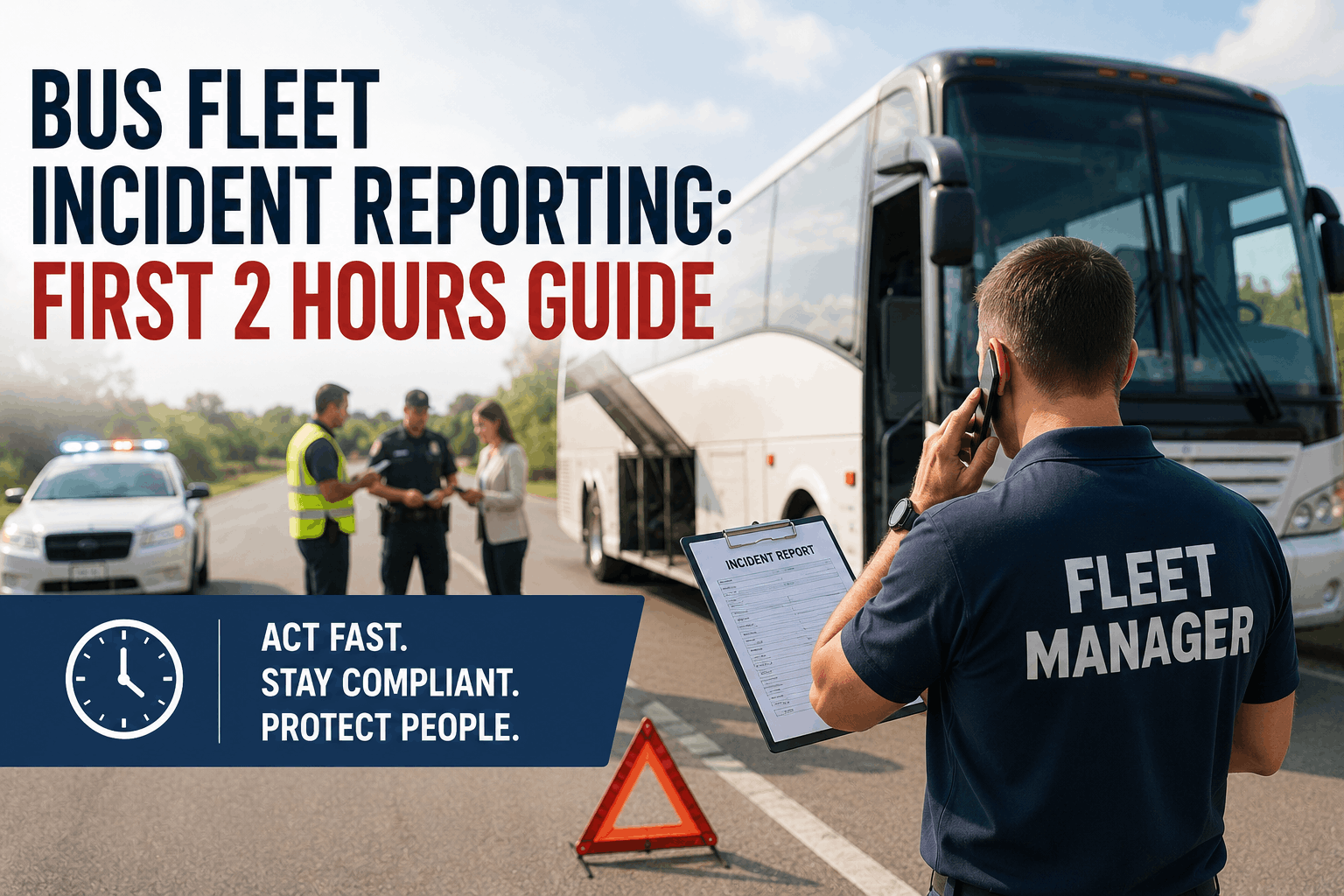
When a bus incident occurs, the first two hours are operationally critical. Delayed documentation, missed FMCSA post-accident drug testing windows, incomplete passenger records, and late insurer notification can expose your fleet to serious liability and compliance failures. Bus fleet managers need a structured, time-bound incident response protocol that captures every required data point before evidence degrades and regulatory deadlines pass. BusCMMS provides a purpose-built incident reporting system that guides drivers and fleet staff through every required step, from the moment of impact through police report coordination, vehicle condition capture, and formal insurer notification. Whether you operate a school bus fleet, transit operation, or charter service, incident documentation done right protects your organization, your drivers, and your passengers. Start with a Book Demo to see the incident workflow in action, or explore the platform directly with a Free Trial and configure your response procedures today.
Every minute after an incident matters. Structured reporting protects your fleet, your drivers, and your compliance record.
Incident Reporting by the Numbers
BusCMMS Incident Reporting Capabilities
Step-by-step digital incident report forms ensure drivers capture every required detail including location, time, weather, road conditions, and involved parties without missing fields.
Book DemoDrivers can attach photo and video documentation of vehicle damage directly within the incident record, timestamped and GPS-tagged for insurer and legal use.
Book DemoRecord passenger details, injury status, and witness information directly in the incident log. Maintains a structured passenger manifest linked to each reported event.
Book DemoAutomatic alerts for post-accident drug and alcohol testing requirements based on incident severity, keeping fleet managers informed of CDL regulatory obligations in real time.
Book DemoLink police report numbers, officer details, and jurisdiction information directly to the incident record, creating a complete documentation package for legal and insurance review.
Book DemoBuilt-in notification checklist tracks insurer contact, claim reference numbers, and communication timestamps ensuring no required notification step is missed after an incident.
Book DemoFleet Incident Problems BusCMMS Addresses
FMCSA requires post-accident drug testing within specific timeframes for CDL drivers. Paper-based processes cause delays that void compliance requirements and create serious regulatory exposure.
BusCMMS triggers immediate compliance alerts when an incident is logged, notifying fleet managers of testing requirements, deadlines, and the nearest authorized testing facility based on incident location.
Book DemoDrivers under stress frequently forget to capture vehicle damage photos, witness contact details, or road condition notes. Incomplete records weaken insurance claims and legal defense.
Guided mobile incident forms prompt drivers through every documentation step with mandatory fields and photo upload requirements before the report can be submitted as complete.
Book DemoMany fleet operators miss insurer notification windows because incident information sits in paper forms at the depot rather than reaching the fleet manager and risk team immediately after the event.
Incident submissions in BusCMMS generate instant notifications to designated fleet managers and safety officers, with a built-in insurer notification checklist and timestamp tracking for each communication.
Book DemoPaper reports, email chains, and spreadsheet logs make it impossible to review incident history by vehicle, driver, or route during audits or when preparing safety performance reports.
All incident records are stored centrally in BusCMMS with full audit trails, linked to the specific vehicle asset, driver record, and route. Searchable and exportable for compliance reviews at any time.
Book DemoBusCMMS vs. Other Fleet Management Platforms
| Capability | BusCMMS | Fleetio | Samsara | Geotab | Verizon Connect | Fleet Complete |
|---|---|---|---|---|---|---|
| Incident Report Forms | ✓ Guided, Bus-Specific | ✓ General | Partial | Partial | Partial | ✓ General |
| FMCSA Compliance Alerts | ✓ Built-In | Limited | Limited | Limited | Limited | Limited |
| Passenger Documentation | ✓ Structured | ✗ | ✗ | ✗ | ✗ | ✗ |
| Photo/Video Capture | ✓ In-App | ✓ | ✓ | Partial | Partial | ✓ |
| Insurer Notification Tracking | ✓ Checklist + Timestamps | ✗ | ✗ | ✗ | ✗ | ✗ |
| Police Report Linking | ✓ | ✗ | ✗ | ✗ | ✗ | ✗ |
| Bus Fleet Specialization | ✓ Purpose-Built | General Fleet | General Fleet | General Fleet | General Fleet | General Fleet |
| Audit-Ready Incident Logs | ✓ | ✓ | Partial | Partial | Partial | ✓ |
| Mobile Driver Submission | ✓ | ✓ | ✓ | ✓ | ✓ | ✓ |
Reduce incident documentation gaps, meet compliance deadlines, and protect your fleet with structured digital reporting.
Operational Alignment Across Fleet Regions
Incident workflows aligned with FMCSA post-accident requirements, DOT inspection documentation, and CDL driver compliance record-keeping for US-based bus fleets.
Supports incident documentation practices aligned with DVSA operator licence obligations, maintenance record requirements, and bus operator audit readiness in the UK.
Incident reporting and maintenance logs structured to support transit operator documentation requirements across provincial transit authorities and school bus regulations in Canada.
Supports transport fleet operators in the UAE with structured incident documentation, service records, and preventive maintenance tracking aligned with local transport authority operational workflows.
BusCMMS supports operational documentation workflows. Fleet operators are responsible for ensuring compliance with applicable local regulations. BusCMMS does not provide legal or regulatory advice.
How Fleet Operators Use BusCMMS Incident Reporting
A regional school bus operator with 140 vehicles was managing incident reports entirely on paper. Drivers completed handwritten forms that reached the depot hours after incidents, causing missed drug testing windows and delayed insurer notification.
The fleet had no standardized process for capturing passenger injury status, witness information, or vehicle damage photos at the scene. Incident records were incomplete and difficult to retrieve during annual safety audits.
BusCMMS replaced paper forms with guided mobile incident submissions. Drivers were prompted through every required field including passenger documentation and photo capture before submission was accepted.
A city transit authority operating 320 buses was experiencing inconsistent incident documentation quality across different depots and driver groups. Some incidents were logged with full detail while others lacked basic scene information.
Safety managers could not run consistent fleet-wide incident trend reports because records existed across multiple paper systems. Preparing for quarterly safety board reviews required days of manual record retrieval.
Centralized incident records in BusCMMS gave safety managers a single searchable incident log across all depots. Standardized forms eliminated documentation quality variation between drivers and routes.
A charter bus operator with 55 vehicles and multi-state operations struggled to manage incident reporting when drivers were operating far from the home depot with limited communication to fleet management staff.
Remote incidents often resulted in insurer notification delays exceeding 24 hours. Documentation submitted by drivers was frequently missing key fields, requiring follow-up calls to reconstruct event details.
Mobile incident submission through BusCMMS allowed drivers to complete full incident documentation from any location and submit directly to fleet managers. Instant notifications reached the operations team within seconds of submission.
BusCMMS Deployment Roadmap
Review current incident reporting workflows, identify documentation gaps, and map existing compliance requirements to BusCMMS incident module capabilities.
Configure fleet profile, depot locations, route data, and regulatory jurisdiction settings to align incident reporting requirements with your operational territory.
Register vehicle assets with identification details, maintenance history, and compliance records so every incident report is automatically linked to the correct vehicle profile.
Configure incident form fields, compliance alert triggers, notification routing, and insurer contact workflows according to your fleet's operational and regulatory requirements.
Train drivers on mobile incident submission, safety officers on compliance alert response, and fleet managers on the incident review and reporting dashboard.
Enable incident trend reports, compliance tracking dashboards, and fleet safety performance metrics across all depots and vehicle groups.
BusCMMS support team provides active go-live assistance, incident workflow validation, and post-deployment review to confirm all documentation requirements are being captured correctly.
Frequently Asked Questions
Improve incident response speed, meet compliance deadlines, reduce documentation gaps, and give your safety team full visibility over every fleet event.
Purpose-built incident reporting for bus fleet operators. Structured. Compliant. Audit-ready.