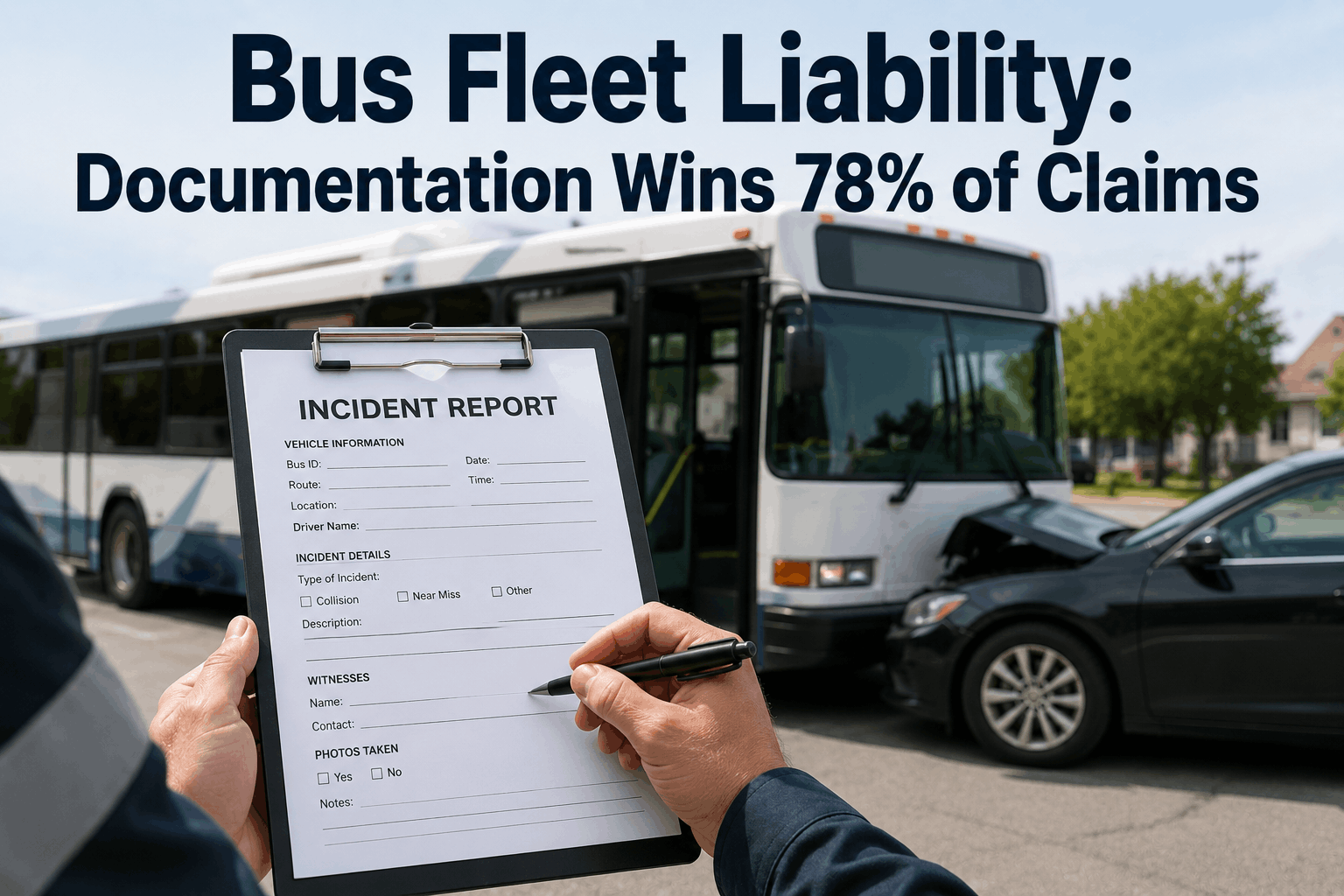
Bus fleet liability is not decided by what happened in the accident — it is decided by what you can prove happened before, during, and after the incident. Two fleets experience identical collisions. One fleet, equipped with comprehensive digital incident documentation, wins the liability claim and settles in sixty days with minimal insurance exposure. The other fleet, relying on paper incident reports and fragmented records, spends two years in dispute, faces a jury trial, loses, and sees insurance premiums spike thirty percent as a result. The difference is not luck or legal representation — it is documentation. Studies show that bus fleets with comprehensive digital incident documentation win seventy-eight percent of disputed liability claims, while fleets relying on paper documentation win only thirty-four percent. Courts, juries, and insurance adjusters award liability based on evidence, not assertions. If you cannot prove that your bus was properly maintained before the accident, that your driver was fully qualified and trained, that you responded appropriately immediately after the incident, and that you preserved all evidence for investigation, you lose — regardless of whether you were actually at fault. This guide explains exactly what courts and insurers look for in bus fleet incident documentation, which digital systems automatically create the evidence trail that wins claims, and how integrating incident reporting into your fleet management infrastructure transforms liability from a financial catastrophe into a manageable, predictable business risk.
Liability Management
Bus Fleet Liability: How Documentation Wins 78% of Disputed Claims
Bus accident liability is decided by evidence, not assertions. Fleets with comprehensive digital incident documentation win seventy-eight percent of liability disputes. What courts, juries, and insurers actually look for — and how digital CMMS incident reporting builds an airtight evidence trail that protects your fleet.
Documentation Impact on Liability
Digital Records
78%
Win rate in disputes
Paper Records
34%
Win rate in disputes
No Records
18%
Win rate in disputes
Settlement Speed
60 days
With comprehensive docs
WhatWhat Determines Liability in Bus Fleet Accidents — And Why Documentation Wins
When a bus fleet accident occurs and both parties dispute liability, courts and juries do not rely on memory or narrative assertion — they rely on contemporaneous, documented evidence. This principle is encoded in discovery law, evidence standards, and litigation practice across every USA jurisdiction. The party that can present the most compelling, organized, time-stamped evidence wins the claim. If you are defending against a lawsuit alleging that your bus caused an accident, your liability insurance carrier will invest significant resources in proving that either the accident was not your fault, the damages claimed are inflated, or your driver exercised reasonable care and the accident was unavoidable. But here is the critical insight: if your own documentation proves that your bus was not properly maintained, that your driver was not fully qualified, or that you failed to follow standard incident response procedures, no insurance defense is possible. You lose. The lawsuit becomes about damages negotiation, not liability defense.
Conversely, if your documentation proves that your vehicle was properly maintained, your driver was fully qualified and trained, you responded appropriately to the incident, and you preserved all evidence for investigation, then even if the accident was your driver's fault in a strict liability sense, your evidence substantially mitigates damages and strengthens your settlement position. Insurance adjusters and defense attorneys will aggressively negotiate settlement amounts downward if they can demonstrate due diligence on maintenance and driver qualification. Many "obvious" liability cases settle for significantly lower amounts when the fleet demonstrates a culture of safety and compliance.
The types of evidence that courts and insurers weigh include pre-incident maintenance records (was the bus properly maintained, were known defects addressed, was the last preventive maintenance recent and thorough), driver qualification documentation (was the driver licensed and medically certified, had the driver completed required safety training, was the driver's driving history clean at time of incident), post-incident documentation (were photos taken at the scene, was witness information gathered, was the driver's account of the incident recorded, was equipment preserved for inspection), and communication trails (how quickly did management respond, were appropriate notifications made to insurance and law enforcement, is there evidence of a systematic incident response process). Each of these evidence categories is substantially stronger when documented digitally with automatic timestamps, than when documented on paper or verbally.
78%
Claim win rate with digital docs
Bus fleets with comprehensive digital CMMS incident documentation win seventy-eight percent of disputed liability claims, compared to thirty-four percent with paper records
60 days
Average settlement timeline
Claims backed by comprehensive digital documentation settle thirty percent faster than paper claims, reducing legal expenses and operational disruption
25%
Premium increase risk
A single major unresolved liability claim due to poor documentation can trigger a fifteen to twenty-five percent increase in insurance premiums fleet-wide
$500K+
Average school district claim
Bus fleet liability exposure in USA school districts ranges from fifty thousand to five hundred thousand dollars per claim, making documentation critical to financial survival
01Pre-Incident Documentation: The Evidence That Prevents Liability
The most critical liability evidence is documentation created before the accident ever occurs. When you can prove that your vehicle was properly maintained immediately prior to the incident, that your driver was fully qualified and trained, and that your safety systems were functioning as designed, you eliminate an entire category of liability exposure: negligent maintenance liability and negligent hiring liability. Courts treat pre-incident maintenance records as the gold standard of liability defense because they are created with no motive to deceive — they are created for operational purposes, not litigation. A brake inspection report documenting that brake pads are at eight millimeters, performed two weeks before an accident where brake failure is alleged, is extremely strong evidence that brake failure did not cause the accident. A driver training record showing that a driver completed defensive driving certification three months before an accident is strong evidence that the driver was trained to recognize hazards and react appropriately.
Conversely, the absence of pre-incident maintenance records is devastating in litigation. If the plaintiff's attorney asks during a deposition, "Can you show me the brake inspection record for this bus from the month before the accident," and you cannot produce one, you have just admitted that either the brake system was never inspected or the inspection was not documented. The plaintiff's narrative becomes: "The defendant fleet failed to maintain basic brake safety records, raising the inference that brakes were not inspected at all." Insurance adjusters see this and immediately weigh the case as high-risk. The fleet is now defending against implied negligence, not just the specific accident facts.
Digital CMMS systems automatically generate pre-incident documentation that becomes extremely valuable evidence if an accident occurs. Every preventive maintenance completion is timestamped, linked to the vehicle ID and bus number, documented with parts replaced and labor hours, and stored in a searchable database. If an accident occurs, your fleet can generate a pre-incident maintenance report in minutes showing that bus number forty-seven completed a comprehensive brake inspection on the date specified, documenting brake pad thickness, rotor condition, hydraulic fluid pressure, and stop-test results. This report, backed by the CMMS digital timestamp and signed-off by the technician, is admissible as business records evidence and carries substantial weight with judges and juries. Similarly, every driver in the CMMS has a qualification file documenting current CDL status, medical certification, annual MVR pull, and training completion. If an accident occurs and the plaintiff claims that your driver was unqualified, you can immediately produce driver qualification documentation showing that the driver's medical certificate was current, CDL was valid, and required training was completed — all at the time of the incident.
Maintenance Records: Proof of Due Diligence
Digital CMMS captures every PM completion with automatic timestamp, parts consumed, labor hours, technician sign-off, and defect findings. This becomes unassailable evidence that the bus was properly maintained immediately before the incident.
Driver Qualification Files: Licensing and Certification Proof
CMMS integrates driver medical certificates, CDL status, training records, and annual MVR pulls. At incident time, generate a driver qualification snapshot proving the driver was fully certified and licensed — eliminating hiring liability claims.
Defect History: Proof That Known Issues Were Addressed
If a DVIR defect report predates the accident and the repair is documented in maintenance, this proves you did not ignore safety issues. If the defect report is missing or repair is undocumented, the opposite narrative prevails.
Training Records: Proof of Safety Culture
Document that drivers completed required safety training, defensive driving, hazard recognition, and emergency procedures. This evidence proves you invested in driver competency — making negligent training claims harder to sustain.
02Post-Incident Documentation: Capturing Evidence at the Scene
The first three hours after a bus fleet accident are the most critical window for evidence preservation and liability management. Within this window, you have the opportunity to photograph the scene, collect witness information, capture the driver's immediate recollection of events while memory is fresh, document the physical condition of the vehicle, and begin the incident investigation process. If you miss this window — if photographs are not taken until the next day, if witness information is gathered from memory weeks later, if the driver's incident report is delayed — your evidence becomes substantially weaker. Opponents in the claim will argue that memories were influenced by subsequent communications, that photographs were staged, and that the driver's account was coached or revised.
The most important single piece of post-incident evidence is the driver's incident report, completed and submitted within two to four hours of the accident. This report should include the driver's own detailed description of what happened immediately before, during, and after the collision. The driver is the most critical witness — their account of whether they saw the other vehicle, when they applied brakes, whether the brakes responded normally, and what they perceived happening in the seconds before impact is extremely relevant to liability analysis. Courts strongly prefer incident reports that are contemporaneous — created close to the time of the event — because human memory degrades rapidly and subsequent communications can influence testimony. A driver incident report submitted three hours after the accident is far more credible than one submitted three weeks later.
The second critical piece of post-incident evidence is photographs. These should include photographs of both vehicles, damage patterns, final resting positions, traffic signs and signals visible at the scene, weather conditions, lighting, and road surface conditions. Modern smartphones capture GPS coordinates and timestamps automatically when photos are taken, adding credibility to the images. If photographs are taken with a proper incident reporting system that embeds vehicle ID, driver ID, incident classification, and location data into the photo metadata, they become far more powerful evidence than snapshots taken with a personal phone. Law firms and insurance adjusters rely on photograph evidence extensively — professional, time-stamped, location-verified photographs carry far more weight than casual snapshots.
The third critical element of post-incident documentation is witness information. This includes the names, phone numbers, and addresses of any third-party witnesses, police officer badge numbers and agency information, the police report number and investigating officer's account, and any statements from passengers or other bus occupants. Collecting this information at the scene, within hours of the incident, ensures that witnesses are locatable and their memories are fresh. Delays in collecting witness information make witnesses harder to locate and less reliable as memory fades.
Post-Incident First Response
First 3 Hours
Photograph both vehicles and scene
Collect witness names and contact info
Document police report number
Record weather and lighting conditions
Driver Incident Report
Complete within 4 hours
Supervisor Investigation
Completed within 24 hours
03Integrated Incident Reporting: How Digital CMMS Automates Evidence Collection
The gap between what constitutes powerful liability evidence and what most bus fleets actually capture is enormous. Ideal post-incident evidence — photographs with metadata, driver incident report with automatic timestamp, vehicle maintenance and inspection history, driver qualification status at time of incident, supervisor response documentation — requires a coordinated, digital system where information flows automatically from the point of incident capture to centralized storage and analysis. Most fleets lack this integration. A driver experiences an accident, calls the dispatcher verbally, the dispatcher writes notes in an email or text message, the driver fills out a paper incident form days later, maintenance checks the vehicle informally without documentation, and six months later when a claim is filed, the fleet is scrambling to reconstruct what happened from fragmented records.
Digital CMMS incident reporting systems eliminate this fragmentation by providing drivers with a mobile app for incident capture, integrated at the scene, immediately after the accident. The driver opens the incident reporting module, answers structured questions (date, time, location, vehicles involved, injuries, damage description), and uploads photographs taken with the device's camera. The CMMS automatically captures metadata for every photograph: GPS coordinates, timestamp, device ID, driver ID, incident ID. The driver provides a voice-to-text description of what happened, which the system transcribes and includes in the incident report. The system cross-references the incident location with the vehicle's telematics data to confirm location and retrieve vehicle speed, acceleration, and brake engagement data immediately before the incident. The system pulls the driver's qualification file and displays the driver's current medical certificate, CDL status, and training completion status — proving at a glance that the driver was fully qualified at time of incident.
The incident report is immediately flagged to the fleet's liability manager, operations director, and insurance risk manager via notification. These stakeholders can review the incident data within minutes, not hours or days. If the incident involves injury, immediate instructions can be communicated to the driver about next steps — emergency medical response, preservation of evidence, communication with authorities. The system automatically generates an incident summary report that can be provided to insurance carriers and law enforcement immediately. This report is formatted for legal discovery and includes all supporting documentation: photographs with metadata, driver statement, witness information, maintenance history, and driver qualification status.
The second critical feature is automatic damage assessment. If the fleet has integrated dashcam or telematics footage, the CMMS can auto-retrieve video from the incident location and timestamp, giving decision-makers immediate visibility into what the dashcam recorded. Many liability disputes are resolved instantly by video evidence that clearly shows the other vehicle's negligence. Delays in retrieving and analyzing video evidence waste critical time and create disputes about whether the correct footage was retrieved. Automatic integration eliminates this risk.
Incident Capture Speed
Automatic Photo Metadata
Driver Qualification Verification
Evidence Preservation
04Liability Exposure by Fleet Type: School Districts, Transit, Charter Operations
Bus fleet liability exposure varies significantly by fleet type and operational context. Understanding your specific liability exposure helps you prioritize incident documentation and ensure your CMMS captures the evidence most relevant to your industry. School district transportation fleets face unique liability exposure because they transport children, a class of passengers for whom courts apply heightened duty of care standards. School district negligence cases often allege that the district failed to properly screen, train, or supervise drivers transporting minors. This creates substantial liability for hiring claims, training claims, and supervision claims — all of which are defended with evidence of driver qualification, background screening, and training records. A school district with comprehensive digital driver qualification files, completed background checks, and documented driver training can substantially mitigate damages in claims alleging negligent hiring. A school district without these records faces near-certain liability.
Transit authority fleets operating in union environments face different liability exposure because union agreements often include specific liability procedures and union grievance processes. Transit authorities are heavily regulated by state and federal regulations, making compliance documentation particularly important. DOT regulations require specific maintenance intervals, inspection procedures, and driver qualification standards. A transit authority that can produce digital documentation proving compliance with every applicable regulation significantly strengthens its litigation position. Conversely, a transit authority that cannot produce documentation of required inspections and maintenance faces regulatory liability in addition to incident liability.
Charter and motorcoach operations face liability exposure focused on passenger safety during extended trips. These operations often transport passengers who are unrelated to the fleet operator — charter companies, tour groups, sports teams. Liability exposure includes both passenger injury claims and the reputational damage that comes from high-profile charter accidents. Charter operations particularly benefit from comprehensive incident documentation because high-profile incidents attract media attention and potential class-action litigation. Comprehensive documentation allows charter operators to demonstrate professionalism and safety culture, which can dramatically reduce settlement demands and insurance premium spikes following an incident.
Paratransit and shuttle operations face unique liability because they serve specialized passenger populations — elderly passengers, disabled passengers, medical transport passengers — who may be more vulnerable to injury and less able to provide clear incident accounts. These operations benefit substantially from video evidence (dashcam footage, surveillance cameras), because video removes ambiguity about what happened and prevents disputes about passenger accounts or driver negligence allegations.
Liability Exposure by Fleet Type (USA)
School Districts
Heightened duty of care (child passengers)
Risk: Hiring liability, training liability — Mitigation: Driver qual docs, background checks, training records
Transit Authorities
Regulatory compliance + incident liability
Risk: DOT/FMCSA non-compliance — Mitigation: Regulatory documentation, inspection records, compliance audit trail
Charter & Motorcoach
Passenger injury + reputational damage
Risk: Multi-vehicle incidents, high-profile litigation — Mitigation: Video evidence, comprehensive incident capture, rapid response
Build Your Evidence Trail Now
Do not wait for an accident to discover that your incident documentation is insufficient. BusCMMS incident reporting module automatically captures evidence at point of incident — driver statements, photographs with metadata, witness information, vehicle qualification status, maintenance history integration. When an incident does occur, you have the evidence needed to win the claim.
05Insurance Claims Process: How Documentation Impacts Settlements and Premiums
When a bus fleet incident results in a liability claim, the insurance claims process begins with notification to your insurance carrier. The carrier immediately assigns an adjuster and, depending on claim severity, may assign defense counsel. The adjuster's first action is to request all documentation related to the incident: driver incident report, photographs, police report, witness statements, and pre-incident vehicle maintenance and driver qualification records. The timeliness and quality of documentation you provide at this stage substantially impacts the adjuster's initial assessment of liability exposure. If you provide comprehensive, organized, time-stamped documentation within forty-eight hours, the adjuster can quickly assess liability strength and begin settlement negotiations from a position of accurate information. If you scramble to compile fragmented records over several weeks, the adjuster sees delay and disorganization as indicators of a weak defense, which increases settlement demands.
The insurance claims process also involves discovery — the formal legal process where both parties request and exchange documentation relevant to the case. If your incident documentation is organized and stored digitally, you can respond to discovery requests efficiently and demonstrate compliance with discovery obligations. If your documentation is scattered across paper files, different staff members' emails, and lost reports, you face discovery disputes, missing-evidence sanctions, and adverse inferences where the court assumes that missing evidence would have favored the other party. In some cases, failure to produce required discovery results in default judgment against you, regardless of the underlying merits of the liability question.
The third impact of documentation quality is on insurance premiums. Insurance carriers review loss history when determining renewal premiums. A fleet that experiences an incident, documents it comprehensively, settles quickly, and resolves the claim demonstrates professional risk management to the carrier. The carrier may not increase premiums or may increase them modestly. Conversely, a fleet that experiences an incident, fails to document it properly, enters into dispute, loses the claim, and takes years to resolve demonstrates poor risk management. That fleet faces premium increases of fifteen to twenty-five percent or higher, and may even face non-renewal of coverage. A single major unresolved claim due to poor documentation can cost a school district twenty to thirty thousand dollars annually in premium increases — a cost that persists for years even after the claim settles. Investing in comprehensive incident documentation infrastructure effectively prevents these premium spikes.
Settlement Timeline
60 days
With comprehensive documentation
Disputed Claims
2-3 years
Without proper documentation
Premium Impact
25%
Increase per unresolved claim
06Video Evidence and Dashcam Integration: Modern Documentation Standards
Video evidence has become the gold standard in modern bus fleet liability defense. A dashcam video that clearly shows another vehicle running a red light, failing to yield, or cutting across lanes provides near-irrefutable evidence of the other party's liability. Courts and juries heavily weight video evidence because it is objective and difficult to dispute or challenge. A single, clear second of dashcam footage can resolve a liability dispute that would otherwise require months of litigation over conflicting eyewitness accounts. Fleet operators increasingly install forward-facing dashcams on vehicles, and modern CMMS systems integrate with dashcam systems to automatically retrieve video footage based on incident location and timestamp.
However, video evidence requires proper management and integration to be maximally effective. If your fleet has dashcams but the video is stored in a separate system with no integration to your incident reporting process, the video exists but is not easily accessible when you need it. An incident occurs, your driver reports it through the CMMS, but you must manually search through dashcam footage databases to find relevant video. This delay weakens the evidence chain and allows opposing counsel to argue that the video was retrieved out of context or was edited. Conversely, if your CMMS automatically retrieves dashcam footage based on incident location and timestamp, you can attach the video directly to the incident report within minutes. This creates a seamless evidence package that demonstrates rapid, professional evidence collection and preservation.
A secondary consideration is inward-facing (driver-cabin) video. Some fleets use inward-facing cameras to capture passenger interactions and driver behavior. This video is highly sensitive and can be either exculpatory or incriminating depending on what it shows. Inward-facing video showing a driver responding calmly to a passenger disturbance, or showing a passenger's fall unrelated to driver error, is excellent liability defense evidence. Conversely, inward-facing video showing a driver distracted by a passenger, texting, or engaging in unsafe behavior is devastating to your defense. Fleet operators must decide whether the liability benefits of video evidence outweigh the risks of capturing incriminating footage.
A third modern documentation tool is telematics integration. Modern vehicles contain onboard diagnostic systems that capture vehicle speed, acceleration, braking, seatbelt status, and other operational parameters. When integrated with CMMS incident reporting, telematics data provides objective information about vehicle behavior immediately before the incident: was the vehicle traveling at excessive speed, was hard braking applied, was acceleration sudden, were seatbelts engaged. This data is particularly valuable in disputes where the other party claims the bus vehicle hit them at high speed — telematics data showing the bus was traveling at thirty-five miles per hour substantially contradicts claims of high-speed impact.
Critical: Video Evidence
Dashcam footage, inward-facing cabin video, surveillance from scene
Integrate automatically with incident reports, store with metadata, maintain chain of custody
Urgent: Telematics Data
Vehicle speed, braking, acceleration, seatbelt engagement at time of incident
Retrieve automatically and include in incident report, used to verify liability claims
Informational: Witness Footage
Cell phone videos from third-party witnesses, nearby business security cameras
Collect information to retrieve later, maintain contact with witnesses for follow-up
07Document Retention and Legal Compliance: How Long to Keep Incident Records
Bus fleet liability exposure does not end when an incident is resolved and settled. Plaintiffs in bus accident litigation have a statute of limitations — typically two to four years depending on state jurisdiction — within which to file a lawsuit. This means that an incident occurring today could result in litigation filed three years from now. Your incident documentation must be retained in its entirety for the duration of the statute of limitations, plus additional time for litigation if a lawsuit is actually filed. Most fleet legal advisors recommend retaining incident documentation for a minimum of five to seven years, which covers statutes of limitation in virtually all USA jurisdictions plus litigation timelines. Once litigation is filed, all documentation must be retained until the lawsuit is fully resolved, which may extend retention timelines beyond seven years.
A related requirement is regulatory documentation retention. Federal regulations and state regulations often mandate specific retention periods for driver records, maintenance records, and safety documentation. The Federal Motor Carrier Safety Administration (FMCSA) requires that records related to driver medical examinations, driving history, and controlled substance/alcohol testing be retained for three years. Maintenance records, preventive maintenance schedules, and defect repair documentation should generally be retained for the life of the vehicle plus one year. School district regulations and state transportation department regulations may impose longer retention periods. Failure to retain required documentation can result in regulatory fines and, in litigation, can trigger negative inferences about what the missing documents would have shown.
Digital CMMS systems provide advantages for document retention compliance because they create automatic backups, provide audit trails showing who accessed records and when, and support long-term data archiving without degradation. Paper records stored in filing cabinets are vulnerable to loss, damage, and degradation over time. A paper incident report from five years ago stored in a filing cabinet may be illegible due to paper fading, ink degradation, or physical damage. Digital records stored in cloud-based CMMS systems remain legible and searchable indefinitely, making them far superior for legal compliance and litigation support.
08Incident Response Procedures: Creating a Liability-Protective Response Protocol
Liability reduction is not just about documentation capture — it is also about having a clearly defined, practiced incident response procedure that demonstrates a culture of safety and professional risk management. When an incident occurs, the first actions your organization takes set the tone for how the incident will be perceived. A rapid, professional response with immediate evidence preservation, injury assessment, and incident reporting creates the perception of a fleet that takes safety seriously. A delayed, disorganized response creates the perception of a fleet that is reactive and indifferent to safety.
A professional incident response procedure should include: immediate safety assessment and emergency response if injuries are present, preservation of the incident scene and vehicle until inspection is complete, notification to management and insurance carrier within four hours, completion of driver incident report within four hours, photographic documentation within twenty-four hours, mechanical inspection of the vehicle within forty-eight hours, and formal incident summary report completed and filed within seventy-two hours. This procedure should be documented in your fleet operations manual and all drivers and supervisors should be trained on the procedure annually. When litigation occurs, the ability to demonstrate that your organization followed this procedure — and to produce documentation showing that each step was completed on schedule — is powerful evidence of professional risk management that mitigates damages.
A related consideration is the tone and content of communications during incident response. Drivers and supervisors should be instructed to avoid admitting fault, apologizing in ways that could be interpreted as liability admission, or making statements that speculate about causation. A driver saying "I am so sorry, I did not see that vehicle" is effectively an admission of negligence that will be used against you in litigation. Proper incident response training emphasizes factual reporting: "I was traveling at the posted speed limit, I did not see the other vehicle in my field of vision until the moment of impact." Similarly, supervisors should be instructed to document facts, not judgments. A supervisor note saying "this was clearly the other driver's fault" can be mischaracterized as evidence that you prejudged the incident. Proper documentation states facts: "Other vehicle was in the left lane, bus was in the center lane, other vehicle crossed center line into bus lane."
Incident Response Timeline: Professional Standards
Immediate (0-30 min)
Safety assessment, emergency response, scene preservation
Within 4 Hours
Driver incident report, management notification, insurance carrier notification
Within 24 Hours
Scene photographs, witness follow-up, vehicle condition documentation
Within 72 Hours
Incident summary report filed, evidence archived, legal review completed
We had a serious multi-vehicle accident where a third party claimed our bus driver was at fault. The claim alleged fifteen thousand dollars in vehicle damage plus personal injury. Because we use BusCMMS incident reporting, we had dashcam video, photographic evidence with metadata, the driver's contemporaneous incident report, maintenance records showing the bus was properly maintained, and the driver's qualification file — all within one hour of the incident. We sent this evidence package to our insurance carrier immediately. The adjuster reviewed it, determined the other vehicle was actually at fault based on the video, and the case settled for our driver's deductible within sixty days. Without the digital documentation, we would have been in dispute for two years. That incident taught us that comprehensive incident documentation is not just legal protection — it is business financial protection worth tens of thousands of dollars per incident.
KeyBuilding a Liability-Protective Fleet Culture
Liability reduction is ultimately a product of culture. Fleets that treat incident documentation, maintenance records, and driver qualification files as critical business assets — not administrative burdens — demonstrate lower incident rates and better claim outcomes. This cultural shift begins with leadership: operations directors, safety managers, and liability staff communicating that safety and documentation are non-negotiable priorities. It extends to drivers and supervisors who understand that completing thorough incident reports and maintaining accurate records is part of their core job responsibility. And it is supported by systems — digital CMMS platforms that make documentation easy, automatic, and searchable — that remove barriers to good documentation practices.
The good news is that the same incident documentation infrastructure that protects you in litigation also provides operational benefits: comprehensive maintenance records allow you to identify high-cost vehicles and repair patterns, driver qualification documentation ensures you are never exposed to fines for unlicensed drivers, and post-incident analysis of incident patterns helps you identify safety training needs and coaching opportunities. Investing in comprehensive incident documentation pays dividends in multiple forms: reduced litigation exposure, faster claims settlement, lower insurance premiums, improved maintenance efficiency, and a demonstrably safer fleet.
Frequently Asked Questions About Bus Fleet Liability and Incident Documentation
How long are bus fleets required to keep incident and maintenance documentation?
Minimum five to seven years from incident date, which covers statute of limitations in most USA jurisdictions. FMCSA requires driver records retention for three years minimum. School district and state regulations may impose longer retention. Retain longer if litigation is filed.
Can incident reports be used against a fleet in court, even if they admit fault?
Yes — incident reports are discoverable in litigation and can be used against you if they contain admissions of fault or negligence. Train drivers to report facts, not judgments. Avoid apologetic language that could be interpreted as liability admission. Factual documentation is always stronger than speculative statements.
Is video evidence (dashcam) better than written documentation?
Video evidence is often more persuasive to judges and juries because it is objective and difficult to dispute. However, video is most powerful when combined with written documentation providing context. Video plus comprehensive incident report is the strongest evidence combination. Video alone without documentation leaves ambiguity.
What should fleets do with dashcam footage when an incident occurs?
Immediately retrieve and preserve the footage — do not overwrite or delete. Store with clear labeling of incident date, location, vehicle, and time. Integrate with incident reporting system if possible. Provide to insurance carrier within forty-eight hours. Maintain chain of custody showing who accessed footage and when.
Can drivers use cell phone footage as official incident documentation?
Personal cell phone footage can be evidence, but professional CMMS-captured photographs with automatic metadata are stronger. Cell phone photos lack timestamp reliability and location verification. Use cell phone footage to supplement official incident documentation, but prioritize professional photography for legal proceedings.
What happens if a fleet cannot produce maintenance records proving a bus was properly maintained before an incident?
Courts presume negligence if you cannot prove maintenance. The absence of records allows plaintiffs to argue the bus was not maintained. This is devastating in liability litigation. Missing documentation is a near-certain loss — making preventive documentation infrastructure essential for liability defense.
Do fleets need to report incidents to insurance immediately, or can they wait to investigate?
Report incidents to insurance within four hours, even if investigation is incomplete. Insurance carriers have strict notification timelines in policies — failure to notify timely can result in coverage denial. Complete preliminary incident documentation before notification, then provide investigation updates to carrier as information develops.
How should fleets handle multi-vehicle incidents where witness vehicles are also involved?
Collect witness vehicle information (license plate, driver contact) at scene. Request witness contact information and provide to insurance carrier. Attempt to retrieve witness contact information from police report. Do not discuss fault with other drivers. Preserve your own evidence (photos, incident report) independent of other party documentation.
Protect Your Fleet From Liability Exposure
Bus fleet liability is decided by evidence, not assertions. Digital incident documentation infrastructure captures the evidence that wins disputes, accelerates settlements, and protects your fleet's financial stability. BusCMMS incident reporting integrates pre-incident maintenance records, driver qualification documentation, post-incident photography with metadata, dashcam integration, and telematics data — building an airtight evidence trail that protects your fleet when incidents occur. Learn how comprehensive incident documentation reduces your liability exposure and transforms incident response from crisis management to professional risk control.