You just took over the shop. Maybe you were the lead tech last week; maybe you came in from outside. Either way the buses roll tomorrow morning whether you are ready or not, and everyone is watching how the new bus maintenance manager handles the first month. A clear 90-day plan is how you go from reacting to running the place — and you can see the fleet dashboard that makes week one far less blind in a demo.
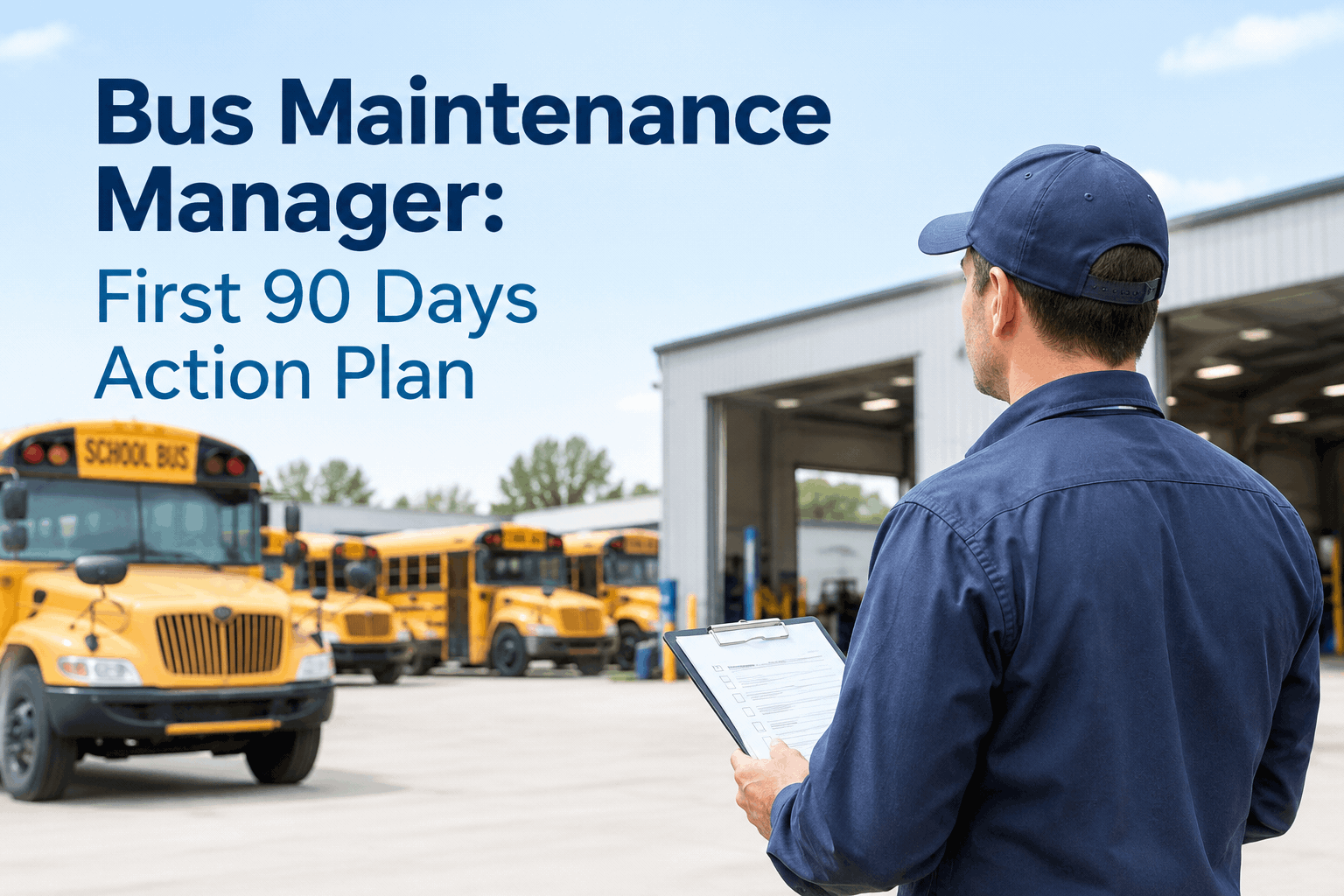
Bus Maintenance Manager: First 90 Days Action Plan
Three phases, one quarter: understand the fleet you inherited, stop the bleeding, then build the system that keeps it running. Here is the roadmap — and how to show results by day 90.
Why the First 90 Days Decide the Next Three Years
A new bus maintenance manager inherits a shop mid-motion — buses on routes, a backlog you didn't create, techs with their own habits, and a boss who wants to know the fleet is in good hands. The temptation is to dive straight into the loudest fire. The managers who last do the opposite: they spend the first stretch understanding what they actually have before changing anything, because the decisions you make in the first quarter set the pattern for years. Move too fast and you break trust; move too slow and the backlog buries you.
The hardest part of month one is that you can't fix what you can't see — and most shops hand a new manager a filing cabinet, not a dashboard.
That visibility problem is the whole reason the plan below works faster with a system behind it. When fleet availability, PM compliance, the open backlog, and cost per bus are on one screen, your assessment phase takes days instead of weeks. You can walk that first-30-days view with our team in a demo.
The Three Phases of Your First 90 Days
Each phase has one job. Do them in order — assessing before stabilizing, stabilizing before systematizing — and by day 90 you have a running operation and the numbers to prove it.
Assess what you inherited
Resist changing anything yet. Learn the fleet: every bus's age, mileage, and history; the open backlog and what's safety-critical in it; PM compliance; and your techs' skills and certifications. Walk the yard, read the records, listen to the crew.
Win by day 30: you can name your worst three buses, your biggest risk, and your real backlog — from data, not hallway talk.Stabilize the operation
Now act on what you found. Triage the backlog by safety and route impact, get work orders flowing so nothing falls through the cracks, and knock down the overdue PM that's causing the breakdowns. This is where you earn trust — visible wins, fewer road calls.
Win by day 60: the backlog is shrinking, work orders are tracked, and the shop is reacting less and planning more.Systematize for the long run
Build the machine that runs without heroics: PM on a real schedule by mileage and calendar, bus-specific inspections every driver completes, parts stocked ahead of need, and KPIs you report up. Make the fixes from phase two permanent.
Win by day 90: a repeatable system and a one-page report showing availability up and backlog down since you started.Each phase is lighter when the record-keeping, work orders, and PM scheduling live in one place instead of across binders and spreadsheets. You can start free and set up your fleet before week one is over.
Your First-Week Checklist
Before the big phases, there's week one. Walk in and work through this list — it is the fastest way to replace “I have no idea what I just took over” with a real starting picture. Every box you can't tick is a blind spot to close first.
- Pull the full fleet list: age, mileage, statusKnow how many buses you have, how old, and which are down right now.DAY 1
- Find the open backlog — especially safety itemsWhat repairs are waiting, and which can't wait another day.CRITICAL
- Check PM compliance & overdue servicesHow far behind is preventive maintenance? That gap is your breakdown source.CRITICAL
- Meet the techs; log skills & certificationsWho can do what, whose certs are current, where the gaps are.WEEK 1
- Review the compliance pictureDVIRs, annual inspections, and records — is anything exposed before an audit?WEEK 1
- Set your baseline numbersAvailability, backlog size, road calls — so you can prove improvement at day 90.WEEK 1
On paper, this list is a week of digging through files; on a dashboard, it's an afternoon. You can see your week-one picture pulled in one place in a demo.
The Four Numbers to Track From Day One
You can't improve what you don't measure, and at day 90 you'll want proof you moved the needle. Start tracking these four the week you arrive — their baseline is your “before,” and their trend is your case.
Fleet availability
Share of buses ready for service. The number your boss cares about most.
PM compliance rate
Scheduled maintenance done on time. The leading indicator of fewer breakdowns.
Open backlog & road calls
Work waiting, and breakdowns on routes. Your clearest early-win metrics.
Cost per mile / per bus
What the fleet costs to run. The number that wins budget conversations.
Tracked by hand, these take hours a week to compile; tracked by the system, they're live on a dashboard. You can start free and set your day-one baseline today.
How BusCMMS Compresses the 90 Days
The plan works on paper; a bus-built CMMS makes it work on schedule. BusCMMS turns each phase from a research project into a screen you open — so a new manager spends the quarter improving the fleet, not reconstructing what it's doing.
Instant fleet picture (Phase 1)
Availability, PM compliance, backlog, and cost per bus on one dashboard, so your assessment is an afternoon, not a month.
Work orders & triage (Phase 2)
Route every repair through tracked work orders, prioritized by safety and route impact, so the backlog shrinks in the open.
PM & DVIRs on schedule (Phase 3)
Fuel-type-aware PM and bus-specific inspections that run on mileage and calendar, so prevention replaces firefighting for good.
KPIs to prove it (Day 90)
Availability, PM compliance, and cost trends in a report you hand your superintendent to show the quarter's gains.
That is a first quarter that ends with results on a slide instead of excuses in a meeting — the same plan, executed on a system that does the remembering for you.
A New Manager's Take
My first week, I asked for a report on fleet availability and got a shrug and a binder. I spent three weeks just figuring out what we had — buses I didn't know were down, PM nobody had tracked in months. If I did it again, I'd stand up the system first and spend those weeks fixing instead of counting. By the time I had real numbers, I'd lost a month I could have used to show the superintendent progress. The plan was right; I just started it with the wrong tools.
Key Takeaways for Your First 90 Days
Assess before you act
Understand the fleet you inherited before changing anything — month one is for seeing.
Stabilize with visible wins
Clear the backlog and track work orders in month two — that's how you earn trust.
Systematize so it lasts
Put PM and inspections on a schedule in month three so the gains don't slip.
Measure from day one
Baseline your KPIs early so day 90 ends with proof, not promises.
Run your first 90 days as a bus maintenance manager in three deliberate phases — assess, stabilize, systematize — and you end the quarter with a fleet that runs better and the numbers to show for it. The plan is simple; having the fleet's whole picture in front of you is what lets you actually execute it.