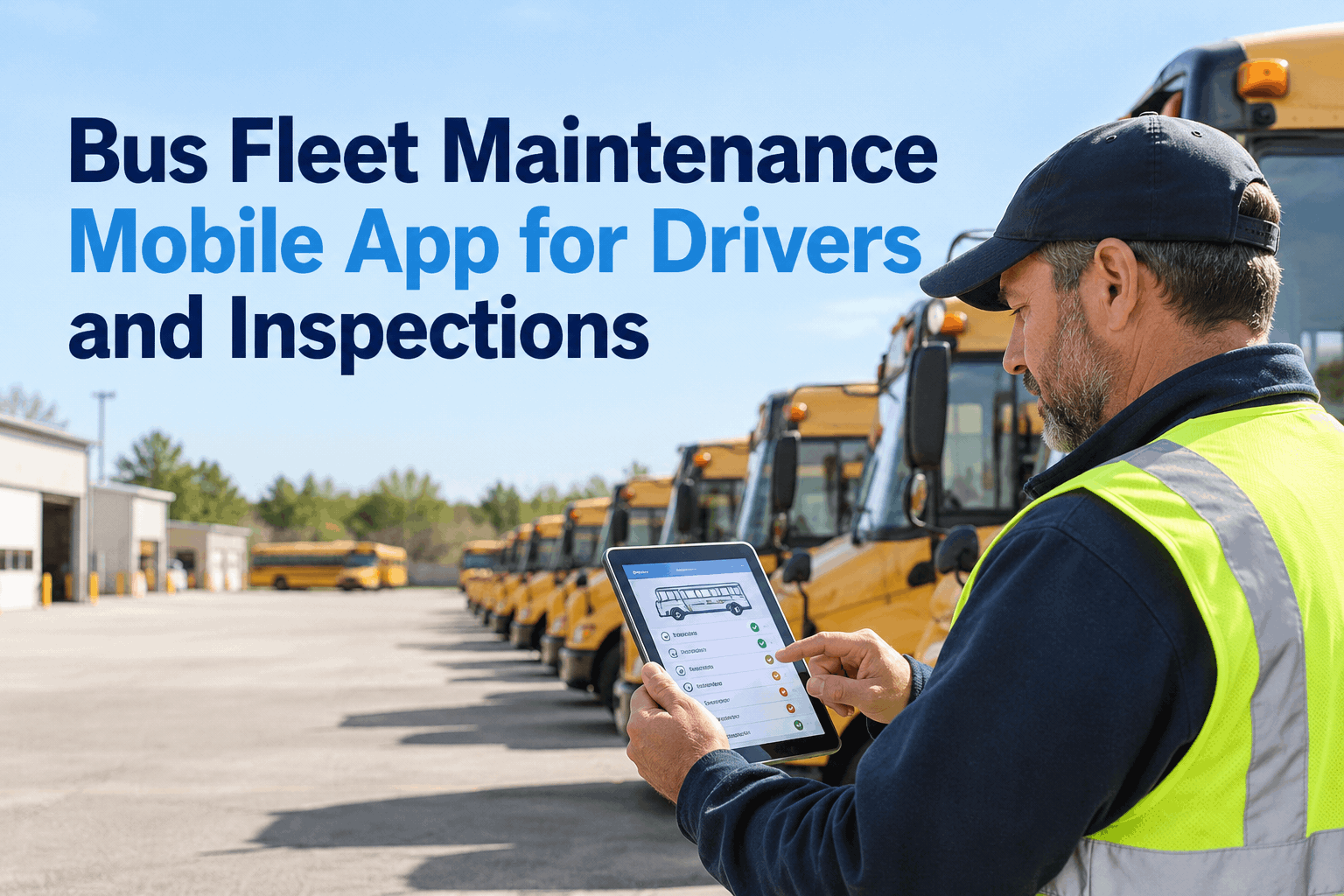
School district transportation directors face a unique challenge: operating safe, reliable bus fleets while managing tight budgets and complex compliance requirements. Unlike commercial fleets, school districts cannot sacrifice safety for cost savings; every decision about vehicle maintenance, driver behavior, inspection standards, and capital planning affects the safety of students. The most effective school district transportation programs use digital tools that automate routine tasks (daily vehicle inspections, PM scheduling, work order management, compliance documentation) so that human decision-makers can focus on strategy (fleet age management, safety improvements, budget optimization). Without these tools, transportation directors spend 30-40% of their time on administrative tasks: chasing technicians for maintenance updates, manually documenting inspections, ensuring compliance with DOT regulations, and creating reports for the superintendent and school board. With purpose-built fleet management software, these tasks are automated, real-time visibility replaces manual reporting, and compliance is built-in rather than bolted-on. BusCMMS is the only fleet management software designed specifically for school district transportation: AI-powered daily vehicle inspections (DVIR), automated PM scheduling for your specific bus fleet, digital work order tracking with technician accountability, automated DOT compliance documentation, warranty claim recovery ($15,000-$35,000 annually per 40-bus fleet), and real-time KPI dashboards showing fleet health to the superintendent. A school district implementing BusCMMS reports: 30-40% reduction in time spent on compliance and documentation, 25-35% reduction in emergency maintenance events, 94%+ vehicle availability (vs 88-90% industry average), and $15,000-$35,000 annual warranty recovery. ROI is typically achieved within 6-12 months.
Bus Fleet Management Software for School Districts: Digital Compliance Built In
BusCMMS automates DVIR inspections, PM scheduling, work order tracking, and DOT compliance. Reduce downtime 25-35%, recover $15,000-$35,000 annually in warranty claims, and gain real-time fleet visibility for your superintendent. Purpose-built for pupil transportation. Free trial -- no credit card required.
Why School Districts Choose BusCMMS
School districts are different from commercial fleets. You operate 40-150 buses serving fixed routes on a seasonal schedule (school year primarily), with maintenance concentrated during summer break. Your stakeholders include: transportation director (manages fleet and budget), superintendent (ultimate owner of transportation program), school board (sets policy and budget), drivers (operate buses daily), technicians (maintain buses), and parents (trust you with their children's safety). Each stakeholder has different information needs: transportation director needs work order status and technician productivity; superintendent needs fleet health scorecard and budget tracking; school board needs safety metrics and compliance documentation; drivers need vehicle availability and reliability; technicians need clear work order priorities and parts availability; parents need to know buses are safe and reliable. A fleet management software that serves only technicians or only administrators is insufficient for school districts. BusCMMS serves all stakeholders with role-based dashboards: technicians see work orders and PM tasks; transportat directors see real-time fleet status and budget; superintendents see KPI dashboards with fleet health, safety, and compliance status; school boards get annual reports showing safety record and budget performance.
Replace manual 20-35 minute inspections with AI dashcam inspections completing in 3-5 minutes. AI detects brake wear, tire condition, lighting, windshield damage, and exterior condition with 88-94% accuracy. Inspections automatically logged in CMMS with defects flagged for technician action. Drivers spend less time on paperwork; buses get inspected more frequently.
BusCMMS auto-schedules preventive maintenance based on your fleet's specific bus types (school bus, transit bus, paratransit), duty cycle (urban/highway), and mileage. PM templates are pre-configured for Blue Bird, IC Bus, Thomas and other school bus manufacturers. Technicians see assigned PM tasks in priority order; system tracks PM completion percentage and alerts when PM is overdue.
Technicians log all maintenance work digitally: parts used, labor hours, diagnostic codes, photos of failed components. Real-time status visible to transportation director and maintenance supervisor. Work orders automatically calculate cost per vehicle and per work type. Historical data enables trend analysis: which bus models have highest maintenance cost, which repair types recur most, where to focus preventive efforts.
School district transportation is subject to FMCSA (Federal Motor Carrier Safety Administration) regulations and state safety audits. BusCMMS auto-generates required documentation: vehicle maintenance records, driver qualification files (DQF) integration, inspection checklists, safety metrics reports. When auditors arrive, compliance evidence is organized and immediately accessible, not scattered across paper files.
School districts purchase new buses with 3-year powertrain warranties. BusCMMS tracks warranty windows, flags warranty-eligible repairs, auto-generates warranty claims with OEM documentation, and tracks reimbursements. Average school district (40 buses) recovers $15,000-$35,000 annually in warranty claims through systematic tracking. Without system, claims fall through cracks and warranty value is lost.
Superintendent gets one-page dashboard showing: fleet health status (green/yellow/red), vehicle availability %, downtime hours per bus per month, safety incident rate, PM compliance %, maintenance cost per mile, and budget tracking (actual vs budgeted). Monthly reports with charts and context replace hours of manual data compilation. Board presentations become data-driven instead of narrative.
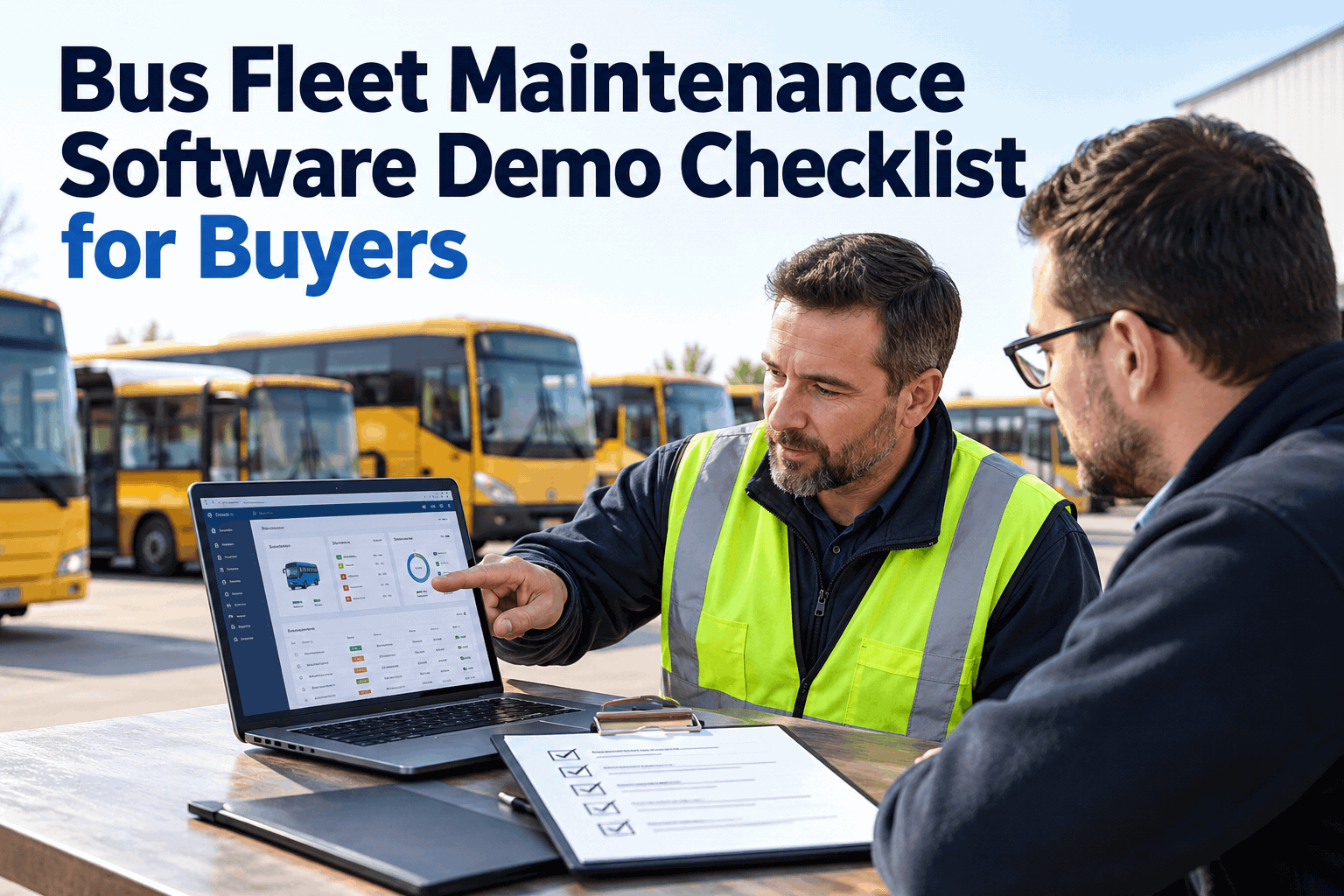
See BusCMMS in Action
30-minute demo customized for school districts. See how DVIR automation, PM scheduling, warranty recovery, and superintendent dashboards work together. No obligation, no credit card required.
How BusCMMS Solves School District Transportation Challenges
School districts face FMCSA compliance audits, state transportation audits, insurance requirements, and superintendent requests for safety data. Currently, compliance documentation is scattered: maintenance records in one system, inspection forms in filing cabinets, driver records in another system. Transportation director spends 10-15 hours per week chasing compliance evidence and compiling reports.
BusCMMS Solution: All compliance documentation auto-generated and organized in one platform. Audit prep time reduced from 40-60 hours to 2-3 hours. Inspector arrives and all requested records are immediately accessible. Superintendent gets monthly compliance snapshot showing audit readiness status.
Transportation directors budget $X for maintenance but actual spend varies $X ± 20-30% year to year due to unpredictable failures. When a transmission fails ($6,000-$8,000), the budget is blown. Technicians work reactively on emergency repairs rather than proactively on preventive maintenance. PM compliance is 70-80% instead of 90%+, leading to more failures and higher costs.
BusCMMS Solution: Predictive maintenance and systematic PM scheduling reduce emergency repairs by 25-35%. Budget becomes more predictable: maintenance spending variance reduces to ±8-12%. Warranty claim tracking recovers $15,000-$35,000 annually (funding for additional PM equipment or technician training). Superintendent gets monthly cost tracking against budget with variance explanation.
Parent and board concerns about bus safety drive pressure for safety improvements. Transportation director wants data-driven safety decisions (which routes have accidents, which drivers need coaching, which buses have defects) but lacks visibility. Maintenance and safety are not systematically linked: broken wheel cylinder fails during route, incident occurs, but root cause analysis is incomplete.
BusCMMS Solution: AI DVIR inspections detect potential safety issues (worn brakes, bad tires, lighting failures) before they cause incidents. Predictive brake maintenance prevents brake failures. Driver safety dashcam data correlates to maintenance events (harsh braking pattern may indicate brake issues). Safety metrics dashboard shows superintendent that proactive maintenance reduces incident risk by 35-45%.
Without digital work orders, there is no accountability for maintenance quality. Technician says "I fixed the brakes" but no evidence of what was done, what was found, what parts were used. If bus has issue weeks later, root cause analysis is impossible. Quality varies by technician and no one tracks who does good work vs poor work.
BusCMMS Solution: Every work order documented digitally: parts used, labor hours, photos of failed components, diagnostic codes, completion notes. Quality control is built in: supervisor reviews work orders before closure. Historical data shows which technicians have best quality metrics and which buses have recurring issues. Data-driven conversations about training needs and quality improvement.
Transportation director knows fleet is aging (average age 8+ years) and will need replacement capital in next 3-5 years, but can't quantify how much or make a data-backed business case to school board. Superintendent asks "Should we replace buses?" and transportation director can't answer with data: cost per mile trends, reliability by vehicle age, maintenance cost projections.
BusCMMS Solution: System tracks age, mileage, and maintenance cost per vehicle. Trend analysis shows cost per mile increasing 8-12% annually for vehicles over 8 years old. Capital planning projections built-in: if we replace 5 buses per year starting year 1, maintenance costs will decrease $25,000/year by year 3. Superintendent can present to school board with clear ROI case for capital budget.
Bus fleet maintenance is seasonal: summer heavy (pre-season inspections, PM), school year light (reactive repairs only). Technicians laid off summer-to-summer lose benefits and institutional knowledge. High turnover (20-25% annually) means constant training of new technicians. Experienced technicians leave because job feels unstable and disorganized.
BusCMMS Solution: Digital systems and clear processes make technician jobs feel more professional and organized. PM scheduling and predictive maintenance create more stable work (not all emergency repairs). CMMS training module helps new technicians become productive faster (12 weeks vs 4-6 months), improving retention. BusCMMS as a selling point to new hire candidates: "We use professional fleet management tools."
Real School District Results
Implemented BusCMMS to improve PM compliance (was 74%, target 90%). Within 6 months: PM compliance reached 91%, downtime reduced 22% (from 1.2 hrs/bus/month to 0.94 hrs), warranty claims recovered increased from $3,000/year to $28,000/year (first year). Budget variance reduced to ±5% (was ±18%). Transportation director's reporting time cut from 15 hours/week to 4 hours/week. Superintendent now has automated KPI dashboard instead of manual monthly reports.
Focused on DVIR automation and safety improvements. AI inspections deployed on all buses within 10 weeks. Defect detection improved from 58% (manual inspection) to 89% (AI inspection). Brake-related maintenance increased (catching issues early) but emergency brake failures dropped 60%. Safety incident rate declined 12% year-over-year (fewer brake failures during routes). Parent complaints about bus reliability dropped 40%. Capital equipment investment in AI inspection system paid back within 18 months through maintenance cost reduction.
Superintendent requested data on fleet condition to justify replacement capital budget. Using BusCMMS historical data, transportation director presented: fleet average age 9.2 years (industry benchmark 7 years), maintenance cost per mile increased 14% over 3 years (vs 6% industry trend), vehicle availability declining from 93% to 88% year-over-year. School board approved $1.2M capital for 8 new bus purchases and 2-year replacement schedule. Within 2 years, fleet average age normalized to 6.8 years, maintenance cost per mile decreased 8%, vehicle availability improved to 94%.
BusCMMS Pricing & Implementation for School Districts
BusCMMS pricing is transparent and predictable, designed for school district budgets. Pricing is per-bus-per-month, scaling with fleet size (larger fleets get volume discounts). A 40-bus district pays $35-$55 per bus per month ($1,400-$2,200/month), or $16,800-$26,400 annually. This includes: unlimited work orders, PM scheduling, DVIR integration, warranty claim management, technician mobile app, superintendent KPI dashboard, 24/7 support, and unlimited users. No hidden setup fees (first 30 days are free to test). Implementation takes 2-4 weeks: Day 1-2 system setup and CMMS configuration, Day 3-7 technician training, Day 8-14 DVIR camera installation and training, Day 15-28 data migration from prior system and parallel testing. Most school districts go live within 30 days with zero downtime.
ROI Calculation (40-Bus School District): Annual BusCMMS cost = $21,600. Annual savings from warranty recovery = $24,000 (average 40 buses recovers $600/bus/year). Annual savings from reduced emergency maintenance = $8,000 (25% reduction in emergency repair events). Annual savings from reduced compliance documentation burden = $4,000 (transportation director saves 600 hours annually at $6.67/hour savings). Total annual benefit = $36,000. Year 1 net ROI = $14,400 (BusCMMS pays for itself in 7 months, then generates $14,400 annual benefit). Year 2+ annual benefit = $36,000.
We were drowning in compliance documentation and maintenance coordination. Superintendent asked for a safety report for the board and I spent 3 days pulling data from email, spreadsheets, and filing cabinets. With BusCMMS, I have a one-page KPI dashboard that updates daily: fleet health, vehicle availability, safety incidents, maintenance costs, compliance status. Implementation was fast (3 weeks) and technicians were productive on day 1. Within 6 months, warranty recovery alone funded the software investment. The superintendent now understands transportation program performance through data instead of anecdotes. This software changed how we manage the fleet.
FAQ: BusCMMS for School Districts
Does BusCMMS work with our existing technician tools or maintenance shop equipment?
How long is implementation and what's involved?
What happens to our data if we leave BusCMMS?
Is BusCMMS FERPA compliant for storing school bus route and student data?
How much data entry burden is placed on technicians?
What if our school district uses multiple bus manufacturers (Blue Bird, IC Bus, Thomas)?
Do we need to upgrade our IT infrastructure or network to run BusCMMS?
How does BusCMMS handle seasonal staffing (technicians laid off in spring)?
Next Steps: Free Trial or Demo
Ready to transform your school district's bus fleet management? Two options: (1) Start free trial -- 30 days full access to all features, no credit card required, no obligations. Try with your real buses, real maintenance schedules, real work orders. (2) Schedule personalized demo -- 30-45 minute session with BusCMMS expert customized for school districts. We'll show DVIR automation, PM scheduling for your specific fleet, warranty claim tracking, and superintendent dashboard. Both options are free and no-commitment.
What to expect from trial or demo: You'll see how BusCMMS improves fleet visibility (real-time work order status, technician productivity metrics), reduces compliance burden (automated documentation, audit readiness), and enables data-driven decisions (KPI dashboards, trend analysis, capital planning). Most transportation directors recognize within 2-3 weeks that BusCMMS will save them 5-10 hours per week on compliance and reporting, freeing time for strategic fleet management. If you have questions during trial, support team is available (chat, email, phone) to help you customize BusCMMS for your district's specific fleet composition and maintenance approach.