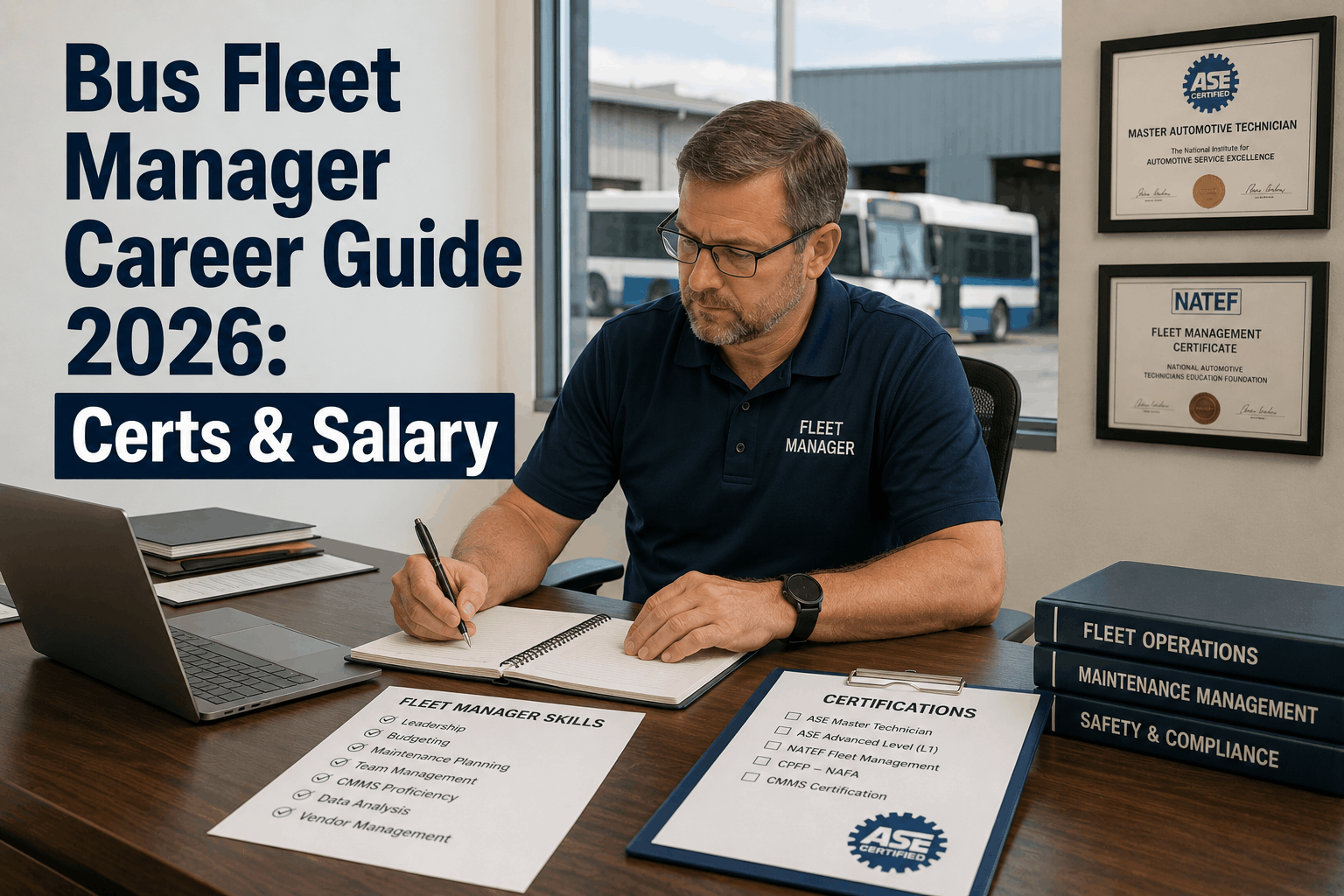
The transit industry faces a critical shortage of experienced bus fleet managers. Agencies report struggling to fill roles because candidates don't understand what the job actually involves, what certifications unlock opportunities, or how CMMS expertise has become a decisive factor in hiring. The salary range spans $58,000 to $112,000 depending on location, fleet size, and certifications — a 93% gap driven entirely by credential stack and technical competency. Yet most job candidates don't know which certifications matter, how to build verifiable CMMS expertise, or how to position themselves for senior fleet management roles that command six-figure compensation. Here's the complete 2026 career roadmap for bus fleet managers: certifications that agencies actually require, salary progression by state, the technical skills that unlock advancement, and how CMMS proficiency has become the highest-leverage career investment in fleet management.
2026 Career Guide
Bus Fleet Manager Career Guide 2026: Certifications, Salary, and CMMS Skills
ASE certifications. NATEF standards. State-by-state salary ranges ($58K–$112K). Required technical skills. Why CMMS expertise accelerates career growth. The career framework every fleet manager needs to advance from technician to director-level leadership.
The Bus Fleet Manager Career Path: From Technician to Director
A career in bus fleet management typically progresses through four distinct levels, each with different salary expectations, certifications, and skill requirements. Understanding this progression helps you make strategic career decisions and position yourself for advancement.
Level 1
Fleet Technician / Mechanic
Entry Level: $38,000–$52,000 annually
Foundation role. Primary responsibilities: routine maintenance, inspections, repairs, and diagnostics. Working under supervision, often on specific vehicle systems (brakes, cooling, electrical). Most candidates enter here with trade school credentials or apprenticeship completion.
ASE A1 (Engine Repair) or A4 (Suspension/Steering)
High school diploma + trade school or apprenticeship (2–4 years)
CDL (commercial driver's license) for some agencies
Basic computer skills for work order entry
Level 2
Lead Technician / Senior Mechanic
Mid Level: $52,000–$72,000 annually
Intermediate role with supervisory scope. Responsibilities: complex diagnostics, mentoring junior technicians, coordinating schedules, and contributing to maintenance strategy. Candidates typically progress to this level after 5–7 years of hands-on technical experience plus additional certifications.
ASE L1 (Maintenance & Light Repair) or multiple A-series credentials (A1, A4, A5)
NATEF (National Automotive Technicians Education Foundation) certification preferred
CMMS system proficiency (generating reports, analyzing data)
Familiarity with PM scheduling and predictive maintenance concepts
Level 3
Fleet Manager
Senior Level: $72,000–$95,000 annually
Management role with strategic responsibility. Oversee full maintenance operations: budget planning, technician hiring and development, vendor management, compliance reporting, and cost optimization. Candidates reach this level after 8–12 years of progressive experience, combining technical expertise with business acumen.
ASE Master Technician or multiple ASE certifications (minimum 5 A-series)
Proven CMMS expertise: system administration, report generation, data analysis
Budget management and financial acumen
FTA compliance knowledge (49 CFR 396 annual inspection)
Project management capability (fleet replacements, system implementations)
Level 4
Director of Maintenance / VP Fleet Operations
Executive Level: $95,000–$112,000+ annually
Executive role with organizational oversight. Responsibilities: multi-agency fleet strategy, capital planning, departmental budgets exceeding $10M, board reporting, vendor contracts, and long-term fleet health. Candidates typically have 15+ years of progressive management experience plus specialized expertise in advanced CMMS platforms and strategic planning.
ASE Master Technician status mandatory
Advanced CMMS expertise: system selection, implementation, KPI development
Strategic planning and capital budgeting experience
Board-level reporting and communication skills
FTA/DOT compliance and audit management
Optional: Bachelor's degree in fleet management or transportation management
Map your career path with a mentor — schedule a 1-on-1 session
Essential Certifications: What Agencies Actually Require vs. Nice-to-Have
Certifications are the quantifiable proof of your skills. Not all certifications carry equal weight. Transit agencies prioritize certain credentials because they directly impact compliance, cost, and capability. Here's which certifications unlock opportunity and which are nice additions.
ESSENTIAL
ASE L1: Maintenance & Light Repair
Why Agencies Require It: L1 covers PM services, routine maintenance, basic diagnostics, and safety inspections — the core 80% of transit fleet work. Every fleet manager needs this credential.
Requirements: Pass 40-question exam covering oil changes, brake service, fluids, filters, belts, hoses, lighting. Two years hands-on experience or 3,000 hours required before testing.
Impact on Salary: Baseline credential. +$4,000–6,000 annually vs. non-certified technician.
ESSENTIAL
ASE Master Technician
Why Agencies Require It: Master Technician status requires passing eight ASE exams across major systems (engine, brakes, suspension, transmission, electrical, etc.). It's the credential that proves you understand the entire bus, not just one system.
Requirements: Minimum five A-series ASE certifications plus two years experience managing technicians, or all eight A-series certifications with five years hands-on experience.
Impact on Salary: The single highest-leverage credential. Master Technician holders command +$12,000–18,000 premium vs. single-certification technicians. Fleet Manager and Director roles almost always require this.
ESSENTIAL
NATEF Medium/Heavy Duty Truck Certification
Why Agencies Require It: NATEF (National Automotive Technicians Education Foundation) certification validates that you've completed a structured program meeting industry standards. It's the educational framework equivalent to ASE but covers broader systems and maintenance concepts.
Requirements: Completion of accredited NATEF program (typically 1,800 hours classroom + hands-on training) or equivalent experience-based qualification.
Impact on Salary: Often paired with ASE credentials. +$6,000–8,000 annually vs. non-NATEF certified peers.
HIGHLY VALUED
FTA/DOT Compliance & Safety Management
Why Agencies Require It: Transit agencies operate under strict federal oversight (49 CFR 396 annual inspection requirements). Managers who understand compliance requirements prevent audit findings and protect agency funding. This is increasingly required for manager-level roles.
Requirements: FTA compliance training (available through APTA or transit training programs). No formal exam, but validation of knowledge required.
Impact on Salary: Enables manager-level promotion. +$8,000–12,000 annually for manager roles.
HIGHLY VALUED
CMMS System Certification (BusCMMS, Optimetrics, etc.)
Why Agencies Require It: CMMS proficiency is now a differentiator in hiring. Agencies using cloud-based platforms actively seek candidates who can configure PM schedules, generate KPI reports, and optimize workflows. This skill is increasingly required at manager level.
Requirements: Platform-specific training (typically 2–5 day course) or demonstrated expertise through hands-on system administration.
Impact on Salary: Accelerates progression to manager level. Candidates with advanced CMMS skills progress 2–3 years faster than non-certified peers. +$6,000–10,000 annually for manager roles.
SPECIALIZED (Career Accelerators)
Predictive Maintenance & Diagnostics
Why Agencies Require It: Advanced diagnostics (oil analysis, vibration monitoring, thermal imaging) enable early failure detection. Transit agencies investing in predictive maintenance actively seek technicians and managers with these skills.
Requirements: Specialized training programs (typically 1–2 weeks) covering diagnostics tools and data interpretation.
Impact on Salary: Niche expertise. +$8,000–15,000 for managers with predictive maintenance expertise. Fastest-growing skill in the industry.
SPECIALIZED (Career Accelerators)
Lean Six Sigma (Fleet Operations)
Why Agencies Require It: Lean Six Sigma training teaches process optimization and cost reduction methodologies. Applied to fleet operations, it enables managers to reduce maintenance costs, improve technician efficiency, and streamline workflows. Some larger transit agencies explicitly seek Green Belt or Black Belt certification.
Requirements: Green Belt (40-hour course, typically 2–3 days) or Black Belt (intensive 4–6 week program).
Impact on Salary: Advanced operational skill. +$10,000–16,000 annually for managers with Lean Six Sigma credentials. Often unlocks director-level advancement.
Build your certification roadmap — schedule a career mentoring session
Bus Fleet Manager Salary by State: 2026 Real Data
Compensation varies dramatically by geography, fleet size, and certification level. Here's the 2026 salary breakdown for bus fleet managers across major U.S. markets, based on transit agency data and labor surveys.
State
Entry Technician
Fleet Manager
Director
California
$52,000–68,000
$88,000–$112,000
$110,000–$135,000
Texas
$42,000–54,000
$68,000–$85,000
$85,000–$108,000
New York
$48,000–62,000
$78,000–$98,000
$100,000–$128,000
Florida
$40,000–50,000
$62,000–$78,000
$78,000–$98,000
Ohio
$38,000–48,000
$58,000–$72,000
$72,000–$92,000
Illinois
$44,000–56,000
$72,000–$90,000
$92,000–$118,000
Pennsylvania
$42,000–54,000
$66,000–$82,000
$82,000–$105,000
Washington
$50,000–64,000
$82,000–$105,000
$105,000–$132,000
Colorado
$45,000–58,000
$70,000–$88,000
$88,000–$112,000
Virginia
$43,000–55,000
$68,000–$85,000
$85,000–$108,000
Key Salary Insights for 2026
Certification Premium:
ASE Master Technician holders earn 18–22% more than single-certification technicians at same experience level
CMMS Expertise Premium:
Advanced CMMS proficiency commands 12–16% salary premium for manager-level roles. This gap is widening as agencies modernize systems.
Geographic Gap:
California, Washington, and New York offer highest compensation; Midwest and Southern states typically 20–30% lower. However, cost of living differs proportionally.
Career Progression Speed:
Candidates with ASE Master Technician + CMMS certification reach manager level (Level 3) in 6–8 years. Without these credentials, typical progression is 12–15 years.
Compare your current salary against market benchmarks — schedule a strategy call
The Technical Skills Every Fleet Manager Must Master in 2026
Beyond certifications, transit agencies increasingly evaluate candidates on hands-on technical competencies. These are the skills that distinguish average candidates from ones who get hired and promoted.
CMMS Administration & KPI Development
Configure preventive maintenance schedules, generate compliance reports, set up KPI dashboards, and optimize work order workflows. This is now a baseline requirement for manager-level roles. Agencies moving to cloud-based platforms actively seek candidates with hands-on CMMS expertise.
Level Required: Manager (Level 3+)
Preventive Maintenance Strategy
Design and implement PM programs that minimize breakdowns while controlling costs. Understand interval optimization, component criticality, and cost-per-mile calculations. This bridges technical knowledge and financial acumen.
Level Required: Lead Technician (Level 2+)
FTA/DOT Compliance Management
Know 49 CFR 396 annual inspection requirements, federal funding documentation, audit procedures, and compliance gap identification. This is mandatory for manager roles and increasingly expected at senior technician level.
Level Required: Lead Technician (Level 2+)
Diagnostic Troubleshooting
Use multimeters, scan tools, and diagnostic equipment to isolate electrical, engine, and brake system faults. Modern transit buses have advanced electronics; traditional mechanical troubleshooting alone is insufficient.
Level Required: Technician (Level 1+)
Excel & Data Analysis
Build cost tracking spreadsheets, analyze maintenance trends, create performance dashboards, and present data to leadership. Managers spend 30–40% of time in data analysis and reporting.
Level Required: Lead Technician (Level 2+)
Budget Planning & Cost Control
Forecast annual maintenance spending, control parts inventory costs, negotiate vendor contracts, and justify budget requests to leadership. This separates strong technicians from manager-capable leaders.
Level Required: Manager (Level 3+)
Staff Training & Development
Design training programs, mentor junior technicians, provide technical feedback, and foster a culture of continuous improvement. Agencies prioritize managers who build strong teams.
Level Required: Manager (Level 3+)
Project Management
Oversee fleet replacement projects, system implementations, and capital improvements. Managers coordinate with vendors, track budgets, and ensure on-time, on-budget delivery.
Level Required: Manager (Level 3+)
Start developing CMMS expertise today — the most in-demand fleet manager skill
How CMMS Proficiency Accelerates Your Career
Modern transit agencies view CMMS expertise as a career accelerator. Candidates with hands-on platform proficiency progress faster, earn more, and unlock senior roles that purely technical candidates cannot reach. Here's why CMMS skills have become the highest-leverage career investment.
Advantage 1: Career Speed
Without CMMS expertise: 12–15 years typical progression to manager level. Traditional path: technician → lead technician → manager.
With CMMS expertise: 6–8 years typical progression. Advanced CMMS skills fast-track promotion because managers who can optimize systems create immediate cost savings.
Impact: 4–7 year acceleration. That's $200,000–400,000 in additional earnings over a career.
Advantage 2: Job Security
CMMS systems represent multi-year investments for transit agencies. Managers who understand their selected platform (whether BusCMMS, Optimetrics, or legacy systems) become valuable institutional knowledge holders. Agencies are reluctant to lose managers who know the system deeply.
Impact: Higher job security, stronger negotiating position in salary discussions, and opportunities to lead system upgrades that command premium compensation.
Advantage 3: Cross-Industry Mobility
CMMS expertise transfers across industries. Your skills managing transit fleet maintenance in a CMMS apply equally to school district fleets, municipal vehicle operations, and private logistics companies. This expands your job market and negotiating power.
Impact: More job options, higher compensation in competitive markets, and the ability to command premium salaries as a contractor or consultant.
Advantage 4: Consulting & Leadership
Directors with deep CMMS expertise become sought-after consultants for agencies implementing new systems. Some managers transition to consulting roles earning $120,000–$180,000+ annually for system implementation projects.
Impact: High-value career path. Consulting fees often exceed traditional manager salaries and offer flexibility.
CMMS Skills Progression & Career Impact
Level 1: Basic User
Enter work orders, view maintenance history, basic report generation. Impact: Meets job requirements but doesn't differentiate you. Time to achieve: 2–4 weeks on-the-job training.
Level 2: Power User
Configure PM schedules, generate KPI reports, analyze trends, manage work order routing. Impact: Demonstrates advanced capability. Salary advantage: +$6,000–8,000 at manager level. Time to achieve: 3–6 months focused learning.
Level 3: Administrator/Expert
System configuration, custom report building, integration with other platforms, training others, troubleshooting. Impact: Highly valuable. Salary advantage: +$12,000–16,000 at manager level. Enables director-level advancement. Time to achieve: 1–2 years hands-on experience.
Level 4: System Architect
Lead platform selection, design implementation workflows, optimize for organizational needs, serve as internal expert. Impact: Director-level only. Consulting potential. Time to achieve: 3–5 years at administrator level.
Develop expert-level CMMS skills — join a hands-on training program
Five years ago I was a lead technician at $65,000. I invested in ASE Master Technician certification and learned our CMMS system inside and out. Within three years I was promoted to fleet manager at $85,000. Two years after that, I moved to a director role at $110,000. The CMMS expertise was the differentiator. When I updated my resume to show I had optimized our PM schedule and reduced maintenance costs by 18%, every interview focused on my ability to drive operational improvements. CMMS skills are what got me the director role.
— Fleet Director, 200-bus transit agency, USA
Building Your Career Action Plan: 2026 and Beyond
Career advancement requires intentional planning, not just on-the-job learning. Here's a strategic roadmap for building a competitive profile and advancing in bus fleet management.
Year 1: Foundation Building
If you're at entry level (technician): Pursue ASE L1 (Maintenance & Light Repair) certification. Study for 4–6 weeks, pass the exam. Cost: ~$150 exam fee. Impact: +$4,000–6,000 salary increase, validates competency to employers.
Action items: Register for ASE exam, use study guides, join a study group, schedule exam. Timeline: 6–8 weeks total.
Year 2–3: Credential Stacking
If you're at entry-to-mid level: Pursue ASE A1 (Engine Repair) + A4 (Suspension/Steering) certifications. These are the most relevant to bus maintenance. Study for each separately, spread over 12 months. Cost: ~$300 total.
Parallel action: Enroll in NATEF Medium/Heavy Duty program or equivalent (1,800 hours). Many community colleges offer this part-time. Timeline: 18–24 months part-time.
Impact: You'll be positioned for Lead Technician roles (Level 2), salary range $52,000–$72,000.
Year 3–5: Specialization
If you're at lead technician level: Complete ASE Master Technician credential (5+ A-series exams). This is the critical milestone for manager advancement. Cost: ~$750–1,000 total. Timeline: 24 months (pass one exam every 6 months).
Parallel action: Pursue FTA/DOT compliance training (online, 2–3 days). Become the expert on federal regulatory requirements. Cost: ~$500–1,000.
Impact: You're now competitive for Fleet Manager roles (Level 3). Salary range: $72,000–$95,000.
Year 5–7: Manager-Level Expertise
If you're at manager level: Master a CMMS platform. Choose one (BusCMMS, Optimetrics, etc.) and become the in-house expert. Complete certification courses, configure systems, generate advanced reports. Cost: $2,000–5,000 for training. Timeline: 12–18 months.
Parallel action: Take Lean Six Sigma Green Belt training (40 hours, online or in-person). Learn process optimization methodologies. Cost: $1,500–3,000.
Impact: You're positioned for Director roles (Level 4). Salary range: $95,000–$112,000+.
Year 7+: Executive Path
If you're at director level: Consider an MBA in Fleet Management, Transportation Management, or Business Administration. Many online programs (2 years part-time) align with your experience.
Parallel action: Build consulting expertise. Lead system implementations for other agencies. Establish yourself as a thought leader through speaking engagements or industry publications.
Impact: Executive director roles, VP positions, consulting opportunities. Compensation: $110,000–$150,000+ annually.
Map your personalized career roadmap — schedule a mentoring session
Where Transit Agencies Recruit Fleet Managers in 2026
Knowing where to look for opportunities accelerates your career search. Transit agencies recruit fleet managers through specific channels — understanding these increases your visibility to hiring managers.
APTA (American Public Transportation Association)
APTA is the primary networking hub for transit professionals. Job board lists positions from agencies nationwide. APTA conferences (annual + regional) connect you directly with hiring decision-makers. Member agencies often post senior positions exclusively to APTA.
Action: Join APTA (individual membership ~$300/year), post your profile, attend conferences, subscribe to job board.
Government Job Boards
Most transit agencies are government entities, so positions appear on government job sites: USAJobs.gov (federal), state job boards, and individual agency websites. These positions often offer competitive salary, pension benefits, and job security.
Action: Bookmark job boards for transit agencies in your target regions. Set up alerts for "fleet manager" or "maintenance director" positions.
Industry-Specific Recruiters
Specialized recruiters focus on transit and fleet management talent. They know which agencies are hiring before positions are publicly listed. Having a relationship with a transit recruiter can surface opportunities quickly.
Action: Connect with recruiters specializing in transit on LinkedIn. Share your resume and career goals. Recruiters contact you when opportunities match your profile.
LinkedIn & Professional Networks
Many agencies post fleet manager positions on LinkedIn first. Building a strong profile with your certifications, CMMS expertise, and accomplishments makes you visible to recruiters and hiring managers searching for candidates.
Action: Optimize LinkedIn profile, list all certifications, highlight CMMS and cost-saving achievements, connect with transit industry peers.
Industry Events & Conferences
APTA conferences, state transit associations, and maintenance symposiums are hunting grounds for recruiters. Attending and networking can result in job offers. Many agencies recruit candidates they meet in person over formal applications.
Action: Attend at least one major industry conference per year. Speak with vendors and agencies. Exchange contact information.
Connect with our transit industry network — schedule a networking call
Your Fleet Manager Career Starts With the Right Skills.
ASE Master Technician. CMMS expertise. FTA compliance knowledge. NATEF certification. Strategic certifications accelerate advancement from technician ($38K–$52K) to director ($95K–$112K+) within 8–10 years instead of 15+. CMMS proficiency is the highest-leverage skill. Master a platform. Become invaluable.
Bus Fleet Manager Career FAQs
What's the fastest path from technician to fleet manager?
ASE Master Technician + CMMS expertise + FTA compliance training. This combination accelerates progression to manager level from 12–15 years to 6–8 years. Focus on these three areas and progression becomes rapid. Most agencies fast-track candidates with this credential stack.
Do I need a college degree to become a fleet manager?
No — most fleet managers rise through technical ranks via certifications and experience, not formal education. However, some larger transit agencies prefer managers with associate or bachelor's degrees. A degree plus certifications is optimal for director-level roles but not essential for fleet manager positions.
Is it worth getting an MBA for fleet management career advancement?
For director-level roles (Level 4+), an MBA in fleet management, transportation, or business administration strengthens candidacy and increases salary ceiling by $15,000–25,000. For manager-level roles, MBA is nice-to-have but not essential if you have ASE Master Technician + CMMS expertise.
Which CMMS platform should I learn first?
Learn whichever platform your current or target employers use. Research job postings in your region — identify the most commonly mentioned CMMS platform (BusCMMS, Optimetrics, Dude Solutions, etc.). Expertise in a widely-used platform is more valuable than expertise in a niche system.
Can I transition from fleet management to other industries?
Yes — fleet management expertise transfers to school district operations, municipal vehicle fleets, logistics, construction equipment fleets, and private transportation. Your CMMS and PM skills are valuable across all industries. This cross-industry mobility increases earning potential.
What's the difference between ASE and NATEF certifications?
ASE (Automotive Service Excellence) tests individual technical competencies via exams. NATEF (National Automotive Technicians Education Foundation) validates that you completed a structured training program. Both are valuable — ASE is the performance credential; NATEF is the educational credential. Most employers want both.
How often do I need to renew my ASE certifications?
ASE certifications expire every five years. Renewal requires passing a recertification exam or completing continuing education. Maintaining current certifications signals ongoing professional development — employers prefer managers with current, active credentials.
What salary can I negotiate with ASE Master Technician + CMMS expertise?
For a fleet manager role, this credential stack justifies salary in the $85,000–$105,000 range depending on location, fleet size, and agency budget. In high-cost areas like California or New York, $100,000+ is typical. This combination puts you in the top 15% of fleet manager compensation.
Build Your Fleet Management Career in 2026
ASE Master Technician certification. CMMS platform expertise. FTA compliance training. The proven pathway from technician to manager to director. Strategic career planning accelerates advancement and increases lifetime earning potential by $400,000+.