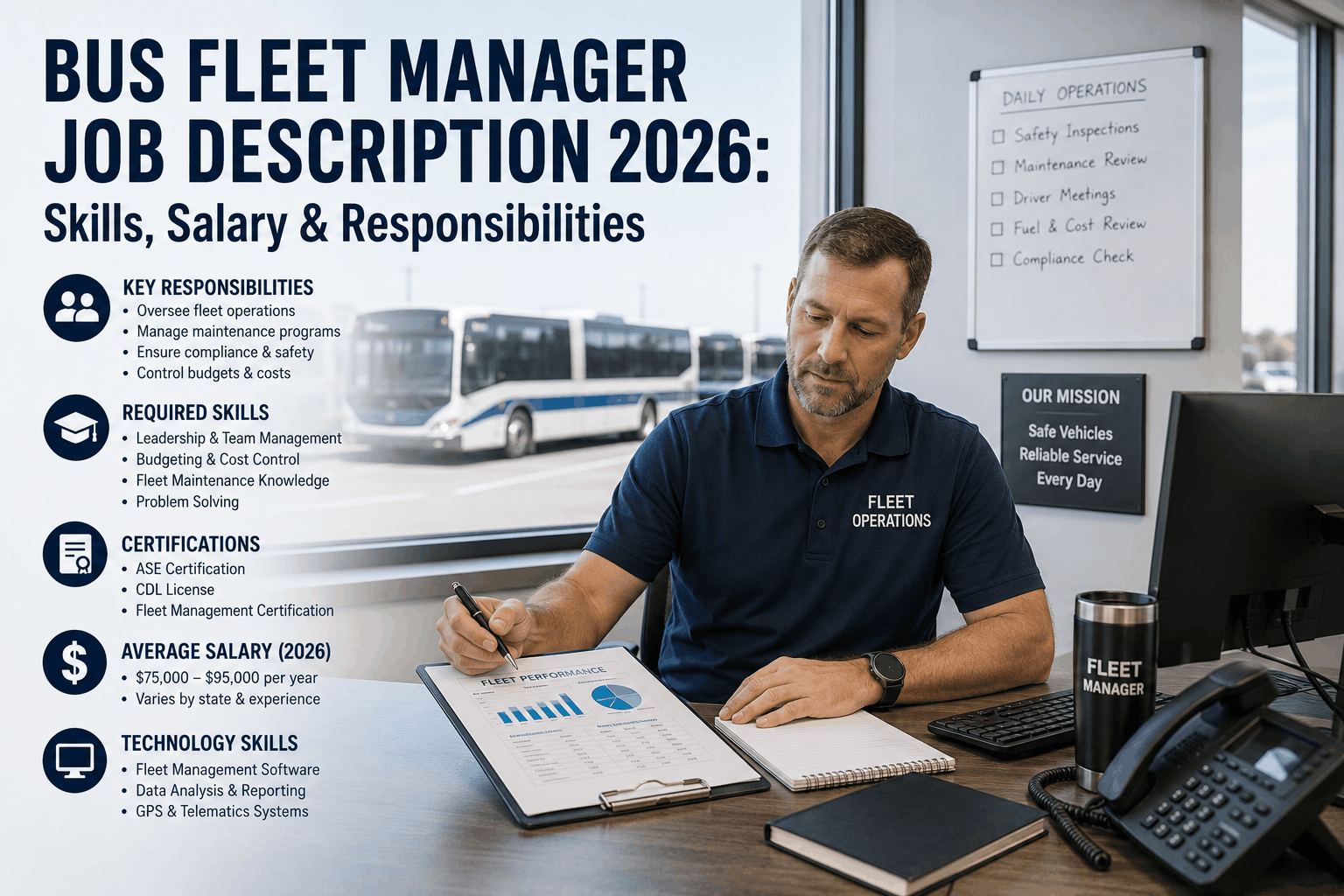
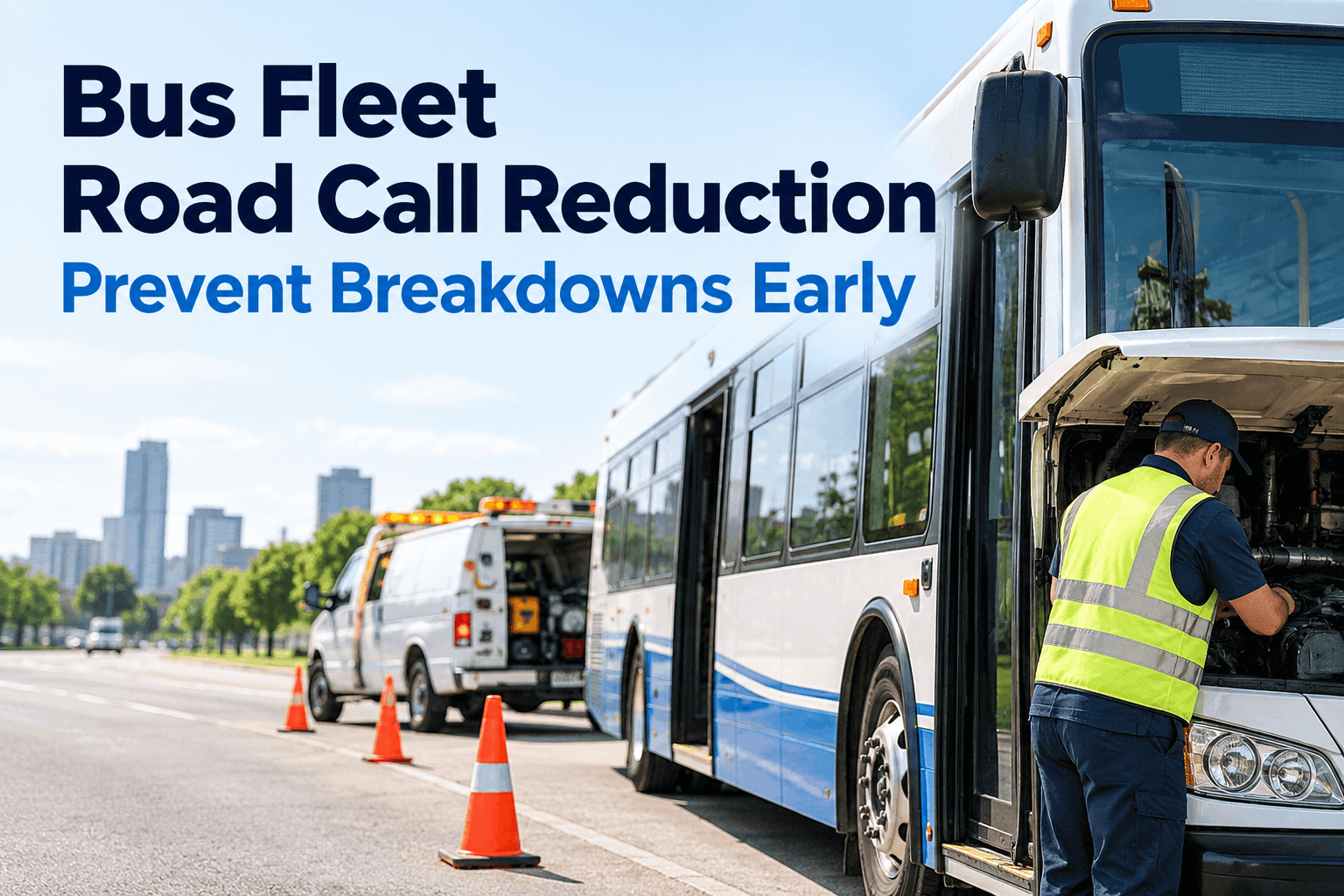
The bus fleet manager role in 2026 is nothing like it was five years ago. You're no longer just scheduling maintenance and tracking vehicle records. You're a data-driven operations executive managing multi-million-dollar asset portfolios, navigating overlapping federal (FMCSA), state, and sometimes federal transit authority (FTA) compliance frameworks simultaneously, implementing predictive maintenance strategies that reduce breakdowns by 40%, managing driver safety and qualification tracking across multiple state jurisdictions, overseeing technician teams and dispatch operations, and increasingly, managing the transition from diesel to electric bus operations. The average bus fleet manager today earns $75,000 to $130,000+ annually, with certified professionals commanding $8,000–$18,000 premiums over non-certified peers. This comprehensive guide breaks down the complete job description, exact skills employers expect, certifications that matter, realistic salary ranges by experience and geography, and the career path that gets you there.
Bus Fleet Manager: The Complete 2026 Job Description, Skills, and Salary Guide
What employers expect, what you need to know, and what you'll earn in the largest growing role in transportation management
Bus Fleet Manager: The Role in 2026
A bus fleet manager oversees all operational aspects of a bus transportation operation: vehicle maintenance, scheduling, driver management, compliance, budgeting, and increasingly, technology adoption and data analytics. The role spans three distinct domains. First: operational management — maintaining fleet uptime, coordinating maintenance schedules, managing preventive maintenance programs, responding to breakdowns, and ensuring vehicles are dispatch-ready. Second: compliance and regulatory management — tracking FMCSA annual inspections, maintaining driver qualification files, documenting DVIRs, managing FTA triennial review documentation (if federally funded), ensuring ADA compliance, and preparing for audits. Third: strategic management — implementing cost reduction initiatives, analyzing fleet performance data, managing technician teams, evaluating new technologies (telematics, predictive maintenance, electric vehicle transition), and preparing capital replacement plans.
The role has evolved because bus transportation is now data-intensive. A fleet manager who can extract insights from maintenance data, identify cost reduction patterns, and predict component failures before they cause breakdowns has substantially higher market value than one managing by spreadsheet and memory. Similarly, certifications like CAFM (Certified Automotive Fleet Manager) now command salary premiums because they signal competency in modern fleet operations.
Core Responsibilities: What Bus Fleet Managers Actually Do Daily
1
Maintenance Planning & Scheduling
Develop and maintain preventive maintenance schedules (PM-A, PM-B, PM-C intervals). Ensure all buses receive required services on schedule. Coordinate with technicians to manage workload. Track component wear patterns and adjust intervals based on actual data. For a 50-bus fleet, this typically means managing 15–25 scheduled maintenance tasks weekly and ensuring no PM services are missed. Document all work in compliance with FMCSA requirements (49 CFR 396).
2
Compliance & Documentation Management
Maintain annual DOT vehicle inspection schedules and ensure 100% completion. Track driver CDL status, medical certificates, and Clearinghouse queries. Manage DVIR (Driver Vehicle Inspection Report) documentation and defect follow-up. Coordinate FTA triennial review documentation if applicable. Maintain 14-month records of all maintenance and inspection reports. Coordinate with auditors during FMCSA/FTA compliance reviews. Respond to roadside inspection findings and out-of-service orders.
3
Budget & Cost Management
Develop annual maintenance and parts budgets. Track YTD maintenance spending vs. budget. Identify cost reduction opportunities (parts consolidation, vendor optimization, preventive vs. corrective work ratio). Analyze cost per mile metrics. Evaluate vendor pricing and contract terms. Make capital allocation decisions on parts inventory. Report to operations director on fleet spending and efficiency metrics. Benchmark performance against industry standards ($0.32–$0.58/mile typical range).
4
Team Leadership & Operations
Supervise maintenance technicians (typically 4–8 for a 50-bus fleet). Manage work order prioritization and dispatch. Conduct safety briefings and training. Address performance issues or skill gaps. Manage technician schedules and overtime. Recruit and onboard new technicians. Foster quality and safety culture. For larger operations (100+ buses), manage multiple locations and multi-depot coordination.
5
Data Analytics & Reporting
Extract and analyze fleet performance metrics from CMMS (downtime hours, repair costs, component failure rates). Identify trends and anomalies. Generate monthly/quarterly reports for operations leadership. Use telematics data (fuel consumption, idle time, harsh braking) to identify driver behavior issues or mechanical problems. Present insights that drive operational decisions. Increasingly, this includes analyzing predictive maintenance algorithms to prevent failures before they occur.
6
Technology & System Management
Manage CMMS platform (Computerized Maintenance Management System) — the operational nervous system. Configure PM schedules, work order workflows, parts inventory. Integrate telematics data from vehicles. Evaluate and implement new tools (predictive maintenance, electric vehicle charging management). Ensure data integrity and system compliance. Train team on platform use. Increasingly, manage transition to electric vehicles (charging infrastructure, different maintenance requirements, battery health tracking).
Required Skills & Competencies: What Employers Actually Look For
CMMS Proficiency
CRITICAL
You must be comfortable operating a fleet management platform (BusCMMS, Dude Solutions, etc.). Configure PM schedules, generate work orders, extract reports, integrate telematics. Non-negotiable for roles above 20 vehicles.
FMCSA/DOT Regulatory Knowledge
CRITICAL
Understand 49 CFR Part 396 (inspections/maintenance), 49 CFR Part 391 (driver qualifications), 49 CFR Part 395 (HOS). Know DVIR requirements, inspection intervals, record retention. Be able to audit your fleet for compliance gaps before an inspector does.
Preventive Maintenance Program Development
CRITICAL
Know how to design PM intervals (PM-A/B/C or equivalent). Understand mileage-based vs. time-based vs. engine-hour triggers. Be able to build a program from scratch and explain the rationale to technicians and finance. Know which systems need frequent attention (brakes) and which don't (transmission).
Data Analytics & Excel/BI Tools
CRITICAL
Extract data from CMMS and create meaningful reports. Comfortable with spreadsheets, pivot tables, trend analysis. Ideally familiar with basic BI tools (Tableau, Power BI). Ability to identify patterns in maintenance data and translate them into actionable decisions.
Budget Management & Cost Analysis
CRITICAL
Build annual maintenance budgets. Track spending vs. budget. Calculate cost per mile. Analyze vendor pricing. Understand the economics of preventive vs. corrective work ($420 brake job vs. $1,850 emergency roadside repair). Be able to justify spending decisions to CFO/operations director.
Team Leadership & Supervision
HIGH
Manage technicians effectively. Conduct performance reviews. Handle conflict. Motivate team. Implement safety protocols. For director-level roles, manage multiple facility managers. For roles over 100 buses, manage multi-depot operations.
Telematics & Diagnostics Interpretation
HIGH
Understand what engine fault codes mean. Interpret telematics data (fuel consumption, idle time, harsh braking, speed). Know how to use this data to diagnose mechanical issues before they cause breakdown. Increasingly mandatory skill as fleets adopt telematics.
Communication & Documentation
HIGH
Write clear work orders. Explain compliance requirements to technicians. Present data to operations leadership. Prepare audit documentation. Respond to regulatory inquiries. Strong written communication is essential because your work is documented and audited.
Vendor Management & Negotiation
MEDIUM
Build relationships with parts suppliers, repair shops, fuel vendors. Negotiate pricing. Compare quotes. Manage contracts. Ensure quality and delivery timelines. For larger fleets, this becomes increasingly strategic.
Education, Experience & Certifications That Matter
Formal Education (Preferred but not always required)
Bachelor's degree in logistics, business, supply chain management, or transportation
Associate degree in fleet management or automotive technology
High school diploma + 5–7 years field experience (path to manager for technicians)
Impact: Bachelor's degree increases earning potential by 15–25%. Many successful fleet managers came up through technician roles without formal degrees but compensated with certifications and experience.
Essential Certifications (Salary Premium: +$8K–$18K/year)
CAFM (Certified Automotive Fleet Manager) — NAFA (National Association for Fleet Administration). 3–5 year tenure + exam. This is THE credential in fleet management. Shows competency across operations, compliance, technology, and cost management. Worth $10K–$15K salary premium.
CFM (Certified Fleet Manager) — NAFA alternative. Similar credibility. Requires 2 years fleet role + exam.
ASE (Automotive Service Excellence) — Demonstrates technical knowledge of vehicle systems. While not required for management, shows credibility with technician teams.
CDL (Commercial Driver License) — Not required but strongly preferred. Gives you ability to test-drive repairs and understand driver perspective. Many employers prefer this.
Certification path: Entry role → 2–3 years experience → CAFM exam → promotion to manager/director roles. Certified professionals advance faster and earn consistently higher salaries across all fleet sizes.
Preferred Experience for Hiring
3–5 years in fleet operations (coordinator, technician, supervisor, or dispatcher roles)
Experience with a CMMS platform (any platform counts — you can learn new ones)
Exposure to FMCSA compliance (DVIRs, inspections, maintenance documentation)
Technician background or hands-on mechanical knowledge strongly preferred
Multi-depot or multi-location fleet experience for director-level roles
Salary Ranges: What Bus Fleet Managers Earn in 2026
National Average: $75,000–$130,000+ (varies significantly by experience, certification, location, fleet size)
Entry-Level Fleet Coordinator/Supervisor (20–40 buses)
$45,000–$65,000
High school diploma or associate degree, 1–2 years experience, no certifications. Responsible for scheduling, basic compliance tracking, technician coordination. This is the stepping stone role.
Path forward: Get CMMS experience, pursue CAFM certification, advance to manager role in 2–3 years. Salary can jump $15K–$25K with promotion.
Mid-Level Fleet Manager (40–100 buses)
$65,000–$95,000
Bachelor's degree or equivalent experience, 3–5 years fleet operations, basic CMMS proficiency. Full responsibility for maintenance programs, compliance, and technician team. May manage one or two facilities.
Certification impact: +$8K–$12K if CAFM certified. Geographic premium: Northeast/West Coast typically +$8K–$15K vs. South/Midwest. Unionized vs. non-union operations can vary ±$10K.
Senior Fleet Manager (100–250 buses)
$85,000–$125,000
Bachelor's degree, 5–10 years experience, CAFM certification expected. Manages multi-site operations, reports to VP operations or director. Responsible for strategic initiatives (PM program optimization, technology adoption, budget planning, multi-depot coordination).
Bonus/incentive potential: 10–20% of base salary for roles at this level, based on cost targets and safety metrics. Data-driven decision-making and cost reduction initiatives significantly impact earning potential.
Director of Fleet Operations (250+ buses)
$110,000–$180,000+
Bachelor's/MBA, 10+ years experience, CAFM required. Executive-level role reporting to VP or COO. Manages multi-region operations, strategic fleet initiatives (EV transition, telematics integration), capital planning, director team management.
Bonus/incentive: 20–35% of base salary typical. Total compensation in top-tier roles (major transit agencies, large school districts) can exceed $200K with benefits.
Salary Multipliers That Actually Matter
Geography
Highest: New York, California, Northeast corridor (+15–25% vs. national average)
Fleet Size Responsibility
Each 50-bus increment adds $8K–$15K for manager-level roles
Certification (CAFM)
+$10K–$18K annually across all experience levels
Industry Sector
School districts: $60K–$100K | Public transit: $75K–$130K | Private charter: $70K–$120K
Cost Reduction Track Record
Documented 20%+ maintenance cost reduction = promotion + $15K–$30K bump
Multi-Depot Experience
+$10K–$20K for roles managing 2+ locations simultaneously
How to Get Into This Role: The Career Path
Step 1: Start in a Related Role (Year 0–1)
Begin as fleet dispatcher, maintenance coordinator, or technician. Get CMMS experience. Learn basic compliance requirements. Shadow fleet manager. Salary: $35K–$50K. The goal is to get your first year in a fleet environment and demonstrate you can follow processes.
Step 2: Build Technical Knowledge (Year 1–2)
Deep dive on FMCSA regulations, DVIR processes, PM scheduling. Become the person who can explain why brake inspections matter or what a DVIR defect means. Start running your own reports from CMMS. Salary: $45K–$60K. This is when you transition from coordinator to supervisor.
Step 3: Get Certified (Year 2–3)
Pursue CAFM certification. Requires 3 years tenure (some paths 2 years) + exam (~$1,000 + 100 hours study). This certification is a signal to employers that you're serious about the career. Major salary jump when added to your resume. Salary progression: $55K–$75K.
Step 4: Move to Manager Role (Year 3–4)
With 3+ years experience and CAFM certification, you're competitive for fleet manager positions (40–100 bus range). You're ready to manage technician teams, own PM programs, and drive cost reduction initiatives. Salary: $65K–$95K depending on fleet size and location.
Step 5: Advance to Senior/Director Roles (Year 5–10)
With proven track record of cost reduction, safety improvements, and technology adoption, move to senior manager or director roles. Manage multiple facilities or larger single-location operations. Salary: $90K–$180K+ depending on scope. Most director roles require 10+ years and MBA preferred.
A Typical Day: What Fleet Managers Actually Do
7:00 AM: Check overnight maintenance data in CMMS. Bus #14 flagged brake fault code. Review to see if it's critical (yes, grounding the bus) or informational. Coordinate with shop foreman — needs priority diagnostic before morning runs. Check PM schedule — three buses due for service this week, all on track.
8:00 AM: Team meeting with technicians. Review this week's work orders. Discuss Bus #14 brake issue, resource allocation, any parts delays. One technician reports low on brake pads — order them immediately to avoid shortage. Safety briefing: remind team about OSHA requirements for lift usage.
9:00 AM: Finance meeting with operations director. Year-to-date spending is tracking 8% over budget due to unexpected transmission repairs on Bus #27. Present plan to get back on track: accelerate preventive maintenance on remaining fleet to catch problems before they become emergency repairs. Discuss vendor consolidation saving opportunities.
10:30 AM: Extract CMMS report for FTA triennial review documentation (due next month). Pull 12-month maintenance history, PM compliance rates, component failure analysis, driver qualification status. Find a gap: two drivers' medical certificates expire next month — flag and create reminder to get them renewed before they're no longer compliant.
12:00 PM: Lunch + field walk. Check on Bus #14 brake diagnostic progress. Technician found a brake line leak, not a failed pad. Parts ordered, should be ready by tomorrow. Walk through shop — check parts organization, material safety, vehicle condition. Spot-check a few buses for obvious defects.
1:30 PM: Vendor meeting (virtual). Brake parts supplier presenting new product line. Compare pricing vs. current vendor. Discuss volume commitment — if you consolidate orders with them, get 12% discount vs. current 8%. Analyze their delivery reliability and warranty terms. Make decision.
3:00 PM: Quarterly board report preparation. Fleet uptime is 97% this month (target 95%). Maintenance cost per mile: $0.34 (down from $0.41 last year thanks to PM focus). 12 buses are approaching end-of-useful-life and will need capital replacement planning for next budget cycle. Present this to fleet director and board.
4:30 PM: Onboard new dispatcher. Review CMMS platform basics, work order process, compliance documentation. This person will help manage the scheduling load as fleet grows. Five minutes before end of day: check overnight alert system. No critical issues.
5:30 PM: End of day. Tomorrow: follow up on Bus #14 brake repair completion, coordinate delivery of new parts, review three new PM schedules for electric bus test fleet.
Job Market Demand: Why Fleet Manager Roles Are Growing Fast
Bus fleet management is one of the fastest-growing fields in transportation. Why? Three converging forces. First: fleet retirements and generational shifts. Experienced fleet managers are retiring, and there's a shortage of qualified replacements because the field was less professionalized 10–15 years ago. Second: technology adoption. Fleets are moving from paper/spreadsheet operations to CMMS platforms, telematics integration, and predictive analytics — requiring managers with modern software skills. Third: regulatory complexity and safety scrutiny. FMCSA enforcement is intensifying, FTA compliance is tightening, and insurance carriers demand better documentation — meaning fleets need sophisticated managers who understand both operations and compliance.
Industry data indicates that positions like "fleet manager" and "fleet operations director" are growing 8–12% annually across school districts, public transit agencies, and private charter operators. Experienced candidates with CAFM certification and CMMS proficiency have multiple job offers within 30–60 days of job search.
Conclusion: The Bus Fleet Manager Path in 2026
The bus fleet manager role is no longer a support function — it's a strategic operational role. The best candidates combine technical understanding of vehicle systems, regulatory knowledge, data analysis skills, and team leadership ability. Starting salary of $45K–$65K can grow to $110K–$180K+ with experience, certification, and demonstrated cost reduction achievements. The path is clear: start in a coordinator/technician role, build CMMS expertise, get CAFM certified within 2–3 years, advance to manager roles, and from there to director-level positions managing multi-million-dollar operations.
If you're considering this career: entry barriers are low (high school diploma suffices to start), demand is strong, earning potential is significant, and the work directly impacts operational success. The best time to start is now — most major transit agencies and school districts are actively hiring.