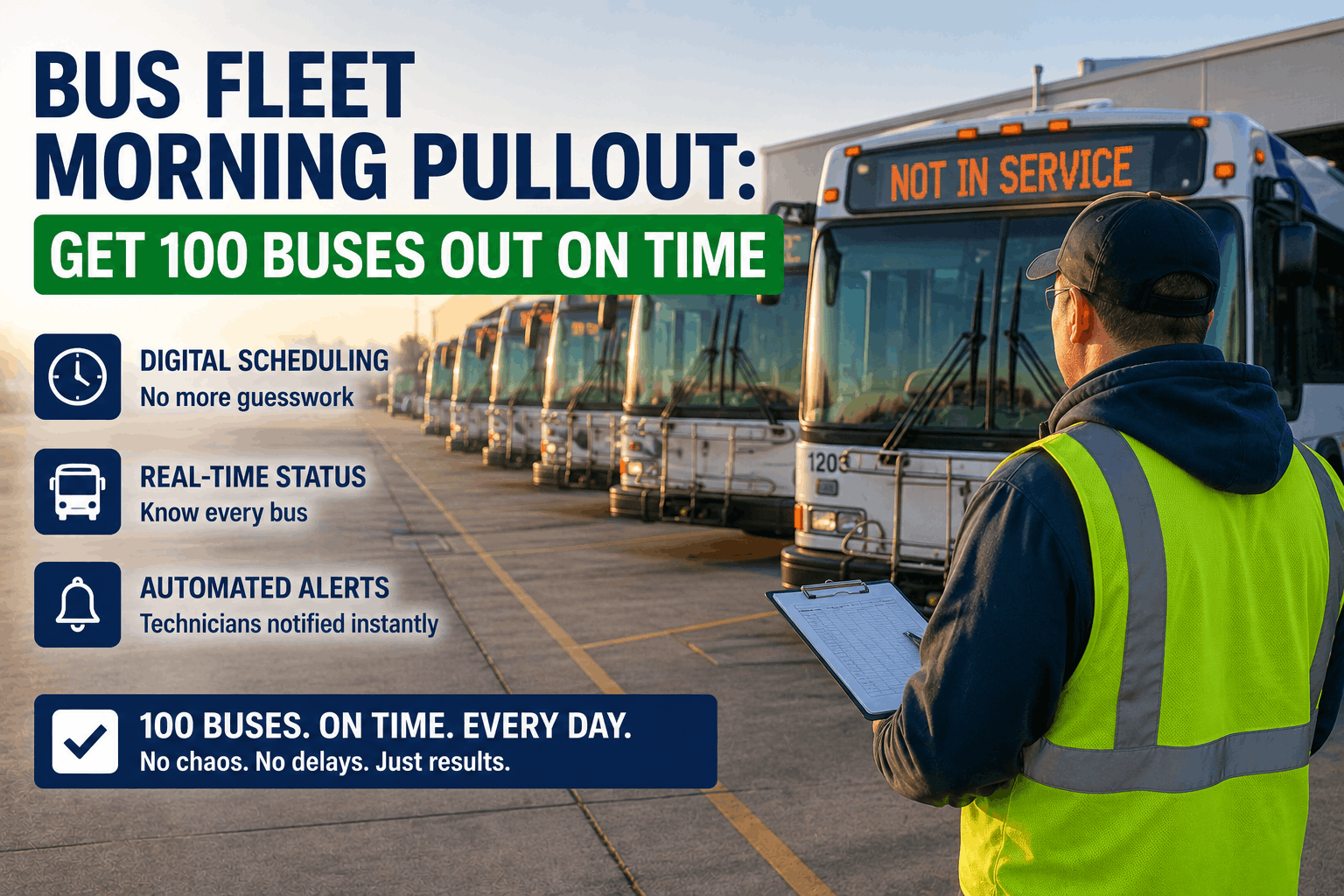
Every morning at 5:30 AM, something goes wrong at bus depots across North America. A driver calls in sick. A bus shows a warning light. Maintenance discovers a critical repair from the previous night's DVIR. Dispatchers scramble. Mechanics work frantically. Route supervisors make manual calls to reassign buses. By 6:15 AM, three routes are running 20-30 minutes late. Students miss connections. Parents call. Operations managers handle complaints before 7 AM coffee. This is the morning pullout chaos. It's the most visible failure point in fleet management. When buses don't leave on time, everyone sees it. Yet most fleets manage the morning pullout with spreadsheets, phone calls, and institutional memory. A driver knows Bus 47 always has brake issues on Tuesdays, so they grab Bus 22 instead. The maintenance coordinator keeps a mental map of which buses are in service. The dispatcher has a printed route sheet from 2003. None of this scales. Here's how digital scheduling, real-time vehicle status, and automated alerts eliminate the chaos and get 100 buses out on time, every single day.
Fleet Operations Excellence
Bus Fleet Morning Pullout: Get 100 Buses Out On Time
Morning pullout failure is the most visible fleet management failure. How digital scheduling, real-time vehicle status, and automated technician alerts get 100 buses out on time, every day, without the 5 AM chaos. A complete guide to eliminating pullout delays, optimizing vehicle readiness, and ensuring every route starts on schedule.
Why Morning Pullout Fails: The Invisible Coordination Problem
A 100-bus fleet has roughly 140 route assignments on any given morning (accounting for backup routes and special services). Each bus needs to be mechanically ready, fueled, cleaned, assigned to a driver, and dispatched to a starting location. On paper, this should take 90 minutes. In reality, it takes 2-3 hours and still runs late because coordination across maintenance, dispatch, and operations is happening manually.
The typical failure cascade: 5:45 AM — Maintenance discovers a brake issue on Bus 12 during the pre-trip walk-around. They pull the bus from service. Dispatch doesn't know yet. 5:50 AM — A maintenance technician manually calls the dispatcher to report Bus 12 is down. But the dispatcher is on another call and doesn't answer. 5:55 AM — The dispatcher calls back. They need to reassign the route. But they don't know which backup bus is ready. They pull Bus 34, which is currently being fueled. 6:05 AM — Bus 34 is ready, but its driver is on a break. Route start time was 6:00 AM. 6:10 AM — Driver for Bus 34 shows up. The reassignment is communicated via radio and verbal instruction. 6:15 AM — Route departs 15 minutes late.
This scenario repeats 3-5 times every morning in a 100-bus fleet. By 7 AM, you have cascading delays across multiple routes. Parents call schools. Schools call transportation. It's the most visible operational failure. Yet the root cause is simple: information isn't flowing between systems in real-time. Maintenance knows Bus 12 is broken, but dispatch doesn't. Dispatch doesn't know which buses are ready, so they guess.
The Morning Readiness Dashboard: Real-Time Vehicle Status for Every Bus
The solution is a single source of truth for vehicle readiness. A real-time dashboard that shows, for every bus at 5:30 AM: (1) Is this bus mechanically ready? (status from pre-trip inspection system); (2) Is this bus fueled? (status from fuel tracking); (3) Is this bus assigned to a route? (status from dispatch schedule); (4) Is this bus's assigned driver present? (status from attendance system or manual check-in). When any of these four statuses is not green, the entire fleet team knows immediately. No phone calls. No guessing.
How real-time status works: At 5:15 AM, drivers begin pre-trip inspections on their assigned buses. As they complete each pre-trip, the system marks that bus as "Pre-trip Complete" on the morning readiness dashboard. Simultaneously, the fuel system logs which buses have been fueled. The dispatch system shows which buses are assigned to which routes. At 5:30 AM, operations management opens the morning readiness dashboard and sees: 97 buses are ready (green). 2 buses show mechanical issues (red). 1 bus is not yet fueled (yellow). Immediately, the system has automatically reassigned the two broken buses to backup vehicles. Drivers for those backup vehicles have received push notifications with their new assignments. The fuel truck has received an alert that Bus 88 still needs fuel, and routes a refueling stop.
By 5:40 AM — 20 minutes before first route start — every one of the 100 buses is either confirmed ready or has an automated backup plan in place. When 6:00 AM arrives, buses depart on schedule because the system eliminated the guessing and paralysis.
Automation: From Manual Cascades to Algorithmic Reassignment
Here's where the system gets powerful. When a bus fails pre-trip inspection and is marked unavailable, the system doesn't wait for a human decision. It automatically applies reassignment logic: (1) Find all routes currently assigned to that bus; (2) For each route, identify backup buses that are ready and have compatible mechanical specifications (e.g., if the original bus is a 40-seater and the route requires 40+ capacity, don't assign a 35-seater); (3) Prioritize reassignment based on timing (routes starting soonest get first pick of backups); (4) Check driver availability and location for the backup bus; (5) Send automated notifications to the new driver with updated assignment, route details, and any special instructions.
This entire reassignment happens in 60-90 seconds. No human coordinator involved. No phone calls. The driver for the new bus receives a notification on their phone: Your assignment has changed. You are now assigned to Route 7 (instead of Route 4). Departure time: 6:00 AM. Bus 34. Starting location: Terminal B. New route manifest: attached. Departure in 45 minutes. The driver acknowledges, and they're ready to go.
What happens when there's no backup bus available? This is rare if your fleet size is right-sized, but the system handles it. It automatically escalates: (1) Alert operations management immediately that Route X cannot be covered by a ready bus; (2) Recommend specific actions: delay route 15 minutes (if 15-minute delay is acceptable), combine Route X with Route Y (if routes serve overlapping areas), or notify school/institution that Route X will start 20 minutes late. (3) Send notifications to passengers about the delay before they're stranded.
The Driver Notification System: 30-Second Communication to All Drivers
One of the worst sources of morning pullout chaos is driver confusion. A driver arrives expecting to drive Bus 12, but it's down, so they're reassigned to Bus 34. But they don't know. They wait by Bus 12. The route starts late while someone tracks them down. Digital systems solve this through automated notifications that reach every driver the moment their assignment changes.
The communication happens through multiple channels simultaneously: (1) Push notification to their mobile app (if they have the BusCMMS driver app installed); (2) SMS text message (ensuring reception even if driver doesn't have app open); (3) Dashboard alert visible when they clock in at the terminal; (4) Verbal announcement over dispatch radio (for drivers who prefer audio). No driver can claim they didn't know their assignment changed.
What the notification includes: New bus assignment (with photo of bus for visual confirmation). Updated departure time. Updated starting location. Number of passengers assigned. Any special instructions (wheelchair accessibility needs, special behavior cases, etc.). Real-time bus status (fueled, clean, pre-trip complete). Confidence score (this bus is 98% likely to complete the route without mechanical issues, based on predictive maintenance data).
Predictive Readiness: Knowing 24 Hours in Advance Which Buses Will Be Down
The most sophisticated morning pullout systems don't just react to buses that fail pre-trip. They predict which buses will likely be down and pre-position backups the night before. Here's how: At 6:00 PM the previous evening, the system analyzes yesterday's post-trip DVIRs and mechanic notes. Bus 47 had a note: "Brake fluid low, topped off, recommend replacing master cylinder next service." The system's predictive model calculates: This bus has an 87% probability of brake failure in the next 48 hours based on historical failure patterns for this component and this bus's usage. At 8:00 PM, the system automatically designates Bus 47 as tentatively unavailable for the morning and marks Bus 34 (a compatible backup) as pre-positioned. If Bus 47 does indeed fail the pre-trip in the morning, the reassignment is already decided and communicated. If it passes, great — one extra ready bus available for any other emergencies.
This predictive positioning eliminates the single biggest variable in morning pullout: unexpected mechanical failures. You're no longer surprised by a broken bus at 5:45 AM. The system saw it coming and prepared. In fleets that implement predictive readiness, morning pullout delays drop 65-80% because you're no longer managing emergencies, you're managing known situations with prepared responses.
Integration Points: Connecting to Fuel Systems, Cleaning, Dispatch Software
The morning readiness system only works if it has real-time data from every system that touches a bus before departure. This means integrations with: (1) Fuel management systems (so you know which buses are fueled); (2) Cleaning/wash bay management (so you know which buses have been cleaned); (3) Route dispatch software (so you know which routes are assigned to which buses); (4) Driver management and attendance systems (so you know which drivers are clocked in and at which location); (5) Predictive maintenance system (so you know which buses are at risk of failure); (6) IoT sensors on buses (GPS, engine temperature, fuel level, door locks, etc.) for real-time vehicle status.
If your fleet uses best-of-breed systems (separate fuel vendor, separate cleaning vendor, separate dispatch software), the integration complexity is real but manageable through APIs. Most integrations take 2-4 weeks to set up. If your fleet uses an all-in-one CMMS like BusCMMS, the integrations are already native — fuel, cleaning, dispatch, predictive maintenance, and notifications all speak the same language.
Best Practices: How Successful Fleets Manage Morning Pullout
Practice 1: Stagger Pre-Trip Inspections
Don't have all 100 drivers show up at 5:45 AM and all start pre-trips at the same time. This creates a bottleneck where everyone is rushing and the inspection system is overwhelmed. Instead, stagger driver arrivals: 5:15-5:30 AM for routes departing 6:00-6:30 AM; 5:30-5:45 AM for routes departing 6:30-7:15 AM. This spreads the load and gives maintenance better visibility into which buses are failing pre-trip and have time to source a backup.
Practice 2: Backup Bus Reserve
Maintain 8-12% of your fleet as ready backup vehicles that are not assigned to regular routes. For a 100-bus fleet, that's 8-12 buses. These buses are fueled, cleaned, and ready to deploy on any morning. They're the safety net. When Bus 47 fails pre-trip, you immediately assign the route to Backup Bus 7 instead of scrambling to find a replacement. Yes, this costs you 8-12% of capacity, but the operational reliability gain is worth 10x that cost.
Practice 3: Pre-Trip Quality Standards
Not all pre-trips are equal. A rushed 5-minute pre-trip will miss 70% of defects. A thorough 12-minute pre-trip will catch 95% of defects. Set a minimum time standard and enforce it through the system. If a driver marks a 45-item pre-trip complete in 3 minutes, the system flags it as incomplete and sends them back to actually inspect the bus. This feels harsh, but it ensures that pre-trip failures are actually mechanical failures, not inspection laziness.
Practice 4: Maintenance Preparation
Maintenance teams should review the previous day's DVIRs by 4:00 PM and begin any work needed to ensure morning readiness. If 3 buses have known issues that will likely fail pre-trip, have repair work started so they're ready by morning. This is where predictive maintenance feeds forward into morning readiness — you're not fixing the problem on the morning it causes a delay, you're fixing it the afternoon before.
Practice 5: Escalation Protocol
Define clear escalation: If 5 or more buses are unavailable at 5:50 AM, automatically trigger the contingency protocol (notify schools of likely delays, prepare to combine routes, alert senior management). This prevents the paralysis of "should we delay routes? should we call students? should we do nothing and hope?" The decision tree is pre-made.
Measuring Success: KPIs That Show On-Time Pullout Performance
KPI 1: On-Time Departure Rate Percentage of routes that depart within 5 minutes of scheduled time. Target: 98%+. Baseline for most fleets: 75-82%. Improvement with digital scheduling: +15-23 percentage points.
KPI 2: First-Route Completion Rate Percentage of first routes that complete without mechanical failure requiring mid-route reassignment. Target: 99%+. Baseline: 92-95%. Improvement with predictive readiness: +4-7 percentage points.
KPI 3: Pre-Trip Exception Rate Number of buses that fail pre-trip inspection and require reassignment as a percentage of fleet. Target: <1.5%. Baseline: 3-5%. Improvement with predictive positioning: 50-60% reduction.
KPI 4: Driver Assignment Notification Delivery Time Time from when a driver's assignment changes to when they receive the notification. Target: <90 seconds. Baseline (with phone calls): 5-8 minutes. Improvement with automated notifications: achieves target.
KPI 5: Backup Bus Utilization Efficiency How often backup buses are actually used vs. sitting idle. Target: 40-60%. Low utilization (30-40%) means you have too many backups. High utilization (70%+) means you don't have enough.
We were losing 30-45 minutes on pullout nearly every morning. Buses didn't leave on time, parents called, schools called us. We implemented a real-time readiness dashboard and automated reassignment in January. By March, we were at 98% on-time departures. Not 98% on a good morning — 98% every morning. The system knows which buses will likely fail and has backups ready the night before. When something unexpected happens, the reassignment is automatic. Drivers get notifications instantly. There's no more scrambling. The single biggest source of operational stress in my job was morning pullout. Now it's basically invisible.
Morning Pullout Questions
How much does real-time vehicle status save in operational costs?
A fleet with 30-45 minutes of daily pullout delays across 100 buses costs roughly $35K-$45K annually in missed service, driver overtime, and administrative response. Real-time status systems reduce this to <$5K annually, representing a $30K-$40K annual savings. The system investment typically pays for itself in 6-8 months.
What percentage of morning delays are actually mechanical vs. operational?
Industry data shows: 40-45% mechanical (bus failures), 30-35% driver-related (late arrival, assignment confusion, lack of accountability), 20-25% coordination/communication (dispatch doesn't know bus is ready). Digital systems address the operational 55-60% immediately. The mechanical 40-45% requires predictive maintenance to fully eliminate.
How many backup buses do we actually need for a 100-bus fleet?
8-12 backup buses (8-12% of fleet size) is the standard. This accounts for the worst-case day where 8-10 buses fail pre-trip simultaneously. Most days, you'll only need 2-3 backups. The 8-12% reserve also provides flexibility for special events and route changes. Fleets that drop below 5% backup capacity consistently experience pullout delays.
Can we implement this without disrupting current dispatch software?
Yes, modern readiness dashboards integrate with existing dispatch systems through APIs. Most implementations run parallel for 4 weeks (legacy dispatch + new readiness system) before fully switching. The integration complexity depends on your current dispatch software's API maturity. Most take 2-4 weeks to implement.
What if a driver refuses to switch to their reassigned bus?
This is rare with a good notification system because drivers understand the reasoning. If it does happen, the system logs the driver's refusal, escalates to dispatch management, and triggers backup protocols (reassign the route to a different driver, delay the route, combine with another route). Clear communication prevents most refusals.
How long does it take to see results from implementing real-time status?
Week 1: Dashboard visibility improves, but manual coordination still happens. Week 2-3: Automated reassignment kicks in, on-time performance improves 8-12%. Week 4+: Process optimization and driver accountability compounds the effect. Full maturity (98%+ on-time) typically takes 6-8 weeks with active management and process discipline.
What's the actual decision-making time when multiple buses fail pre-trip?
With manual coordination: 8-15 minutes (phone calls, finding available drivers, reassigning routes). With automated reassignment: 60-90 seconds (system identifies backup buses, notifies new drivers, route is ready). The 7-13 minute time savings means the difference between a 5-minute delay and a 20-minute delay across affected routes.