Bus #39 got an oil change last month. It's only run 2,100 miles since. Your PM schedule just fired another work order because 90 days passed. Your mechanic drained perfectly good oil — $180 in materials, 45 minutes of labor — because the calendar said so, not because the bus needed it. Multiply that across 15 low-use buses and you've wasted $2,700 this quarter on oil alone. That's not preventive maintenance. That's over-maintenance — and it's the budget leak nobody in your district is looking for.
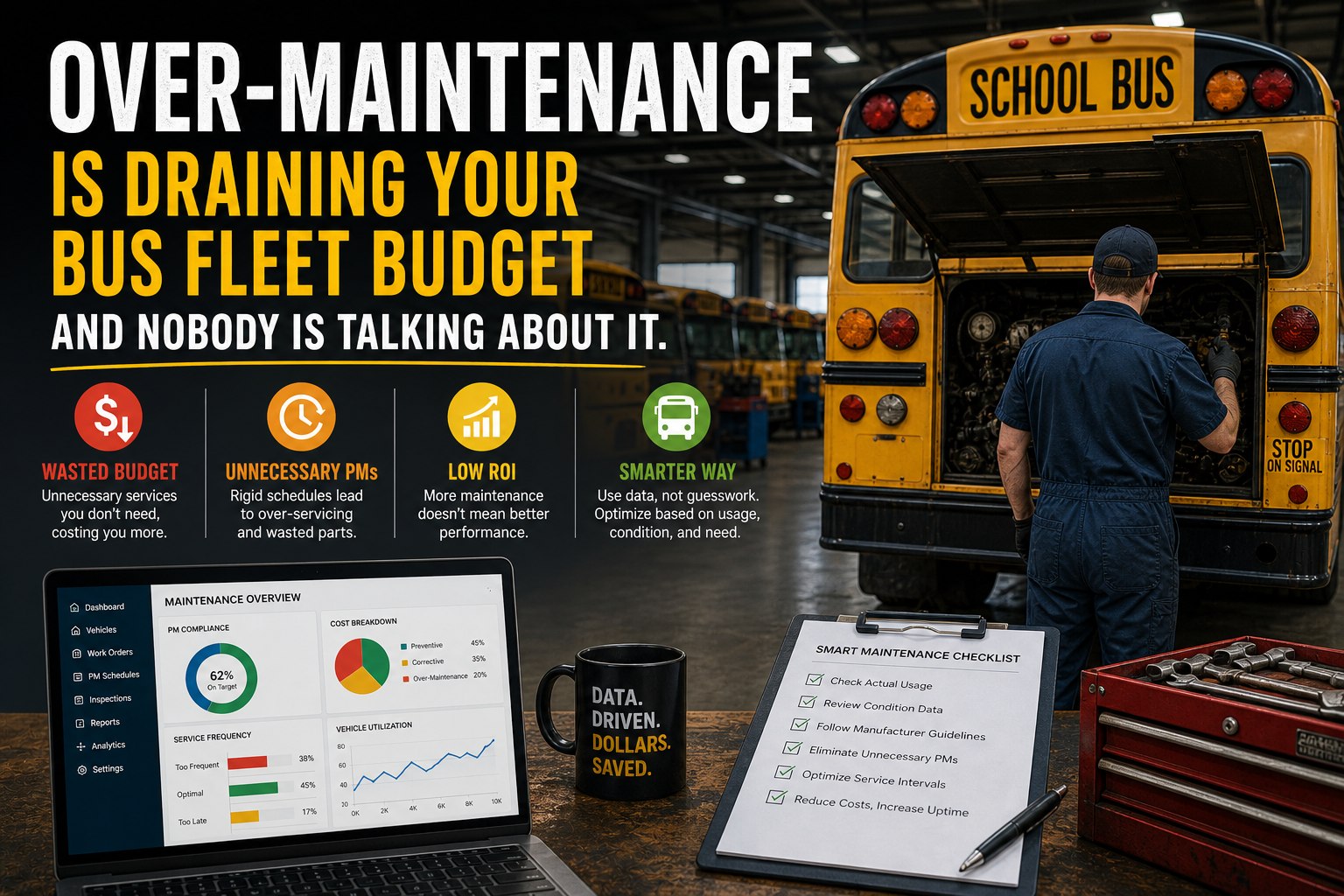
Over-Maintenance Is Draining Your Bus Fleet Budget and Nobody Is Talking About It
Rigid PM schedules waste 12–18% of your maintenance budget on services buses don't need yet. Here's how to expose it, prove it, and fix it.
Your Maintenance Budget
50-bus fleet: $28K–$48K/yr wasted on services that aren't due
The Exposé: 3 Ways Over-Maintenance Hides in Plain Sight
Under-maintenance is visible — breakdowns, angry parents, DOT violations. Over-maintenance is invisible — the budget just "costs what it costs" and nobody questions whether every service was necessary. Here's where it hides:
What Happened
Bus #39 runs 8,000 miles/year. Bus #12 runs 22,000. Both get oil changes every 90 days. Bus #39 has barely broken in the oil.
The Math
The Calendar Trap
What Happened
PM says "replace brake pads at 30,000 miles." Bus runs flat suburban routes — pads still have 40% life at 30K. You threw away parts with thousands of miles left.
The Math
The Mileage Myth
What Happened
Your mechanic spends 45 min per unnecessary PM. Good oil drained, clean filters swapped, nothing worn replaced. Work order filed. Nothing improved.
The Math
The Labor Drain
Combined, these three leaks cost a 50-bus fleet $28,000–$48,000/year. Not from negligence. From a PM schedule that treats every bus the same — regardless of whether it ran 2,100 miles or 12,000 since the last service.
BusCMMS exposes this waste in the first 30 days. The system tracks actual mileage per bus and shows you which buses are being serviced before they need it. You see "Bus #39: oil changed at 2,100 miles vs 5,000 mile trigger" and immediately know you over-serviced it. That visibility is the difference between a PM program that costs what it should and one that costs 18% too much.
See which buses are being over-serviced — bring your fleet data to a demo
The Diagnostic: Does Your Fleet Have This Problem?
Check off the symptoms. If 3 or more describe your operation, you're over-maintaining.
Show us your PM schedule — we'll show you where it's over-servicing. Book a demo.
The Fix: Multi-Trigger PM That Matches Each Bus's Reality
The solution isn't less maintenance. It's the right maintenance at the right time for each individual bus. Here's how BusCMMS does it:
Bus #39 — Low Use (8,000 mi/yr)
Bus #12 — High Use (22,000 mi/yr)
Same fleet. Same day. Two completely different PM decisions — both correct. The low-use bus doesn't get unnecessary service. The high-use bus gets serviced before the calendar would have caught it. That's multi-trigger PM. That's what right-sized maintenance looks like.
See multi-trigger PM running on a real fleet — book a 20-min demo
"We ran a 90-day calendar PM for 12 years. When we switched to BusCMMS multi-trigger scheduling, we found 22 of our 55 buses were getting oil changes 30–45 days too early because they barely ran over summer. First year savings: $41,000 in unnecessary services — and zero increase in breakdowns. Same fleet health, significantly less spending."
Stop draining your budget on maintenance that isn't due — sign up free
The industry spent 20 years saying "you're not doing enough PM." That worked — most fleets now take PM seriously. But the pendulum swung too far. I audit fleet PM programs regularly, and 60–70% have at least 15% over-maintenance — services too early, on buses that didn't need them, because the schedule is rigid and usage-blind.
The fix isn't less maintenance — it's smarter maintenance. A bus running 8,000 miles a year and one running 22,000 shouldn't share PM intervals. BusCMMS makes multi-trigger scheduling the default. That one feature saves most fleets 12–18% in year one.
Over-maintenance costs the average 50-bus fleet $28,000–$48,000/year. It persists because nobody gets fired for doing too much — and because most systems default to rigid calendar scheduling. BusCMMS multi-trigger PM fires work orders based on actual mileage, calendar, and engine hours per bus. Low-use buses get longer intervals. High-use buses get serviced when the data says so. Same reliability. 12–18% less spending. The difference is knowing which buses need service now — and which can wait.
Bring your PM schedule to the demo — we'll find the waste together