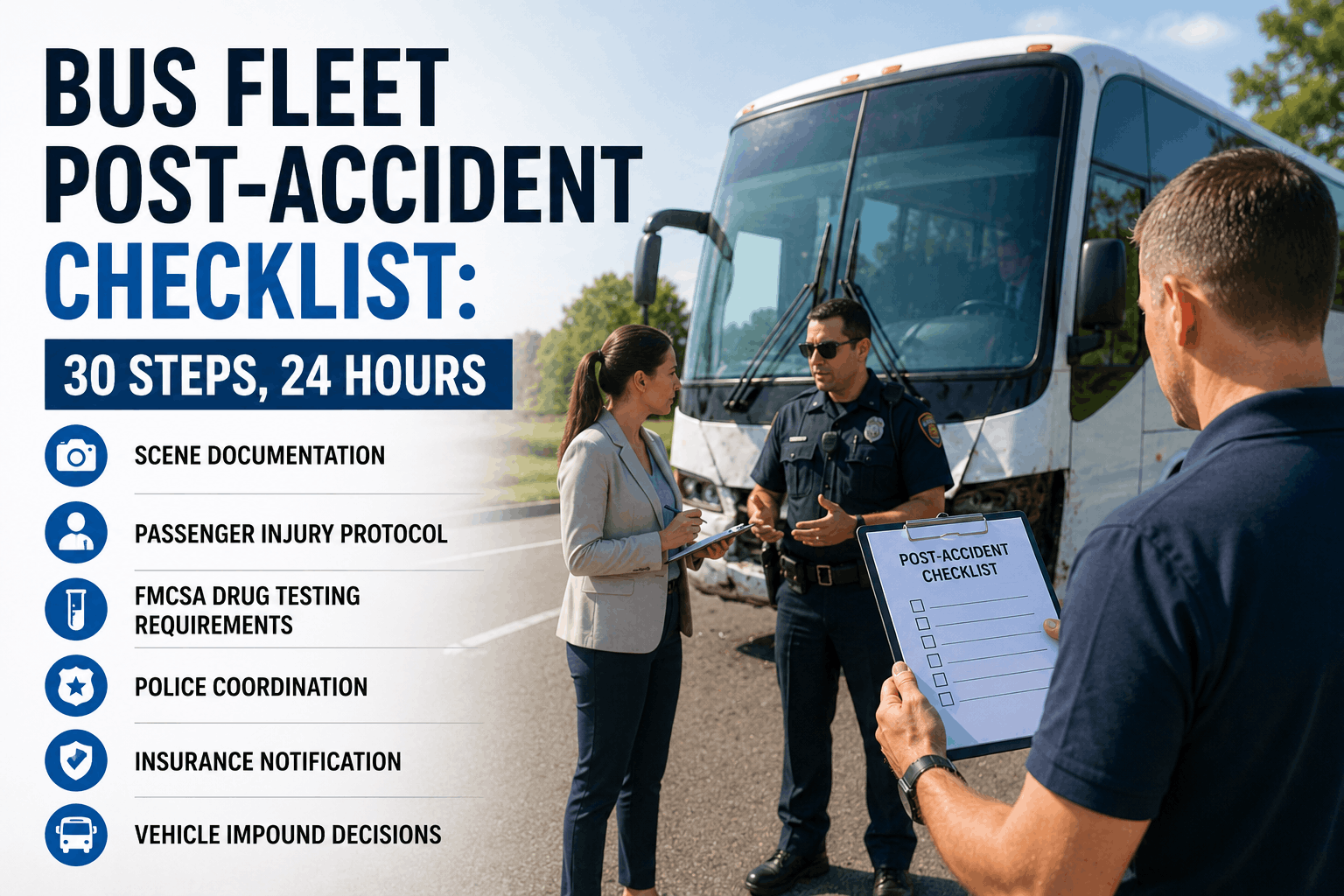
Bus Fleet Post-Accident Checklist: 30 Steps, 24 Hour
At 7:43 AM, Bus 22 rear-ended a sedan at an intersection. Driver walked around to check damage, called dispatch, and waited for police. Nobody documented the passenger count. Nobody photographed the road surface before the tow truck moved the vehicles. Nobody called the collection site for drug testing until 11:15 AM -- 3 hours and 32 minutes after impact. The alcohol test missed the 2-hour documentation window. The drug test was collected at hour 33, one hour past the 32-hour hard cutoff. Two required tests became two FMCSA violations. The lawsuit that followed cited the missing passenger documentation as evidence the carrier did not know who was on the bus. All of this was avoidable. Not with better drivers or faster supervisors -- with a documented 30-step checklist that every person in the response chain follows in sequence. This page gives you that checklist: 30 steps, organized across the first 24 hours, with every FMCSA deadline built in.
Incident Reporting -- BusCMMS 2026
Bus Fleet Post-Accident Checklist: 30 Steps, 24 Hours
Scene documentation. FMCSA drug testing. Passenger records. Insurer notification. Vehicle impound decision. Every step, every deadline, in sequence -- from impact to 24-hour close-out.
30 steps. 4 phases. Every FMCSA deadline built in.
Run This Checklist in BusCMMS -- Every Step Timestamped Automatically
BusCMMS Incident Reporting structures all 30 steps as a guided mobile workflow. Drivers and supervisors complete each phase on their phones. Every action gets a timestamp and GPS location. FMCSA accident register auto-populates from field data. Documentation that used to take hours completes in minutes.
Bus fleets that rely on paper incident reports and verbal communication chains fail for 4 structural reasons -- none of them related to driver competence. These are design failures in the response system itself.
No Sequence Enforcement
Paper: Steps happen in whatever order the dispatcher remembers. Critical testing initiation gets delayed while lower-priority tasks are completed first.
Smart: BusCMMS presents steps in mandatory sequence. Testing trigger determination appears before documentation tasks -- because it has the shortest deadline.
No Deadline Visibility
Paper: Nobody on scene knows the 2-hour alcohol documentation window is running. It misses because nobody was watching it.
Smart: BusCMMS shows elapsed time from incident first report. Testing deadline alerts appear at 90 minutes and 7 hours. The clock is visible to everyone in the response chain.
No Photo Timestamps
Paper: Photos taken on a personal phone. No GPS. No timestamp in metadata. Defense attorneys challenge photo timing and authenticity routinely.
Smart: BusCMMS photo capture embeds GPS coordinates and ISO timestamp from the incident report creation. Every photo is linked to the incident record, timestamped, and unalterable.
No Supervisor Visibility
Paper: Supervisor learns what happened from a phone call. No visibility into which steps are complete, which are outstanding, or whether testing has been initiated.
Smart: BusCMMS sends the supervisor a real-time incident dashboard the moment a report opens. Each completed step updates live. Outstanding steps show with elapsed time.
The 30-Step Post-Accident Checklist
Complete every step in sequence. Steps within each phase can run in parallel where noted, but phases cannot be skipped. All steps with a deadline note carry a federal or legal compliance requirement -- missing them creates regulatory exposure independent of the accident itself. Run this checklist digitally in BusCMMS and every step gets an automatic timestamp from the moment of first report.
PHASE 1: 0 -- 15 MINUTESImmediate Scene Response
Steps 1 -- 8
PHASE 2: 15 -- 60 MINUTESTesting, Notifications, and Evidence Collection
Steps 9 -- 16
Paper Incident Reports Miss Deadlines. BusCMMS Catches Every One.
The 2-hour alcohol documentation window, 8-hour test deadline, and 32-hour drug collection deadline are all visible in BusCMMS from the moment the incident report opens. No more missed deadlines because nobody was watching the clock.
PHASE 3: 1 -- 4 HOURSInvestigation Records and Insurer Coordination
Steps 17 -- 24
PHASE 4: 4 -- 24 HOURSCompliance Documentation and 24-Hour Close-Out
Steps 25 -- 30
Paper Process vs BusCMMS Digital: Post-Accident Documentation
The difference between a paper incident response and BusCMMS is not speed -- it is completeness, timestamp integrity, and deadline visibility. Here is how the two approaches compare across every critical element of a post-accident response.
Documentation Element
Paper Process
BusCMMS Digital
Scene photo evidence
Personal phone photos, no GPS, no timestamp in record
Photos with GPS coordinates + ISO timestamp, linked to incident record permanently
FMCSA testing trigger
Determined by memory and phone calls; often delayed
Built-in decision tree -- 3 triggers shown with yes/no prompts, determination documented with timestamp
Testing deadline visibility
Nobody tracking; 2-hour and 8-hour windows routinely missed
Elapsed time shown from incident first report; alerts at 90 minutes and 7 hours
Passenger documentation
Handwritten list, often incomplete; lost or damaged
Digital form, complete fields required, stored permanently and searchable
FMCSA accident register
Manual entry from memory, often done days later, error-prone
Auto-populated from incident report field data; no transcription, no errors
Supervisor visibility
Phone calls; supervisor does not know what steps are done
Real-time dashboard from moment report opens; each step shows complete/outstanding
Insurance notification record
Phone call with no documentation of what was said or when
Notification logged with timestamp, contact name, and claim number in incident record
Witness information
Handwritten cards, easily lost; not linked to incident
Digital entry linked to incident; searchable by name, date, or incident number
ELD/telematics preservation
Frequently forgotten until data has overwritten
ELD preservation reminder appears in checklist workflow within first 60 minutes
FMCSA audit readiness
45-minute filing cabinet search; incomplete records common
Complete incident record exported in under 60 seconds for any audit request
Critical Deadline Timeline: First 32 Hours
The FMCSA post-accident testing requirements in 49 CFR 382.303 create three overlapping deadline windows that must be managed simultaneously. Missing any one of them creates regulatory exposure independent of the accident. The chart below shows all three deadlines and the documentation required at each threshold.
FMCSA Post-Accident Deadline Tracker
Alcohol test -- begin ASAP
Now
Clock starts at impact -- no waiting
2-hour alcohol doc threshold
2 hrs
Document delay reason if not complete
8-hour alcohol hard stop
8 hrs
Cease attempts + document -- hard FMCSA deadline
Internal review complete
24 hrs
All 30 steps complete, corrective actions scheduled
32-hour drug collection hard stop
32 hrs
Cease attempts + document -- hard FMCSA deadline
Source: 49 CFR 382.303 (eCFR confirmed). 3-year accident register retention per 49 CFR 390.15. 5-year test record retention per 49 CFR 382.401.
What Changed When This Fleet Digitized Their Incident Response
"Before BusCMMS, we had two FMCSA findings in the same audit cycle -- both for missing post-accident testing documentation. Not failed tests. Missing documentation. The tests were done but the paperwork was incomplete, the timestamps were wrong, and one delay reason memo was never filed. After building the 30-step incident workflow in BusCMMS, we had an incident 8 months later. The alcohol test was done in 94 minutes. The drug test was collected at hour 6. Every step was timestamped. When FMCSA pulled our records 14 months later, the reviewer said our incident documentation was the most complete she had seen in a peer review. We went from two findings to zero."
Fleet Safety Director, regional bus operation (BusCMMS customer)
How Post-Accident Documentation Influences Fleet Operations
Every gap in post-accident documentation has a downstream consequence beyond the immediate incident. Incomplete records create compounding risk across multiple dimensions of fleet operations.
CSA Score Impact
Accidents with missing documentation receive less favorable treatment in FMCSA's CSA Crash Indicator BASIC than properly documented ones. Preventability determination submissions require complete incident documentation -- missing records eliminate this option entirely.
Insurance Premium Effects
Insurers review incident documentation quality during renewal. Fleets with complete, timestamped digital incident records demonstrate lower risk than those relying on incomplete paper files. Documentation quality is a measurable underwriting factor for commercial fleet policies.
Litigation Defense
A missing post-accident test, absent passenger list, or unobtained witness statement becomes a plaintiff attorney's tool in civil litigation. Complete documentation is your defense. Gaps in your record are characterizations of your negligence in a courtroom.
Safety Culture Signal
Fleets with structured incident response protocols have measurably lower repeat incident rates. The discipline of following a 30-step process signals to every driver and supervisor that incidents are taken seriously -- and changes behavior before the next one occurs.
Frequently Asked Questions: Bus Post-Accident Checklist 2026
What are the FMCSA post-accident drug and alcohol testing deadlines?
Under 49 CFR 382.303, alcohol testing must be completed as soon as practicable; if not done within 2 hours, document the reason and continue trying; if not done within 8 hours, stop and document. Drug testing must be collected within 32 hours -- after which, cease attempts and document. Sign up and BusCMMS tracks all three deadlines automatically from first incident report.
What triggers FMCSA post-accident testing on a bus incident?
Three triggers: any fatality (testing required regardless of citation), medical treatment away from scene plus driver citation, or vehicle towed plus driver citation. The employer makes the trigger determination and must document it with a timestamp. BusCMMS presents all three triggers as a guided yes/no decision tree within the incident report.
Does a police breathalyzer test satisfy the FMCSA requirement?
No. Law enforcement testing is a separate legal process and does not satisfy 49 CFR 382.303. Even if police administer a breath test at the scene, the employer must still arrange a DOT-compliant test through their approved collection program within the required timeframes. Book a demo to see how BusCMMS structures testing coordination in the incident workflow.
How long must post-accident records be retained?
FMCSA accident registers must be retained 3 years per 49 CFR 390.15. Post-accident test records must be retained 5 years per 49 CFR 382.401. Documentation of missed testing attempts must also be maintained and produced upon FMCSA request. BusCMMS retains all incident documentation beyond these minimums with one-click export.
When should legal counsel be notified after a bus accident?
Immediately if the incident involves a fatality or any serious injury (head, spine, fracture, or loss of consciousness). Legal counsel should be in the loop before the driver or supervisor makes additional statements to third parties. Attorney-client privilege applies to communications made in anticipation of litigation.
What is the FMCSA accident register and who must maintain it?
Under 49 CFR 390.15, every FMCSA-regulated motor carrier must maintain an accident register for 3 years recording: date, location, driver name, injuries, fatalities, and hazmat involvement. It is the first document FMCSA auditors request during a compliance review. BusCMMS auto-populates the register from incident field data -- no manual entry required.
What should be documented if a vehicle must be impounded?
Document: the impound authority (police agency or name), impound facility name, address and contact number, date and time of impound, reason stated for impound, and contact person at the facility. If evidence data (dashcam, ELD) is inside the vehicle, request access through proper legal channels before the data overwrites or the vehicle is released for repair.
How does BusCMMS help with post-accident documentation compliance?
BusCMMS Incident Reporting provides a guided 30-step mobile workflow with automatic timestamps, GPS photo capture, FMCSA testing trigger determination, real-time supervisor notification, testing deadline alerts, FMCSA accident register auto-population, and 5-year record retention. Sign up free and have your incident response workflow live in under 30 minutes.
Every Step Timestamped. Every Deadline Tracked. Every Record Audit-Ready.
BusCMMS Incident Reporting structures all 30 steps of this checklist as a guided mobile workflow -- for drivers and supervisors. FMCSA testing triggers determined automatically. Accident register auto-populated. Documentation retained 5 years. Complete incident record exported in 60 seconds for any audit or litigation request.
The Checklist That Runs Itself. The Documentation That Protects Your Fleet.
30 steps. 4 phases. Every FMCSA deadline tracked automatically. Complete in BusCMMS before you leave the scene. Available from day one -- no setup required.