A used Type C school bus looks great in the photos. The seller says "runs perfect." The price is $15,000 under budget. Then your mechanic finds a cracked frame rail, a transmission that slips in third and brake drums worn past limits. Suddenly that $15,000 savings is a $22,000 repair bill. This 75-point checklist is what your mechanic walks through before you sign anything.
Pre-Purchase Guide 2026
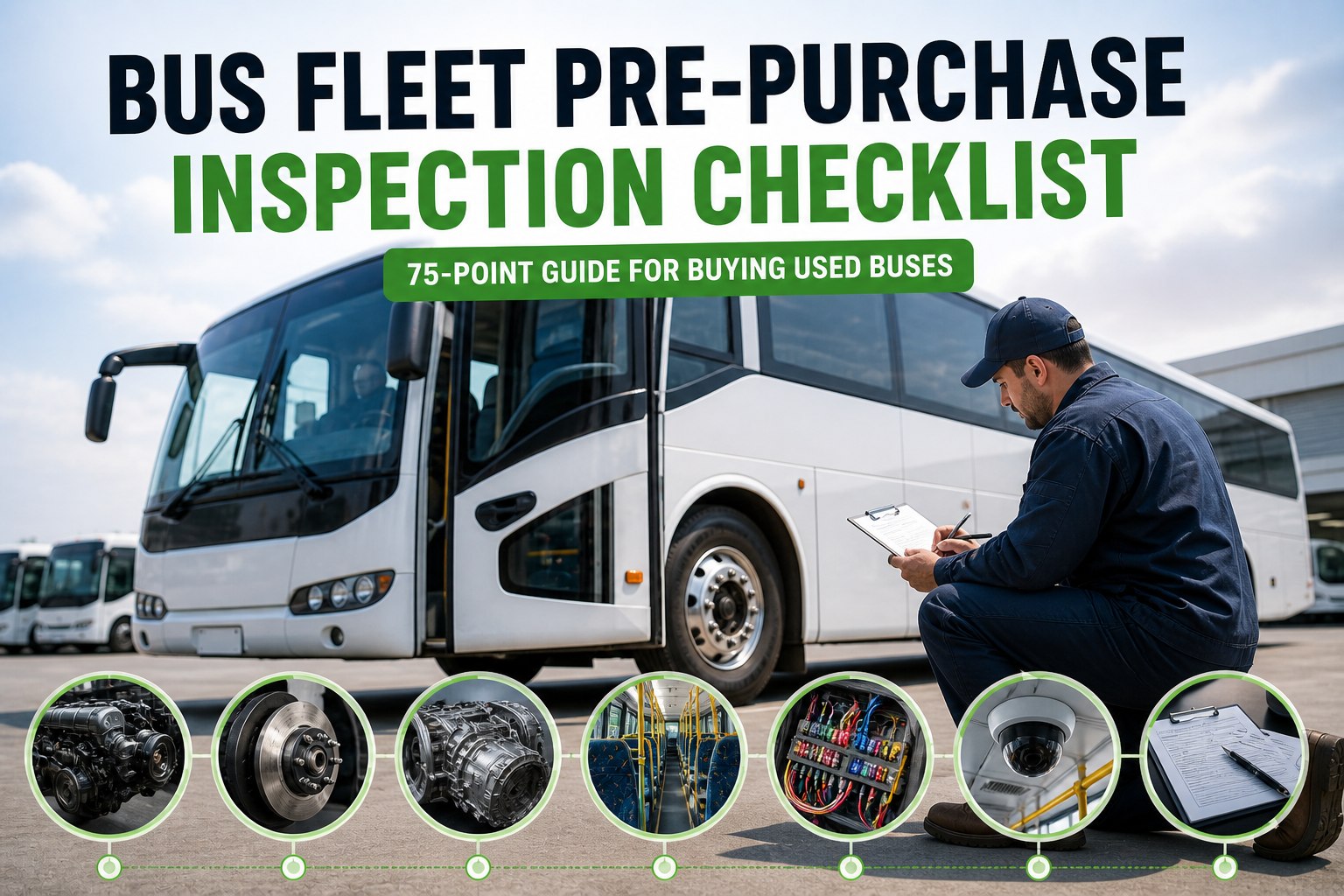
Bus Fleet Pre-Purchase Inspection Checklist: 75-Point Guide for Buying Used Buses
Engine, transmission, brakes, body, electrical, interior, road test, and records -- every item your mechanic checks before you buy.
75-Point Inspection
01
5 Deal-Breakers -- Check These First
Before you spend 2 hours under the bus, check these five. If any fail, walk away.
1
VIN Mismatch
Dashboard, door jamb, and title must match. Mismatch = theft, salvage, or parts bus.
2
Cracked Frame Rail
Any crack, weld repair, or rust-through on frame rails. Repair: $8,000-$15,000+.
3
White/Blue Exhaust Smoke
White = coolant in cylinders. Blue = burning oil. Major engine work: $4,000-$12,000.
4
Transmission Slippage
Any delay over 2 seconds or hard clunk P to D = internal damage. Rebuild: $3,500-$7,000.
5
No Maintenance Records
Zero service history = zero accountability. If the seller cannot show records, walk.
02
The Complete 75-Point Checklist
Click each checkbox as your mechanic inspects. Every unchecked item is a question you need answered before signing.
15
Engine & Drivetrain
Start cold -- watch for smoke, listen for knocks
12
Brakes & Steering
#1 cause of out-of-service orders at roadside
Get this as a guided digital inspection on your phone -- sign up free
10
Body & Frame
Rust kills buses -- check every panel and the floor
10
Electrical & Lights
12% of OOS orders are lighting violations
12
Interior & Safety Equipment
Emergency exits need separate 90-day inspections
See how failed items auto-generate work orders -- book a 20-min demo
8
Road Test
Minimum 20 minutes -- include highway and hills
8
Records & Compliance History
The paperwork is as important as the metal
Track every bus from pre-purchase through retirement -- sign up free
You Inspect It Once. You Track It Forever.
The pre-purchase checklist gets the bus into your fleet. BusCMMS keeps it there -- PM schedules, digital DVIRs, work orders, per-bus cost tracking, and compliance documentation from day one through retirement.
03
Turning Defects Into Negotiation Leverage
Every defect you find is money off the price -- or a reason to walk. Here is what common findings cost to fix:
Brake reline (all wheels)
$1,800-$3,200
Transmission rebuild
$3,500-$7,000
DPF replacement
$2,500-$5,000
Full tire set (6)
$2,400-$4,200
AC system repair
$800-$2,500
Seat replacement (10)
$1,500-$3,000
Body rust repair
$1,200-$4,000
Electrical harness repair
$600-$2,000
Fleet Expert Review
I have bought and inspected over 200 used buses in 15 years. The single best predictor of a good purchase is not mileage or age -- it is maintenance records. A 2012 bus with 180,000 miles and complete service history is almost always a better buy than a 2016 with 90,000 miles and no records. Records prove somebody cared.
The second thing: scan for fault codes before starting the engine. Sellers clear codes before showing the bus. But stored codes tell you what broke before -- and what is likely to break again. A bus with 47 stored codes and "zero problems" is a bus whose seller is lying.
The Bottom Line
A used bus is a $20,000-$80,000 decision that will either save your district money or drain it for 10 years. This 75-point checklist covers every system that determines which outcome you get. Once you buy it, BusCMMS tracks it -- PM schedules, inspections, work orders, cost tracking, and DOT compliance -- from purchase day through retirement.
Smart Buying Starts With Data. Smart Ownership Starts With BusCMMS.
From pre-purchase inspection to daily DVIRs to annual DOT compliance -- one platform tracks every bus for its entire lifecycle.
Frequently Asked Questions
How long does a 75-point pre-purchase inspection take?
A complete inspection takes 2-3 hours including the road test. The 5-minute deal-breaker check can be done first -- if any fail, you save the remaining time. Budget a full morning for each bus you are seriously considering.
Should I hire a mechanic or inspect myself?
Always use a qualified mechanic for pre-purchase -- ideally one who works on buses daily. The deal-breaker check and walk-around can be done by any fleet manager, but brake measurements, air system tests, and fault code scans require tools and experience. A professional inspection costs $200-$400 and can save you $5,000-$20,000.
What is the most important thing to check?
Maintenance records. A bus with complete service history tells you everything: was it maintained on schedule, what has been replaced, what is coming due. After records: frame for cracks, brakes (most common OOS item), and stored fault codes.
How do I verify the odometer was not rolled back?
Compare title mileage to ECM (engine control module) reading -- they should be within 5%. Pull a vehicle history report by VIN. Check maintenance records for logged mileage at service dates. BusCMMS tracks mileage from day one so your fleet never has this ambiguity.
What should I do immediately after buying?
Five things on day one: complete a full annual DOT inspection, change all fluids, scan and clear fault codes, set up the bus in your CMMS with baseline data, and schedule its first PM service. BusCMMS lets you add a bus and set up PM schedules in under 10 minutes.