An OSHA officer walks into your bay and asks two things: can I see your 300A summary, and when was that lift last inspected? If either answer is a shrug, that is a problem clean records would have prevented. Bus maintenance shop safety is two jobs at once — keeping the shop physically safe, and keeping the paperwork that proves it. You can see shop inspections and corrective work documented in a demo.
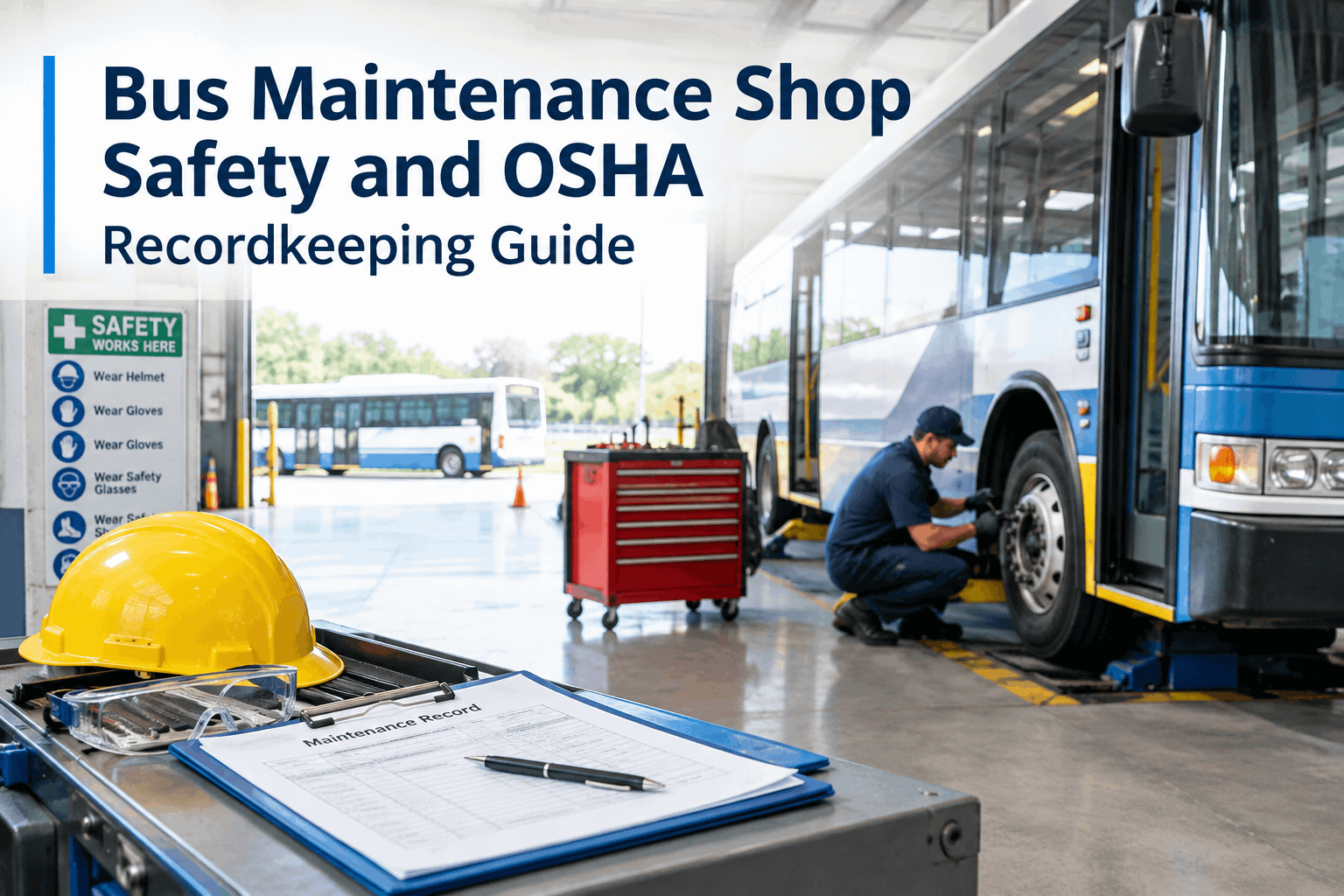
Bus Maintenance Shop Safety and OSHA Recordkeeping Guide
A bus maintenance shop is one of the more hazardous workplaces a fleet runs — lifts, chemicals, high voltage, heavy parts. Keeping it safe is half the job; documenting that you did is the other half. Here is how both fit together.
A safe shop
Hazards controlled and equipment inspected — lifts and jacks rated and checked, lockout/tagout followed, chemicals stored right, PPE worn. The work itself is done safely.
A documented shop
The proof it is safe — OSHA injury and illness records kept and posted on schedule, equipment inspections logged, and corrective work tracked to a close. If asked, you can show it.
Most shops are strong on one pillar and weak on the other. A compliant shop needs both, and the records are usually the gap.
Why Bus Shop Safety Is Both a Practice and a Paper Trail
A bus maintenance shop concentrates risk: a tech under a 15,000-pound bus on a lift, high-voltage systems on electric buses, solvents and fuel, pressurized air, heavy wheels and batteries. Doing that work safely is the first obligation. But OSHA does not just want a safe shop — it wants to see the records that prove you run one. An injury with no documentation, or a lift with no inspection history, reads to a compliance officer as a program that exists on hope rather than process.
In an OSHA review, an undocumented safe shop and an unsafe one look the same — the records are what tell them apart, and what protect you.
Closing that documentation gap is where a maintenance system helps most — you can walk through how shop equipment and corrective work stay on record in a demo.
The Hazards a Bus Maintenance Shop Has to Control
Shop safety starts with naming the hazards and having a control for each. A bus garage carries a specific set — here are the big ones and what keeping them in check looks like.
Lifts, jacks, and hoists
Rated for the load, inspected on a schedule, and never improvised. A lift failure under a bus is catastrophic — inspection history is non-negotiable.
Electrical and high voltage
Shop wiring, tools, and — on electric buses — lethal high-voltage systems that only qualified techs touch, with lockout/tagout before any work.
Chemicals and fluids
Fuel, coolant, solvents, and used oil stored, labeled, and disposed of correctly, with safety data sheets on hand and spill response ready.
Lockout / tagout
Energy sources — electrical, hydraulic, pneumatic — isolated and tagged before a tech works on a system that could move or energize.
PPE and fire safety
Eye, hand, and respiratory protection available and used, extinguishers charged and inspected, and exits and aisles kept clear.
Compressed air and tires
Air systems maintained and tire work done with cages or restraints — a bus tire at pressure is a serious energy hazard if it lets go.
Every one of these has a maintenance side — the lift that needs its annual inspection, the extinguisher on a check cycle, the fume system that needs service. Those belong on a preventive schedule just like the buses, which you can see scheduled for shop equipment in a demo or set up free yourself.
OSHA Recordkeeping: the Forms Every Shop Has to Know
If your shop has more than ten employees and is not in a low-hazard industry — and a bus garage is not — OSHA injury and illness recordkeeping under 29 CFR 1904 applies. It comes down to three forms and a calendar.
Swipe sideways to see all columns
Keep these records for five years, and be ready to share them with employees or an OSHA representative on request. This is a plain-language overview, not legal advice — confirm the specifics for your operation with OSHA or your safety advisor. Book a demo to see how corrective-work records organize alongside your safety program.
Is an Injury Recordable? The OSHA Decision
Not every cut or bruise goes on the 300 log. OSHA has a clear test, and knowing it keeps you from both under-recording (a violation) and over-recording. The decision runs through two gates.
The 300 criteria include death, days away from work, restricted or transferred work, medical treatment beyond first aid, loss of consciousness, or a significant diagnosis. First aid alone does not make it recordable — but it should still be addressed. Start free and keep the corrective-action side documented.
Where Maintenance Records Fit Your Shop Safety Program
Be clear on the line here: BusCMMS is a maintenance system, not an OSHA injury-log tool — your 300, 300A, and 301 forms are their own process. What a maintenance system does is own the equipment-and-corrective-work half of shop safety, which is a big part of what an auditor asks to see.
Shop equipment on a PM schedule
Lifts, hoists, extinguishers, and fume systems get scheduled inspections with a logged history — the record an inspector asks for first.
Hazards become corrective work orders
A found problem — a frayed cord, a leaking jack — becomes a tracked work order with an owner, so it is fixed and closed, not forgotten.
A clean, searchable record trail
Every inspection and corrective action logged and exportable, so your maintenance documentation supports the safety program instead of living in a binder.
Pair that with your OSHA recordkeeping and your shop is safe and provably so. You can book a demo and see shop-equipment inspections and corrective records in one place.
The Shop Safety and Recordkeeping Checklist
Run this against your bus maintenance shop. The safety items keep people whole; the recordkeeping items keep you compliant — and an inspector will ask about both.
- Lifts, jacks, and hoists inspected on scheduleEach lifting device is rated, inspected on its interval, and has a logged inspection history.SAFETY
- Lockout/tagout and PPE in daily useEnergy isolation before work, and eye, hand, and respiratory protection worn, not just available.SAFETY
- Chemicals labeled, stored, and SDS on handFuel, solvents, and used fluids handled right, with safety data sheets accessible to techs.SAFETY
- OSHA 300 log kept currentEvery recordable work-related injury and illness logged as it happens, not reconstructed at year-end.RECORDS
- 300A summary certified and posted Feb 1–Apr 30The annual summary reviewed, signed by a company executive, and posted where employees can see it.RECORDS
- Equipment-inspection records kept five yearsShop-equipment inspection and corrective-work history retained and retrievable, alongside your OSHA forms.RECORDS
The safety items are the shop foreman's daily job; the records are what make that job provable when it counts. Start free and keep the maintenance-records half organized.
A Shop Supervisor's Take
We had a safe shop — I knew it, my techs knew it. Then we had an OSHA visit and the officer asked for lift inspection records, and I had a drawer of paper I had to dig through for an hour. Nothing was wrong, but it looked disorganized, and that is its own problem. Now every lift and hoist is on an inspection schedule in the system, hazards I find become work orders, and when someone asks for proof it is a report, not a dig. The shop was always safe. Now I can show it in five minutes.
Key Takeaways on Bus Maintenance Shop Safety
Safety is practice plus proof
A safe shop and a documented shop are two jobs — and the records are usually the gap.
Know the three OSHA forms
301 incident report, 300 log, 300A summary — posted Feb 1 to Apr 30, kept five years.
Recordable has a clear test
Work-related plus a 300 criterion — first aid alone does not make it recordable.
Maintenance records back it up
Equipment inspections and corrective work orders are the half a CMMS keeps audit-ready.
Treat bus maintenance shop safety as both a daily practice and a documented one — hazards controlled, equipment inspected, OSHA records current, and corrective work tracked — and an inspection becomes a formality instead of a scramble. A safe shop you cannot prove is a risk you are still carrying.