Last July, Bus #22 overheated on Route 7 with 44 students onboard — 97°F outside, AC compressor seized, and the coolant hose that had been seeping since May finally let go. The driver pulled into a gas station parking lot. 44 kids sat in a bus with no AC and rising cabin temps for 90 minutes waiting for a substitute. The repair bill: $4,200 for the head gasket. The AC compressor: $1,800. The coolant hose that started it all: $45. Total avoidable cost: $6,045. Overheating is the #1 cause of summer bus breakdowns. A failed AC system is the #1 summer service call. Both are preventable with a pre-summer inspection that takes 2 hours per bus. Here's the complete summer prep checklist — 6 systems, 35 inspection items, and the schedule that gets your fleet through August without a single heat-related breakdown.
Summer 2026 Fleet Prep
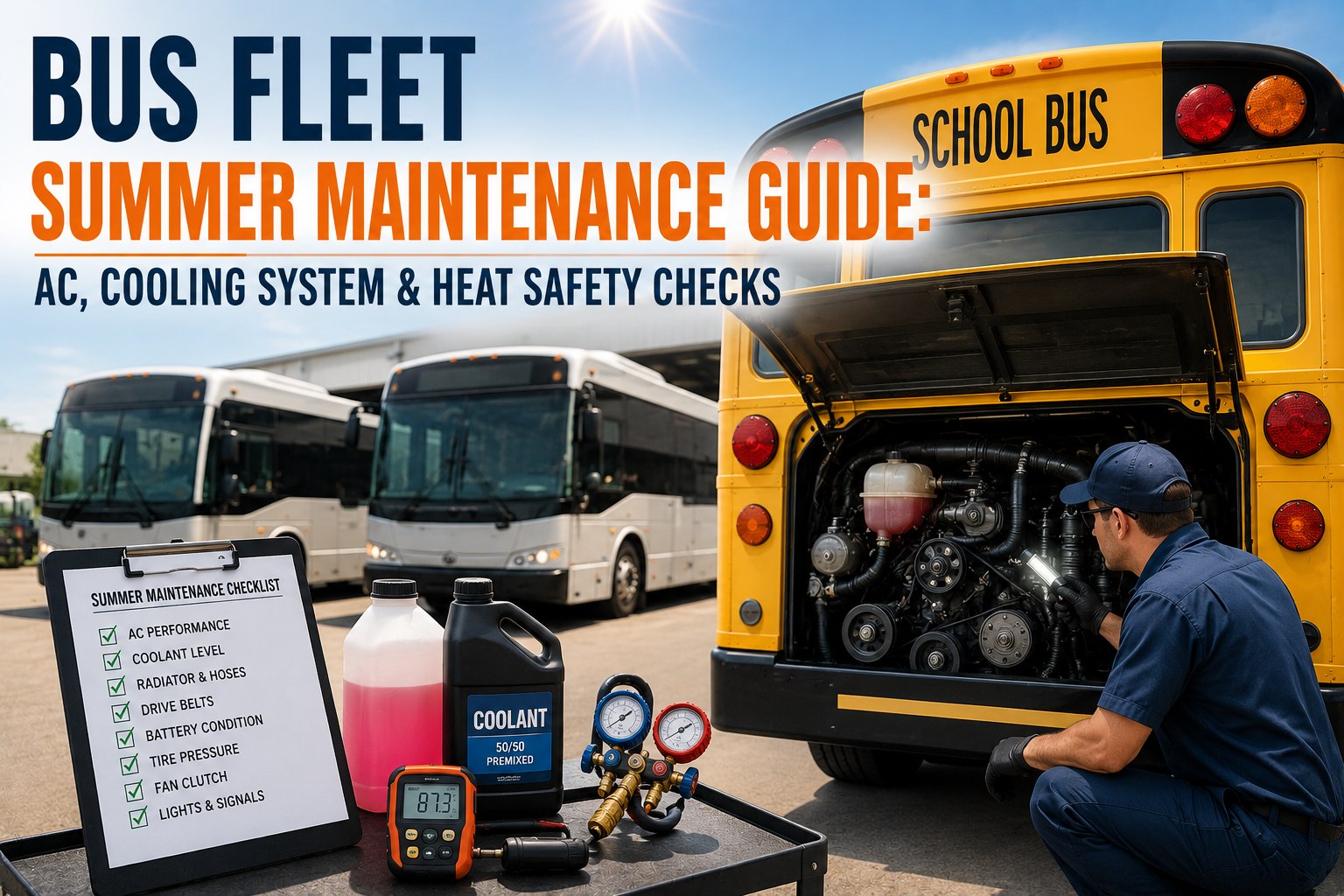
Bus Fleet Summer Maintenance Guide: AC, Cooling System & Heat Safety Checks
6 heat-critical systems. 35 inspection items. The pre-summer checklist that prevents the $6,000 breakdown on the hottest day of the year.
Summer Heat Damage Cascade
95°F+ ambient
AC runs at 100% load
Engine temp climbs
Weak hose / low coolant / dirty radiator fails
$4,200+ head gasket failure
Pre-summer inspection breaks this chain at step 1
01
6 Heat-Critical Systems: The Summer Inspection Checklist
Complete this checklist on every bus before the first 90°F day. Each system is more stressed in summer than any other season — and each failure cascades into the next.
1
Cooling System — #1 Summer Killer
Overheating causes head gaskets ($4,200), warped cylinders ($6,800+), and engine blocks ($12,000+)
2
AC / HVAC — #1 Summer Service Call
Failed AC = driver fatigue + student heat risk + parent complaints + route cancellation
Schedule summer cooling + AC inspections for your fleet — book a demo
3
Belts & Hoses — Heat Accelerates Every Failure
Rubber degrades faster in heat. A thrown serpentine belt = no water pump + no alternator simultaneously
4
Tires — Heat + Pavement = Blowout Risk
Hot asphalt raises tire temp 20–50°F above ambient. Overinflated + worn = blowout
5
Battery & Electrical — Heat Kills Batteries Faster Than Cold
Summer heat evaporates battery fluid and accelerates plate corrosion. Replace at 4 years max.
6
Fluids & Oil — Heat Thins Everything
High temps degrade oil faster. Summer oil change intervals should be shorter, not longer.
That's 35 items across 6 systems. On paper, your mechanic checks "cooling — OK" and "AC — OK" and moves on. In BusCMMS, each item is a separate line on a guided summer PM checklist with measurement fields, pass/fail gates, and photo capture. Coolant strength gets a refractometer reading. AC vent temp gets a thermometer reading. Belt tension gets a measurement. No shortcuts. No "OK" checkboxes. Every item documented, every failure work-ordered, every bus verified before the first 90°F day.
Get the summer PM checklist as a guided digital inspection — sign up now
The $45 Hose You Skip Today Is the $6,000 Breakdown in July.
BusCMMS summer PM templates cover all 6 heat-critical systems with measurement fields, photo capture, and auto-generated work orders for every failure. Schedule your entire fleet's summer prep in one afternoon. Every bus inspected. Every weakness caught. Every hose replaced before it ruptures with 44 students onboard.
"We ran the BusCMMS summer prep checklist on all 52 buses in May. Found 7 coolant hoses that were soft, 3 fan clutches that weren't engaging properly, 11 AC systems with low refrigerant, and 4 batteries below 80% capacity. Total repair cost to fix everything: $3,800. Last summer — before BusCMMS — we had 6 heat-related breakdowns that cost us $14,200 in emergency repairs plus 3 route cancellations. The summer checklist paid for itself 4 times over before June."
Every bus that enters summer without a cooling system inspection, AC check, and belt/hose replacement is a bus waiting to overheat on the hottest day of the year — with students onboard. The 2-hour inspection costs $180. The breakdown it prevents costs $6,000+. Summer doesn't wait for your schedule. Get the inspections done now.
Fleet Expert Review
The cooling system failure that grounds your bus in July started as a seeping hose in April. The AC compressor that seizes on a 98°F afternoon had low refrigerant in May. The battery that dies in a parking lot with 40 students was at 70% capacity in March. Every summer breakdown has a 2–3 month warning period. The question is whether your PM schedule catches the warning or waits for the failure.
BusCMMS summer PM templates are designed to run in May — before the heat arrives. Cooling system pressure test, AC performance measurement, belt and hose replacement, tire age check, battery load test, and fluid condition verification. Every item has a measurement field, not a checkbox. When your mechanic enters "vent temp: 62°F" instead of "AC — OK," you know the system is underperforming before the compressor seizes. That's the difference between a $45 hose replacement in May and a $6,000 head gasket in July.
The Bottom Line
Summer bus breakdowns are the most preventable failures in fleet maintenance. Cooling system, AC, belts, hoses, tires, battery, and fluids — 6 systems, 35 items, 2 hours per bus. Complete the inspection in May. Fix everything before June. Enter summer with every bus verified, every weakness caught, every hose replaced. BusCMMS summer PM templates make the inspection guided, measured, and documented — not rushed and rubber-stamped.
Summer Doesn't Wait. Neither Should Your Maintenance.
6 heat-critical systems. 35 inspection items. Summer PM templates with measurement fields, photo capture, and auto-generated work orders. Schedule your fleet's summer prep in BusCMMS — every bus inspected, every weakness caught, before the first 90°F day.
Frequently Asked Questions
When should summer bus maintenance start?
May — before the first 90°F day. Every cooling system, AC, belt, hose, tire, and battery should be inspected and serviced before summer heat arrives. Waiting until June means your mechanic is fixing failures instead of preventing them. BusCMMS auto-schedules summer PM cycles based on your fleet calendar so inspections happen on time every year.
What's the #1 cause of summer bus breakdowns?
Overheating — caused by low coolant, dirty radiators, failed fan clutches, weak water pumps, or degraded hoses. Overheating leads to head gasket failure ($4,200+), warped cylinders ($6,800+), and in worst cases, engine block failure ($12,000+). A cooling system pressure test and hose inspection catches 90% of these problems for under $200 per bus.
Is heat really worse for batteries than cold?
Yes. Heat evaporates battery electrolyte and accelerates internal plate corrosion. A battery that survives winter often fails in summer because the heat finished what cold started. Industry recommendation: load-test every battery at seasonal changes, replace at 4 years regardless of test results, and use AGM (absorbed glass mat) batteries for better heat tolerance.
How often should bus AC systems be checked?
Full AC system inspection (refrigerant, compressor, condenser, evaporator, cabin filter) once annually before summer. Vent temperature check monthly during summer operation — any vent reading above 55°F indicates declining performance. BusCMMS summer PM templates include AC vent temp measurement fields so you track cooling performance across the season.
Can BusCMMS schedule seasonal maintenance automatically?
Yes. BusCMMS supports calendar-based PM triggers alongside mileage and engine hours. Set a "Summer Prep" PM to auto-generate work orders every May for your entire fleet. The summer template includes all 35 items across cooling, AC, belts, tires, battery, and fluids — guided, measured, and documented. Repeat annually without manual scheduling.