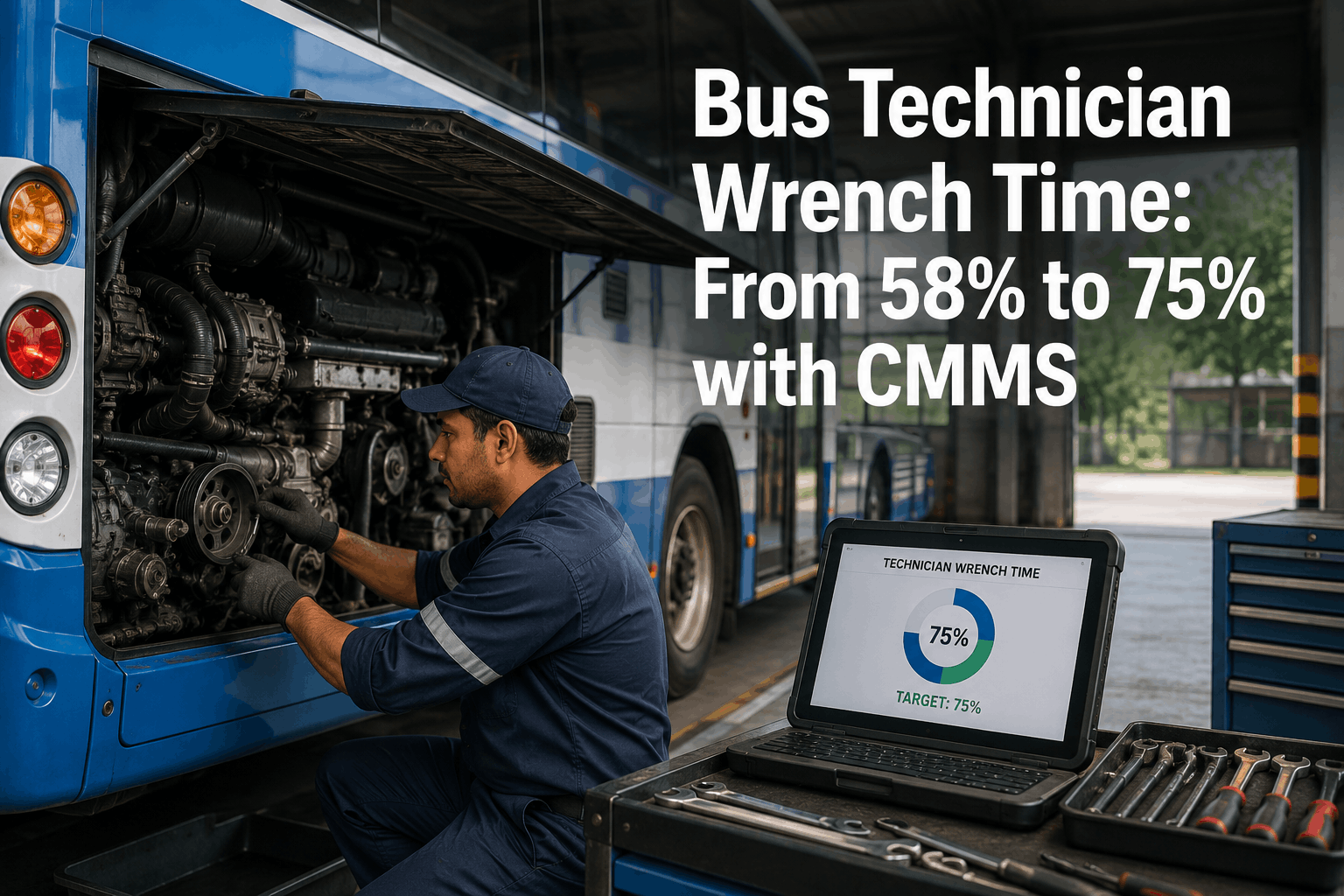
The average bus fleet technician in the United States spends only 58 cents of every labor dollar actually turning wrenches. The other 42 percent of their paid shift goes to hunting down parts, waiting on paper work orders, manually logging completed jobs, tracking down a supervisor to approve a repair, or standing at a parts counter waiting for a manual inventory check. This is the wrench time problem, and it is one of the most expensive inefficiencies in bus fleet operations. For a shop with 6 technicians earning an average of $28 per hour, that 42 percent non-productive time represents over $140,000 per year in labor cost that produces zero maintenance output. A purpose-built bus fleet CMMS eliminates most of the administrative and logistical friction that kills technician productivity, raising wrench time from the US fleet average of 58 percent to 75 percent or higher within 90 days of deployment. BusCMMS is designed specifically for bus fleet maintenance shops, giving technicians instant digital work orders, integrated parts lookups, mobile job logging, and real-time communication with supervisors from the shop floor. If your technicians are spending nearly half their shift on anything other than maintenance work, schedule a demo to see exactly how BusCMMS restructures your shop workflow, or start your free trial and run your first digital work order this week. This guide covers what wrench time actually measures, why 58 percent is the paper-based fleet average, and how US bus fleet shops are reaching 75 percent with CMMS in 90 days.
Bus fleet technicians lose 42% of every shift to non-productive activity. BusCMMS eliminates the documentation waste, parts delays, and scheduling friction that kills wrench time.
What Wrench Time Means and Why 58% Is the US Bus Fleet Baseline
Wrench time is the percentage of a technician's paid shift spent directly performing maintenance or repair work on vehicles. It excludes time spent waiting for work orders, searching for parts, manually completing paperwork, attending briefings, traveling within the depot, or waiting for supervisor authorization. In a well-run maintenance operation, wrench time of 70 to 75 percent is considered achievable and operationally healthy. Below 60 percent, the shop is carrying significant labor cost inefficiency that compounds across every technician on the payroll.
The US fleet maintenance industry average for bus technician wrench time sits at approximately 55 to 60 percent, with paper-based and partially digitized shops consistently landing at the lower end of that range. The root causes are well documented across transit authority maintenance assessments and commercial fleet productivity studies. Technicians spend 8 to 12 minutes per job retrieving a paper work order and recording job start. Parts lookup on paper inventory systems consumes 15 to 25 minutes per shift across typical job volumes. Manual job completion logging adds 6 to 10 minutes per closed work order. Supervisor communication for authorization or clarification averages 10 to 18 minutes per shift in shops without digital communication tools. Shift handover documentation in paper-based environments costs 10 to 20 minutes at the start and end of each shift. Together these activities consume 49 to 85 minutes of productive time per technician per shift before a single additional inefficiency enters the picture.
When a bus fleet transitions to a CMMS with digital work orders, mobile job logging, integrated parts inventory, and real-time supervisor communication, most of these time drains are either eliminated entirely or reduced to under two minutes. The operational math is straightforward. Recovering 45 to 60 minutes of productive time per technician per shift translates directly into a wrench time improvement from the 58 percent baseline toward 75 percent, which is the standard target for digitized bus fleet maintenance shops.
What Raising Wrench Time from 58% to 75% Delivers
Progression based on BusCMMS deployment benchmarks across US bus fleet shops. Individual results vary based on fleet size, shop configuration, and adoption pace.
The 5 Activities That Steal Wrench Time in Bus Fleet Shops
Understanding exactly where non-productive time comes from is the first step to eliminating it. Across US bus fleet maintenance shops still operating on paper work orders and manual systems, five activities consistently account for the majority of the productivity gap. Each of these is a direct target of BusCMMS functionality, and eliminating them is how the platform drives wrench time from 58 to 75 percent within a standard 90-day deployment window.
In a paper-based shop, a technician starting a job walks to the dispatch board, retrieves the work order, records the start time manually, and returns to the vehicle. When the job is complete, they walk back, fill out completion notes, mileage, time, and parts used, and return the form to the supervisor pile. This round trip costs 12 to 20 minutes per job across the full documentation cycle. A technician completing 4 to 6 jobs per shift loses 48 to 120 minutes per day to this process alone.
When a technician needs a part not immediately on hand at their bay, they walk to the parts room, check a manual inventory log or wait for a parts clerk, verify availability, place a request if it is not in stock, and return to the vehicle. If the part is not available, they may wait while an order is placed or move to a different job, losing the setup time invested in the original vehicle. In shops without integrated digital inventory, parts hunting accounts for 15 to 25 minutes of non-productive time per shift per technician.
Many US bus fleet maintenance shops require supervisor sign-off before a technician can begin a repair above a certain cost threshold, order a specific part, or close a safety-related work order. In paper systems, this requires physically locating the supervisor, waiting for their availability, explaining the situation, and receiving verbal or written authorization. If the supervisor is occupied, the technician either waits unproductively or moves to another job and loses task context. This communication delay averages 10 to 18 minutes per shift in paper-based environments.
At shift start and end, technicians in paper-based shops spend significant time reviewing incomplete work orders from the previous shift, manually recording job status updates, and briefing or receiving briefs from supervisors and incoming technicians. Without a digital system showing real-time job status, this handover process requires manual communication for every open work order. Across a typical shop with 8 to 15 open work orders at any time, shift handover consumes 15 to 25 minutes per technician at each shift boundary.
Before diagnosing a repeat fault or performing a complex repair, technicians often need to review the vehicle's maintenance history, previous repair notes, and technical specifications. In paper-based systems, this requires locating the physical vehicle file, searching through handwritten logs, and potentially consulting multiple binders or filing cabinets. For older vehicles with long service histories, this lookup process alone can consume 15 to 30 minutes before a diagnosis even begins, and critical previous repair information is frequently missing or illegible.
How BusCMMS Eliminates Each Wrench Time Killer
BusCMMS delivers work orders directly to technicians on mobile devices at their bay. Job details, vehicle information, required tasks, and parts needed are all visible before the technician touches the vehicle. Job start and completion are logged with a single tap, replacing the paper walk-around entirely. The time cost of work order retrieval and recording drops from 12 to 20 minutes per job to under 60 seconds, recovering the single largest source of non-productive time in the typical bus fleet shop.
See This FeatureTechnicians look up part availability directly in BusCMMS from their mobile device without leaving the bay. The system shows real-time inventory levels, bin locations, and reorder status. When a part is not in stock, the technician submits a parts request digitally and receives notification when the part arrives, allowing them to continue with other jobs without losing time at the parts counter. Parts hunting drops from 15 to 25 minutes per shift to under 3 minutes for the average lookup and request cycle.
See This FeatureAuthorization requests, repair clarifications, and escalation alerts are sent directly through BusCMMS to the supervising manager's dashboard. Supervisors receive a notification with full job context and can approve, decline, or respond with instructions without physically locating the technician. The authorization delay drops from 10 to 18 minutes of waiting to a notification response typically completed within 2 to 4 minutes. Technicians continue working while the request is processed instead of standing idle at the parts room or supervisor desk.
See This FeatureEvery open work order in BusCMMS shows real-time status visible to all authorized users including technicians, supervisors, and fleet managers. Incoming shift technicians arrive to a dashboard showing exactly which jobs are in progress, which are on hold for parts, and which are ready to start. Shift handover briefing is replaced by a 60-second dashboard review instead of 15 to 25 minutes of manual status communication. Supervisors know the status of every vehicle in the shop at any moment without walking the floor.
See This FeatureEvery vehicle's complete maintenance history is accessible from BusCMMS on any mobile device in under 10 seconds. Technicians diagnosing a repeat fault see every previous repair note, part replaced, and technician comment on that specific fault for that specific vehicle. Service manual links, torque specifications, and technical bulletins can be attached to vehicle profiles and work order templates. The 15 to 30 minute paper file search is replaced by an instant digital lookup that often contains more complete and accurate information than the paper records it replaces.
See This FeatureBusCMMS automatically generates preventive maintenance work orders based on mileage, engine hours, or calendar intervals configured for each vehicle and maintenance type. Technicians arrive to pre-scheduled PM jobs already in their queue, eliminating the supervisor time required to manually identify, assign, and communicate PM tasks each day. Planned work fills available technician time efficiently instead of leaving gaps that become idle time when paper-based scheduling falls behind or loses track of PM intervals.
See This FeatureThe Financial Value of Every Percentage Point of Wrench Time
Wrench time improvement is not an abstract operational metric. Each percentage point of wrench time recovered translates directly into additional maintenance capacity at zero additional labor cost. For a bus fleet maintenance shop, understanding the financial value of that capacity helps justify the CMMS investment and sets a measurable ROI expectation before deployment begins.
| Shop Scenario | Technicians | Avg Hourly Rate | Wrench Time | Productive Hours/Day | Annual Labor Value |
|---|---|---|---|---|---|
| Paper-based (baseline) | 6 | $28/hr | 58% | 27.8 hrs | $144,144 |
| BusCMMS (75% target) | 6 | $28/hr | 75% | 36.0 hrs | $186,480 |
| Recovered capacity | 6 | $28/hr | +17pts | +8.2 hrs/day | +$42,336/year |
Calculation based on 250 working days per year, 8-hour shifts, and the stated hourly rate. Productive hours reflect wrench time percentage of paid shift hours across all technicians.
BusCMMS vs. Competitors: Technician Productivity Features
| Productivity Feature | BusCMMS | Fleetio | Samsara | Geotab | Verizon Connect | Fleet Complete |
|---|---|---|---|---|---|---|
| Mobile work orders at the bay | ✓ Bus-specific | ✓ | Partial | ✗ | ✗ | Partial |
| Integrated parts inventory lookup | ✓ Real-time | ✓ | ✗ | ✗ | ✗ | Partial |
| One-tap job time logging | ✓ | ✓ | ✗ | ✗ | ✗ | ✗ |
| Real-time supervisor alerts | ✓ Instant | Partial | Partial | ✗ | Partial | ✗ |
| Vehicle history on mobile | ✓ Full history | ✓ | ✗ | Partial | ✗ | Partial |
| Auto PM work order generation | ✓ Bus-configured | ✓ | ✗ | Partial | ✗ | Partial |
| Wrench time reporting | ✓ Built-in KPI | ✗ | ✗ | ✗ | ✗ | ✗ |
| Bus fleet specialization | ✓ Purpose-built | General | General | General | General | General |
| Technician productivity dashboard | ✓ | Partial | ✗ | ✗ | ✗ | ✗ |
Every percentage point of wrench time recovered is maintenance capacity your fleet gets for free. BusCMMS recovers 17 points in 90 days.
How US Bus Fleets Raised Wrench Time with BusCMMS
A school district transportation department in Georgia managing 112 school buses with a 7-technician maintenance shop was struggling with technician productivity. A time-study conducted by the district's operations director found that technicians were averaging 56 percent wrench time across a standard shift. The 7 techs were running behind on preventive maintenance schedules, with 23 overdue PM jobs identified at any given time. The root cause was a paper work order system that required technicians to spend significant portions of each shift at the dispatch board, parts counter, and completing manual documentation.
BusCMMS was deployed across the Georgia district's shop in 8 days. Digital work orders reached technicians on mobile devices at their bays. Parts lookups moved to the BusCMMS mobile app. PM scheduling was configured for all 112 vehicles, auto-generating work orders at the correct mileage and calendar intervals. The shift handover process dropped from a 20-minute manual briefing to a 2-minute dashboard review.
A mid-sized transit authority in Tennessee operating 185 buses across two maintenance facilities was tracking labor efficiency as part of a broader operational improvement initiative. The authority's maintenance director identified that across both facilities, technicians were averaging 61 percent wrench time, with the larger depot performing worse at 57 percent due to higher job volume and a more complex paper work order routing process. Supervisor time spent on work order assignment, status tracking, and technician communication was consuming 3 to 4 hours per shift day at each facility.
BusCMMS was deployed simultaneously at both Tennessee facilities. The unified dashboard gave the maintenance director real-time visibility across both shops from a single login. Supervisors transitioned from manual work order management to digital assignment and real-time status monitoring, freeing 2 to 3 hours per day of supervisor time that was redirected to quality control and technician support. Digital parts requests eliminated the queue at both facilities' parts counters.
A charter bus company in North Carolina with 38 coaches and a 4-technician shop was experiencing a specific wrench time problem: their technicians were highly skilled but spending significant time managing their own work queues, hunting for vehicle history in paper files, and waiting for the owner-operator to authorize repairs above a set cost threshold. The owner was frequently unavailable or between offices, causing authorization waits of 30 to 60 minutes for non-emergency repair approvals. Revenue-generating coaches were sitting idle while technicians waited for authorization on repairs they were fully capable of completing immediately.
BusCMMS mobile authorization notifications reached the owner's smartphone wherever he was located. Repair approvals that previously required physical presence or a phone call were reviewed and approved digitally with full job context visible in the BusCMMS app. Vehicle history was immediately accessible on mobile, eliminating the paper file search before every complex diagnosis. The 4 technicians received their daily work queues digitally, pre-prioritized by vehicle availability requirements and scheduled departure times.
BusCMMS Deployment Roadmap for Wrench Time Improvement
Conduct a time-study or review supervisor estimates to establish your current wrench time baseline across each technician group. Identify the specific activities consuming the most non-productive time in your shop to prioritize BusCMMS configuration accordingly.
Register all bus fleet vehicles in BusCMMS with complete profiles including VIN, make, model, mileage, engine hours, and maintenance history. This enables full vehicle history lookup on mobile from day one and ensures PM scheduling generates correctly from go-live.
Load current parts inventory into BusCMMS with bin locations, reorder points, and supplier details. Technicians gain instant mobile parts lookup from day one, eliminating the parts counter walk as the primary source of mid-shift productivity loss.
Configure preventive maintenance schedules for every vehicle type in your fleet based on manufacturer intervals, DOT requirements, and your operational standards. BusCMMS will auto-generate PM work orders at the correct mileage and calendar triggers, filling technician queues with planned work automatically.
Train all technicians on the BusCMMS mobile app for work order receipt, job time logging, parts requests, and supervisor communication. Most technicians are fully proficient in BusCMMS mobile workflows within 2 to 3 practice jobs, with the onboarding team providing live support through the first week.
Configure the supervisor work order management dashboard, authorization notification workflows, and real-time shop status views. Supervisors gain live visibility of every technician's current job, time on task, and work queue status without leaving their workstation.
Activate the BusCMMS technician productivity dashboard to begin tracking wrench time, jobs per shift, parts request cycles, and work order completion rates. Review weekly KPIs at the 30, 60, and 90-day marks against the baseline to confirm productivity improvement trajectory.
What Bus Fleet Maintenance Supervisors Say About BusCMMS
We did an informal time study before going live with BusCMMS and found our techs were at around 57 percent wrench time, which honestly shocked me when I saw the number written down. We knew there was waste in the system but seeing it quantified made the case clear. The biggest culprits were exactly what BusCMMS fixed first: the paper work order process, parts runs, and the 20-minute handover briefing we did at every shift change. After 90 days on BusCMMS I had my supervisor re-run the same time study. We came in at 74 percent. Same 5 techs, same shop, same vehicle count. We were getting more maintenance done every single day without adding a dollar to the labor budget. The parts integration alone saved us at least 15 minutes per tech per shift. The mobile job logging was the one our techs adapted to fastest because they immediately understood it was saving them trips to the board. I would tell any fleet maintenance supervisor in the country that if you have not measured your wrench time, you are almost certainly losing money you do not know you are losing.
Frequently Asked Questions
Industry benchmarks for well-run US commercial bus fleet shops with digital work order systems place wrench time between 70 and 78 percent, with 75 percent being the standard CMMS-enabled target achievable within 90 days. Paper-based bus fleet shops typically measure between 54 and 62 percent. Schedule a demo to discuss your shop's baseline and improvement potential.
Most BusCMMS bus fleet shops see measurable wrench time improvement within the first two weeks of go-live as digital work orders and mobile job logging eliminate the largest sources of non-productive time immediately. The 75 percent target is typically reached between 60 and 90 days as parts integration and PM automation reach full adoption. Start your free trial to experience the workflow change firsthand.
Yes, BusCMMS includes a technician productivity dashboard that tracks wrench time, jobs completed per shift, average job duration, parts request cycles, and work order backlog metrics for individual technicians and the full shop. Fleet managers and maintenance supervisors can review daily, weekly, and monthly wrench time trends without manual data collection.
BusCMMS integrates parts inventory management directly into the technician mobile workflow, so technicians submit digital parts requests from their bay and receive notification when parts are ready without requiring a dedicated parts clerk to manage a separate system. Reorder alerts and low-stock notifications reach the shop manager automatically based on configurable minimum stock levels.
BusCMMS supports multi-shift operations with real-time work order status visible to all shift technicians and supervisors simultaneously, so incoming shift technicians see exactly which jobs are in progress, on hold, or ready to start without any manual handover briefing process. Job notes and technician comments added during a previous shift are immediately visible to the incoming technician opening the same work order.
BusCMMS mobile workflows support offline operation for job time logging and form completion in areas of poor connectivity within the shop, with data syncing automatically when the device reconnects to the network. Technicians are not interrupted by connectivity gaps during active job recording, and no time data is lost during a brief offline period.
BusCMMS is designed for ease of use by maintenance technicians, not software specialists, with simple tap-based job logging, photo capture, and parts lookup workflows that most technicians learn within their first two practice jobs during onboarding. The BusCMMS onboarding team provides hands-on training support and most shops report full technician adoption within the first week of go-live.
BusCMMS automatically generates DOT-compliant preventive maintenance work orders at the correct mileage and calendar intervals, ensuring PM tasks are always in the technician queue before compliance deadlines are missed. Completed PM records are stored with full technician signatures, parts used, and timestamps, creating an audit-ready compliance log alongside the productivity improvements in wrench time. Book a demo to see the PM compliance workflow in detail.
Raise your bus fleet technician wrench time from 58% to 75% in 90 days. Recover 68 minutes of productive time per technician per shift. Pay for BusCMMS with labor efficiency gains in the first quarter.
Purpose-built for bus fleet maintenance shops. Configured in days. Measurable results in weeks.