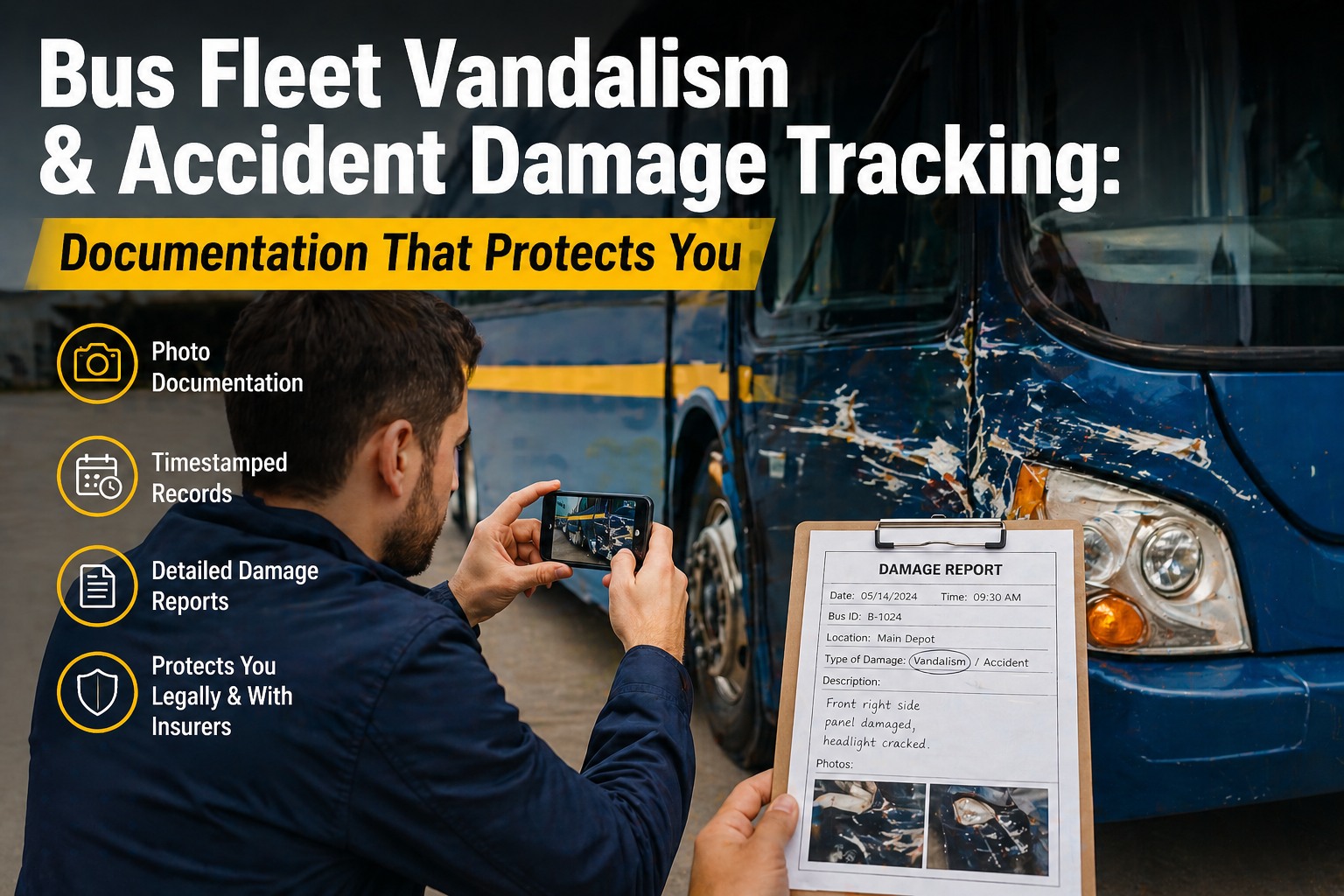
Last month, a Texas school district's $12,400 vandalism claim got denied. The reason wasn't fraud or policy limits — it was three missing photos ,and no timestamp proving when the damage occurred. The same insurer approved an identical claim from a neighboring district that used digital documentation. This guide shows you exactly what insurers need to approve claims — and how to capture it in under 5 minutes per incident.
Recover What You're Losing
Bus Fleet Vandalism & Accident Damage Tracking
The Documentation That Gets Your Money Back
One recovered claim pays for a full year of BusCMMS
Paper Reports
34%
Claims Approved
Digital CMMS
97%
Claims Approved
01
Why 42% of Fleet Damage Claims Get Denied
The #1 reason isn't fraud or policy exclusions — it's insufficient documentation. Insurers can't approve what they can't verify. Missing timestamps, unclear photos, and gaps in the paper trail give adjusters grounds to deny or delay your claim.
42%
Insufficient Documentation
Fix: Timestamped photos, complete forms
28%
Pre-Existing Damage Claims
Fix: Daily inspections prove baseline
18%
Missed Filing Deadlines
Fix: Same-day digital submission
12%
Policy Exclusions
Fix: Know your coverage limits
02
The 6-Point Documentation Checklist
Miss any one of these elements and your claim is at risk. BusCMMS captures all six in one mobile form — timestamped, GPS-tagged, and instantly synced to the cloud.
1
Timestamped Photos
GPS-tagged, multiple angles, before anything moves
2
Vehicle Identification
Bus number, VIN, license plate, odometer
3
Incident Details
Date, time, location, weather, description
4
Witness Statements
Names, contact info, signed declarations
5
Police Report
Case number, officer info, official record
6
Repair Estimates
Itemized costs, shop quotes, parts breakdown
Sign up free and get pre-built damage report templates instantly →
03
Paper vs Digital: The $47,000 Difference
One district's first-year savings after switching to digital damage tracking. Same insurance company, same types of damage — just better evidence.
Paper-Based Systems
Photos stored on phones, lost when drivers leave
No timestamps — can't prove when damage occurred
Reports get lost, coffee-stained, misfiled
3–5 days to compile claim package
No baseline — "pre-existing damage" disputes
Digital CMMS Tracking
Photos attached directly to incident records
Automatic GPS + timestamp on every photo
Cloud storage — nothing ever gets lost
Instant submission — claim filed same day
Daily inspections prove pre-incident condition
Book a demo to see how digital tracking recovers denied claims →
04
The Critical 48-Hour Window
Most policies require notification within 24–72 hours. Here's the timeline that gets claims approved — and what happens when you miss it.
0–15 min
Immediate Response
Secure scene, begin photo documentation before anything moves
15–60 min
Full Documentation
Complete incident report, all photos, witness info collected
1–2 hours
Manager Review
Report submitted, reviewed, towing/repair decisions made
24 hours
Insurance Filed
Claim submitted with complete documentation package
48 hours
Repair Started
Estimates obtained, work order created, bus scheduled
Your Next Incident Could Pay for BusCMMS
The average denied claim costs $4,200. BusCMMS costs a fraction of that — and our districts see 97% approval rates. One recovered claim pays for a full year.
05
Real Results from Real Districts
$47,200
Recovered in Year 1
Claims that would have been denied got approved with proper documentation
97%
Approval Rate
Up from 66% with paper — same insurers, same policies, better evidence
4 Days
Faster Processing
Average reduction in claim resolution time with complete documentation
$0
Pre-Existing Disputes
Daily inspections prove baseline condition — no more disputed claims
"Our first vandalism claim after switching to BusCMMS was fully covered — $8,400. The same insurance company denied a similar claim the year before when we were using paper. The only difference was the documentation."
Sign up free and start protecting your fleet from denied claims →
What Insurance Adjusters Actually Look For
Adjusters aren't evaluating just the damage — they're evaluating your evidence. When a claim lands on their desk, they're asking: Can I verify this? Does the timeline add up? Is there any way this could be pre-existing?
The claims that get approved fast have three things in common: timestamped photos taken immediately before anything moves, documented baseline condition from daily pre-trip inspections, and complete documentation filed quickly within 24 hours.
Fleets with systematic digital tracking don't just get better claim outcomes — they often qualify for lower insurance premiums because insurers see them as lower risk.
Book a demo and see exactly how damage tracking works for your fleet →
How Much Are You Losing to Denied Claims?
Most fleet managers don't know until they add it up. A 15-minute demo shows you exactly what you're leaving on the table — and how to recover it.
Frequently Asked Questions
How quickly should damage be documented after an incident?
Immediately — within minutes of discovery. Take photos before anything moves, before cleanup, before any repairs. The strongest claims have documentation from the exact moment damage is found. Most insurance policies require notification within 24–72 hours, but the quality of your initial documentation determines whether your claim gets approved.
What if vandalism happens overnight with no witnesses?
Your pre-trip inspection from the previous day becomes your proof. If you documented the bus was in good condition yesterday and today it has slashed seats, you've established a clear timeline. This is why daily inspections with photos are critical — they create the baseline that protects you when incidents occur.
Can BusCMMS actually improve our claim approval rate?
Districts using BusCMMS report 97% claim approval rates, up from 66% with paper documentation. The difference is systematic: GPS-tagged photos, automatic timestamps, daily inspections proving baseline condition, and complete documentation packages filed same-day. Same insurers, same policies — just better evidence.
How long does it take to start using BusCMMS for damage tracking?
Most districts are documenting their first incident within 24 hours of signup. The damage report form is pre-built with all six required elements — drivers just fill it out and attach photos. No setup, no customization, no training courses. Your first documented incident could be this week.
What's the ROI on digital damage documentation?
One recovered claim typically pays for a full year of BusCMMS. If the average denied claim costs $4,200 and digital documentation increases your approval rate from 66% to 97%, the math is simple. One Texas district reported $47,200 in first-year recovered claims alone.