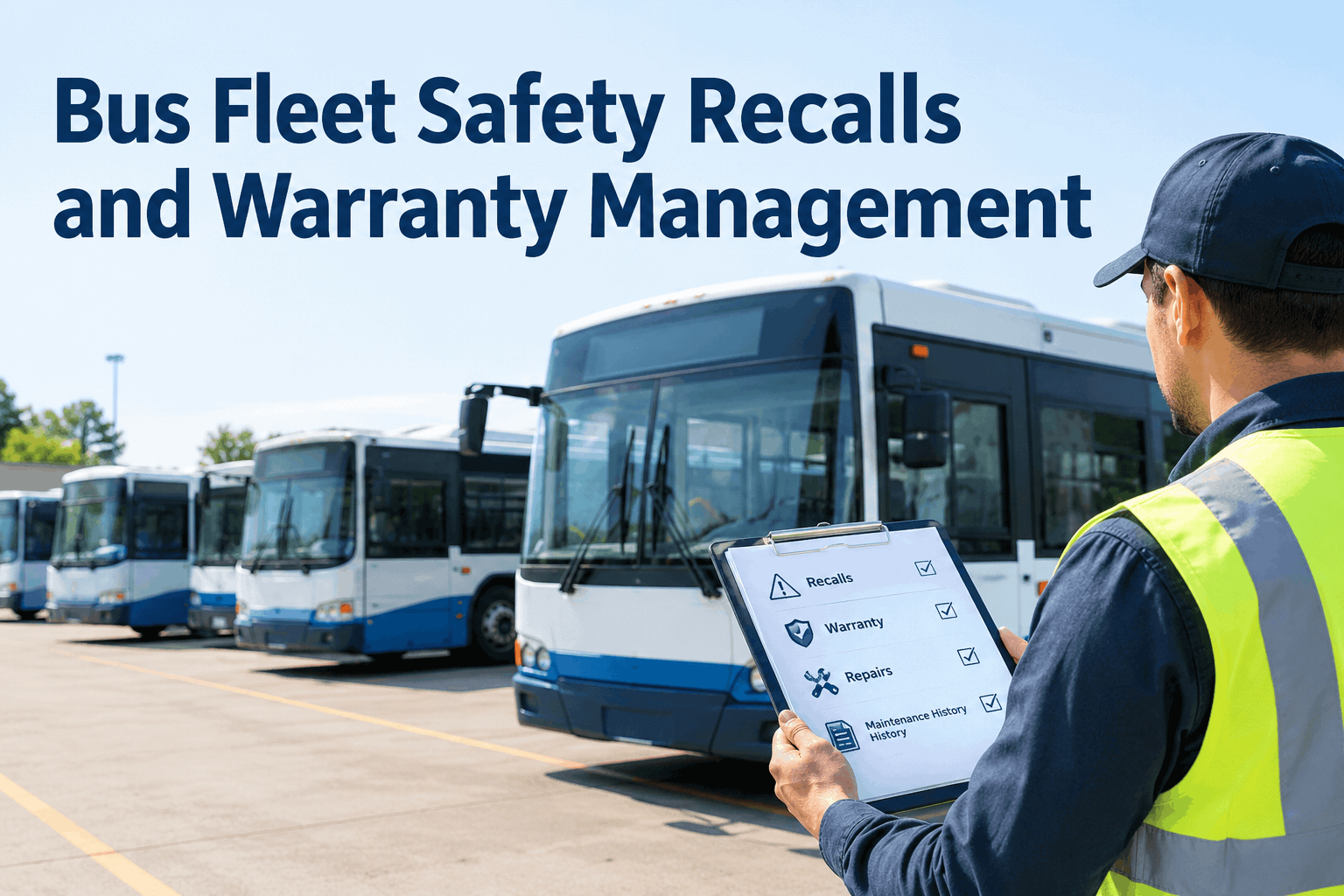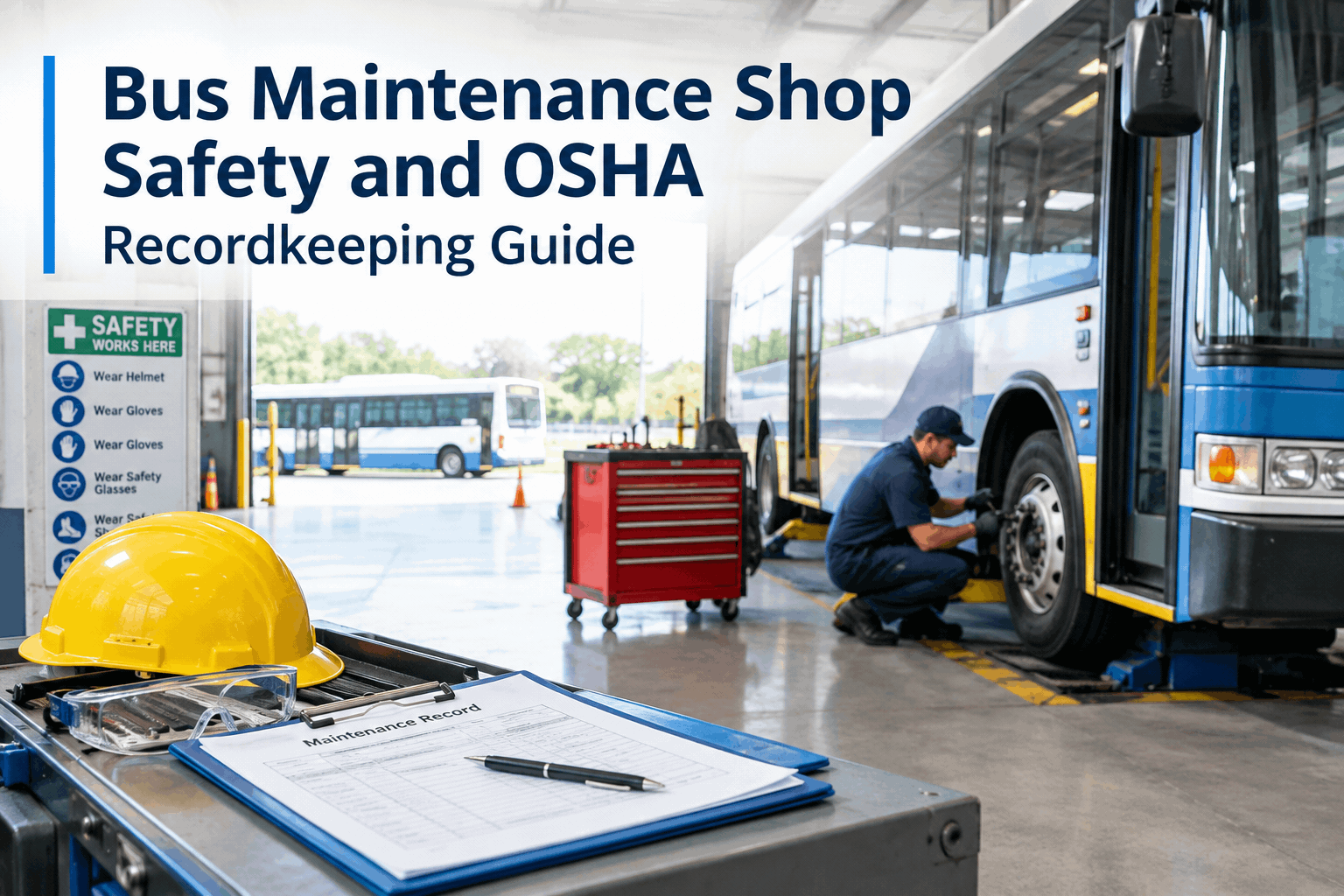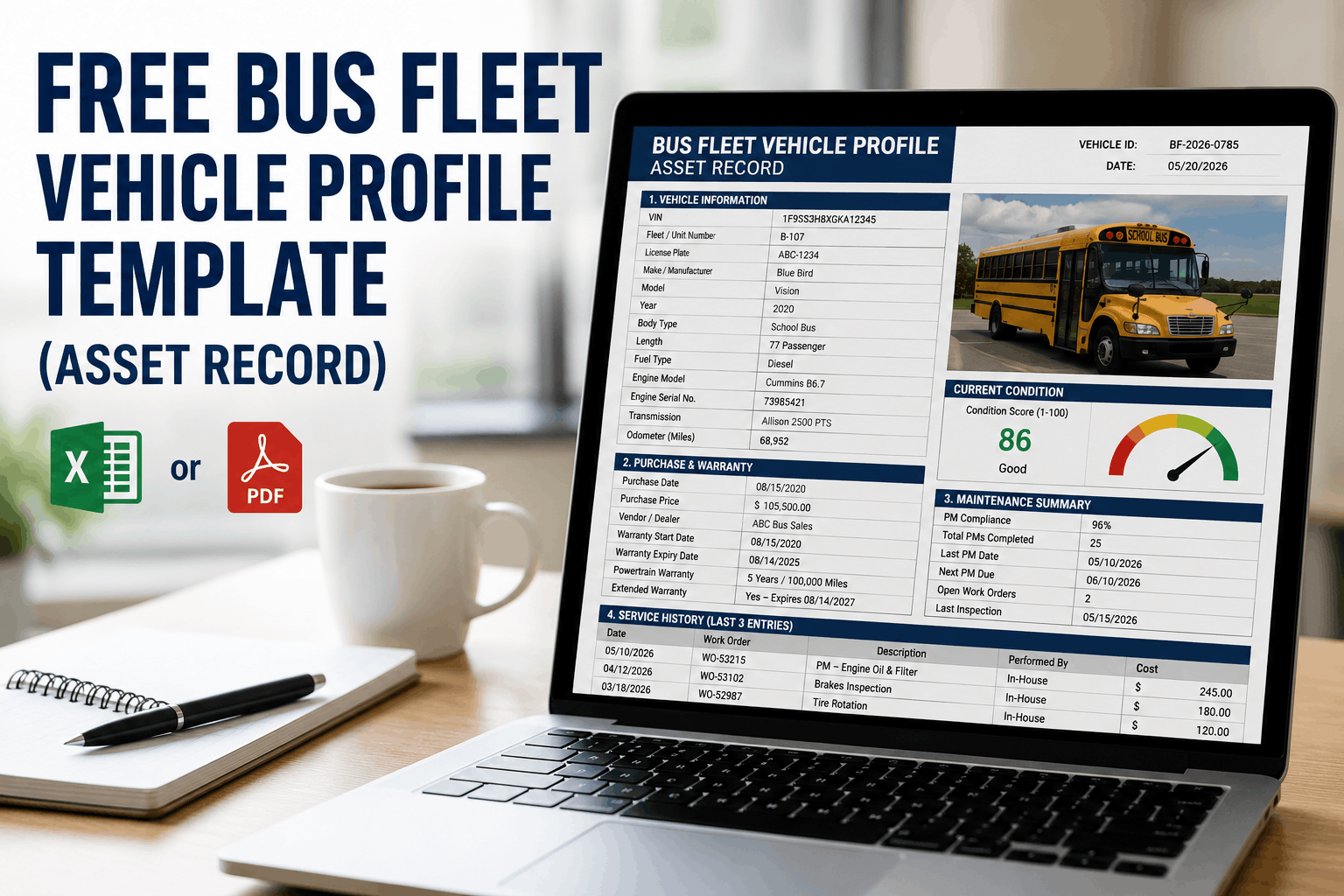
Every bus fleet runs on records. Without a complete, standardized vehicle profile for each asset, preventive maintenance slips through the cracks, warranty claims get denied, and CMMS migrations stall. A free bus fleet vehicle profile template gives your transportation department one master asset record that captures VIN, specifications, purchase data, warranty status, PM history, inspection logs, and current condition score — all in one place. Whether you operate 12 school buses or 400 transit coaches, a consistent vehicle data sheet is the foundation of every maintenance decision your team makes.
Free Download + CMMS Migration Ready
Free Bus Fleet Vehicle Profile Template — One-Page Asset Record
Standardize every bus asset record: VIN, specs, purchase data, warranty, PM history, and condition score. Built for school districts, transit agencies, and charter operators ready to migrate to a CMMS.
Fleet Record Impact
Get a CMMS That Manages Every Vehicle Profile Automatically
BusCMMS stores, tracks, and maintains your entire fleet asset library — VIN records, spec sheets, warranty dates, PM intervals, inspection logs, and condition scores — updated in real time, accessible from any device.
01
What Is a Bus Fleet Vehicle Profile Template?
A bus fleet vehicle profile template is a standardized one-page asset data sheet capturing every essential detail about a single bus — the birth certificate, maintenance passport, and condition report for each vehicle in your fleet. Transportation directors across the United States rely on these records during fleet audits, budget planning cycles, state DOT inspections, and CMMS migration projects. When asset data is fragmented across paper folders and spreadsheets, a standardized bus vehicle data sheet template forces discipline and creates a single source of truth.
The template covers eight core sections: vehicle identification, powertrain specifications, purchase and financing data, insurance and registration, warranty status, preventive maintenance schedule, inspection and repair history, and condition scoring. Each section feeds directly into work order creation, asset lifecycle management, and retirement planning. Start organizing your fleet records today — Sign Up and import your existing asset data into BusCMMS in hours.
02
Industry Challenges: Why Fleet Records Break Down
Across U.S. school districts and transit agencies, vehicle data management is consistently underdeveloped. Maintenance managers deal with incomplete asset files, conflicting records between mechanics and administrators, and warranty coverage that lapses unnoticed because nobody tracked expiration dates. These breakdowns stem from the absence of a standardized bus fleet vehicle profile system — not negligence.
Scattered Paper Records
Bus maintenance histories stored in physical folders, binders, and filing cabinets that are inaccessible during roadside inspections or DOT audits.
Inconsistent Spreadsheets
Multiple versions of bus spec sheets across departments, each maintained differently, producing conflicting data that undermines procurement and budget planning.
Missed Warranty Deadlines
Powertrain and component warranties expire unnoticed because no system tracks coverage dates, costing districts thousands in avoidable repair expenses.
CMMS Migration Delays
Fleets attempting to adopt fleet maintenance software stall because asset data is not normalized — no consistent format for VINs, purchase dates, or PM intervals.
Tribal Knowledge Risk
Experienced mechanics retire or transfer, taking undocumented knowledge about specific bus quirks, known failure patterns, and repair histories with them.
No Condition Visibility
Fleet managers cannot make data-driven replacement decisions without a standardized condition scoring system applied consistently across every asset.
03
Why a Standardized Vehicle Profile Template Matters
A bus fleet vehicle profile template is the operational backbone of every reliable fleet. When every bus has a complete, current, and accessible asset record, your team makes faster decisions, administrators produce audit-ready documentation on demand, and leadership plans capital budgets with confidence.
Consider a typical U.S. school district running 85 buses. Without standardized profiles, compiling asset data for an annual budget presentation takes 6 to 8 hours. With complete bus vehicle data sheets in BusCMMS, that report generates in minutes. Explore how Preventive Maintenance Planning integrates with vehicle profiles to automate the entire PM lifecycle — from scheduling to work order closure.
04
What Your Bus Vehicle Profile Template Should Include
A production-ready bus fleet vehicle profile template covers these eight sections. Each field maps directly to a data field in a CMMS, making migration seamless when you are ready to digitize.
01
Vehicle Identification
VIN, unit number, license plate, year, make, model, body type, seating capacity, fuel type (diesel / CNG / propane / electric), GVWR
02
Powertrain Specifications
Engine make, model, serial number, transmission type, horsepower, EPA emissions tier, DEF system, battery specs (electric buses)
03
Purchase and Financing Data
Purchase date, price, vendor, PO number, financing method (lease / bond / grant), grant program, expected useful life, salvage value
04
Insurance and Registration
Insurance carrier, policy number, expiration date, registration expiration, state DOT number, USDOT number, route assignment
05
Warranty Status
OEM base warranty date and mileage, powertrain warranty, aftermarket warranties, extended service contracts, warranty claim log
06
PM Schedule and History
Oil change, filter, brake, tire, coolant, and transmission intervals; annual safety inspection dates; last and next PM due dates
07
Inspection and Repair Log
DVIR history, roadside inspection records, DOT results, work orders with labor and parts cost, recurring defect patterns, technician notes
08
Condition Score and Lifecycle
Current odometer, condition rating (1-10), structural assessment, replacement priority, projected replacement year, cumulative cost, cost per mile
05
Key Benefits of Standardizing Bus Asset Records
Eliminate Missed PM Intervals
When every bus has a documented PM schedule linked to odometer and calendar, automated triggers replace manual follow-up and maintenance intervals never fall through the cracks. Fleets using Maintenance Scheduling tools report 68% fewer overdue service events.
Accelerate CMMS Migration by 4x
Fleets with pre-normalized asset data in a standard bus CMMS migration template import their entire vehicle library in hours rather than weeks. BusCMMS accepts direct CSV imports from your completed vehicle profile spreadsheet.
Protect Warranty Coverage
Documented warranty dates with automated expiration alerts stop your fleet from leaving money on the table. A single recovered warranty claim on an engine or transmission typically exceeds $4,000 — more than the cost of implementing proper record-keeping.
Audit-Ready in Minutes
State DOT audits, federal grant compliance reviews, and insurance inspections require complete, current vehicle records. Standardized profiles mean your team can produce any vehicle's complete history instantly, from any device.
Enable Data-Driven Replacement Planning
Condition scores, cumulative maintenance cost, and cost-per-mile data transform subjective retirement decisions into objective, defensible recommendations that district boards and transit authority leadership can approve with confidence.
Reduce Technician Ramp-Up Time
When a new mechanic can open a bus vehicle file template and immediately see the full repair history, known defect patterns, and component specifications, they become productive in days rather than months — critical given the technician shortage affecting U.S. school bus and transit maintenance shops.
06
How BusCMMS Manages Vehicle Profiles Automatically
A paper or Excel bus fleet vehicle profile template is a starting point — not a destination. Once your asset data is standardized, BusCMMS transforms each static vehicle record into a living, connected asset profile that updates automatically as your fleet operates.
1
Import Your Asset Data
Upload your completed bus asset record template as a CSV or enter assets manually. BusCMMS maps every field — VIN, specs, purchase data, warranty dates — into structured profiles accessible by your entire team from day one.
2
Connect PM Schedules to Every Asset
Assign preventive maintenance intervals by mileage, engine hours, or calendar date. BusCMMS generates PM work orders automatically when thresholds approach, routing them to the right technician — the core of Preventive Maintenance Planning.
3
Log Inspections and Repairs Automatically
Every Inspection Management event and completed work order posts directly to the vehicle profile. Drivers submit digital DVIRs from their phone; technicians close work orders with parts, labor, and timestamp — all linked to the correct asset.
4
Track Condition Score in Real Time
BusCMMS calculates each bus's condition score from inspection outcomes, defect frequency, repair cost trends, and mileage. Managers see a fleet-wide dashboard and drill into any asset for the complete picture.
5
Generate Reports for Compliance
Pull any vehicle's full history for DOT audits, grant reporting, or insurance renewals in seconds. Maintenance Reporting exports are formatted for state student transportation reporting systems used across U.S. school districts.
07
Best Practices: Building and Maintaining Bus Asset Records
Implementing a vehicle profile template is a process, not a one-time event. High-performing U.S. school districts and transit agencies build these data quality habits into daily operations.
Assign a Data Owner Per Asset
Designate one person responsible for keeping each bus's profile current — typically the lead mechanic or shop foreman. In larger transit operations, a fleet administrator handles data quality across the full asset library.
Update Records at Every Service Event
Make vehicle profile updates a mandatory step in closing any work order. In BusCMMS, this is automatic — every completed work order updates odometer, parts, labor cost, and technician notes directly to the asset record.
Standardize Condition Scoring Criteria
Define what scores of 3, 5, 7, and 10 mean for your fleet before your first cycle. Include structural condition, mechanical reliability, technology readiness, and regulatory compliance status in your scoring rubric.
Capture Warranty Data at Purchase
Record warranty information on delivery day. Scan the warranty certificate, note every expiration date, and set automated alerts in your CMMS for 90 and 30 days before each deadline.
Run Quarterly Data Quality Audits
Schedule quarterly spot-checks on 10 to 15 bus asset records against physical vehicles. Verify odometer readings, confirm component specs, and update any fields that have drifted from reality.
Link Records to Telematics Data
When BusCMMS connects with Samsara or Geotab GPS, odometer readings sync automatically, fault codes create draft work orders, and vehicle utilization enriches each profile. This is full Asset Tracking automation.
08
Industry Applications by Fleet Type
Bus fleet vehicle profile templates and CMMS asset management serve every segment of U.S. bus transportation differently. Here is how each fleet type uses vehicle records in practice.
School Bus Districts
Vehicle profiles support state student transportation audits, NSTA compliance, special needs accessibility equipment tracking, and annual safety inspection documentation. Districts use condition scores to prioritize replacement requests in EPA Clean School Bus Program grant cycles.
Transit Agencies
FTA-funded transit operations maintain asset records to satisfy NTD reporting requirements, FTA State of Good Repair standards, and ADA compliance documentation. Transit vehicle profiles also support 12-year useful life and 500,000-mile lifecycle tracking for federal capital grant compliance.
Charter Bus Operators
Charter fleets use vehicle profiles to manage FMCSA compliance, DOT documentation, interstate registration (IRP), and IFTA fuel tax reporting. Condition scores support equipment selection for high-value client contracts and peak-season capacity planning.
Airport Shuttle Fleets
Airport ground transportation operators maintain profiles for TSA security compliance, airport authority contract requirements, ADA certification, and high-frequency PM driven by intense daily mileage. Electric shuttle profiles also track battery health and charging infrastructure needs.
09
Performance Metrics: What Standardized Records Deliver
Performance benchmarks from U.S. bus fleets that moved from ad hoc record-keeping to standardized vehicle profiles in a dedicated CMMS.
Reduction in missed PM events
68%
Faster CMMS asset migration
4x
Audit documentation time saved
75%
Warranty claim recovery rate improvement
55%
Fleet availability increase
22%
Technician onboarding time reduced
60%
10
Comparison: Manual Records vs. Digital Vehicle Profiles in BusCMMS
| Capability | Paper / Excel Template | BusCMMS Digital Profile |
|---|---|---|
| VIN and spec storage | Manual entry, version conflicts | Centralized, single source of truth |
| PM schedule tracking | Manual calendar reminders | Automated triggers by mileage or date |
| Work order history | Separate paper files | Auto-linked to every asset record |
| Warranty expiration alerts | None | Automated 90-day and 30-day alerts |
| Inspection log integration | Separate DVIR binders | Digital DVIR linked to asset profile |
| Condition scoring | Subjective, inconsistent | Calculated, data-driven, trend-tracked |
| DOT audit readiness | Hours of document retrieval | Instant report generation |
| Telematics integration | Manual odometer entry | Auto-sync with Samsara and Geotab |
| Mobile access | Not available | Full access on any device |
| Multi-fleet scalability | One file per bus, unmanageable | Unlimited assets, centralized view |
| CMMS migration readiness | Requires manual reformatting | Native CSV import, instant setup |
11
Condition Score Distribution Chart
This chart illustrates a typical bus fleet condition score distribution before and after implementing standardized vehicle profiles with consistent scoring criteria in BusCMMS. Fleets with complete records identify replacement candidates earlier and extend average fleet useful life.
Fleet Condition Score Distribution (Before vs. After Standardization)
12
Maintenance Cost Lifecycle Scorecard
Vehicle profiles that track cumulative maintenance cost and cost per mile give fleet managers the evidence needed to defend replacement decisions. This scorecard shows how cost data typically evolves across a 12-year school bus lifecycle.
Years 1-3
New Asset Phase
Avg. $0.18/mile
Warranty coverage active — document every claim
Years 4-6
Stable Performance Phase
Avg. $0.31/mile
PM compliance critical — profile data drives scheduling
Years 7-9
Increased Maintenance Phase
Avg. $0.52/mile
Condition score monitoring signals replacement need
Years 10-12
End-of-Life Phase
Avg. $0.79/mile
Cumulative cost data justifies capital replacement request
Before BusCMMS, our vehicle records were split between paper binders and a spreadsheet nobody updated. When our state DOT audit came up, I spent three days pulling files. After importing everything into BusCMMS, our next audit took less than two hours. We caught two warranty expirations we would have missed — one was a $6,200 transmission repair still under coverage. Fleet availability went from 91% to 97% in our first year because PM compliance finally had real teeth.
13
Frequently Asked Questions
What is included in a bus fleet vehicle profile template?
A complete template covers VIN, powertrain specs, purchase data, warranty status, insurance, PM history, inspection logs, and a condition score. BusCMMS pre-loads all these fields when you Sign Up and import your existing fleet data.
How do I use a vehicle profile template for CMMS migration?
Fill out the template in Excel or PDF, then export as a CSV and upload directly to BusCMMS. Our import tool maps your columns automatically, so your asset library is live within hours — not weeks.
Can I track warranty expiration dates inside BusCMMS?
Yes. BusCMMS stores OEM and aftermarket warranty dates per vehicle and sends automated alerts at 90 and 30 days before expiration. This feature alone recovers thousands in covered repairs for most fleets.
Is a standardized bus asset record required for federal grant compliance?
FTA-funded transit agencies must meet NTD reporting and State of Good Repair requirements that depend on complete asset records. EPA Clean School Bus grants also require documented vehicle age, fuel type, and condition data at application.
How often should I update each bus vehicle profile?
In BusCMMS, profiles update automatically at every work order completion and inspection event. For manual templates, update after every service event and run a quarterly data quality audit across your full fleet.
Does BusCMMS support electric bus vehicle profiles?
Yes. BusCMMS includes electric-specific fields for battery pack capacity, state-of-health, charging infrastructure assignment, and range-per-charge tracking — alongside all standard diesel and CNG bus profile fields. Book a Demo to see it in action.
What condition score system does BusCMMS use?
BusCMMS calculates condition scores on a 1-to-10 scale using inspection outcomes, defect frequency, repair cost trends, and mileage relative to expected lifecycle. Scores update automatically after every completed inspection or work order closure.
Can multiple technicians and administrators access the same vehicle profile?
Yes. BusCMMS is cloud-based with role-based access — mechanics, shop foremen, transportation directors, and administrators can all view or edit profiles per their permission level, from any device, in real time.
Stop Managing Bus Records in Spreadsheets. Start with BusCMMS.
Every bus in your fleet deserves a complete, current, connected asset profile. BusCMMS delivers automated vehicle records, PM scheduling, inspection management, warranty alerts, condition scoring, and audit-ready reporting — built exclusively for school bus and transit fleets across the United States.
The Bottom Line
A free bus fleet vehicle profile template gives every U.S. school district, transit agency, charter operator, and airport shuttle fleet the foundation they need to organize asset data, enforce PM compliance, protect warranty coverage, and prepare for CMMS migration. But a template is only the beginning. BusCMMS transforms each static vehicle record into a living, intelligent asset profile that updates automatically, alerts proactively, and reports instantly — giving your fleet the operational backbone that paper and spreadsheets can never deliver. Start Free today and bring every bus in your fleet into a single, connected system.