You sent the winterization checklist to the shop three weeks ago. Are all sixty buses done? Honestly — you're not sure. A few you know got the full treatment, most you assume did, and then the first cold snap hits and three won't start in the lot. The checks were never the hard part; knowing they actually happened on every bus is. Bus fleet winterization readiness tracking is how you replace “I think so” with a live status. You can see a fleet readiness board that tracks every bus in a demo.
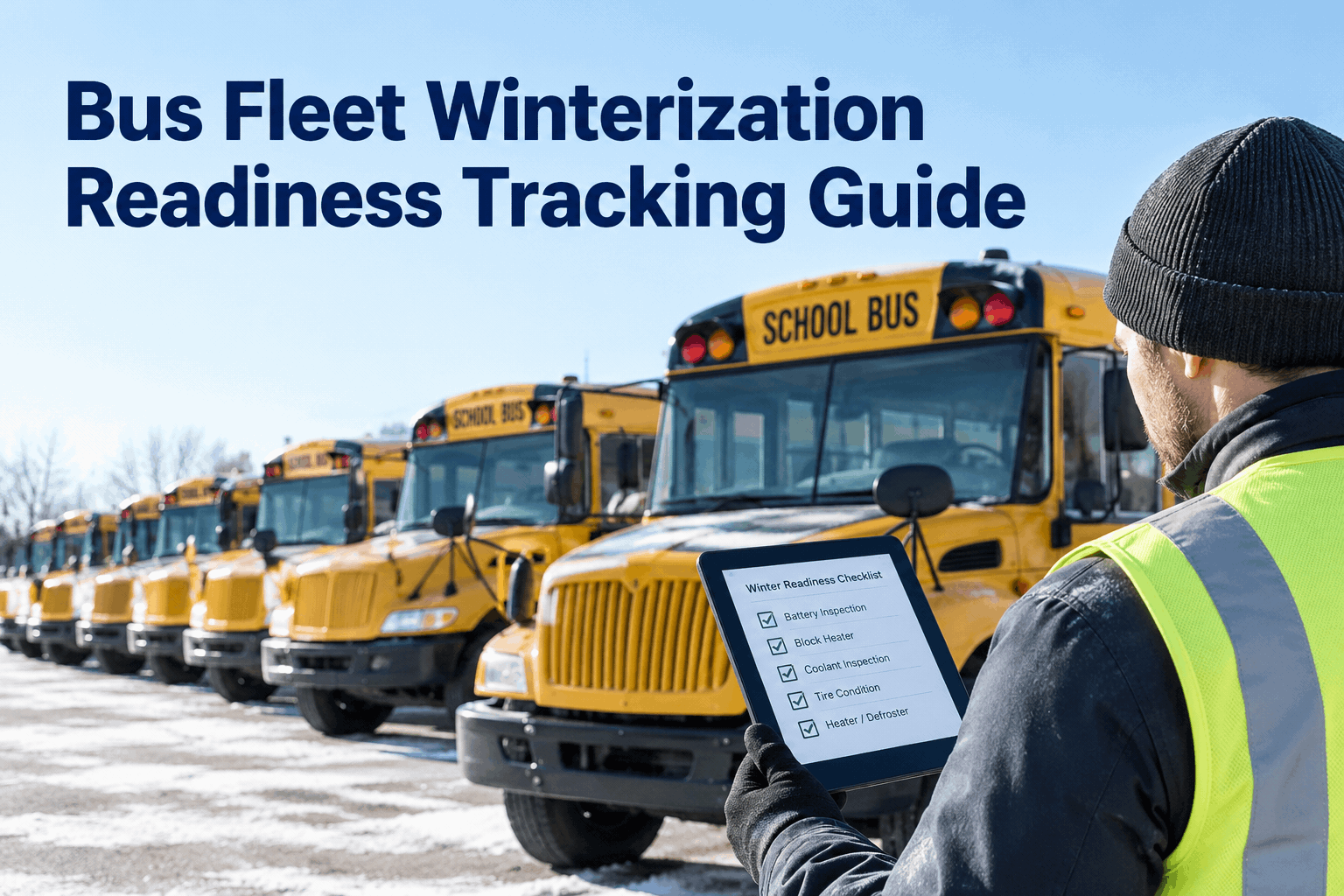
Bus Fleet Winterization Readiness Tracking Guide
The winter checks are simple. The hard part is knowing, across a whole fleet, which buses are done, which are half-done, and which still have an open repair — before the cold exposes the gap.
Winterization Fails on Tracking, Not Knowledge
Nobody on your crew is confused about how to winterize a bus — test the batteries, check the antifreeze concentration, make sure the block heaters work, top the washer fluid. The checks are routine. What breaks down is visibility: on a fleet of forty or sixty buses, a paper checklist handed out at the start of the season tells you nothing about where things actually stand three weeks later. Some buses got the full treatment, some got half of it, and a few have an open repair blocking them — and you can't tell which is which until a dead battery or a gelled fuel line tells you on the coldest morning of the year.
The gap isn't in the checklist — it's in knowing which buses are actually done. A readiness tracker turns “I think most are ready” into “these six aren't, and here's who's on them.”
That's the whole case for tracking winterization instead of just assigning it: you see the gaps while there's still time to close them. You can start free and put every bus's winter status on one board.
What a Winterization Check Actually Covers
Before you can track readiness, it helps to see what “ready” means. Cold-weather prep for a bus groups into four areas — each a few checks, all of them things that quietly fail in the cold if skipped.
Starting system
- Batteries load-tested
- Terminals clean & tight
- Block / engine heaters work
- Glow plugs & starter checked
Fluids & fuel
- Antifreeze concentration tested
- Winter fuel / anti-gel treatment
- Oil & fluids rated for cold
- Washer fluid winter-grade
Traction & stopping
- Tire tread & pressure for cold
- Chains on board if required
- Brakes & air system checked
- Wiper blades & defrost working
Cabin & rider comfort
- Heater & defroster output
- Door seals & weatherstrip
- Emergency gear winter-ready
- Exhaust system sealed
That's the content of a winter check — now the real question is tracking it across every bus. You can see these checks built into a trackable inspection in a demo.
The Winterization Readiness Checklist to Track
This is the list that goes on every bus — and the one your readiness board tracks to completion. Each item is either done, in progress, or blocked by a repair; the ones that aren't green by the first freeze are the buses that don't start.
- Batteries load-tested & terminals cleanCold cuts cranking power — a weak battery that started fine in fall won't in January.WON'T START WITHOUT
- Block / engine heaters functionalA working heater is what gets a cold diesel to start reliably on a sub-freezing morning.WON'T START WITHOUT
- Antifreeze concentration testedProtection rated for your lowest temps — weak coolant freezes and cracks the block.HIGH
- Winter fuel / anti-gel treatmentUntreated diesel gels in the cold and strands the bus — dose before the first hard freeze.HIGH
- Heater, defroster & wipers workingDriver visibility and cabin warmth — a safety item, not just comfort.TRACK
- Tires, brakes & emergency gear readyTread for cold traction, brakes checked, chains and winter kit on board if required.TRACK
Tracked per bus, this list stops being a page on a clipboard and becomes a status you can act on. You can load it as a tracked winterization inspection in a demo.
Untracked vs. Tracked: The First Cold Morning
The difference between a fleet that handed out a checklist and one that tracked it shows up on the first freeze. Same checks, same crew — completely different mornings.
Checklist handed out, not tracked
- Three buses won't start — batteries never tested
- No idea which units are actually done
- A flagged repair sat open, nobody assigned it
- Routes scramble, you learn the gaps the hard way
Readiness tracked to 100%
- Every bus confirmed ready before the freeze
- The board showed the gaps with time to close them
- Each flagged item became an assigned work order
- First cold morning is just another morning
Every line in that left column is a bus whose status nobody could see until it failed. You can start free and make sure your fleet lands in the right column.
How BusCMMS Tracks Winter Readiness to 100%
Tracking winterization is a monitoring-and-follow-through problem — the checks happen in the bay, but someone has to see where every bus stands and chase the ones that aren't done. That's exactly what a bus-built CMMS does without a clipboard.
Live fleet readiness board
Every bus's winterization status — ready, in progress, or blocked — on one screen, with the overall percentage you report up.
Scheduled winter inspection
The winterization check scheduled on every bus as a bus-specific inspection, so nothing is left to a loose paper list.
Incomplete checks become work orders
A failed item or a half-done check turns into an assigned follow-up repair with an owner, so no bus stays “almost ready.”
Defects tracked to closure
Every flagged winter item is followed from open to fixed, so the board only hits 100% when the fleet truly is ready.
The result is winter readiness you can prove at a glance, not a stack of checklists you hope got finished. You can book a demo and see the readiness board on your own fleet.
A Fleet Manager's Take
I used to send out the winter checklist and just trust it got done. Then one December morning, seven buses wouldn't start — batteries nobody had actually tested — and I was pulling drivers and swapping routes before 6 a.m. Now I watch a readiness board all through the fall. I can see exactly which buses are done, which are waiting on a part, which nobody's touched. We hit 100% two weeks before the first real cold last year. The checklist was always the same; now I can actually see it getting finished.
Key Takeaways on Winterization Tracking
The gap is visibility, not know-how
Your crew knows the checks; the failure is not seeing which buses are done.
Track to 100%, not “most”
A readiness board shows the handful of buses that aren't ready — before the cold does.
Incomplete checks need an owner
Turn every flagged item into an assigned work order so nothing stays half-done.
Batteries & heaters start the bus
The no-start items come first — cold exposes a weak battery or dead heater fast.
Treat bus fleet winterization as something you track, not just assign — a live readiness board that gets every bus to 100% before the first freeze — and the cold stops surprising you. The checks are simple; seeing them finished on every bus is what keeps your fleet starting on the coldest mornings.