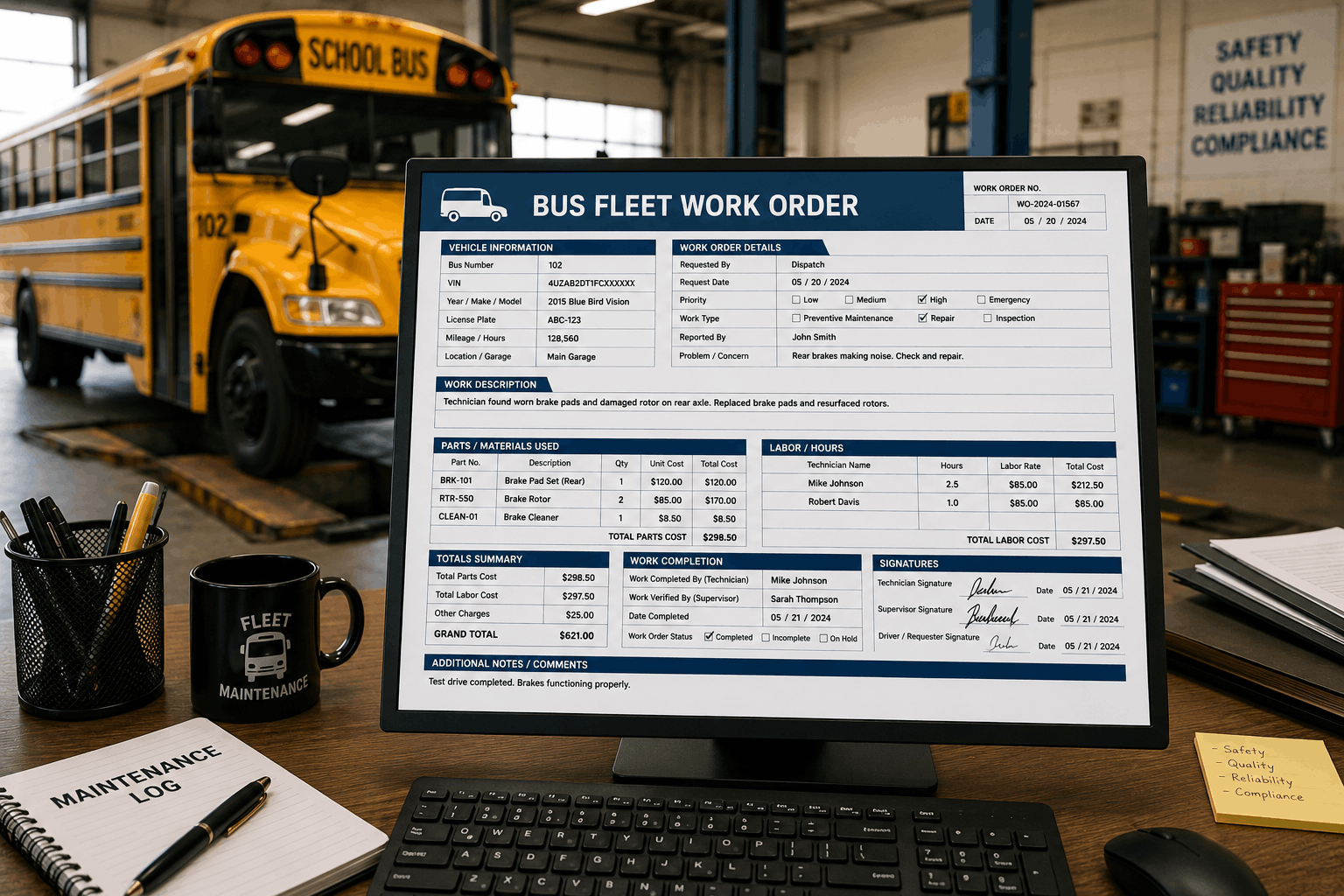
A 48-bus school district in Missouri was cited for DVIR compliance violations during a random FMCSA audit. The violations were not mechanical — the buses were maintained properly. The problem was documentation. Some DVIRs were missing the driver's signature. Others lacked the mechanic's repair certification. A few had been filed in the wrong order or filed weeks after the defects were reported. The audit cited 23 DVIR-specific violations and threatened out-of-service orders if compliance was not restored within 90 days. The district's buses were perfectly safe. The documentation trail that proved they were safe did not exist. This guide provides the free, FMCSA-compliant Bus DVIR template for 2026 — every required field under 49 CFR 396.11, all 11 inspection components per federal regulation, the three-signature chain in the correct order, and the step-by-step process that keeps your fleet audit-ready. Updated for the February 2026 FMCSA Final Rule that explicitly authorizes electronic DVIRs.
DVIR Template — FMCSA Compliant 2026
Bus Driver Vehicle Inspection Report (DVIR) Template: FMCSA-Compliant Form
Download a free, FMCSA-compliant Bus DVIR template. Includes all 11 required safety inspection categories per 49 CFR 396.11, pre-trip and post-trip sections, the three-signature chain for defect certification, and 2026 eDVIR rule compliance guidance.
DVIR Compliance by the Numbers
FMCSA audits that include DVIR review
89%
Fleets that pass DVIR audits without violations
7%
Accidents prevented annually by proper DVIRs
~14,000
Civil penalty per DVIR violation (2026)
Up to $16,000
01
What a DVIR Is, When It's Required, and What FMCSA Expects
A Driver Vehicle Inspection Report is a federally mandated document that creates an official record when a driver finds a defect or deficiency in a commercial motor vehicle. The DVIR is not just a safety record — it is a legal document that establishes a paper trail proving defects were identified, communicated to maintenance, and repaired before the vehicle returned to service. FMCSA uses DVIRs to assess fleet safety compliance, and auditors review DVIR records in 89% of compliance inspections.
Under 49 CFR 396.11, DVIRs are required from drivers operating commercial motor vehicles with a Gross Vehicle Weight Rating (GVWR) of 10,001 pounds or more, vehicles designed to carry nine or more passengers (including the driver), or vehicles placarded for hazardous materials. Bus drivers must complete a DVIR at the end of each operating day — documenting the condition of 11 federally mandated inspection categories. If the driver finds a defect that would affect safe operation, the driver must document it and the bus cannot return to service until repairs are certified.
The 2020 rule change eliminated the requirement for property carriers to submit "no defect" DVIRs. However, passengers-carrying CMV drivers (school buses, transit buses, charter buses) must still document inspections even when no defects are found. More importantly, best practices recommend filing "no defect" DVIRs as company policy — it creates a positive compliance record, demonstrates inspection diligence, and provides a data trail for predictive maintenance.
The 11 Required DVIR Inspection Categories (49 CFR 396.11)
1
Lighting devices & reflectors
All headlights, tail lights, brake lights, parking lights, marker lights functioning
2
Brake systems
Service brakes, parking brakes, emergency brakes, brake fluid level, brake line condition
3
Steering mechanism
Steering wheel play, steering linkage, ball joints, tie rod ends, power steering condition
4
Windshield wipers & washers
Wipers functioning, washer fluid present, visibility adequate
5
Mirror & windows
All mirrors present, windows intact, glass clean, no obstructions
6
Electrical systems
Battery condition, alternator output, wiring integrity, warning lights functioning
7
Tires & wheels
Tread depth (minimum 4/32" per FMCSA), pressure, sidewall condition, wheel attachment
8
Suspension system
Springs, shock absorbers, bushings, leaf spring condition, mounting integrity
9
Coupling devices
Fifth wheel condition (if applicable), hitch safety, drawbar attachment
10
Engine systems
Coolant level, oil level, fuel level, belts, hoses, leak-free operation
11
Safety equipment
Fire extinguisher present, first aid kit present (school buses), emergency equipment
DVIR Compliance Starts With the Right Template
This DVIR template includes every required field under 49 CFR 396.11, the three-signature chain that prevents audit violations, and bus-specific safety items. Download and use immediately, or let BusCMMS digitize the entire DVIR workflow.
02
The Three-Signature Chain: The #1 DVIR Violation and How to Fix It
FMCSA auditors cite missing or incomplete signatures on DVIRs more frequently than any other DVIR violation. Most fleets think a DVIR needs only the driver's signature. Federal regulation requires up to three signatures on every DVIR with defects, and the signature chain must be unbroken for compliance. Missing a single signature link triggers an audit citation and increases corrective action risk.
The three-signature chain is: (1) Driver inspects the vehicle and documents any defects found on the DVIR. Driver signs and dates the form. The bus cannot move until this step is complete. (2) Maintenance technician repairs all documented defects. Technician signs the DVIR, documents what was repaired, and certifies the bus is safe to operate. (3) The next driver operates the vehicle and must review the previous DVIR before beginning their shift. If defects were listed, the next driver signs the DVIR acknowledging that repairs were made and the vehicle is safe.
This three-step process is required by 49 CFR 396.11 and 396.13. Each signature must be supported by printed name, date, and time. Electronic signatures with timestamps are now explicitly authorized under the February 2026 FMCSA Final Rule. The DVIR template provided below includes all three signature fields in the correct sequence, with annotations explaining when each signature is required.
The Three-Signature Chain: Step by Step
1
Driver Inspects & Documents
Driver completes pre-trip or post-trip inspection
Documents any defects in DVIR
Signs and dates form
Bus cannot move until step 1 is complete
2
Mechanic Repairs & Certifies
Repairs all documented defects
Describes repair work on DVIR
Signs and dates certification
Bus cannot return to service until step 2 is complete
3
Next Driver Reviews & Confirms
Reviews previous DVIR before operating
Confirms repairs were made
Signs acknowledging defect correction
Next driver can then operate the vehicle
03
2026 Update: Electronic DVIRs Are Now Explicitly Authorized by FMCSA
On February 19, 2026, FMCSA published Final Rule FMCSA-2025-0115, explicitly authorizing electronic DVIRs. The rule, effective March 23, 2026, adds clear eDVIR language to 49 CFR 396.11 and 396.13. While electronic DVIRs were permitted under 49 CFR 390.32 since 2018, the 2026 rule removes all remaining regulatory ambiguity and encourages carriers to transition from paper to digital.
Electronic DVIRs are now fully compliant when: all three signatures are captured electronically with timestamps; records are stored digitally and can be produced during audits without requiring paper printouts; photo evidence of defects and repairs can be attached to the DVIR; and GPS location data is captured along with the DVIR timestamp. FMCSA explicitly supports the transition to digital, recognizing that electronic records provide better audit trails, faster defect-to-repair cycles, and more defensible documentation in litigation.
Paper DVIRs remain fully legal and compliant. However, digital DVIR systems generate significantly lower audit violation rates — agencies using digital DVIRs report 15–25% fewer DVIR-specific violations than those using paper forms. The difference comes from automated enforcement of the three-signature chain, mandatory field completion before submission, and audit-ready record organization.
Paper vs. Electronic DVIR: Compliance Outcomes
Paper DVIRs
DVIR audit violation rate:
18–22%
Time to complete audit trail:
3–6 weeks
Missing signature citations:
40–50% of audits
Defect-to-repair time:
2–7 days
Electronic DVIRs
eDVIR audit violation rate:
3–7%
Time to complete audit trail:
1–2 days
Missing signature citations:
0–5% of audits
Defect-to-repair time:
4–24 hours
"The audit violations we received were not because our buses weren't maintained properly. They were because our DVIR documentation didn't prove that they were. We had defect reports filed out of order, missing mechanic signatures, and no clear audit trail from defect discovery to repair certification. After we implemented the DVIR template and moved to digital signatures, we went from 22 DVIR violations in an audit to zero violations in the next triennial review. The same buses. The same maintenance. Completely different outcome because the documentation was organized and complete. Now our fleet is audit-proof."
Your Buses Are Safe. Your DVIR Documentation Should Prove It.
DVIR compliance is not complicated — it requires the right template, clear processes for the three-signature chain, and consistency. This free DVIR template includes every required field, all 11 inspection categories, and bus-specific safety items. Download it today, or move to a digital DVIR system that automates compliance and eliminates audit violations.
04
FAQ: Bus DVIR Template, Compliance, and Electronic DVIRs
Do school buses need to file a DVIR even if no defects are found?
Federal law (2020 rule change) no longer requires "no defect" DVIRs from passenger-carrying CMV drivers. However, industry best practice strongly recommends filing daily "no defect" DVIRs as company policy — creating a positive compliance record and providing predictive maintenance data. BusCMMS recommends all-defect reporting as standard.
Can electronic DVIRs with digital signatures pass FMCSA audits?
Yes — the February 2026 FMCSA Final Rule explicitly authorizes electronic DVIRs with digital signatures, timestamps, and cloud storage. Paper DVIRs remain legal, but eDVIRs produce lower audit violation rates (3–7% vs. 18–22%) and faster defect-to-repair cycles. FMCSA actively encourages carriers to go digital.
What is the difference between a pre-trip and post-trip DVIR?
Pre-trip DVIRs inspect the vehicle before the driver starts their shift, ensuring it is safe to operate. Post-trip DVIRs document the vehicle's condition at the end of the shift, catching defects that occurred during the day. Federal regulation requires 49 CFR 396.13 pre-trip review (driver must examine vehicle and review previous DVIR) and 49 CFR 396.11 post-trip documentation (at end of each driving day).
What is the penalty for missing DVIR documentation during an audit?
FMCSA civil penalties for DVIR violations are up to $16,000 per violation (2026 rates). Violations include missing signatures, incomplete defect descriptions, failed three-signature chain, or records not available in 48 hours. Out-of-service orders can be issued for serious safety defects with missing repair certification.
How long must DVIR records be retained?
Motor carriers must retain DVIRs and related maintenance records for at least one year. FMCSA auditors request DVIRs from the past 12 months when reviewing compliance. Electronic storage is now explicitly authorized, so digital DVIR archives that can be produced within 48 hours of request are compliant.
Can a bus return to service with defects listed on the DVIR if time is short?
No — 49 CFR 396.11 prohibits a vehicle from being operated with defects that would affect safe operation or result in mechanical breakdown. If a DVIR lists such a defect, the bus cannot leave the facility until repairs are certified. Violating this exposes the fleet to out-of-service orders and civil penalties.
What happens if a mechanic forgets to sign the DVIR repair certification?
Missing mechanic signature breaks the three-signature chain and is a direct audit violation. The DVIR becomes non-compliant, and auditors may issue a citation. BusCMMS digital DVIRs prevent this by making all three signatures mandatory before submission — no signature, no form completion.
Are photos and GPS data required on digital DVIRs?
Photos and GPS are not federally required but are strongly recommended for digital DVIRs — they provide visual evidence of defects and their locations, and GPS timestamps establish the DVIR was completed on route. BusCMMS supports both but does not require them for compliance. Photos significantly strengthen audits and litigation defense.
The Bottom Line
DVIR compliance failures cost fleets audit violations, out-of-service orders, and civil penalties — even though the buses themselves may be perfectly safe. The 48-bus Missouri district's DVIR violations were not about poor maintenance; they were about poor documentation. The three-signature chain, all 11 required inspection categories, and complete defect-to-repair certification are not optional. This DVIR template includes every federally mandated field and every bus-specific safety item. Download it and use it today, or move to an electronic DVIR system that makes compliance automatic and audit-proof.
DVIR Compliance Made Simple. Audit Violations Made Zero.
BusCMMS generates compliant DVIRs automatically, enforces the three-signature chain, stores records audit-ready, and generates reports for any auditor request. All 11 required inspection categories pre-configured. Bus-specific safety items included. 2026 eDVIR rule compliant. Your fleet goes from audit-vulnerable to audit-proof in weeks.