The quote a fleet manager gets for GPS on a 50-bus fleet almost never matches what the district actually pays over three years. Hardware, labor, activation fees, and the monthly subscription arrive on four different lines -- and the small ones stack up. This is the honest 2026 walkthrough of what each line really costs, what changes for buses specifically, and the CMMS layer most fleets discover they still need after the invoice lands. See what your GPS data does inside BusCMMS → book a 20-min demo.
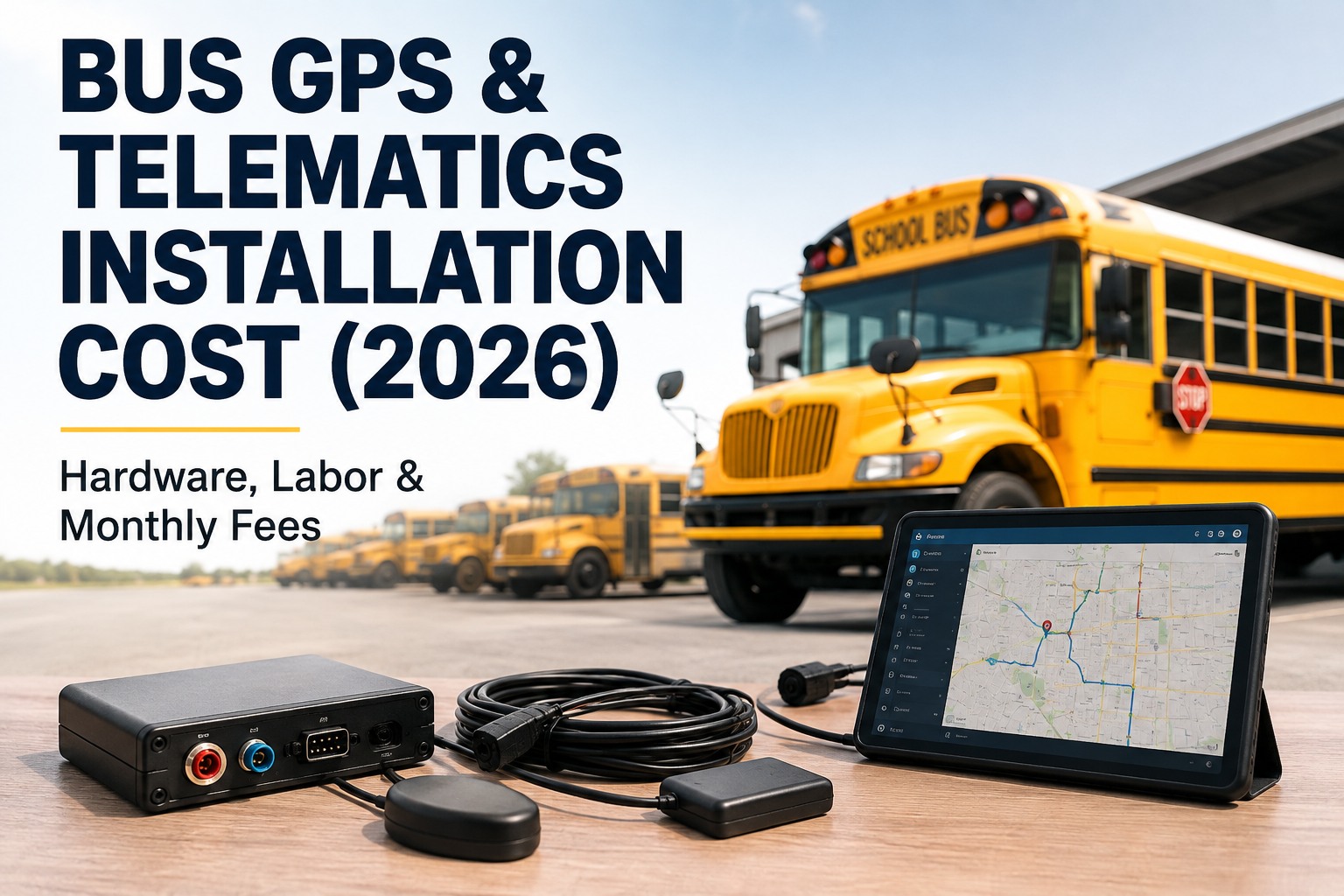
Bus GPS & Telematics Installation Cost
Hardware, install labor, activation fees, and monthly subscriptions -- broken down the way an invoice actually reads.
The 36-Month Cash Flow
When each dollar actually hits your budget.
Watch the upfront spike: hardware + labor + activation land on the first invoice -- roughly $525 per bus, or $26,250 upfront on a 50-bus fleet. School districts and transit agencies budgeting month-to-month get caught off-guard when the P.O. hits capital rather than operating expense.
Pick Your Hardware Tier
3 device classes. Different capabilities. Different install pain.
Plug-and-Play OBD-II
- Plugs directly into the OBD-II port under the dash
- Real-time GPS, engine hours, basic diagnostics
- Movable between buses; no wiring
- Weakness: driver can unplug it; less secure
Hardwired GPS + J1939
- Wired to power, ignition, ground + J1939 CAN bus
- Tamper-resistant, streams full fault codes
- Standard on most bus fleets (Samsara VG, Geotab GO)
- Requires shop time; buses take longer than cars
Telematics + AI Dashcam
- Includes forward + inward-facing AI cameras
- Driver behavior scoring, incident-triggered clips
- Highest ongoing subscription ($45–$65/mo)
- ROI usually justified through insurance discounts
Hardware choice is the smallest cost. The subscription over 36 months is 4-8x bigger. See BusCMMS pull hardware data live → book a demo.
Why Bus Installs Cost More Than the Van Down the Block
Same device. Twice the hours. Different price sheet.
- OBD port at driver's knee
- Single power/ground pull
- Antenna on windshield
- No engine bay access needed
- Labor: $75-$125
- J1939 tap at 9-pin (not OBD-II)
- Full harness routing through firewall
- Antenna needs unobstructed roof mount
- Body panel removal for hidden wiring
- Labor: $125-$250
- Deutsch 9-pin CAN + multiplex tie-in
- Cameras: 3-4 mount points typical
- Cable runs 30+ ft end-to-end
- Coordinate with existing CAD/AVL
- Labor: $200-$400
Batch installs cut labor 40-50%
Shops mobilize once. 10 buses done in a week beats 10 buses over 6 months every time. Bulk installs commonly negotiate labor to under $75 per vehicle even for hardwired units.
Monthly Subscription: The Pricing Pyramid
This is where the real 36-month cost lives.
Enterprise + AI Dashcams + ELD
Samsara enterprise, Motive AI Omnicam, Lytx premium. Insurance-friendly, coaching workflows, video review dashboards. 36-mo contracts standard.
Pro / Standard Fleet
Real-time GPS + driver behavior + geofencing + route optimization. Most bus fleets settle here. Geotab, Zonar, Verizon Connect land in this band.
Basic GPS Tracking
Location, engine hours, basic reports. Fine for small fleets that just need to know where the buses are. Skimps on fault codes and integration.
Tier 2 is the sweet spot for most bus fleets -- unless you can pair it with a CMMS that consumes the data. See how BusCMMS multiplies your Tier 2 spend → book a demo.
The 3-Year Total by Fleet Size
Real math for the 3 tiers, at 4 fleet sizes.
Assumptions: Tier 2 hardwired hardware ($225 avg) + $175 install + $50 activation upfront, then monthly subscription × 36 months. Bulk discount not included -- most fleets negotiate 10-15% off at 25+ buses.
Run your own fleet's 3-year math and see BusCMMS layer on top for $4-$10 per bus per month. Sign up free and try the layered stack today →
5 Hidden Costs the Quote Doesn't Mention
Line items that turn a $70K project into an $85K one.
Downtime During Install
Each bus loses 2-4 hours of service during hardwired install. If you don't have spare units, routes take the hit. Some districts absorb this via weekend batch installs at overtime rates.
4G/5G Cellular Overages
Enterprise dashcam plans stream video clips over cellular. Post-3G-sunset data plans jumped meaningfully. Ping frequency (5-sec vs 60-sec) doubles or triples data cost.
Training & Onboarding
Vendors often bundle "one-time onboarding" fees for dispatcher and admin training. Some waive it. Ask specifically -- it's usually negotiable at contract signing, invisible after.
Early Termination Fees
36-month contracts don't refund on downsizing, bus sales, or agency reorganization. Termination = balance of contract. Read the exit clause before signing anything.
Removal & Reinstall on Bus Rotation
When buses get sold or transferred to another route, hardware doesn't move itself. Uninstall + reinstall = another labor charge. Fleets with rotating buses see this yearly.
The CMMS Gap: Why the Invoice Isn't the Whole Story
A telematics platform tells you where the bus is. It doesn't fix the bus.
Data streams. Nothing changes.
- Fault codes stream into a dashboard nobody in the shop opens
- Mileage updates but PM schedules stay manual
- Dashcam clips get watched after incidents, not before
- DOT audit prep still relies on spreadsheets and paper DVIRs
- Data is rich. Maintenance workflow stays reactive.
Data becomes maintenance action.
- J1939 fault codes auto-create work orders with severity mapped
- Mileage triggers PM at manufacturer intervals -- diesel, propane, CNG, electric
- Bus-specific DVIRs (stop arm, crossing gate, lift, 8-light) pre-loaded
- DOT + FMCSA + NTD reports export in one click
- Every telematics dollar earns 2-4x more in fleet uptime
The multiplier math
Telematics alone captures data. Telematics + CMMS turns data into work orders, PM triggers, and audit trails. For $4-$10 per bus per month on top of your GPS spend, BusCMMS is often the smallest line item on the fleet's tech stack -- and the one that determines whether the other lines pay for themselves.
The invoice above isn't the whole story. The CMMS layer is what closes the loop. See BusCMMS wired to your GPS in 20 min → book a demo.
Our board approved a $118K three-year contract for Samsara Enterprise on 42 buses. The install went smooth, the dashboard is beautiful, and 14 months in we realized nobody in the shop was using any of it. Fault codes streaming, mileage updating, dashcam clips uploading -- into a portal that only two people had logins for. Added BusCMMS on top for a fraction of the monthly cost. Now every fault code becomes a work order the tech gets on their phone. Same telematics investment. Actually earning the ROI now.
Still budgeting the GPS invoice? Add the CMMS line item -- it's the one that turns the other four into ROI. See the full stack in 20 min →
Frequently Asked Questions
How much does bus GPS installation cost per vehicle in 2026?
A standard hardwired GPS install on a Type C school bus runs $125-$250 in labor plus $150-$300 for the hardware itself, with an activation fee of $25-$75. Plug-and-play OBD-II trackers are cheaper -- around $50-$150 hardware with no professional labor -- but less secure and skip fault code streaming. Enterprise setups with AI dashcams run higher: $300-$600 hardware plus $200-$400 install for the extra camera mounting. Total upfront cost per bus for a standard hardwired setup lands around $300-$625. Bulk fleet installs commonly negotiate labor to under $75-$100 per vehicle because shops amortize mobilization across a batch.
What's the real 3-year total cost of GPS on a 50-bus fleet?
For a 50-bus fleet on Tier 2 hardwired GPS with a standard $35/month subscription, the 3-year total lands around $70,500-$89,000 -- roughly $26,000 upfront (hardware + install + activation) plus $63,000 in monthly subscription across 36 months. Enterprise Tier 3 with AI dashcams and ELD runs closer to $110,000-$135,000 over 3 years for the same fleet. Basic Tier 1 tracking runs closer to $54,000. Actual quotes vary by vendor, contract length, and negotiated bulk discounts -- most fleets negotiate 10-15% off list at 25+ vehicles.
Why do buses cost more to install than vans or cars?
Three reasons. First, buses use a 9-pin Deutsch J1939 connector, not the OBD-II port on cars -- different tap point and different harness. Second, the antenna needs an unobstructed roof mount that usually requires body panel removal and hidden cable routing through the firewall. Third, buses are longer -- cable runs on a 40-ft transit bus can hit 30+ feet end to end. A standard van install runs 45-90 minutes at $75-$125 in labor. A hardwired install on a Type C school bus runs 2-4 hours at $125-$250. Transit and motorcoach installs with cameras can hit 3-6 hours and $200-$400 in labor.
Are there hidden costs the vendor quote doesn't include?
Yes -- five common ones. Downtime while buses are in the shop for install ($50-$150 per bus in lost route time). 4G/5G cellular data overages on high-ping-frequency plans or dashcam video streaming ($25-$60/month per bus above base). One-time training and onboarding fees ($500-$2K per site, often negotiable). Early termination clauses that owe the balance of a 36-month contract if the fleet downsizes. And hardware removal/reinstall labor when buses rotate to a new route or get sold ($100-$400 per event). Read the exit clause and cellular data terms before signing.
Do I still need a CMMS if I already have Samsara or Geotab?
For most bus fleets, yes -- telematics and CMMS solve different problems. Samsara, Geotab, Zonar, and similar platforms capture where the bus is and stream fault codes into a dashboard. They do not schedule PM, generate work orders, track parts inventory, or produce DOT audit documentation. The most common gap fleets discover 12-18 months into a telematics contract is that the data streams but nobody in the shop opens the dashboard. Adding a CMMS like BusCMMS ($4-$10 per bus per month) on top of the existing telematics turns fault codes into work orders, triggers PM from mileage, and closes the maintenance workflow. BusCMMS integrates natively with Samsara, Geotab, and Zonar via API.