Bus HVAC system failures cost $2,400-$6,800 per repair event and directly impact student comfort, driver safety, and fleet operational availability. A refrigerant leak discovered in July can cascade into compressor failure by August, extending repair time from 2 days to 8 days and spreading $1,200 in preventive maintenance cost into $4,200 in emergency repairs. This comprehensive bus HVAC inspection checklist covers seasonal maintenance timing, refrigerant system health assessment, heater core diagnostics, ductwork inspection, compressor condition monitoring, compliance with EPA refrigerant handling standards, FAQ answers, and digital tracking strategies that catch cooling system failures 3-4 weeks before catastrophic breakdown.
EPA Compliant · Seasonal Maintenance Ready
Bus HVAC Inspection Checklist: Complete Seasonal Maintenance Guide
Spring prep checklist. Summer monitoring protocol. Fall maintenance sequence. Winter heating diagnostics. Every item a roadside inspector checks. Every metric that predicts cooling system failure 3-4 weeks in advance.
System Component Zones
Why Bus HVAC Maintenance Matters: The Cost of Neglect
School buses and transit buses operate HVAC systems 8-12 hours daily for 200-240 days annually. A single refrigerant leak loses 5-8% of system charge monthly, degrading cooling capacity imperceptibly until suddenly, on a 95-degree July day, the bus interior reaches 115 degrees and drivers must reroute to avoid heat-related illness. Compressor wear accelerates exponentially once refrigerant levels drop below 80% capacity — the compressor works harder to move less refrigerant, heat stress increases, bearing wear accelerates, and failure becomes inevitable within 8-12 weeks.
The financial impact is severe. A preventive refrigerant recharge costs $180-$280 and takes 1-2 hours. A compressor replacement costs $1,800-$2,400 and requires 6-8 hours of labor. A full system rebuild (compressor + condenser + evaporator + ductwork) costs $4,200-$6,800 and removes the bus from service for 3-5 days. For a 120-bus fleet operating on thin margins, even one compressor failure in July can cascade into fleet-wide cooling issues if preventive maintenance isn't catching system degradation early.
EPA refrigerant handling regulations (Clean Air Act Title VI) add compliance complexity. R-134a refrigerant is standard on buses manufactured after 1995. Handling, recovery, and disposal of refrigerant requires EPA certification (Section 608 certification for technicians). Illegal venting of refrigerant to atmosphere carries $25,000+ fines per violation. Digital HVAC tracking enforces EPA compliance by documenting every refrigerant service, technician certification, and recovery procedures in audit-ready records.
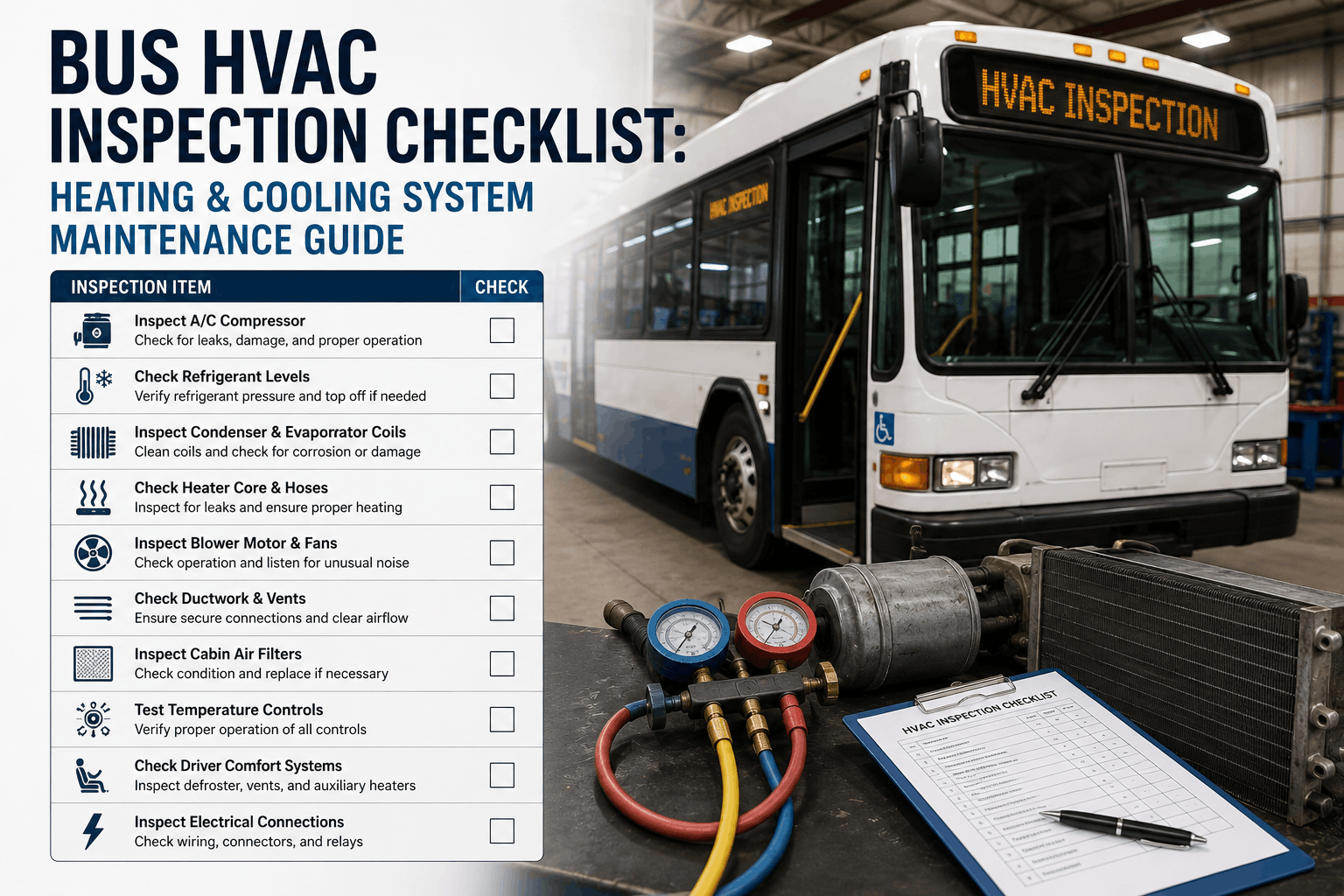
Complete Bus HVAC Inspection Checklist: 22-Point Protocol
This inspection follows the HVAC system flow: compressor → condenser → evaporator → ductwork → controls. Perform seasonal inspections every 90 days (spring, summer, fall, winter variations). Summer inspections (June-August) emphasize cooling system health. Winter inspections (November-February) focus on heater core function. Spring and fall inspections verify system readiness for temperature extremes approaching.
1
Compressor Mechanical Inspection — Visual check for oil leaks around compressor housing and shaft seal. Listen for unusual grinding or squealing during idle. Measure compressor clutch engagement: should engage within 0.5 seconds of AC activation. Clutch disengagement (failure to cool when activated) indicates electrical fault or mechanical seizure. Document any evidence of previous repair (solder joints, recent belt replacement).
2
Refrigerant System Pressure Reading (High/Low Side) — Connect refrigerant manifold gauge set to high-side (discharge) and low-side (suction) ports. Record pressure readings with engine at 1,500 RPM and AC at full cold setting. Normal operating pressures: High-side 200-250 PSI, Low-side 25-35 PSI (varies by ambient temperature and bus model). Pressure imbalances indicate refrigerant charge loss or system blockage. Readings trending downward weekly indicate active leak.
3
Refrigerant Charge Quantity Verification — EPA-certified technician performs charge verification per EPA Section 608 standards. Proper charge specified on compressor nameplate or engine compartment placard. Undercharge by more than 10% automatically triggers system service. Overcharge (common error leading to high-side pressure spikes and compressor stress) also requires recharge. Charge verification required annually minimum, quarterly in high-use fleets.
4
Refrigerant System Leak Detection — Visual inspection for oil accumulation at connection points (indicates active leak). Fluorescent dye leak detection optional but recommended for small leaks hard to spot visually. Electronic leak detector scan of all connections and hoses (sensitivity: detects 0.5 oz/year or greater leak rate). Pressure drop over 2-week period indicates active leak requiring immediate repair to prevent system failure.
5
Condenser Fan Operation — AC condenser mounted in front radiator area requires fan operation to dissipate heat. Verify fan engages when engine temperature exceeds 195°F or AC system pressure exceeds 225 PSI. Listen for fan blade engagement (audible noise or vibration). Airflow through condenser fins should be strong and unobstructed. Blockage by debris, dead insects, or bent fins reduces heat rejection capacity by 25-40%.
6
Condenser Fin Condition — Visual inspection for bent, corroded, or plugged condenser fins. Fins can be straightened with specialized fin comb if damage is light. Severe corrosion in coastal environments or road salt exposure may require condenser replacement. Fin blockage reduces system efficiency by 15-30% per 10% of surface area blocked. Gentle air pressure cleaning (not pressure wash) recommended quarterly in high-dust environments.
7
Evaporator Inlet Temperature Measurement — Measure temperature at evaporator inlet (low-side refrigerant line) during operation. Normal inlet temperature: 45-55°F depending on ambient. Temperature below 45°F indicates potential evaporator blockage or expansion valve malfunction. Temperature above 55°F (while AC is running) indicates insufficient refrigerant charge or compressor inefficiency. Sweat condensation on low-side lines indicates proper system operation.
8
Evaporator Drain Line Inspection — Evaporator core condensation drains through dedicated line exiting vehicle underside. Blockage causes moisture to accumulate inside evaporator, leading to mold growth, odor, and reduced cooling efficiency. Verify drain line is clear and dripping during cooling operation. Flush drain line annually with compressed air or drain cleaning solution to prevent blockage.
9
Ductwork and Air Distribution — Verify air vents on driver and passenger sides are open and clear of obstructions. Check that air flows from AC vents with uniform speed and temperature. Blockages in ductwork (caused by debris, collapsed ducts, or blocked registers) reduce cooling effectiveness. Listen for whistling or grinding sounds indicating duct damage or component malfunction. Ensure controls are responsive when adjusting temperature and fan speed.
10
Cabin Air Filter Condition — Many buses equipped with cabin air filters (secondary filters upstream of AC core). Inspect filter for dirt accumulation, color darkening, or debris. Clogged cabin filter restricts airflow 30-50%, reducing cooling effectiveness and increasing compressor load. Filter replacement interval typically 12-15 months or 15,000-20,000 miles. Replace immediately if visibly clogged or if airflow dramatically reduced.
11
Engine Coolant Circulation (Heater Supply) — Heater function depends on engine coolant circulation through heater core (separate circuit from AC refrigerant system). Verify engine coolant at proper level and concentration (50/50 antifreeze/water). Start engine, set heater to hot, verify hot air flows from heater vents within 3 minutes of engine start. Cold heater output indicates low coolant level, stuck thermostat, or heater core blockage.
12
Heater Core Condition Assessment — Check for sweet-smelling coolant odor (indicates leaking heater core). Inspect floor mats for moisture or coolant staining (evidence of heater core leak). Monitor coolant level: significant weekly loss indicates heater core leak. Heater core replacement cost ($800-$1,200) and labor (4-6 hours) often justifies early core replacement when leak is detected before major damage occurs.
13
Climate Control Panel and Switches — Test all HVAC control functions: temperature dial, fan speed dial, mode selection (vent/AC/heater/defrost), and air intake selection (fresh/recirculate). Switches should be responsive without binding or grinding. AC button should engage compressor clutch audibly. Defrost function should redirect airflow to windshield and side windows. Non-responsive controls indicate electrical fault or corrosion inside control panel.
14
Thermal Output Verification — Measure interior cabin temperature with AC running at full cold: target 65-68°F interior at 95°F ambient (startup), reaching target within 8-10 minutes. Measure heat output with heater running: target 85-90°F interior at 20°F ambient within 5 minutes of full heat operation. Slow heat-up indicates airflow restriction, coolant flow problem, or blower motor weakness.
15
Blower Motor Operation — Blower motor circulates air through AC and heating systems. Test all fan speeds: low, medium, high. Motor should be quiet (no grinding or squealing). Current draw should increase with fan speed increase. Failed bearings produce high-pitched noise. Weak air output indicates motor wear or capacitor failure. Blower motor replacement ($200-$350) is cost-effective preventive maintenance before complete motor failure.
16
Refrigerant Recovery and Service Records Documentation — All refrigerant service (recharge, recovery, system evacuation) must be documented by EPA-certified technician (Section 608 Certification). Recovery equipment used must be EPA-approved. Disposal of recovered refrigerant must be through EPA-licensed recovery center. Maintain service records for minimum 3 years per EPA audit requirements. BusCMMS auto-logs all refrigerant service with technician certification verification.
17
Belt and Hose Condition (AC System Specific) — AC compressor driven by serpentine belt. Inspect belt for cracks, fraying, or debris contamination. Belt tension measured with tension gauge: target 60-120 lbs force depending on belt type. Loose belt slips, reducing compressor speed and cooling effectiveness. Tight belt strains bearings and shortens bearing life. Refrigerant hoses inspected for cracks, bulging, or leaks. Hoses typically require replacement every 10-12 years due to rubber degradation.
18
Expansion Valve (Orifice Tube) Operation — Expansion valve regulates refrigerant flow from condenser into evaporator. Blockage or stuck valve restricts cooling. Leaking valve allows excessive refrigerant into evaporator. Proper operation: slight cooling of expansion valve body during AC operation (verify with infrared thermometer: should be 5-10°F cooler than surrounding components). Failed valve requires system evacuation and replacement ($250-$400 parts + labor).
19
Vibration and Noise Assessment — Operate AC system and listen for grinding, squealing, or knocking sounds. Vibration felt at steering wheel or floor indicates compressor misalignment or bearing wear. Grinding sound indicates bearing failure imminent. Squealing indicates belt slippage or pulley bearing wear. Record any unusual sounds for technician diagnosis. Video recording recommended for technical support analysis.
20
Temperature Stratification in Cabin (Multi-Zone Assessment) — School buses often have temperature variation from driver to rear seats due to air distribution design. Measure temperature at driver location, mid-bus, and rear passengers. Temperature variation should not exceed 8-10°F between hottest and coldest zones. Larger variation indicates blockage in ductwork or failed zone blend door controls in buses with temperature zoning.
21
Seasonal Preparation (Spring/Summer/Fall/Winter) — Spring (March-April): Full AC system charge verification, condenser cleaning, blower motor test before peak cooling season. Summer (June-August): Monthly pressure checks, refrigerant leak detection, electrical connector inspection. Fall (September-October): Heater system prep, thermostat function test, coolant concentration check. Winter (November-February): Weekly heater output monitoring, defrost system verification, cabin defroster effectiveness assessment.
22
Predictive Analytics: Refrigerant Charge Trend Analysis — Digital HVAC systems track refrigerant pressure weekly and calculate charge loss rate. Pressure decline of 10-15 PSI per month indicates small leak. Decline of 25-40 PSI per month indicates moderate leak requiring urgent attention. Sudden pressure drop indicates major leak (compressor seal failure or connection rupture). Trend analysis catches leaks at 5-10% loss before cooling effectiveness noticeably degrades, allowing planned maintenance instead of emergency repairs.
Seasonal Inspection Schedule: When to Check What
HVAC System Failures by Season (per 150-Bus Fleet)
Refrigerant Leak Detection: Early vs. Late Intervention Cost
Preventive HVAC Maintenance vs. Emergency Repairs (Annual Cost Per Bus)
Temperature Complaint Rate: Preventive vs. Reactive Maintenance
24%
Preventive
68%
Reactive Only
Customer Success: HVAC Compliance and Cost Control
Our 95-bus transit fleet was spending $47,000 annually on emergency AC repairs during summer months, with multiple buses out of service mid-route when cooling failed. We switched to quarterly HVAC inspections with pressure trend tracking. In year one, preventive refrigerant recharges cost $8,400 total. Emergency repairs dropped to $6,800. Net savings: $32,000 annually. Zero mid-route AC failures in summer 2024 (compared to average 8 failures in previous three summers). Driver complaints about temperature control dropped 71%. Next step: EPA compliance documentation — every refrigerant service now auto-logged with technician certification attached.
— Fleet Maintenance Director, 95-bus transit system, Texas
Frequently Asked Questions: Bus HVAC Maintenance
How often should school buses and transit buses have HVAC inspections?
Seasonal inspections recommended every 90 days (spring, summer, fall, winter). Summer months (June-August) require monthly pressure monitoring and leak detection due to peak cooling demand stress. EPA regulations require annual EPA Section 608 refrigerant system verification by certified technician.
What is the normal refrigerant pressure range for a school bus AC system?
Normal operating pressures depend on ambient temperature and bus model specifications. Typical range: High-side 200-250 PSI, Low-side 25-35 PSI at engine idle with AC at full cold. Readings below 180 PSI (high-side) or above 40 PSI (low-side) indicate charging issue or system blockage requiring technician service.
What certification do technicians need to service bus HVAC refrigerant systems?
EPA Section 608 Certification required for all refrigerant service work in United States. Three types: Type I (small appliances), Type II (high-pressure systems like bus AC), Type III (low-pressure systems). Bus AC requires Type II minimum. Certification valid for 5 years. Technicians must pass EPA exam or attend approved training course.
How can fleet managers predict HVAC failure before it becomes an emergency?
Trend analysis of refrigerant pressure readings over 4-8 week period reveals leak rate and remaining system health. Pressure declining 10-15 PSI monthly indicates slow leak detectable 3-4 weeks before cooling effectiveness noticeably degrades. Digital HVAC tracking systems auto-calculate leak rate and flag buses needing service before emergency failure occurs.
What is the cost difference between preventive HVAC maintenance and reactive emergency repairs?
Quarterly preventive inspections ($200-$300 per inspection) cost $840-$1,200 annually. Emergency compressor replacement ($1,800-$2,400) plus downtime costs ($800-$1,500 per day) average $4,500-$8,000 per incident. Preventive approach saves 60-75% annually for fleets experiencing 2-4 emergency failures per year.
Can digital HVAC checklists help with EPA refrigerant handling compliance?
Yes. BusCMMS auto-logs all refrigerant service (recharge, recovery, evacuation) with EPA-certified technician verification, recovery equipment documentation, and disposal facility records. Creates permanent audit trail satisfying EPA record-keeping requirements (minimum 3 years). Prevents compliance violations and $25,000+ fines for improper refrigerant handling.
What is the difference between AC compressor failure and refrigerant leak?
Refrigerant leak causes gradual pressure loss over weeks/months (usually 5-20 PSI loss per week depending on leak size). Compressor failure causes sudden pressure loss (complete system depressurization in minutes) with audible grinding or squealing. Leak detected early ($280-$400 repair). Compressor failure detected late ($1,800-$2,400 replacement and possible secondary damage to condenser/evaporator).
Should school districts maintain separate HVAC maintenance schedules for different bus ages?
Yes. Buses over 8 years old require more frequent inspections (monthly vs. quarterly) due to increased wear on seals, bearings, and hoses. Newer buses (0-4 years) may extend inspection intervals to semi-annual if performing well. Digital HVAC tracking auto-adjusts inspection frequency based on vehicle age, failure history, and pressure trend analysis.
22-Point HVAC Protocol. 4 Seasonal Variations.
Zero Emergency Failures During Peak Season.
This complete bus HVAC inspection protocol — guided on mobile, pressure trended weekly, leak rate calculated automatically, EPA compliance documented. Catch cooling system failures 3-4 weeks before breakdown. Preventive maintenance saves $32,000+ annually per 100-bus fleet. Free 14-day trial.