It is 5:45 AM. Twelve buses pull out in an hour, three came back with open defects, two techs are in, and dispatch is already asking which routes are covered. Everything feels urgent, so what gets the wrench first? That is what bus maintenance triage answers — rules that set the order before the morning sets it for you. You can see a ranked work-order queue run the morning in a short demo.
OPERATIONS · MORNING SHOP RUSH
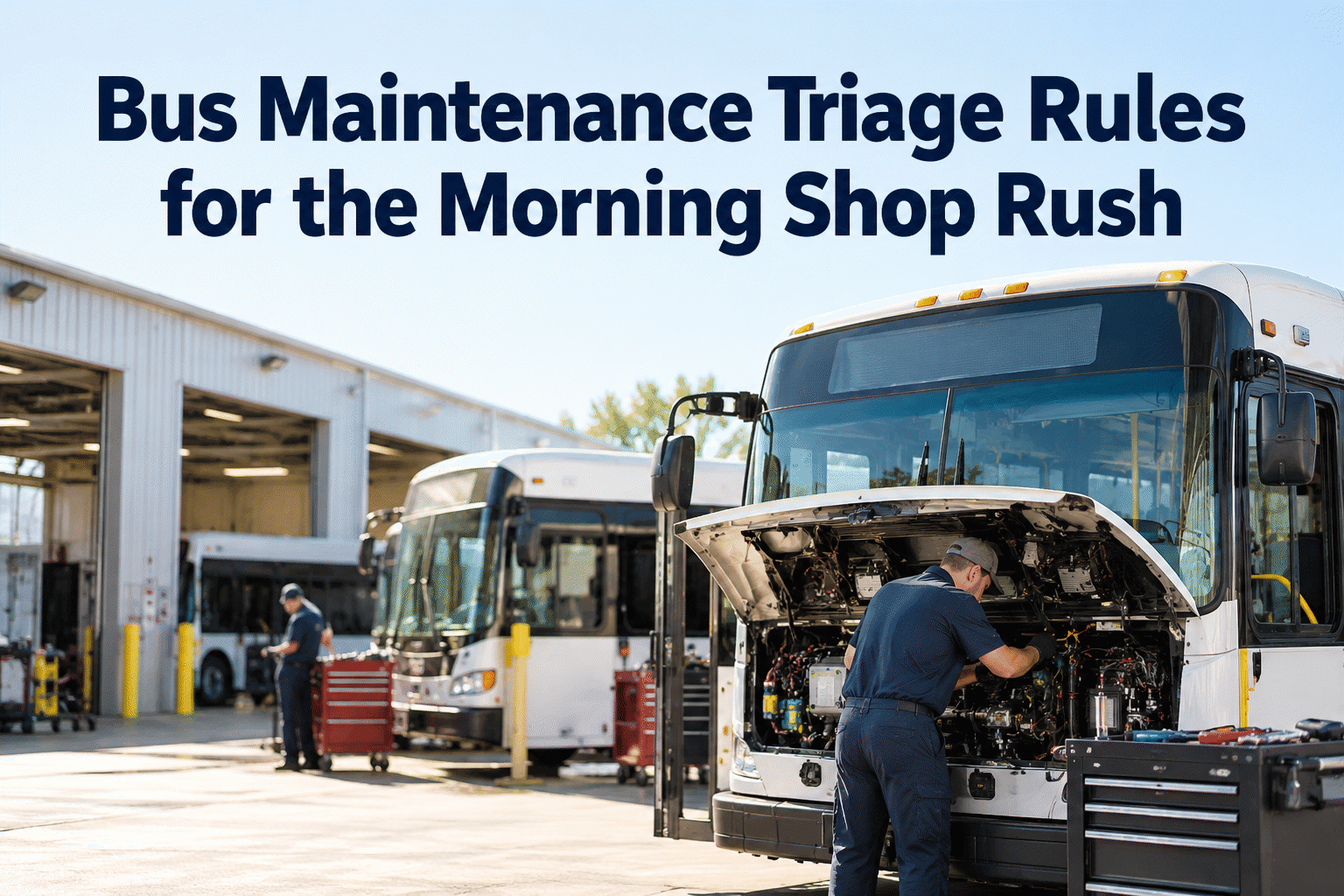
Bus Maintenance Triage Rules for the Morning Shop Rush
When every bus feels like a priority, nothing is. Triage rules sort the morning the way an ER sorts patients — by what actually can't wait. Here are four tiers that decide the order, and how BusCMMS ranks the queue for you before the first bus rolls.
THE FOUR-TIER TRIAGE LADDER
Why the Morning Shop Rush Breaks Without Triage Rules
The morning window is short and the math is unforgiving. Buses have to be inspected, cleared, and rolled before the first bell, and the defects do not line up politely. Without a rule for what comes first, the loudest problem wins — not the most important one — and a bus that could have been swapped sits in a bay while a route goes uncovered.
THE 5-TO-7 AM SQUEEZE
Illustrative morning. Same eight buses, same two techs — the only difference is the order the work is attacked in. Triage is what turns a five-route shortfall into a clean pullout.
The Bus Maintenance Triage Decision: One Rule Per Bus
Triage is not a vibe, it is a decision tree. Run every defect through the same three questions in the same order, and each bus lands in a tier without an argument. The point is that the rule decides, not the loudest driver or the squeakiest wheel.
RUN EVERY DEFECT THROUGH THE SAME QUESTIONS
The order of the questions is the whole trick. Safety first because a safety-critical bus is not a choice — it comes out of service either way. Everything below it is about keeping routes covered with the capacity you have.
A P2 bus — one needed for a route but not safety-critical — is the hardest morning call. Fix it now and the route may wait; swap a spare and the route rolls on time while the repair moves to the day. The right answer depends on two things you need to know instantly: is a spare available, and how long is the fix?
P2 BUS: SWAP OR FIX?
This is why a live availability board matters more than a faster wrench in the morning — the swap-or-fix call is only as good as knowing, right now, what spare you have and what is wrong with the bus.
If you are writing the shop's triage rules on the wall, this is the order that holds up under pressure. The first two are non-negotiable; the rest keep the backlog honest so it does not become tomorrow's emergency.
Safety-critical defects come out of serviceA bad brake, steering, or stop arm is not triaged against routes — the bus does not roll, period.
P1
Route-blocking buses get the spare-or-fix call nextCover the route first — swap if a spare is ready, fix if it is quick, escalate to dispatch if not.
P2
Same-day issues wait until P1 and P2 clearA bus that runs but needs attention is real work, just not before the ones that stop a route.
P3
Backlog gets slotted, not forgottenEvery deferred job keeps its place in the queue and surfaces at the next open bay or PM window.
P4
One owner per bus, no double-handlingAssign each work order to a tech so two people are not chasing the same bus while a third sits.
Triage rules on a whiteboard still depend on someone sorting the chaos every morning. BusCMMS does the sorting in the system, so the queue you open at 5 AM is already ranked and assignable — the rules run themselves.
Prioritized work-order queue
Every defect becomes a work order with a priority tier, so P1 and P2 jobs sort to the top instead of whatever was reported loudest.
Failed DVIRs flow in ranked
A driver's pre-trip defect — a dead stop arm, a soft brake — creates a work order with severity already attached, so it is triaged before you see it.
Live fleet-availability board
See which buses are route-ready and which spares are open right now — the swap-or-fix call without a walk to the back lot.
One assignment per job
Each work order routes to a technician, so no two people chase the same bus and nothing slips between shifts.
95%+fleet availability — BusCMMS's own reported customer result~$2,800per bus a year — BusCMMS's own reported average savings2–4 wkstypical rollout — bus-specific, not a months-long generic CMMS setup
Those are BusCMMS's own reported figures from customer data, and the reason is simple: a ranked queue means the right bus gets the wrench first, every morning.
A Shop Foreman's Take
Key Takeaways on Bus Maintenance Triage
Bus maintenance triage turns the morning scramble into a sequence you can trust. Four things to hold onto.
01
Order beats effort
Same techs, same buses — the sequence decides whether every route rolls.
02
Safety is not triaged
A safety-critical bus comes out of service; it sits above the route question.
03
Swap to cover, fix to keep
A ready spare beats a fast wrench when a route is on the line.
04
Let the queue sort it
Rules built into work orders rank the morning so you do not have to.
Write the rules, build them into the queue, and the morning shop rush stops running you. Good bus maintenance triage is not about working faster — it is about pointing the work you have at the buses that matter most, in the minutes that count.
FAQ
Bus Maintenance Triage: Common Questions
What is bus maintenance triage?+
Bus maintenance triage is the practice of ranking repairs by urgency so the shop fixes the right buses first — especially during the tight morning window before routes roll. Like an emergency room sorting patients, it puts a rule ahead of the panic: safety-critical defects come first, then buses needed for a route today, then same-day issues, then the scheduled backlog. The goal is not to work faster but to work in the right order, so limited techs and a short morning clear the jobs that would otherwise strand a route or put an unsafe bus on the road. A good triage system is written down and consistent, so the same defect gets the same priority no matter who is at the counter.
How do you prioritize bus repairs in the morning?+
Run every defect through the same questions in the same order. First: is it safety-critical — brakes, steering, a stop arm, anything that makes the bus unsafe? If yes, the bus comes out of service regardless of the route. If no, does it block a route today? If yes, make the swap-or-fix call — put a spare in if one is ready, fix it if the repair is quick, escalate to dispatch if neither works. If it does not block a route, does it degrade the bus enough to need same-day attention, or can it be slotted into the backlog? That order — safety, then route coverage, then same-day, then scheduled — keeps the loudest complaint from jumping ahead of the most important repair. Building the tiers into your work orders makes the ranking automatic instead of a daily judgment call under pressure.
What counts as a safety-critical bus defect?+
A safety-critical defect is one that makes the bus unsafe to operate — the kind that should take it out of service rather than onto a route. On a school bus that typically includes brake problems, steering issues, a non-functioning stop arm or crossing gate, bad lights in the 8-light warning system, tire or wheel defects, and anything affecting the emergency exits or a wheelchair lift that carries riders. These are not triaged against route coverage, because the choice has already been made for you: an unsafe bus does not roll. That is exactly why safety sits at the top of the triage ladder — it is the one tier that is a rule, not a decision. The rest of triage is about covering routes with the capacity you have left once the unsafe buses are set aside.
Should I swap a spare bus or fix the one that's down?+
For a route-blocking bus that is not safety-critical, the call comes down to two facts: is a spare available, and how long is the repair? If a spare is ready, swapping it is almost always the better move — the route rolls on time and the repair moves to the day when it is not costing you a pullout. If no spare is available, a genuinely quick fix can beat waiting, but a long repair means the route is at risk and dispatch needs to know now, not at 6:55. The reason this call goes wrong is usually missing information: not knowing which spares are open or what is wrong with the bus. A live fleet-availability view makes the swap-or-fix decision fast and right instead of a walk to the back lot.
How does BusCMMS help with maintenance triage?+
BusCMMS does the sorting so the queue is ranked before you walk in. Every defect becomes a work order with a priority tier, so safety-critical and route-blocking jobs rise to the top instead of whatever got reported loudest. Failed digital DVIRs flow in as work orders with their severity attached, so a driver's pre-trip defect is already triaged. A live fleet-availability board shows which buses are route-ready and which spares are open, which is what makes the swap-or-fix call fast. And each work order is assigned to one technician, so no two people chase the same bus. BusCMMS reports customer fleet availability of 95% or higher and average savings around $2,800 per bus a year — company-reported figures from its own data, driven by the simple fact that a ranked queue puts the wrench on the right bus first.