Bus Operators With Unverified Speed Limiters Face Permit Revocation | Bus CMMS
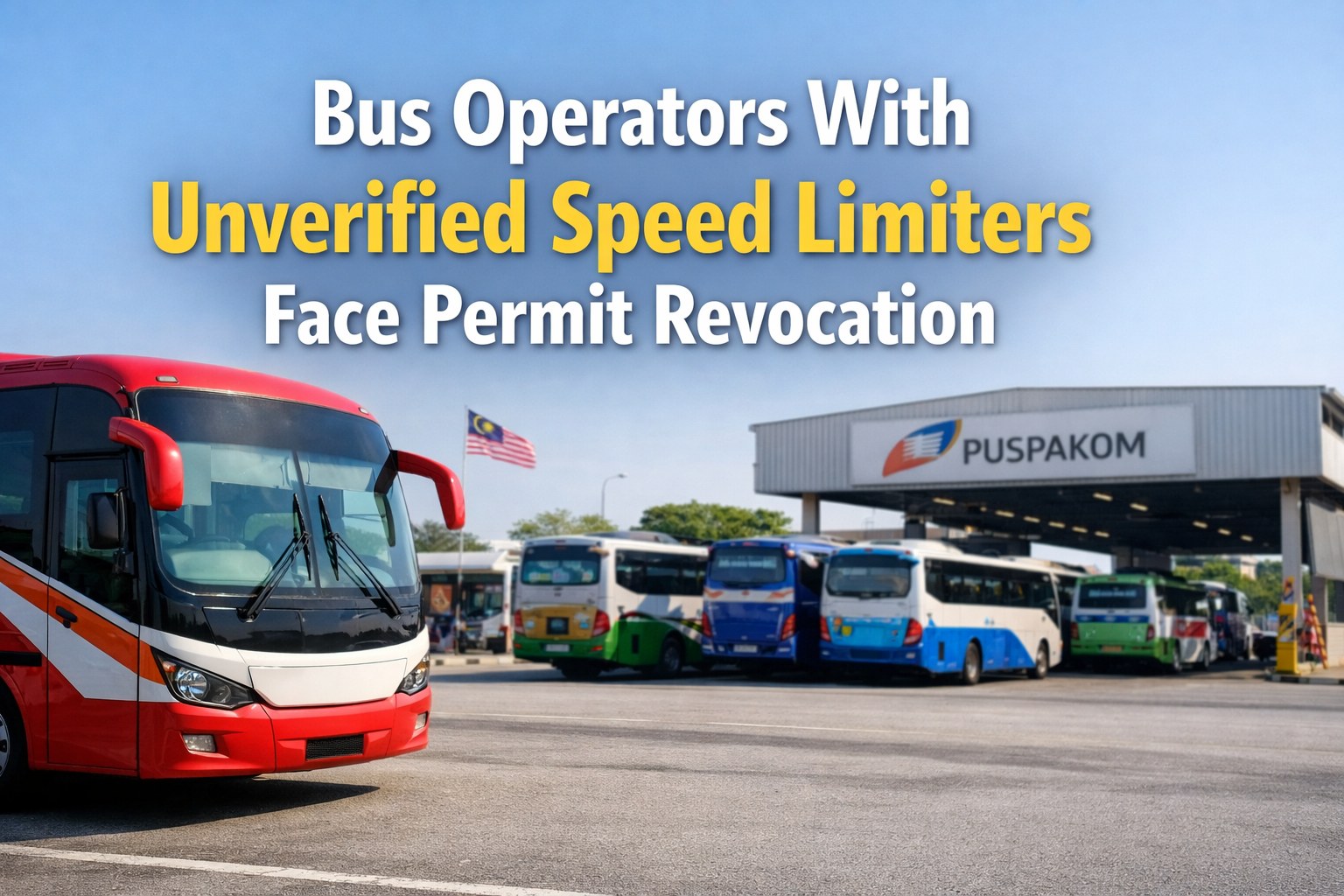
On 24 September 2025, JPJ sent a memo to every major transport association in Malaysia. The message was simple: the Phase 3 SLD retrofit deadline for commercial buses is 1 July 2026. No more extensions. No grace period after that date. Any bus operator who cannot produce a valid SLD Functionality Verification Report at PUSPAKOM inspection or during APAD permit renewal faces immediate permit revocation — not a fine, not a warning, but the revocation of the licence that allows you to operate. As of October 2025, 97% of the 108,805 targeted vehicles had not yet completed SLD verification. That number has moved since, but it tells you exactly how many operators are still racing toward this deadline without a compliance tracking system in place. If your fleet has buses registered before 1 January 2015, this deadline is about your operating permit — and it is less than four months away.
JPJ Phase 3 Enforcement Deadline
1 July 2026
SLD retrofit mandatory · Permit revocation for non-compliance · No further extensions confirmed
108,805
Vehicles targeted nationwide
97%
Still unverified as of Oct 2025
2 yrs
Verification renewal cycle
The Three-Phase SLD Enforcement Timeline — Where Your Fleet Stands
JPJ's mandatory SLD enforcement follows three distinct phases. Each phase targets a different vehicle category. Miss the relevant phase for your fleet and your permit renewal becomes a revocation notice.
ENFORCING
1 Oct 2025
Phase 1
Post-2015 Buses SLD Verification
All buses and goods vehicles registered from 1 January 2015 onwards must have a valid SLD Functionality Verification Report. Must be produced at PUSPAKOM inspection and APAD permit renewal. Renewed every 2 years.
Buses M3 category · registered after Jan 2015
ACTIVE NOW
1 Jan 2026
Phase 2
Pre-2015 Buses ECU Activation
Buses registered before 1 January 2015 that have SLD capability in their ECU must activate it now. Activation must be verified by a JPJ-recognised workshop. Rebuilt/imported vehicles were extended to Phase 3.
Buses M3 category · registered before Jan 2015 with ECU SLD capability
DEADLINE
1 Jul 2026
Phase 3
Retrofit SLD Installation Required
Buses without any built-in SLD capability must have a JPJ-approved retrofit SLD device installed by an authorised workshop. This applies to rebuilt and imported vehicles. The installation must be certified and a Verification Report issued.
All buses without built-in SLD · rebuilt/imported vehicles · permit revocation if missed
All phases require the same documentation: SLD Functionality Verification Report — obtained from the vehicle OEM, a JPJ-recognised Technical Services centre, or an authorised certified workshop. Valid for 2 years. Must be present at PUSPAKOM, APAD permit renewal, and inside the vehicle for JPJ roadside enforcement at all times.
Compliance is not just about installing the device. JPJ enforcement and APAD permit renewal both require specific documents — and every document has an expiry date that must be tracked. Missing any one of them at inspection means your bus does not leave the compound.
Doc 1
SLD Functionality Verification Report
Issued by: vehicle OEM, JPJ-recognised Technical Services centre, or authorised certified workshop. This is the primary compliance document. Required at every PUSPAKOM inspection and APAD permit renewal. Must be physically kept in the vehicle for JPJ roadside enforcement.
Expires: Every 2 years from issue date — must be renewed before expiry
Doc 2
SLD Functionality Verification Slip (Borang)
Issued alongside the Report at the time of verification. For vehicles with OEM-fitted SLDs, this slip comes from the manufacturer. For retrofit SLDs, it is issued by the JPJ-recognised company that performed the installation. Must be uploaded to JPJ's online system weekly by the verifying party.
Tied to the 2-year Report cycle — both expire and renew together
Doc 3
JPJ OPS PEWA Upload Confirmation
All parties involved in the SLD verification process must upload the vehicle's verification slip and functionality report to JPJ's OPS PEWA online system. JPJ requires this to be updated weekly. Without the digital record in the JPJ system, your physical documents may not be sufficient at inspection.
Ongoing requirement — verifying party must update weekly
Doc 4
Workshop / Installer Certification Proof
For retrofit SLD installations, the installing workshop must be JPJ-approved. Only OEM manufacturers, JPJ-recognised Technical Services centres, or accredited certification bodies can legally certify an SLD. Using an unauthorised installer invalidates your documentation regardless of whether the device works correctly.
Required at: Phase 3 installation for all retrofit vehicles
BusCMMS stores every vehicle's SLD Verification Report, tracks the 2-year renewal deadline per bus, and alerts you 60 days before any document expires. Set up your fleet now — before the queue at authorised workshops gets impossible.
What Happens If You Miss the Deadline — The Consequence Flow
The consequences of non-compliance are not ambiguous. Transport Minister Anthony Loke stated them explicitly in June 2025. Here is exactly what the enforcement sequence looks like for a bus operator who arrives at the deadline without verified SLD compliance.
Trigger
JPJ Roadside Check or PUSPAKOM Inspection After 1 July 2026
JPJ enforcement teams conduct roadside checks using Notice 114 (Notis Panggilan Temu Siasat). Operators are given 14 days to produce SLD documentation after a notice is issued. If documents cannot be produced or are expired — enforcement proceeds.
Step 1
Vehicle Barred from Operating — Immediately
A bus found without a valid SLD Verification Report cannot continue its route. Passengers must be accommodated via alternate transport. The vehicle is grounded until compliance is established — which, after the deadline, requires going through the full retrofit or verification process.
Step 2
APAD Permit Renewal Blocked
At permit renewal, APAD requires the SLD Functionality Verification Report as a mandatory submission document. Without it, renewal cannot proceed. A permit that cannot be renewed lapses — and a lapsed permit means the operator cannot legally provide commercial transport services.
Final
Operator Licence Revoked
The Transport Minister's statement was unambiguous: operators whose SLDs are found non-compliant after the grace period ends face permit revocation. This is not a fine that preserves your ability to operate. Revocation means the commercial transport business stops — routes cancelled, vehicles grounded, revenue halted — until the licence is reissued, if it is reissued at all.
Expert Review: How BusCMMS Keeps Your Permit Safe
The operators who lose their permit on 1 July 2026 will not lose it because they failed to install the SLD. Most will lose it because a document expired, a renewal was missed, or they had no system telling them a deadline was approaching. Here is exactly what BusCMMS does to close each gap.
01
Store Every SLD Document Per Vehicle
Each bus in BusCMMS has a dedicated document vault. Upload the SLD Functionality Verification Report, Verification Slip, installer certification, and PUSPAKOM inspection record directly to that vehicle's profile. Every document is timestamped, retrievable in seconds, and tied to the specific vehicle registration number.
Enter the document issue date once. BusCMMS calculates the 2-year expiry for every bus independently — because each vehicle gets verified on a different date, each renewal deadline falls on a different calendar day. The system tracks all of them simultaneously without manual monitoring.
60-Day Advance Renewal Alerts — Before It Becomes a Crisis
BusCMMS alerts your fleet manager 60 days before any SLD document expires — enough time to book an authorised workshop, complete verification, and have the new report ready before APAD permit renewal or PUSPAKOM inspection. Not 3 days before. Not the day it lapses. Sixty days ahead.
60-day advance alertEmail + dashboardAction time built in
04
Compliance Dashboard — Every Bus's SLD Status at a Glance
One dashboard shows every bus in your fleet with its SLD verification status: Compliant, Expiring Soon (within 60 days), or Expired. Fleet managers with multiple depots see all vehicles across all locations on one screen — colour-coded, sortable, and exportable for APAD audit submissions.
The JPJ Phase 3 deadline is not going to be extended again. JPJ's September 2025 memo made it explicit, and the political context — enforcement triggered by a crash that killed 15 students — means any further extension would be publicly indefensible. The operators who still have non-compliant fleets in June 2026 are going to face a queue at authorised workshops that they cannot clear in time. The only protection is starting now, tracking every vehicle's status, and never being surprised by a document expiry that your system should have flagged 60 days earlier. Create your BusCMMS account today and load your fleet's SLD document dates before the workshop queue gets impossible.
Your Permit Is Worth More Than a Missed Reminder
BusCMMS tracks every vehicle's SLD Verification Report expiry, fires 60-day renewal alerts, stores your compliance documents per vehicle registration, and generates the audit-ready fleet status report APAD and JPJ inspectors ask for. Set it up once. Never miss a deadline again.
What is the JPJ Phase 3 SLD deadline and who does it affect?
JPJ Phase 3 takes effect on 1 July 2026 and requires all commercial buses in Malaysia that do not have a built-in SLD function in their ECU to have a JPJ-approved retrofit SLD device installed and certified by an authorised workshop. This primarily affects buses registered before January 1, 2015 that do not have ECU-based SLD capability, as well as rebuilt and imported vehicles. The Phase 3 deadline was extended from January 1, 2026 to July 1, 2026 following representations from the Commercial Vehicles Rebuilders Association Malaysia (CVRAM). JPJ has confirmed no further extension will be granted. Any operator who cannot produce a valid SLD Functionality Verification Report after this date risks immediate permit revocation under APAD and LPKP licensing rules.
What documents must a Malaysian bus operator produce to prove SLD compliance?
There are two primary documents: the SLD Functionality Verification Report and the SLD Functionality Verification Slip (Borang). Both are issued by the vehicle manufacturer (OEM), a JPJ-recognised Technical Services centre, or a JPJ-accredited certified workshop at the time of inspection or installation. These documents must be presented at PUSPAKOM inspections (Pemeriksaan Kenderaan Bermotor), during APAD or LPKP permit renewal applications, and must be kept inside the vehicle at all times for JPJ roadside enforcement checks. Additionally, the verifying party is required to upload all documentation to JPJ's OPS PEWA online system on a weekly basis. Both documents must be renewed every two years from the issue date.
What are the consequences of SLD non-compliance after 1 July 2026?
The consequences are severe and immediate. A bus found without a valid SLD Verification Report at a JPJ roadside check will be issued a Notice 114 (Notis Panggilan Temu Siasat) and barred from operating. Operators who cannot produce documentation at APAD permit renewal will be unable to renew their permit. Transport Minister Anthony Loke stated in June 2025 that operators whose SLDs are found non-compliant once the grace period ends face permit revocation — effectively stopping the entire commercial transport operation. This is not a fine that allows continued operation. It is the termination of the operating licence.
How often does the SLD Verification Report need to be renewed?
The SLD Functionality Verification Report must be renewed every two years from its issue date. Because each vehicle in a fleet typically gets verified on a different date, each renewal deadline falls on a different calendar day. For a fleet of 20 buses, this means potentially 20 separate renewal deadlines spread across any given two-year cycle. Operators managing this manually — through spreadsheets or paper records — frequently miss renewals as the fleet grows. A CMMS that tracks the issue date per vehicle and automatically calculates and alerts on the renewal deadline 60 days in advance eliminates this risk entirely.
How does BusCMMS help Malaysian bus operators manage SLD compliance?
BusCMMS addresses the three most common SLD compliance failures Malaysian operators face: missing document storage (documents are stored per vehicle registration number, retrievable in seconds for any JPJ or PUSPAKOM inspection), missed renewal deadlines (the system calculates the 2-year expiry from the issue date for every bus independently and sends alerts 60 days before expiry), and no fleet-wide visibility (a single compliance dashboard shows every vehicle's SLD status — Compliant, Expiring Soon, or Expired — across all depots and locations, with an exportable report for APAD audit submissions). The system also stores PM records, inspection histories, and other compliance documents so the entire compliance posture of every bus is accessible from one platform.