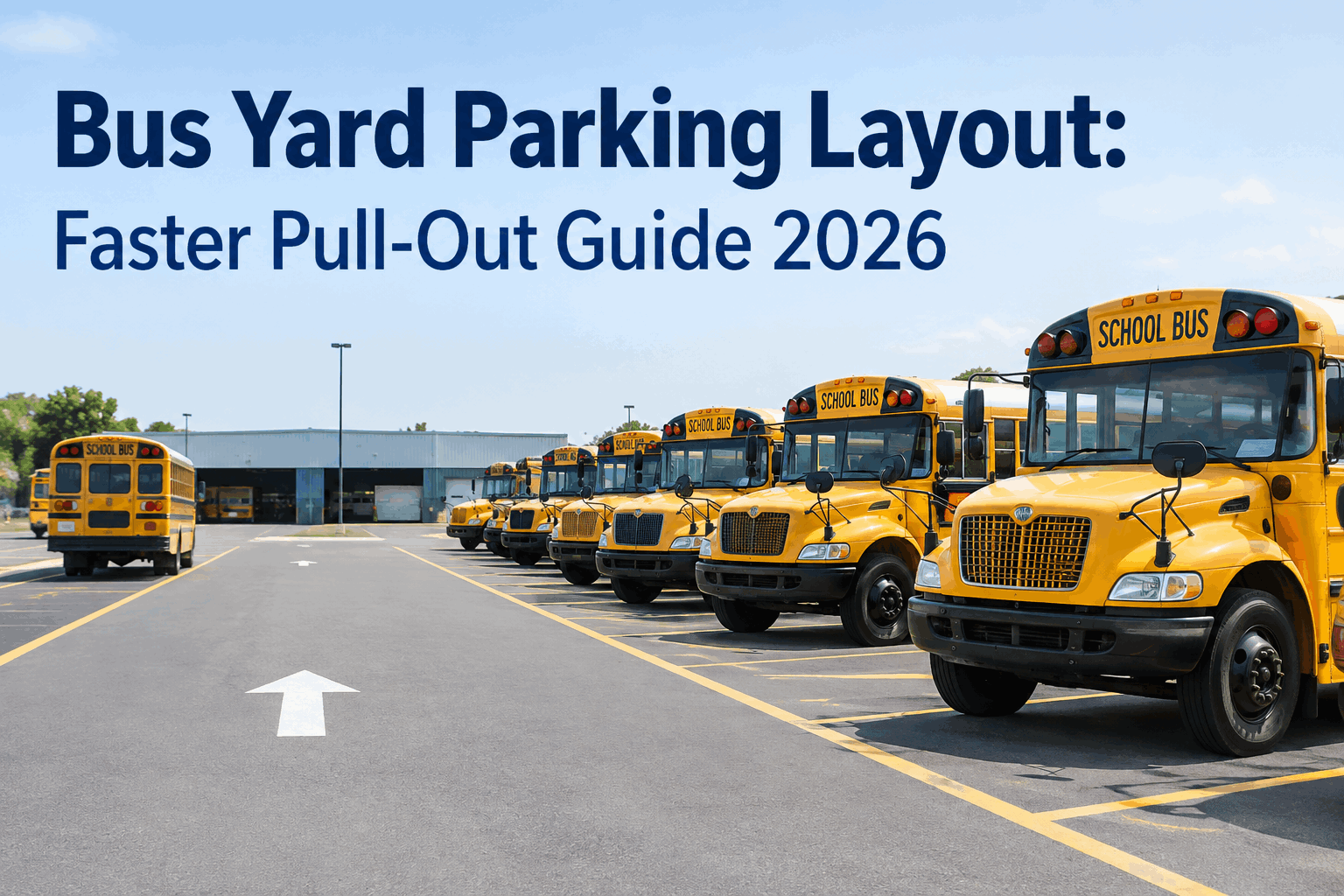
It is 5:52 AM and the yard is a mess. Bus 47 needs to be on route by 6:15 but bus 62 is parked in front of it, and bus 62 has an open DVIR flag nobody put a physical marker on. The spare that should be substituting for the down bus on Route 12 is buried three rows deep. A driver is walking the yard looking for her assigned bus because the whiteboard from yesterday is wrong. Every one of these delays is not a bus problem or a driver problem — it is a yard layout and readiness-assignment problem, and this guide walks through how to fix it before tomorrow morning.
Bus Yard Parking Layout: The Faster Pull-Out Playbook
Zoning by readiness, stall-configuration economics, and the pull-out sequence that gets every bus on route without the morning shuffle.
- 4Readiness zones
- 3Layout types
- 45 minPull-out window
Why Yard Layout Decides Whether You Pull Out On Time
Bus yard parking layout looks like a facilities question. It is actually a dispatch question. Where a bus parks after its afternoon route determines how fast a driver can find it, whether the shop can pull it for PM overnight, whether the spare pool is accessible, and whether the morning pull-out finishes in 45 minutes or 90. Most depots run whatever layout they inherited from the yard's original design, and most have never sat down with a piece of paper and asked whether the bays should be zoned differently based on what each bus actually needs the next morning.
Every dead shuffle — moving 3 buses to get to 1 — costs roughly 4 to 6 minutes of yard time and one driver working around another driver's schedule. On a 60-bus depot averaging four shuffles per morning, that is 20+ minutes of pull-out delay stacked entirely on the wrong parking assignment the night before.
The knock-on damage is the part that makes finance care. Late pull-outs cascade into late first stops. Drivers standing in the yard looking for their bus are drivers being paid to walk. Buses being pulled from the "back" for PM require another driver to shuttle them into the shop lane. And on the days a spare needs to swap in for a road-call substitute, the spare being buried is a 25-minute delay to a route that was already running short. All of it traces back to how the yard was zoned the previous evening. Book a walkthrough to see yard-position tracking against real pull-out timing.
The Dependency Taxonomy: Independent, Semi-Dependent, Total-Dependent
Before any parking assignment is smart, the underlying layout has to allow a bus to leave without permission from another bus. That property has a technical name: parking dependency. Three levels exist, and the level your yard uses today is the largest single constraint on how fast pull-out can move.
Independent
Every bus can pull out to the drive lane without any other bus being moved. Pull-out order is fully flexible. Ideal state. Requires more square footage per bus but eliminates shuffle time entirely.
Semi-Dependent
Buses pull out in a fixed sequence based on assigned lane position. Works when driver assignments and route start times are stable and can be matched to lane order the night before.
Total-Dependent
Getting one bus out requires physically moving one or more others. Every unplanned event (road call, driver call-out, DVIR fail) triggers a shuffle. Highest square-foot efficiency, worst operational cost.
Most depots live somewhere between B and C. The goal is not necessarily to reach A across the whole yard — the real estate math often does not work. The goal is to make sure the route-ready zone is Type A, so the buses that need to leave first do so without a single shuffle. Everything else — PM-due, spare pool, out-of-service — can tolerate more dependency because those buses are not on a 6:00 AM schedule.
Stall Configuration Economics: Which Layout Fits Your Yard
Four stall configurations dominate bus depot design. Each carries different bus-per-acre density, different manoeuvring space requirements, and different dependency defaults. Choosing the wrong one for the site is a permanent tax; choosing right is what makes independent parking affordable in the first place.
Every yard has to balance the trade. Linear packs the most buses on the least concrete but locks you into total-dependent parking (the "shuffle" configuration) — workable only when the pull-out sequence is stable enough to load the lane in exact departure order the night before. Drive-through gives you full independence but uses roughly 40% more square footage per stall. The high-leverage compromise most transit depots run: drive-through in the route-ready zone, sawtooth or angle in the spare pool, linear in the down row where nothing needs to move fast. Sign up free and map your existing yard against a readiness-zoned overlay in the CMMS.
The 4 Readiness Zones: Where Each Bus Actually Belongs
Once the layout allows for parking independence in at least part of the yard, the assignment logic takes over. Every bus at the end of its afternoon route falls into one of four states, and each state has a designated zone. If a bus is in the wrong zone, that is a dispatch error waiting to become tomorrow's delay.
Route-Ready
Who goes here: Buses with a clean DVIR, current PM, valid fuel level, and a route assignment tomorrow before 7:00 AM.
Why it matters: These buses must be pullable in any order without moving another vehicle. Zone 1 is where you spend your best real estate on the lowest dependency.
PM Due Overnight
Who goes here: Buses scheduled for PM, brake check, or non-blocking inspection before their next assignment.
Why it matters: Shop bay access matters more than pull-out speed. These buses need to move into the bay without going through Zone 1 traffic.
Spare Pool
Who goes here: Route-eligible buses not assigned to a run tomorrow. Available for road-call swap or driver-call-in coverage.
Why it matters: Must be accessible — not buried — because when it is needed, it is needed right now. The spare pool being blocked is the fastest way to a missed route.
Down / Awaiting Repair
Who goes here: Buses with an open DVIR fail, waiting on parts, or otherwise flagged out of service.
Why it matters: Zero pull-out urgency, so density is fine here (Type C linear is acceptable). Physical placement also serves as a visual tag — no driver walks into Zone 4 by accident.
The zones are as much a visual language as a spatial one. A driver walking into the yard sees Row A and knows those buses are ready. A shop tech sees Row D and knows nothing there is going out today. A dispatcher covering a road call knows exactly where the spare pool starts. Nobody has to check a whiteboard or make a phone call for basic status — the yard itself communicates it.
The Pull-Out Sequence: How the Morning Should Actually Flow
A well-zoned yard runs a pull-out sequence, not a scramble. Five tiers cover the typical 45-60 minute pull-out window at a school or transit depot — each tier feeds off the previous one being cleared, so Zone 1 does not become the bottleneck for Zone 2 or 3.
Hostler Walk / Final Readiness Sync
Yard hostler walks the row, verifies each bus in Zone 1 is actually route-ready (no overnight DVIR flag added by shop). Any exception moved to Zone 2 or 4. Pull-out board updated.
Early Route Drivers Arrive
Drivers punch in, see their assigned bus and position on the display board, walk directly to it. No dispatch queue. Pre-trip inspection begins.
First Wave Pull-Out (Longest Routes)
Buses assigned to the longest, earliest routes pull out first. Zone 1 begins clearing. Space opens up for hostler to move Zone 3 spares forward if a road call comes in.
Second Wave & Exception Handling
Mid-route drivers arrive. Any bus that failed pre-trip gets swapped from the spare pool — because Zone 3 is accessible, the swap happens in under 10 minutes.
Last Wave Clear · Yard Reset
Final route buses out. Hostler consolidates Zone 3 spares, Zone 2 buses pulled to shop bays for PM. Yard is now in "day mode" for returns starting mid-morning.
Notice what is not in that sequence: nobody walking around looking for a bus, nobody making a phone call to ask which spare to grab, no hostler shuffling three buses to get to one. Every one of those is a symptom of the yard being unzoned. A yard that runs a defined sequence hits the same end time within a 5-minute window every morning — and drivers, shop, and dispatch all know their part.
The Shuffle Math: What Bad Layout Actually Costs
Yard layout looks like a soft cost until you write the numbers down. A shuffle — moving one or more buses to access another — steals hostler time, driver time, and pull-out window all at once. Here is what four shuffles per morning look like on a mid-size fleet.
Sixty labor hours per year against zero capital cost to fix it. The fix is entirely upstream: park the buses that need to leave first in the zone that lets them leave first. It is not more concrete, not new hostlers, not a bigger yard. It is a rule about where each bus goes at the end of its route, applied consistently every night by a dispatcher who has the readiness data in front of them.
How BusCMMS Analytics Turn Yard Layout Into a System
Yard assignment is a data problem before it is a layout problem. Every bus's readiness (DVIR status, PM due date, fuel level, tomorrow's assignment) has to be visible in one place — and that data is exactly what BusCMMS captures during normal operation. Analytics turn it into the parking assignment.
-
Readiness Dashboard
Every bus's status at a glance: route-ready, PM due, DVIR flagged, spare pool, or down. Refreshed as work orders and DVIRs close.
-
Auto Zone Assignment
Every bus's next zone calculated from its status + tomorrow's schedule. Hostler gets a print-ready sheet before end of shift.
-
Driver Assignment Display
Punch-in kiosk or wall board shows each driver their assigned bus + yard position. No dispatch line, no whiteboard scan.
-
Pull-Out Timing Analytics
Actual pull-out completion time trended day over day. See the impact of layout changes and driver behavior on the same chart.
-
Shuffle Event Log
When a hostler has to move a bus to access another, logged as a shuffle event. Trend by day and reason. Find the assignment patterns that keep breaking.
-
Spare Pool Utilization
How often the spare pool is tapped, how often it is blocked, and what the swap time actually was. The fleet-size sizing question with real data behind it.
None of this needs new hardware, GPS positioning, or a WMATA-scale yard automation system to start delivering value. It runs on the same PM, DVIR, and route data already in the CMMS — and the parking assignment sheet a dispatcher generates from it at 4:00 PM the day before is the single highest-ROI report a bus depot can print. Book a walkthrough to see the readiness-to-zone assignment sheet generated for a depot like yours.
The Practitioner View: What Zoning Actually Changed
That story shows up over and over. The layout you inherited is almost never the layout that makes the most of the yard you actually have. What changes is not the concrete — it is the assignment logic that decides where each bus goes at the end of its shift. Sign up free and print your first evening parking sheet within a week.
The Bottom Line on Bus Yard Parking Layout
A bus yard parking layout that makes pull-out fast has four properties: independent parking in the route-ready zone, readiness-based assignment that puts each bus in the right zone every night, a defined pull-out sequence that clears buses in departure order, and a data source that tells the dispatcher what each bus needs before the assignment is made. The concrete matters, but the logic on top of the concrete matters more. Most depots can move from a 90-minute scramble to a 45-minute routine without pouring a single new stall — because the fix lives in the assignment sheet, not the yard. Book a walkthrough to see readiness-zoned parking assignment running on the CMMS.
What is bus yard parking layout and why does it matter?
Bus yard parking layout is how buses are spatially organized within the depot at end of shift — which stall configuration is used (linear, angle, sawtooth, drive-through), how bays are grouped into zones, and how each bus is assigned to a bay based on its readiness status. It matters because pull-out speed the following morning is almost entirely determined by these choices. A yard where every route-ready bus can leave without another bus being moved will pull out 30-50% faster than a yard where the "shuffle" (moving 3 buses to access 1) happens multiple times per morning. On-time first stops, driver overtime, hostler labor, and spare-pool responsiveness all trace back to layout.
What are the main bus depot stall configurations?
Four configurations dominate. Linear (parallel) parks buses end-to-end in rows — highest density but locks the yard into total-dependent parking (requires moving buses to access others). Angle parking (30° or 45°) uses angled bays feeding one-way drive lanes, offers medium density with easier manoeuvring. Sawtooth (60°) is a steeply angled variant that packs more stalls per row while keeping manoeuvre reasonable. Drive-through allows a bus to enter one end and exit the other with no reversing — lowest density but supports fully independent parking. Most modern depots blend configurations: drive-through in the route-ready zone, angle or sawtooth in the spare pool, linear in the down row where nothing needs to leave fast.
How should buses be assigned to parking zones each night?
Four readiness zones cover almost every bus. Zone 1 (Route-Ready, front row): buses with a clean DVIR, current PM, valid fuel, and a route assignment tomorrow — parked where they can pull out without moving any other bus. Zone 2 (PM Due, shop-adjacent): buses scheduled for PM or inspection overnight, parked where they can move to the shop bay without crossing Zone 1 traffic. Zone 3 (Spare Pool, mid yard): route-eligible buses not assigned to a run — must be accessible for road-call swaps. Zone 4 (Down, back row): buses with open defects or awaiting parts — zero pull-out urgency, so density is fine and physical placement doubles as a visual out-of-service tag. Assignment is generated the previous evening from readiness data.
What is a "shuffle" and how much does it actually cost?
A shuffle is when the hostler has to physically move one or more buses to access another. It happens when a bus needed for pull-out is blocked by other buses in a total-dependent parking configuration. Each shuffle typically costs 4-6 minutes of yard time plus one hostler and often one waiting driver. A mid-size depot averaging four shuffles per morning loses roughly 20 minutes of pull-out window daily. Over a school year of five pull-outs per week, that adds up to roughly 60 labor hours — plus the harder-to-measure cost of late first stops, cascading on-time performance drops, and driver goodwill erosion. The fix requires zero capital: it lives in the parking assignment logic the night before.
How does BusCMMS help optimize bus yard parking layout?
BusCMMS captures every bus's readiness data as part of standard operation — open DVIR flags, PM due dates, fuel level, tomorrow's route assignment. That data feeds a readiness dashboard, an automatic zone-assignment sheet the dispatcher can print at end of shift, and a driver assignment display so drivers walk directly to their bus without a dispatch queue. Pull-out timing analytics trend actual completion times day over day so the impact of layout changes is measurable. Shuffle event logging surfaces the assignment patterns that keep breaking. Spare pool utilization data supports fleet-size decisions with real numbers instead of estimates. None of it requires new hardware or GPS positioning — it runs on the same DVIR, PM, and route data already in the CMMS.