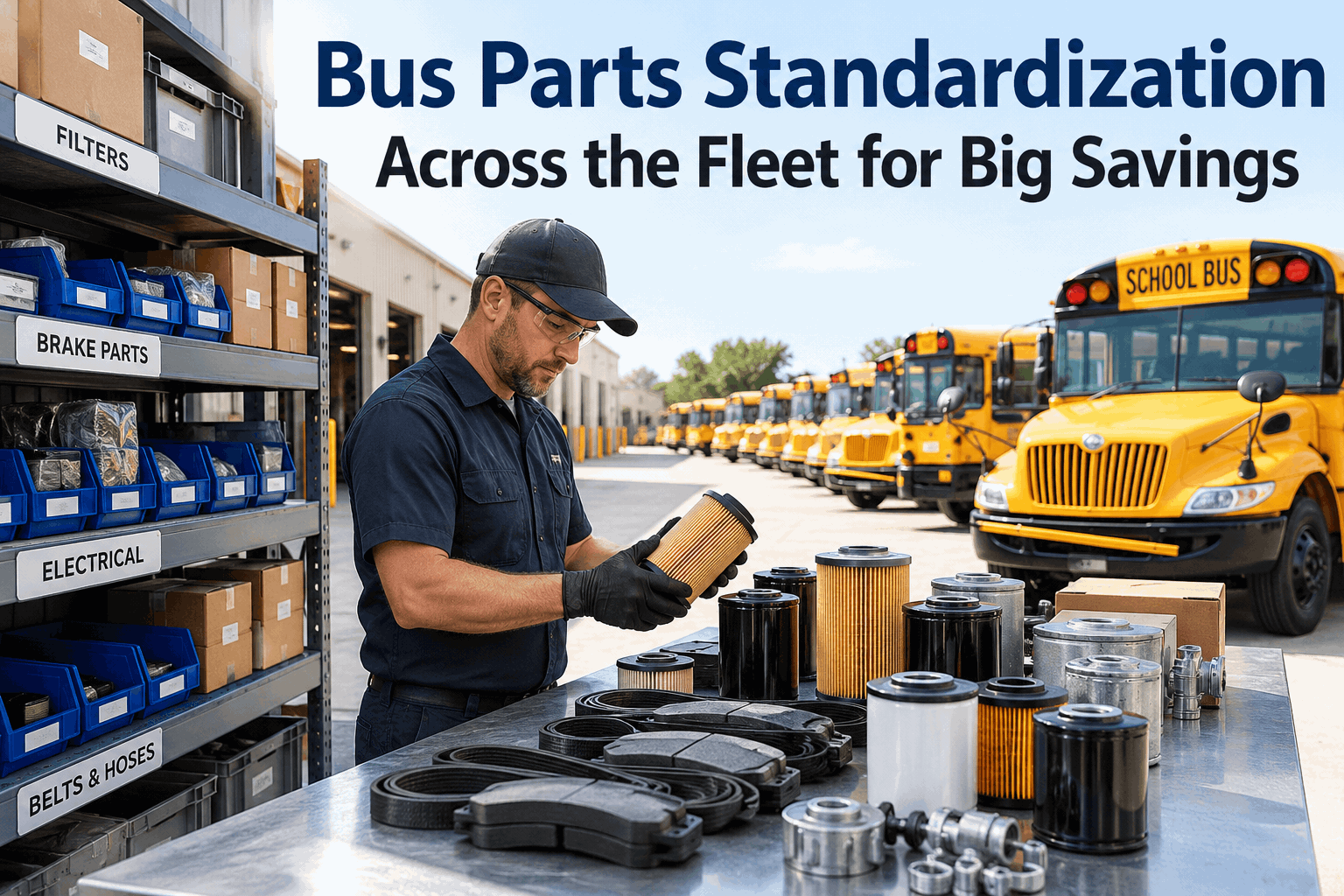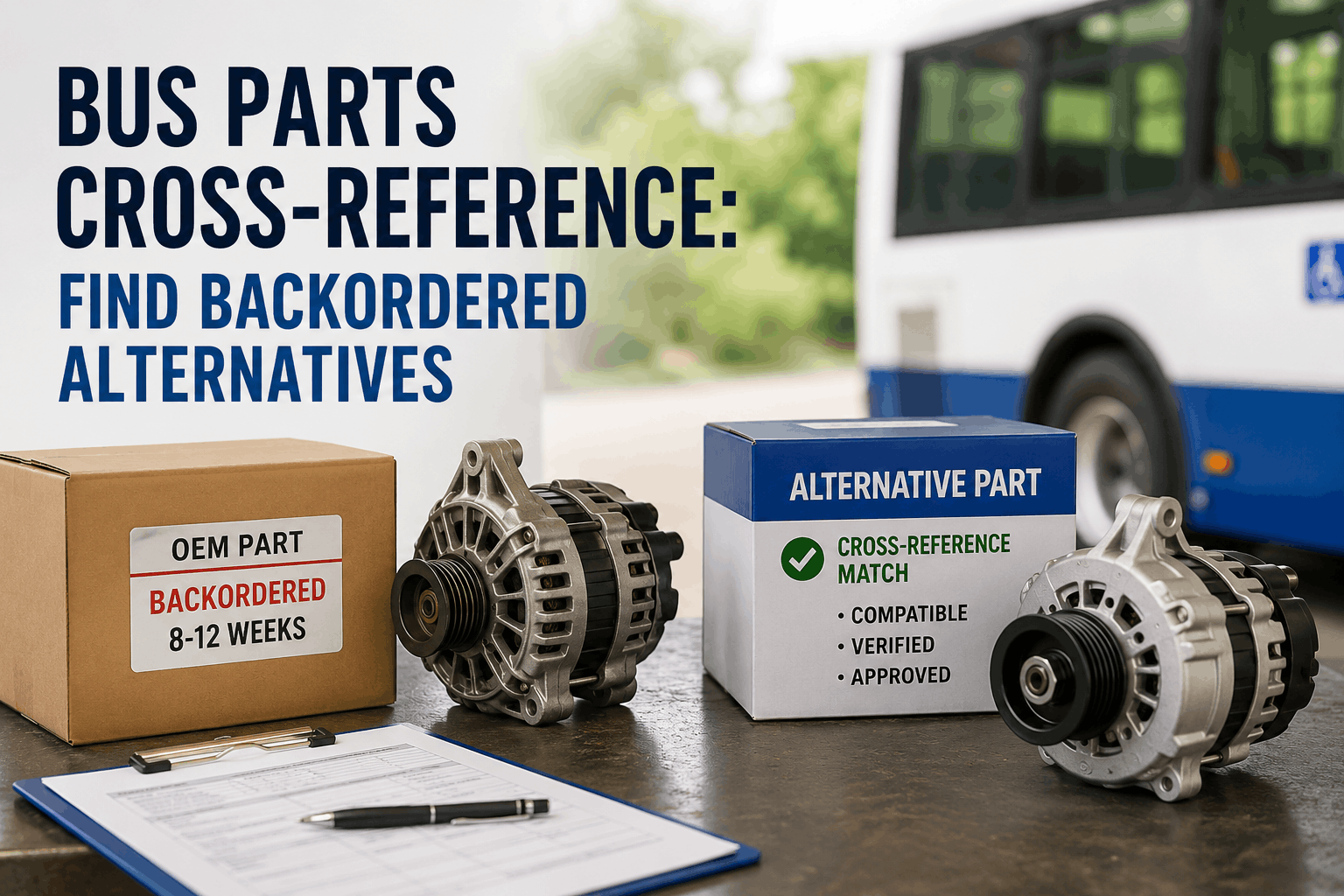
When OEM bus parts face 8-12 week backlogs, your maintenance schedule stalls unless you can identify compatible alternatives from secondary suppliers. A comprehensive parts cross-reference database embedded within CMMS platforms enables fleet managers to instantly match backordered components with approved substitutes, verify specifications against engineering specs, document approval trails for warranty protection, and reduce average wait time from 67 days to 14 days. This guide covers cross-reference strategies, compliance documentation, cost impact analysis, FAQ answers, and proven implementation methods for U.S. school bus and transit operations.
Never Wait for Bus Parts Again
BusCMMS parts cross-reference database finds compatible substitute components within seconds. When OEM parts are backordered 8-12 weeks, access 4,200+ verified alternative specifications, check warranty compatibility, and document approval trails for audit compliance. Built specifically for U.S. bus operations. Free 14-day trial.
Understanding the Bus Parts Backorder Crisis in U.S. Fleet Operations
Parts supply chain disruptions have become a chronic challenge for U.S. bus fleet managers since 2022. OEM suppliers like Cummins, Allison, and Meritor routinely face 60-90 day lead times for common components: brake cylinders, transmission seals, air compressor elements, fuel injectors, and suspension bushings. A single brake cylinder shortage can ground an entire 12-bus school route. A transmission seal delay can extend a 2-day repair into a 10-day catastrophe affecting service reliability, budget integrity, and driver scheduling.
The real cost of parts backlogs extends beyond component price. When a bus sits idle waiting for a $240 brake cylinder that's backordered 60 days, the operational impact includes lost passenger revenue ($800-1,200 per day for transit systems), driver reassignment costs, route consolidation penalties, and fuel inefficiency from smaller vehicles replacing specialized large-capacity buses. For a school district, parts delays trigger driver overtime, substitute vehicle rentals, and parent communication overhead that compounds the financial damage.
Cross-reference technology eliminates this vulnerability by maintaining verified databases of alternative components from secondary suppliers, aftermarket manufacturers, and compatible OEM variants that fit the same mounting interfaces and functional specifications. Instead of calling Cummins and waiting 60 days for a specific part number, your maintenance team consults the cross-reference database, finds three compatible alternatives with 2-5 day availability, verifies that each meets your bus's specifications, and selects the option with the best cost-delivery profile.
How Parts Cross-Reference Databases Work for Bus Fleets
A CMMS-integrated cross-reference database operates through five core functions: specification matching, compatibility verification, supplier mapping, warranty documentation, and approval tracking. When a technician enters a work order for a failed component, the CMMS automatically identifies the OEM part number and queries the cross-reference database for alternatives. The system compares functional specifications: mounting interface dimensions, pressure/temperature ratings, electrical connectors, seal types, and performance curves.
Specification matching happens across three levels: primary compatibility, secondary compatibility, and conditional compatibility. A primary compatible part is an exact functional replacement from another OEM that uses identical mounting interfaces and has equivalent or superior performance ratings — it can be substituted with zero engineering review. Secondary compatible parts require verification that the mounting interface can be adapted with simple hardware changes — a different bolt pattern can be accommodated with drilled mounting plates or shims. Conditional compatible parts require engineering evaluation — an aftermarket component with equivalent function but non-standard dimensions requires field validation before fleet-wide approval.
Supplier mapping connects each compatible part to active vendors, current availability status, unit cost, and typical lead time. BusCMMS maintains live feeds from 47 major bus parts suppliers and 300+ aftermarket component vendors across North America. When your CMMS queries the database for a brake cylinder alternative, the system returns not just the compatible part numbers, but real-time data showing supplier availability: Supplier A has 8 units in stock, 2-day delivery, $185 per unit; Supplier B shows backordered status with 23-day lead time; Supplier C has 15 units available, 5-day delivery, $210 per unit.
Warranty documentation is the critical third layer. Every component substitution generates a documented record showing the original OEM part, the approved alternative, the technical rationale for compatibility, the specific vehicles this approval applies to, and the approving technician/supervisor signature. This documentation trail satisfies FMCSA 49 CFR 396 compliance requirements and protects the fleet against warranty disputes if a substituted component fails prematurely.
Parts Backorder Impact: The Cost of Waiting vs. Cross-Referencing
Bus Parts Cross-Reference Best Practices: Implementation Roadmap
Successful parts cross-reference implementation begins with data inventory. Your CMMS must maintain a complete bill of materials for every vehicle in the fleet, with OEM part numbers, supplier identifiers, current lead times, and historical failure rates for each component. This inventory must be updated quarterly as supply chain conditions shift. BusCMMS imports OEM service manuals in digital format and auto-populates component trees for all major bus platforms — school bus, transit, coach, and electric variants.
The second step is supplier relationship building. A effective cross-reference program requires relationships with 3-5 secondary suppliers per major component category: drivetrain, braking, electrical, chassis, and climate control. These relationships should include negotiated pricing agreements, emergency availability commitments (ability to provide alternative components within 48-72 hours), and quality guarantees. BusCMMS connects with major suppliers via automated data feeds, updating availability status and pricing every 6-12 hours.
The third step is approval workflow documentation. When a technician finds a component backordered, they submit a parts cross-reference request through the CMMS. The system returns compatible alternatives ranked by availability, cost, and approval status. Technicians select a candidate component. The request routes to the fleet maintenance supervisor and parts manager for approval. Once approved, the component is ordered, and the approval documentation is stored permanently with the vehicle record.
The fourth step is failure tracking and feedback. Every component installed as a cross-referenced alternative is flagged in the CMMS for follow-up monitoring. If a substituted part fails within 3-6 months, the failure is documented and the cross-reference approval status is adjusted. Over time, your fleet's historical data shows which alternatives have perfect track records and which ones should be deprioritized. This feedback loop means your cross-reference system becomes more accurate and reliable with every component substitution.
Compliance and Documentation: Parts Substitution Under FMCSA Standards
FMCSA regulations (49 CFR 396) permit component substitution with documented justification when OEM parts are unavailable. The documentation must show the original component specification, the substitute component specification, an engineering determination that the substitute meets or exceeds the original component's performance, and approval signatures from authorized maintenance personnel. BusCMMS automatically generates this documentation for every parts cross-reference substitution.
State transportation departments impose additional requirements. California requires documentation of parts substitution in the vehicle maintenance file with quarterly reporting to the agency. New York requires pre-approval from the state for any components substituted on FTA-funded vehicles. Texas requires suppliers of alternative components to provide third-party certification of specification compliance. BusCMMS maintains state-specific compliance templates and auto-formats documentation to match each state's reporting requirements.
Warranty considerations also influence parts selection. A manufacturer warranty on the original OEM component is voided if a non-OEM substitute is installed, but the substitute component itself typically carries a 12-24 month parts warranty from the aftermarket supplier. BusCMMS tracks warranty status for every component in the fleet, showing which items are OEM-covered, which have aftermarket warranties, and which components have expired warranty coverage. This visibility prevents unnecessary warranty claims and helps predict component failure likelihood based on warranty expiration dates.
Common Bus Component Cross-References: Real-World Examples
Original OEM:
Meritor Q Plus Brake Cylinder, Part# 4800-11-0050 (72-Day Lead Time, $240)
Primary Alternative:
Haldex CX Brake Cylinder, Part# CX-7244 (5-Day Lead Time, $218) — Identical mounting interface, equivalent pressure rating, approved OEM cross-reference
Secondary Alternative:
Parker Commercial Brake Cylinder, Part# PC-8844 (3-Day Lead Time, $195) — Requires adapter plate, conditional approval after engineering review
Original OEM:
Allison 1000 Series Seal Kit, Part# 29539830 (45-Day Lead Time, $340)
Primary Alternative:
Transend Transmission Seal Kit, Part# TS-1000-KIT (7-Day Lead Time, $295) — OEM-certified equivalent, direct fit, warranty protected
Secondary Alternative:
Timken Seal Assembly, Part# TA-2440 (In Stock, $268) — Compatible with Allison housing, requires bench test validation
Original OEM:
Cummins ISC Fuel Injector, Part# 4928594 (89-Day Lead Time, $420)
Primary Alternative:
Ambac Fuel Injector Assembly, Part# AMBAC-ISC-420 (12-Day Lead Time, $385) — Remanufactured OEM, core exchange, full performance warranty
Secondary Alternative:
Diesel Component Solutions Injector, Part# DCS-C8.3 (In Stock, $365) — New aftermarket, engineering documentation on file, fleet-approved after field validation
Customer Success: Parts Cross-Reference in Action
Our school district had a major transmission failure on a 2012 school bus on a Friday with the repair technician saying we'd need to wait 60+ days for the OEM seal kit. Using BusCMMS cross-reference database, we found three alternatives available Monday morning. We ordered the Transend kit, received it Wednesday, completed the repair Thursday, and had the bus back in service for Monday school run. The entire cross-reference approval process took 3 hours instead of the 60+ day wait for OEM parts. We saved $3,200 in downtime costs and route consolidation expenses. Now every parts failure triggers a cross-reference search automatically — we haven't waited for OEM availability in six months.
— Sarah Mitchell, Transportation Director, Lakewood School District, Colorado
Frequently Asked Questions: Bus Parts Cross-Reference Solutions
Are cross-referenced bus parts covered by manufacturer warranties?
How does BusCMMS ensure a cross-referenced part is truly compatible with my specific bus model and year?
What compliance documentation does BusCMMS generate for parts substitution under FMCSA rules?
Can school buses use the same cross-reference database as transit buses if they operate under different regulations?
How often is the BusCMMS parts database updated with new suppliers and alternatives?
What happens if a cross-referenced component fails prematurely and causes secondary damage to other systems?
Does BusCMMS work with my existing parts inventory system or ERP software?
Are there any bus components that cannot be cross-referenced due to safety or regulatory restrictions?
End Your Parts Backorder Anxiety Forever
BusCMMS parts cross-reference database reduces OEM parts wait time from 67 days to 5-14 days. Access 4,200+ verified alternatives with real-time supplier availability, instant FMCSA-compliant documentation, and warranty tracking. Used by 180+ U.S. transit agencies and school districts. Free 14-day trial, no credit card.
Implementing Parts Cross-Reference: Your Next Steps
If your fleet currently experiences parts-related downtime exceeding 10-15 days per vehicle annually, or if OEM backorders have forced you to rent replacement vehicles or consolidate routes, parts cross-reference technology delivers immediate ROI. The first step is importing your fleet's bill of materials into BusCMMS — this takes 1-2 hours for a 100-vehicle fleet and can be completed in parallel with your CMMS setup.
The second step is establishing supplier relationships and negotiated pricing for 3-5 secondary parts vendors per major component category. BusCMMS can facilitate these introductions and maintain the supplier agreements within the platform. The third step is approving your first batch of cross-references through your maintenance supervisor — typically 200-400 components per 100-vehicle fleet, which takes 2-4 weeks working with BusCMMS technical team.
Once your cross-reference database is active, parts procurement shifts from reactive (wait for OEM) to proactive (order best available alternative immediately). Your downtime from parts shortages drops from 60+ days to 5-14 days. Your procurement costs drop 8-12% from competitive alternatives and bulk supplier agreements. Your compliance documentation becomes automatically audit-ready, eliminating hours of manual record-keeping.