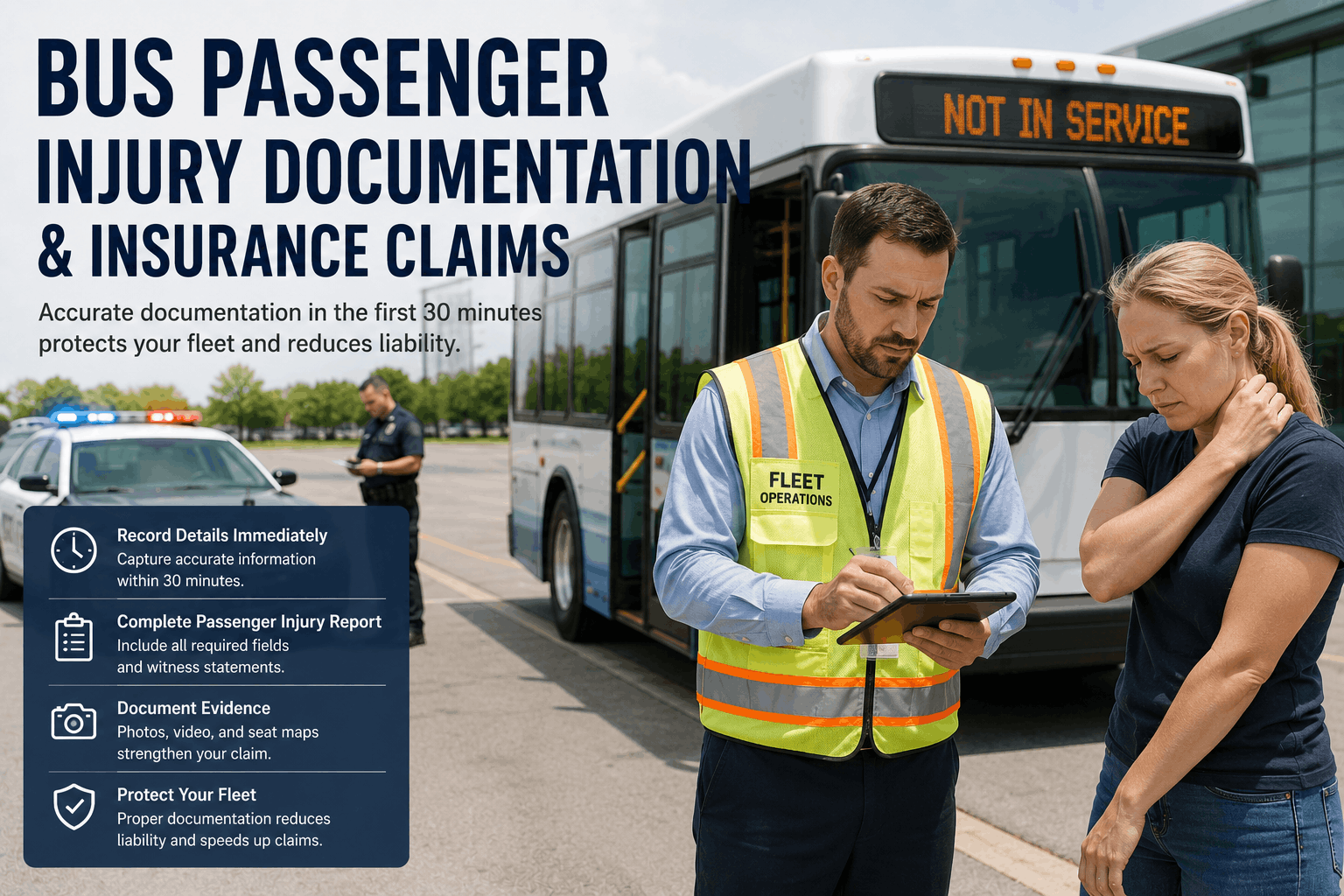
A passenger slips on a wet floor of your bus and falls. They hit their head. Another passenger has a medical episode while riding. A third passenger is injured in a minor collision with another vehicle. In each scenario, the documentation captured in the first 30 minutes — the incident report, photos, witness statements, medical information — determines your insurance company's liability assessment. Poor documentation means the insurance company will push back on claims. They'll say you didn't have adequate incident procedures. They'll question whether the injury was actually bus-related. They'll delay payment. Good documentation means the insurance company has confidence you ran a professional operation. They'll process claims quickly. They'll defend you in litigation because your records prove you did everything right. Most fleets don't understand this. They treat incident documentation as paperwork. It's not. It's your legal defense. Here's how to document passenger injuries in a way that protects your liability exposure and ensures insurance claims get paid .
Bus Passenger Injury Documentation & Insurance Claims
When a passenger is injured on your bus, the documentation captured in the first 30 minutes determines your insurance liability exposure. Complete guide to passenger injury recording requirements and best practices. How professional incident documentation protects your fleet and ensures claims are processed efficiently.
Why Passenger Injury Documentation Matters: Insurance and Liability Exposure
A passenger claims they were injured on your bus. They file a claim with your insurance company. The insurance company investigates. They review your incident report from the day of injury. If your report is vague ("passenger reported discomfort"), the insurance company sees weakness. They suspect you didn't take the injury seriously. They might deny the claim or demand extensive documentation retroactively. If your report is thorough ("passenger reported lower back pain at 2:15 PM while exiting bus; witness observed fall; ice pack applied; EMS called; transported to hospital"), the insurance company sees professionalism. They process the claim confidently because your documentation proves you followed proper procedures.
The financial impact of poor documentation: A denied or delayed insurance claim on a $50,000 medical expense becomes the fleet's financial liability. A delayed claim means the injured passenger is out-of-pocket while waiting for reimbursement, making them more likely to sue the fleet directly. A pattern of poor incident documentation can increase your insurance premiums 15-25% because insurers view poor documentation as evidence of poor safety practices.
The legal impact: If a passenger sues your fleet for injuries, the incident report is the first document the plaintiff's attorney requests. If your report shows you documented the incident thoroughly, photographed the scene, recorded witness statements, and called emergency services, you have a strong legal position. If your report is sparse or missing information, the plaintiff's attorney will argue you were negligent in your procedures, and they'll use the incomplete documentation against you in court.
The 30-Minute Window: What Must Be Documented Immediately After Injury
The first 30 minutes after a passenger injury are critical. This is when memories are fresh, witnesses are present, and the scene is unchanged. Everything captured in this window becomes evidence. What gets missed in these 30 minutes is almost impossible to recover later.
The immediate documentation checklist: (1) Time and location: Exact time of incident (down to the minute). Exact location on the bus (front, middle, rear; near a window, aisle, seat). Route number. Driver name. (2) Incident description: What happened? (passenger fell, passenger reported medical episode, collision with vehicle, passenger became aggressive, etc.). How did it happen? (passenger was standing and bus braked suddenly, bus hit pothole, passenger was exiting and slipped, etc.). Where was the passenger before the incident? (standing, sitting, exiting, boarding). (3) Injuries reported: What injury did the passenger report? (pain, bleeding, loss of consciousness, nausea, etc.). Which body part? (back, head, leg, arm, etc.). Severity (minor, moderate, severe). (4) Immediate actions taken: Was first aid applied? (ice pack, bandaging, etc.). Was EMS called? If yes, what time? Did EMS transport? Did the passenger refuse medical attention? If so, did you document the refusal? (5) Witness information: Names and contact information of other passengers who witnessed the incident. Did they observe the incident directly or hear about it? (6) Driver observations: The driver's account of what happened. The driver's assessment of the passenger's condition. Any environmental factors (wet floor, potholes, debris, slippery surfaces). (7) Photos and video: Photos of the scene (where the injury occurred, any hazardous conditions like wet floors or debris). Photos of any visible injuries on the passenger (with passenger consent). Photos of any damage to the bus. Video footage from bus cameras if available. (8) Passenger information: Name, contact information, date of birth. Insurance information if available. Destination (were they a student, commuter, campus visitor?). Any pre-existing conditions they disclosed (we're recovering from a back injury, we have a mobility issue, we're pregnant, etc.).
Critical mistakes fleets make in the first 30 minutes: (1) Not taking the injury seriously ("passenger said they're fine, so no documentation needed"). (2) Not getting witness information (witnesses leave the bus and are lost forever). (3) Not photographing the scene (30 minutes later, the floor is dry and there's no evidence of a wet condition). (4) Letting the driver fill out the report from memory hours later (details are forgotten, accuracy decreases). (5) Not documenting refusals (if the passenger refused medical attention, document that they were offered and they declined).
Digital Incident Reporting: How Mobile Apps Ensure Complete Documentation
The challenge with paper incident reports: they're filled out after the fact, often hours later, with incomplete information and missing details. A driver files a report at the end of their shift. They can't remember exact times. They don't have witness contact information because they didn't collect it at the scene. They don't have photos because they forgot to take any. The report is sparse and unhelpful when the insurance company needs it.
Digital incident reporting works differently: When an injury occurs on the bus, the driver immediately pulls out their phone and opens the incident app. The app guides them through a structured form: (1) Incident type (select from dropdown: passenger fall, passenger medical, passenger-to-passenger conflict, collision, other). (2) Time and location (app captures current time with one tap; driver selects location). (3) Injury description (text field: driver describes what they observed). (4) Actions taken (checkboxes: first aid applied, EMS called, passenger transported, passenger refused medical attention). (5) Witness information (form to add witness names and contact info; app can text witnesses a link to provide statements digitally). (6) Photos (app allows driver to take photos of scene, any hazards, injuries with passenger consent). (7) Signature and timestamp (digital signature proves the report was made at the scene, not hours later).
The app's intelligence prevents missing information: If the driver tries to submit the form without filling required fields (time, location, injury description), the app prevents submission and highlights missing fields. The driver must complete the form. This prevents the situation where a report is submitted with no time recorded or location unclear. The app also prompts: "Did you take photos of the scene?" If the answer is no, it asks "Why not?" This creates accountability for photo documentation.
What happens after the report is submitted: The incident is instantly transmitted to (1) the dispatch center (for awareness); (2) the fleet's safety director (for immediate investigation if needed); (3) the insurance company's portal (for claim documentation); (4) the bus's maintenance record (if the injury is tied to a mechanical failure or hazardous condition on the bus). Everything is timestamped. Everything is authenticated. The report is immediately admissible as evidence.
The Follow-Up: Tracking Passenger Outcomes and Insurance Claims
The incident report is just the beginning. What happens after the passenger leaves the bus is equally important for documentation. Did the passenger go to the hospital? Was there a diagnosis? What was the treatment? Did the passenger file a claim with insurance? These follow-up details are critical for the insurance company's assessment.
Follow-up documentation that matters: (1) Medical documentation: If the passenger went to the hospital or saw a doctor, request copies of the medical report and treatment records. These establish what injuries were actually found and what caused them. (2) Insurance claim filing: When the passenger files an insurance claim, obtain a copy of the claim for your records. Track the status: submitted, under investigation, approved, denied. (3) Ongoing contact: If the passenger is seriously injured, maintain contact and document their recovery or lack thereof. (4) Settlement or judgment: If the case goes to litigation and settles or results in a judgment, document the outcome. This helps establish claim value for future similar incidents.
Why insurance companies care about follow-up: An incomplete chain of documentation looks suspicious. "Passenger reported back pain" without any follow-up medical documentation is weak. "Passenger reported back pain; transported to City Hospital; diagnosed with lumbar strain; treated with physical therapy; recovered in 8 weeks" is strong. The second version shows you took the injury seriously and has objective medical evidence.
Privacy and Liability: What You Can and Can't Document
Documentation must be thorough, but it also has legal boundaries. You need to know what you can photograph, what information you can record, and what's protected by privacy law.
What you CAN document: (1) Scene photos: The location where the injury occurred (wet floor, broken seat, hazardous condition). You don't need permission to photograph the bus interior or exterior. (2) Incident circumstances: Time, location, what happened, environmental factors. (3) Driver observations: What the driver saw and heard. (4) Passenger name and contact information: Necessary for insurance and follow-up. (5) Injury description (from passenger's own account): "Passenger reported lower back pain." (6) Medical treatment received: Did EMS transport? To which hospital? (7) Witness statements: From other passengers who observed the incident.
What you CANNOT or SHOULD NOT document without permission: (1) Photographs of the injured passenger's body or face (except with explicit permission). (2) Medical records or diagnoses (unless the passenger voluntarily shares them with you). (3) Pre-existing medical conditions unless the passenger discloses them. (4) Mental health information or disability status unless relevant to the incident. (5) Insurance information from the passenger's own policy unless needed for claim purposes. (6) Recorded statements or confessions (in some states, recording without consent is illegal).
Best practice for sensitive documentation: Ask the passenger directly: "With your permission, I'd like to take a photo of any visible injury and document your account of what happened. Is that okay?" If they consent, you can photograph. If they refuse, respect that refusal and document it: "Passenger declined to allow photographs." This actually strengthens your position because it shows you respected their privacy.
We had a passenger slip and fall on our bus. The incident happened at 2:30 PM. Our driver filled out a paper incident report at 5:00 PM (end of shift). The report said "passenger reported discomfort." No time was recorded. No photos were taken. No witnesses were documented. When the passenger filed an insurance claim weeks later, the insurance company had zero confidence in our documentation. They questioned whether the injury was even bus-related. They delayed the claim for months. Eventually they paid, but begrudgingly. After that, we implemented a digital incident system where drivers report injuries immediately from the bus with photos, timestamps, and witness information captured on the spot. Last year, a passenger slipped on water near the boarding door. Our driver submitted a digital report within 3 minutes: time, location, photos of the wet floor, names of two witnesses, description of the injury. When the passenger filed a claim, the insurance company processed it in 10 days because they had complete, professional documentation. It made all the difference.
Passenger Injury Documentation Questions
How long do we need to keep incident reports?
Keep all incident reports for at least 5-7 years. This covers the statute of limitations in most states for personal injury claims. Some states require longer (California: 10 years). Check your state's requirements. Digital systems make archival easy; you can store indefinitely at minimal cost.
What if a passenger refuses to complete an injury report?
Document their refusal. "Passenger was offered incident documentation form. Passenger declined to provide statement or contact information." This protects you by showing you attempted to follow procedures. If they file a claim later, your documentation proves you tried to gather information at the time of incident.
Do we need to report every minor injury or just serious ones?
Document all injuries, even minor ones. What seems minor at the time (passenger reports "slight pain in neck") might develop into a serious claim later (cervical strain, chronic neck pain). By documenting all injuries, you establish a complete record. Insurance companies prefer complete documentation over selective reporting.
Can we modify an incident report after it's been filed?
Never modify a filed report. This looks like you're covering up or changing your story. If you need to add information, file an addendum: "Addendum filed [date]: Additional information obtained from witness interview." Always maintain the original report with timestamp unchanged. Digital systems should prevent editing of filed reports; they only allow addenda.
What should we tell the passenger about their injury claim process?
Tell them: "We've documented your incident and will send this report to our insurance company. Our insurance company will contact you about the claim process." Don't admit fault ("This was our fault, you'll definitely get compensation") or deny fault ("This wasn't our fault, we won't pay for anything"). Stick to factual statements and let the insurance company handle liability assessment.
How do we handle incidents involving minors or students?
For minors, get parent/guardian contact information and notify them immediately. Document parental notification in the incident report: "Parent [name] notified at [time] by [method]." For school buses, follow your school district's incident reporting procedures. Many schools have their own incident report forms; you may need to file both the school's form and your fleet's incident report.
What if the incident involves a collision with another vehicle?
Document everything: other vehicle's license plate, driver information, insurance information, police report number (if police were called), damage to both vehicles (photos), injuries to your passengers, witness contact information from other vehicle. Provide this information to your insurance company and law enforcement. Don't admit fault at the scene; let insurance and police determine liability.
Protect Your Fleet with Professional Incident Documentation
Digital incident reporting. Mobile app with guided documentation. Real-time timestamp and authentication. Photo capture. Witness information collection. The complete system that ensures every passenger injury is documented professionally and immediately. Better documentation means faster claim resolution and stronger legal position.