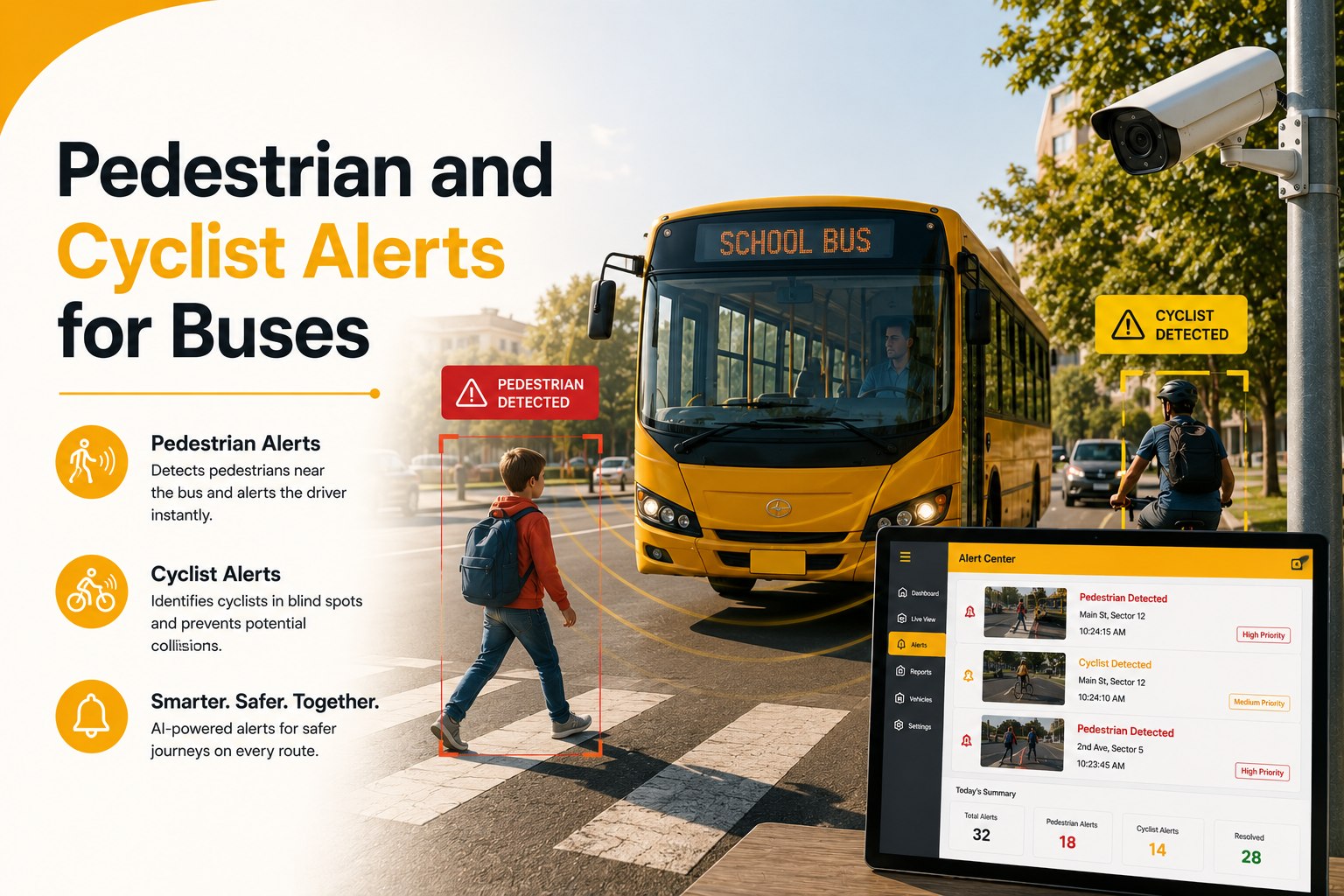
A right-turning bus creates a blind arc exactly where a pedestrian or cyclist is most likely to be — beside the front wheel, out of mirror view, in the half-second before the turn completes. Bus pedestrian detection uses AI to flag a person in that conflict zone as the turn begins, alerting the driver in time to stop rather than after the fact. See how a pedestrian alert becomes a route-level risk record in BusCMMS.
Pedestrian and Cyclist Alerts for Buses
Where the real risk concentrates on a turn, how alert design avoids startling a driver mid-maneuver, and what the federal visibility-impairment duty actually requires.
The Regulatory Duty Behind This: 49 CFR 673.25
Not a suggestion — a specific mitigation duty with a named scope.
49 CFR 673.25, part of the Public Transportation Agency Safety Plan requirements under 49 CFR Part 673, requires large urbanized area transit providers and their safety committees to consider mitigations that reduce operator visibility impairments (eCFR, current as of Jul 2026). This explicitly includes retrofits to vehicles already in revenue service, not just specifications written into future procurements — meaning an agency's existing fleet is squarely in scope, not exempt because the buses were purchased before pedestrian detection technology matured.
Why Urban Routes Carry Disproportionate Risk
Dense intersections multiply the number of conflict points per mile.
A rural route with infrequent turns and wide-open sightlines carries a fundamentally different risk profile than an urban route threading through dense intersections, protected bike lanes, and heavy pedestrian crossings. Every right turn on a congested urban corridor is a fresh conflict point, and a route with dozens of turns per run accumulates risk exposure far faster than raw mileage would suggest. This is exactly why 673.25's scope centers on large urbanized area providers — that's where the conflict density is highest and the visibility-impairment risk is most acute.
The Objection Worth Naming: Footage Overwritten Before It's Needed
A near-miss found three weeks too late is a near-miss you can't review.
Here's the failure that quietly defeats a pedestrian detection program's evidentiary value: a near-miss or complaint surfaces days or weeks after the event, and by the time someone goes looking for the footage, the retention window has already overwritten it. This isn't a detection failure — the alert may have fired correctly in the moment — it's a retention policy failure. Flagged conflict-zone events need to trigger automatic retention holds that pull that specific clip out of the normal overwrite cycle, so a delayed complaint doesn't run into a dead end.
A Scenario From a Real Bus Operation
A route risk map that changed where supervisors rode along.
A transit agency operating in a dense downtown core rolled out pedestrian and cyclist detection across 60 buses and began aggregating conflict-zone alerts by route rather than reviewing them one bus at a time. Within three months, one specific route with a cluster of unprotected right turns near a school zone accounted for nearly a quarter of all fleet-wide alerts — a pattern invisible when events were reviewed bus-by-bus. The agency added a supervisor ride-along rotation on that route and worked with the city on turn-lane signage; alert volume on that corridor dropped by roughly a third over the following two months.
We used to look at these alerts bus by bus and never saw the pattern. Once we mapped them by route, one corridor near a school just lit up. That's not something you catch reviewing individual driver footage — you only see it when the data rolls up to the route level.
Not sure which of your routes carry the highest pedestrian conflict risk? That's worth mapping. Talk to the team about a route risk review →
Built for Buses, Not Adapted From Trucking
The wedge BusCMMS solves that a repurposed fleet platform can't.
BusCMMS is an AI-native bus fleet operations platform built for buses from the ground up, not a trucking fleet tool with bus features bolted on. Routes, stop arms, danger zones, wheelchair lifts, crossing gates, and student riders are first-class objects in the platform, not generic afterthoughts — which is exactly why a pedestrian conflict alert can roll up into a genuine route-level risk map instead of sitting as an isolated event on one bus.
Frequently Asked Questions
What does 49 CFR 673.25 actually require regarding pedestrian visibility?
49 CFR 673.25, part of the Public Transportation Agency Safety Plan under 49 CFR Part 673, requires large urbanized area transit providers and their safety committees to consider mitigations that reduce operator visibility impairments, explicitly including retrofits to vehicles already in service and specifications for future procurements.
Where does pedestrian and cyclist risk concentrate most for buses?
Risk concentrates sharply at the right-turn conflict point, where a bus's front-wheel blind arc sweeps across the exact path a pedestrian or cyclist beside the bus is likely to occupy as the turn begins.
How should a pedestrian detection alert be designed to avoid distracting the driver?
An effective alert uses an escalating visual and audio cue timed to give the driver a real reaction window as the turn begins, filtered to genuine conflict-zone presence, rather than a sudden loud tone that startles the driver mid-maneuver or trains them to ignore frequent false positives.
Why does footage sometimes go missing when a pedestrian complaint is investigated?
A near-miss or complaint often surfaces days or weeks after the event, by which point the standard retention window has already overwritten the footage. Flagged conflict-zone events need automatic retention holds to pull that specific clip out of the normal overwrite cycle.
Do pedestrian detection alerts apply to all transit providers?
49 CFR 673.25's visibility-impairment mitigation duty specifically applies to large urbanized area transit providers under their Public Transportation Agency Safety Plans, though the underlying safety case for pedestrian detection applies broadly to any bus operation running routes with significant pedestrian or cyclist exposure.