Six months in, Bus #08 is at the shop. The crossing gate is intermittent -- sometimes deploys, sometimes does not. The service records show it has been an issue since week two. The dealer says operational damage, warranty denied. Now the transportation director gets to explain to the school board why the district is out $2,100 for a repair on a bus they took delivery of last spring. Somewhere between the OEM assembly line and the transportation office, a proper bus pre-delivery inspection (PDI) checklist got skipped -- and the district owns the problem. PDI is the only window where every factory defect on that new bus is still someone else's.
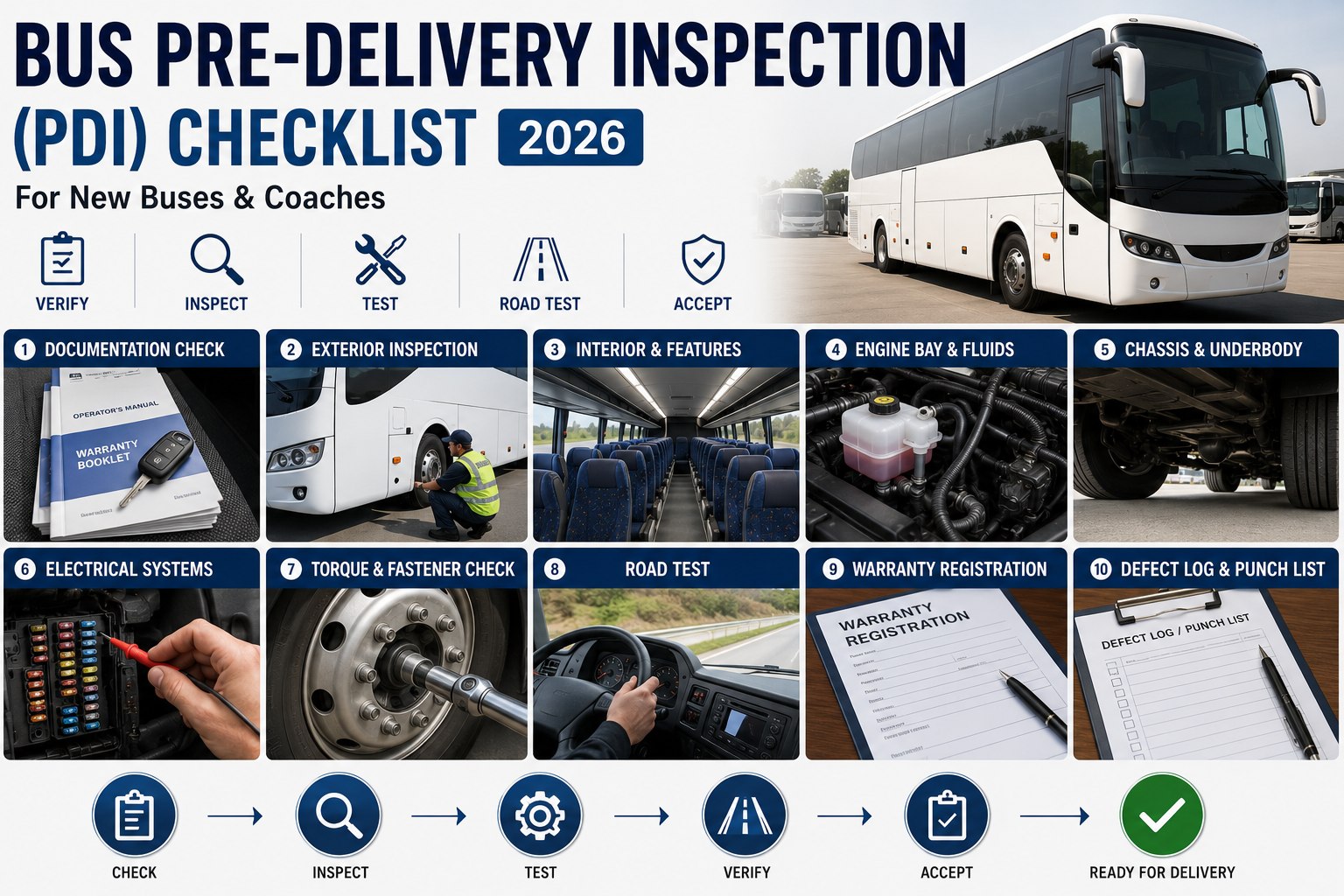
Bus Pre-Delivery Inspection (PDI) Checklist for New Buses & Coaches
The complete acceptance routine for taking delivery from an OEM or dealer -- documentation, fluids, torque, road test, bus-specific safety systems, and warranty registration -- so factory defects stay the manufacturer's problem.
- VIN & documentation
- Safety systems test
- Defect log & warranty
Why PDI Is Your Only Real Leverage Moment
A manufacturing defect found during pre-delivery inspection is 100% the OEM's or dealer's responsibility to fix. The same defect found six months later, after 2,000 miles of routes, becomes a dispute. Sometimes a warranty claim. Sometimes a denied claim. Sometimes a $2,000 line item on your operating budget you never should have paid. The math on a proper PDI is not close.
- 100% Manufacturer responsibility for defects caught before acceptance
- $300-$600 Cost of an independent third-party PDI inspector, per bus
- 30-90 days Typical manufacturing-defect warranty window after delivery
- $8,500 Average emergency roadside repair -- what you're preventing
A brake issue found during PDI is resolved before your driver ever operates the bus. That same brake issue found 3,000 miles in becomes a warranty argument that hinges on whether you can prove the fault existed at delivery -- which is only possible if you have PDI documentation. The average emergency roadside repair on a school bus runs around $8,500 per event (BusCMMS-reported). A PDI defect caught before acceptance costs the district $0. Book a demo to see PDI defect logs tied to bus-specific warranty records.
When & Where the PDI Should Happen
A PDI is not something you do the day the driver walks up to accept the keys. By then you have already committed. The ideal PDI happens at the OEM facility or dealer location -- with the ability to walk away, punch-list defects, and refuse delivery until they are resolved. Timing determines everything.
-
01
5-7 Days Before Delivery
Schedule the PDI with dealer/OEM. Confirm documentation, keys, service manuals will be ready. Book independent inspector if needed.
-
02
48 Hours Before Delivery
Conduct the full PDI at the manufacturer or dealer facility. Any defects found here get fixed before the bus leaves. This is your leverage window.
-
03
Delivery Day
Verify every punch-list item was actually resolved. Re-check the specific defects noted. Only then sign acceptance paperwork.
-
04
Within 24 Hours of Acceptance
Log any defects noticed after acceptance immediately. Under warranty (typically 30-90 days for manufacturing defects) these can still be claimed if documented fast.
Some OEMs require the fleet-conducted PDI as a condition of the warranty agreement -- so verify contractual requirements before delivery. If you cannot send a qualified representative, a third-party bus inspector costs $300-$600 per bus and pays for itself the first time you catch a real defect. Sign up free and load a PDI template into your fleet onboarding workflow.
The Complete Bus PDI Checklist
The full inspection organized by zone. Every item ties to a defect a fleet has actually caught at PDI -- or wishes they had. The final zone (safety systems) is what separates bus PDI from truck PDI, and it is where OEM assembly errors happen most often.
-
01 RepVIN, Build Sheet & Documentation
Before touching anything else · ~15 min
- VIN plate matches invoice, title, and build sheet exactly
- Build date on sticker is current model year (not stale inventory)
- Odometer reading under 500 miles (factory-to-dealer transport)
- Warranty booklet, service manuals, and OEM contact info present
-
02 RepExterior & Body
Daylight only · walk-around · ~30 min
- Paint condition, panel gaps even, no shipping damage
- All exterior lights work -- headlights, brake, marker, hazard
- Body decals, DOT number, and reflective tape aligned per FMVSS
- Tires -- correct spec, matching brand/tread depth, full inflation
- Wheel lug nuts torqued to OEM spec (verify with torque wrench)
-
03 RepInterior & Passenger Compartment
Cabin walk-through · ~30 min
- Seat configuration matches purchase order (row count, spacing)
- All seats secure to floor, no play, seat belts operate correctly
- Student mirror positioned for full cabin view from driver seat
- HVAC blows hot and cold at every duct, no unusual noise
- Interior lights, dash instruments, and warning lights all function
-
04 Diesel techUnder the Hood: Fluids & Mechanicals
Engine off + engine running · ~25 min
- Engine oil, coolant, DEF, power steering, and washer fluids at spec
- No leaks visible under bus after 10 minutes of idle
- All belts and hoses tight, no cracks or shipping damage
- Battery fully charged, connections clean and secure
- Air brake system builds to governor cutoff (120-140 PSI)
-
05 Diesel techFault Codes & Electronics
Scan tool session · ~15 min
- Full scan for active and pending DTCs -- must be clean
- Inactive transit-mode codes cleared per OEM procedure
- Telematics or GPS unit (if pre-installed) verified operational
- Radio, cameras, and driver console power up and function
-
06 CriticalBus-Specific Safety Systems
Full function test each · ~30 min
- Stop arm deploys fully, all red lamps illuminate, retracts cleanly
- 8-light warning system sequences correctly (amber then red)
- Crossing gate deploys and retracts on activation
- Every emergency exit opens from inside and outside (FMVSS 217)
- Wheelchair lift cycles fully -- deploy, level, retract, stow (ADA)
- Backup alarm audible from 15 ft, fire extinguisher charged, kits sealed
Documentation You Must Verify Before Signing
Every one of these documents ties to a specific problem you will have later if it is wrong or missing at delivery. The signature on the acceptance paperwork is the moment they transfer from "dealer's problem" to "your problem."
Required Documents Checklist
Verify each before signing acceptance paperwork
- Certificate of Origin (MSO): Original, correct VIN, correct year
- Invoice / Bill of Sale: Matches PO -- options, seat count, color spec
- Build Sheet: Engine, transmission, retarder brand, axle ratios per order
- Warranty Registration: Complete OEM plus component (engine, transmission, HVAC)
- FMVSS Compliance Label: Present in door frame -- confirms federal standards met
- Owner's Manual + Service Manual: Present, matching model year
- Emissions Certification (EPA): Under-hood label matches invoice engine
- Keys + Fuel Cap Keys: Minimum 2 sets, keyless entry fobs if equipped
- Buy America Documentation: Required for FTA-funded transit purchases
Missing Buy America documentation on a transit bus purchased with federal funds is not a fix-it-later item -- it can jeopardize the entire FTA grant. Same principle applies for school district federal Clean School Bus Program funded purchases. Verify at PDI, not after. Book a demo to see fleet onboarding tied to compliance docs.
The PDI Road Test: 3 Phases, 30 Minutes
A stationary inspection catches most defects but not driveability faults -- pulling brakes, transmission shift shock, retarder engagement, or air compressor duty cycle. The road test is where those show up. Run it in three distinct phases so nothing gets skipped.
-
Phase 1 Yard / low speed
Static & Slow-Roll Checks
- Air pressure builds to governor without dropout
- Service brake, parking brake, low-air alarm all function
- Slow figure-8 -- check steering effort, turning radius, no pulling
- Transmission shifts through all gears without slip or shock
-
Phase 2 City / mid-speed
Urban Route Simulation
- Accelerate through 25-35 mph, smooth power delivery
- Multiple stops -- brake feel consistent, no fade after 10 stops
- Retarder or engine brake engages and disengages cleanly
- No unusual noise from suspension over bumps
-
Phase 3 Highway
Sustained-Speed Test
- Steady 55-60 mph for 10 minutes -- watch for vibration
- Cruise control engages and holds set speed
- No pulling under braking from highway speed
- Post-run: no fluid leaks, no fault codes stored
Log every defect noted on the road test with photos, VIN, and mileage at time of test. That record is what turns "I think there was a vibration" into a defensible warranty claim if it recurs. Book a demo to see PDI defect logs tied to each bus's warranty timeline.
A Transportation Director's Take on PDI
Every new bus that comes in, my shop foreman spends four hours on it before I sign anything. On the last three deliveries we caught a bad crossing gate solenoid, a wheelchair lift that would not level, and a stop arm decal that was on the wrong FMVSS sequence. All three would have been our problem after week two. All three got fixed by the dealer before we ever put a student on the bus. Four hours of PDI has probably saved us fifteen thousand dollars across those three units alone.
That is the pattern: real PDI catches defects that only look small until you find them at 3,000 miles. The four hours pays for itself the first time. On a fleet buying 5-10 buses a year, it pays for itself many times over.
How BusCMMS Handles PDI & New Bus Onboarding
A paper PDI form gets scanned, filed, and lost by month six -- exactly when you need it for a warranty claim. A digital PDI checklist tied to the bus's VIN, timestamped, photographed, and stored against the warranty timeline is what turns PDI from a formality into leverage. Book a demo to see PDI records connected to each bus's active warranty timeline.
-
01
Pre-Loaded PDI Template
Bus-specific PDI checklist tied to VIN. No blank-form fill required per unit.
-
02
Photo Defect Log
Every noted defect attached to inspector, date, VIN, and mileage.
-
03
Warranty Timeline Tracking
30/60/90-day windows tracked per bus. Alerts before claim period ends.
-
04
Fleet Onboarding Workflow
PDI completion auto-triggers first PM schedule, DVIR routing, driver assignment.
-
05
Compliance Doc Vault
MSO, warranty, FMVSS label, Buy America docs stored per bus.
-
06
Punch List Auto-Reminder
Every unresolved defect stays open until dealer signs it off.
What is a bus pre-delivery inspection (PDI)?
A bus pre-delivery inspection is the comprehensive acceptance check performed at the OEM facility or dealer location before the buyer signs delivery paperwork. It covers documentation, VIN verification, exterior and interior condition, mechanical systems, fault codes, bus-specific safety systems (stop arms, crossing gates, emergency exits, wheelchair lifts), and a road test. Any defects found at PDI are the manufacturer's responsibility to fix before delivery -- which is why PDI is the single most important leverage moment in a new bus purchase.
When should a bus PDI be conducted?
The full PDI should ideally happen within 48 hours before the bus leaves the manufacturer or dealer -- close enough to delivery that no operational damage can occur in the gap, but early enough that any defects identified can be fixed before you accept delivery. Schedule the inspection 5-7 days in advance to confirm all documentation and keys are ready. On delivery day, verify every punch-list item was actually resolved before signing acceptance paperwork. Once you sign, you own the vehicle and any defects become your responsibility.
Who should perform the bus PDI -- fleet staff or an independent inspector?
Ideally, a qualified representative from your fleet performs the PDI -- a shop foreman, maintenance supervisor, or diesel technician who understands what "correct" looks like on the specific engine and chassis. If you cannot send a qualified representative, hire an independent third-party inspector specializing in commercial bus inspections. Cost is typically $300-$600 per bus and is minimal insurance against discovering defects after acceptance. Some OEMs require fleet-conducted PDI as a condition of the warranty agreement, so verify contractual requirements before delivery.
What bus-specific items must a PDI cover that a truck or car PDI does not?
Bus PDI includes safety systems that only exist on buses and are commonly assembled incorrectly at the OEM: stop arm deployment and lamp sequence, the 8-light warning system amber/red sequence, crossing gate function, every emergency exit tested for inside and outside operation per FMVSS 217, wheelchair lift full deploy/level/retract/stow cycle per ADA, backup alarm audibility from 15 feet, and fire extinguisher/first aid kit/body fluid cleanup kit presence. On transit buses, add Buy America documentation for FTA-funded units. These are the items most often missed on a generic PDI form.
How does a bus CMMS help with the PDI and new bus onboarding process?
A bus-specific CMMS solves four PDI problems automatically. First, pre-loaded bus-specific PDI templates fire on delivery -- no blank forms to fill by hand per unit. Second, defect photo logs are tied to VIN, inspector, date, and mileage -- exactly the record needed for a defensible warranty claim months later. Third, warranty timelines (30/60/90 days) are tracked per bus with alerts before claim windows close. Fourth, PDI completion auto-triggers the bus's first PM schedule, DVIR routing, and driver assignment -- turning a paper checkoff into a live fleet asset the day it enters service.