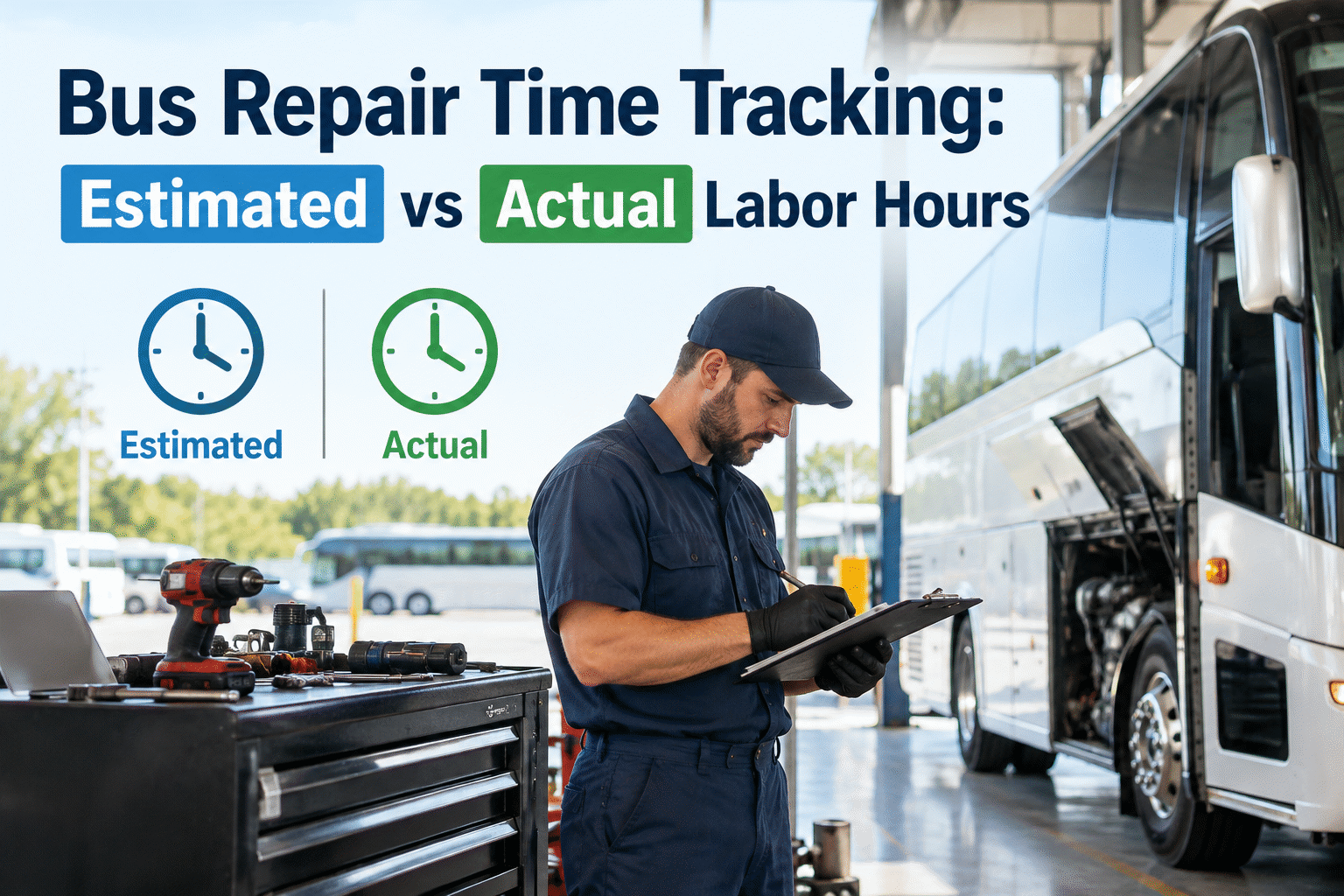
You booked the brake job at two hours and promised dispatch the bus by noon. Four hours later the tech is still under it and three buses are backed up. The problem was not the repair — it was the estimate. Bus repair time tracking, estimated versus actual labor hours on every job, is how a shop stops guessing and schedules from what the work really takes. You can see estimate-versus-actual tracking on live work orders in a short demo.
OPERATIONS · LABOR TRACKING
Bus Repair Time Tracking: Estimated vs Actual Labor Hours
Every repair has two numbers: what you thought it would take, and what it actually took. The gap between them is why your bay schedule slips. Track it on every work order and the gap becomes a pattern you can plan around — here is how.
ESTIMATED VS ACTUAL, BY JOB TYPE
Illustrative jobs. The estimate bar and the actual bar rarely match — and the ones that run over are not random. Electrical faults and brake jobs blowing their estimate every time is a pattern you can schedule for, once you measure it.
Why the Repair Time Gap Wrecks Your Shop Schedule
A bad estimate does not cost you one job — it costs you the whole day. When a repair booked at two hours runs to four, every bus behind it shifts. The bay you promised to the next job is still full, dispatch is calling about a route, and the overrun you could not predict becomes a backup you cannot undo.
ONE OVERRUN PUSHES THE WHOLE DAY
Illustrative morning. The overrun on Bus A is only 90 minutes, but it lands on every bus behind it — which is why estimate accuracy, not raw shop speed, is usually what fixes a chronically late schedule.
Which Repairs Blow the Estimate: Tracking Labor Variance
Once you log estimated versus actual labor hours on enough jobs, the pattern shows up fast. Some job types land on the estimate almost every time; others blow it by double. Knowing which is which is the difference between a schedule built on hope and one built on history.
AVERAGE VARIANCE FROM ESTIMATE, BY JOB TYPE
Illustrative averages. Electrical faults are the classic estimate-killer — the fault is hidden until you dig in. Once the data names the repeat offenders, you pad those estimates and stop over-promising on them.
Tracking estimated versus actual is not a report you file and forget. It is a loop: every job you close feeds the next estimate you set. Run it for a few months and your estimates stop being guesses and start being history — which is when the bay schedule finally holds.
THE ESTIMATE FEEDBACK LOOP
The loop is the whole value. A one-time estimate is a guess; an estimate that learns from every job you have ever closed is a forecast — and a forecast is what a real shop schedule needs.
You do not need a complicated system — you need a few numbers captured consistently on every job. Track these and the estimate-versus-actual picture builds itself.
Estimated hours, set up frontThe number you scheduled against — captured when the work order opens, not guessed later.
MUST
Actual hours, clocked by the techReal wrench time on the job, logged at close — the other half of the comparison.
MUST
Job type and the busSo variance can be grouped by repair and by unit — the pattern lives in the grouping.
MUST
Wait time, kept separateHours lost waiting on a part are not wrench time — split them so a parts delay never skews a tech's numbers.
TRACK
Who did the workNot to police anyone — to learn which jobs a newer tech needs more time for, and plan around it.
The reason most shops do not track this is that it is a pain to do by hand — two numbers, every job, grouped and compared. BusCMMS captures both on the work order and does the comparison for you, so estimate accuracy becomes a dashboard instead of a spreadsheet nobody keeps up.
Estimate and actual on every WO
Set estimated hours when the work order opens; the tech logs actual hours at close. Both live on the job, no side spreadsheet.
Variance by job type and tech
A dashboard groups the gap by repair, bus, and technician, so the repeat estimate-killers surface on their own.
MTTR and turnaround
Mean time to repair and turnaround by job type update automatically — the numbers a realistic schedule is built on.
Workload-aware scheduling
Plan bays and technician hours against real job times, not optimistic ones, so the day you schedule is the day you get.
95%+fleet availability — BusCMMS's own reported customer result25–35%maintenance cost reduction within 12 months, as reported by BusCMMS2–4 wkstypical rollout — bus-specific, so labor tracking starts fast
Those are BusCMMS's own reported figures from customer data — and tighter labor tracking feeds both, because a shop that schedules from real job times wastes fewer hours and keeps more buses on the road.
A Shop Foreman's Take
Key Takeaways on Bus Repair Time Tracking
Tracking estimated versus actual labor is the cheapest fix for a schedule that keeps slipping. Four things to hold onto.
01
The gap is the metric
Estimate minus actual, on every job — that gap is what quietly wrecks the schedule.
02
One overrun pushes the day
A bad estimate does not cost one job — it backs up every bus behind it.
03
Patterns beat guesses
Some job types always run over — measure which, and pad those estimates.
04
Estimates should learn
Feed every actual back into the next estimate and the schedule starts holding.
Capture both numbers, watch the variance, and let your estimates learn from your own history — and bus repair time tracking turns a schedule you hope holds into one you can actually promise. The work takes what it takes; the win is finally knowing what that is.
FAQ
Bus Repair Time Tracking: Common Questions
What is estimated vs actual repair time tracking?+
It is the practice of recording two numbers on every repair: the labor hours you estimated the job would take, and the actual hours the technician clocked doing it. The gap between them is your labor variance. Tracked across enough jobs, it tells you which repairs you consistently under-estimate, which technicians need more time on which work, and how realistic your bay schedule really is. In the auto and fleet world this is sometimes called book time versus actual time — book or flat-rate time being the standard estimate, actual being what really happened. For a bus shop the value is scheduling: an estimate you can trust is the foundation of a day that runs on time instead of falling apart by lunch.
Why do my bus repair estimates keep running over?+
Usually because the estimate was a gut feel, not a number from history — and because certain job types hide their real scope. Electrical faults are the classic example: the repair is quick once you find the fault, but finding it can take hours, so the estimate is almost always low. Brake and suspension work runs over when a seized bolt or a worn part turns a routine job into a fight. The fix is not better guessing; it is measurement. Once you log actual hours against estimates for a few months, the repeat offenders name themselves, and you pad those specific estimates instead of being surprised by them every time. Tracking turns "why are we always behind?" into a list of jobs you now estimate correctly.
How does labor time tracking improve shop scheduling?+
A schedule is only as good as the job times it is built on. If you plan the day assuming a brake job takes two hours when it really takes three and a half, the schedule was wrong before the first bus rolled in. Tracking estimated versus actual gives you the real durations — by job type, and even by technician — so you can plan bays and crew hours against what the work actually takes. That means promising dispatch a bus by a time you can hit, not scheduling four big jobs into a day that only fits three, and seeing a backup coming instead of discovering it at noon. The schedule stops being optimistic fiction and becomes a plan the shop can keep.
Should wait time count against a technician's hours?+
No — and keeping them separate is important. Actual labor hours should be real wrench time on the job. Hours a bus sits waiting on a part, or a tech waits for a bay or a lift, are not the technician's doing, and lumping them into actual time makes a good tech look slow and corrupts your variance data. Track wait time as its own category. That way a repair that ran long because of a parts delay shows up as a supply problem, not a labor problem, and your estimate-versus-actual comparison reflects how long the work takes when it is actually being worked. It also surfaces how much shop time is lost to waiting — often a bigger number than anyone expects, and a separate thing worth fixing.
How does BusCMMS track estimated vs actual repair time?+
BusCMMS captures an estimate on the work order when it opens and the actual hours the technician logs at close, so both numbers live on the job with no separate spreadsheet to maintain. From there a dashboard groups the variance by job type, bus, and technician, so the repairs that consistently blow their estimate surface on their own. Mean time to repair and turnaround update automatically, giving you the real durations to schedule against, and wait time is tracked apart from wrench time so a parts delay never makes a tech look slow. The result is estimate accuracy you earn from your own history — which is what lets you plan bays and crew against real job times. BusCMMS reports customer fleet availability of 95% or higher and maintenance cost reductions of 25 to 35% within 12 months, company-reported figures from its own data, both helped by a shop that schedules from reality.