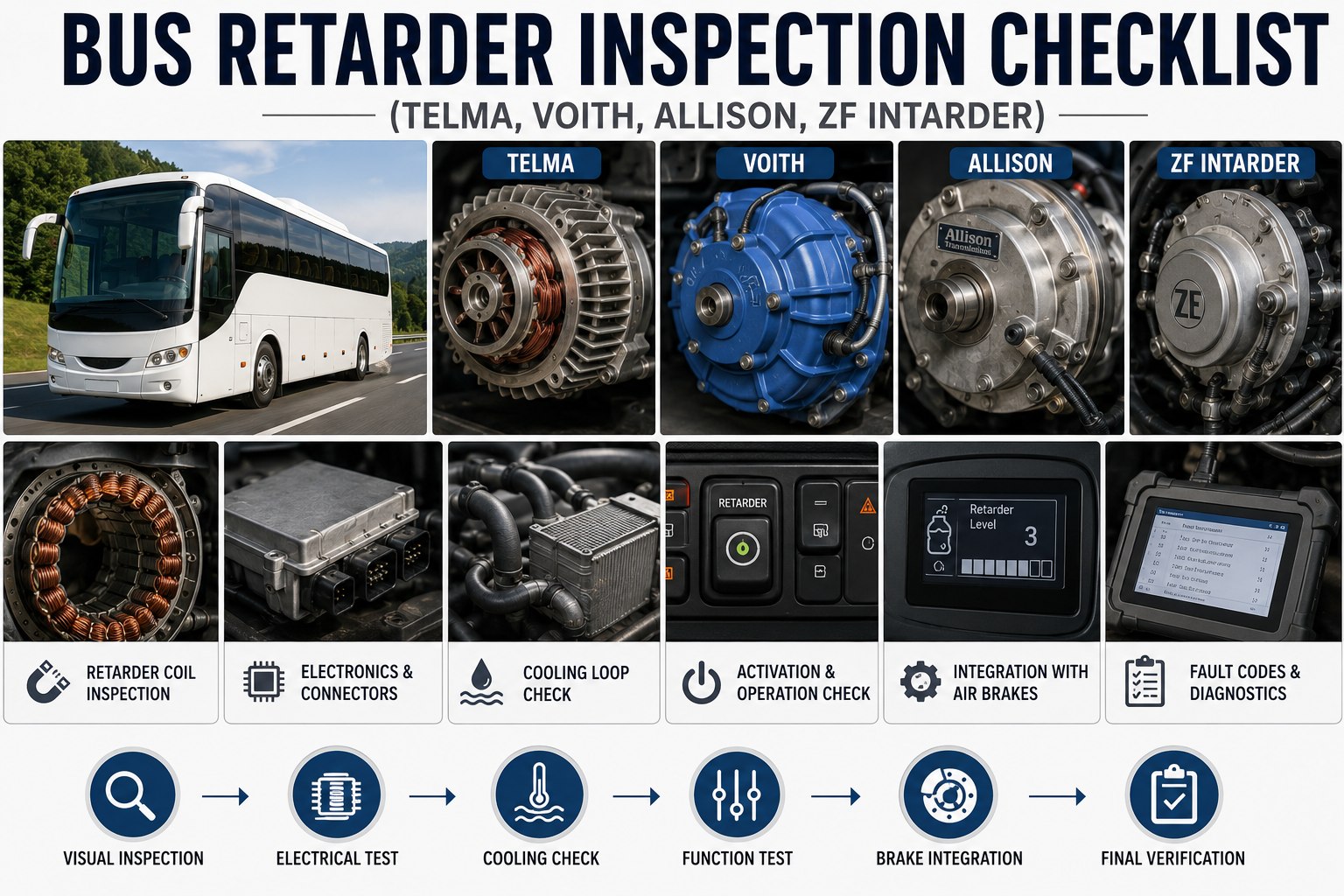
Mile marker 42 on a 6% grade. The motorcoach driver lifts off the throttle expecting the retarder to hold speed steady down the descent. Instead, the dash flashes a retarder fault and the coach starts picking up speed. The driver rides the service brakes for the next four miles. By the time it hits the valley, the shoes are smoking, the drums are blue, and there is $4,800 of foundation brake work waiting at the yard. A real bus retarder inspection checklist -- across Telma, Voith, Allison, or ZF Intarder -- is what keeps that grade from ever ending in a repair bill.
Bus Retarder Inspection Checklist: Telma, Voith, Allison & ZF Intarder
The complete inspection routine for auxiliary bus braking systems -- coil integrity, cooling loops, activation logic, and air-brake integration -- across every major retarder brand on the road.
- Universal checks
- Brand-specific PM
- Fault code triage
Why the Retarder Is the Most Overlooked System on a Bus
Retarders take the load off the foundation brakes on every long descent, every high-speed slowdown, every stop-and-go segment of an urban route. When one is working, you barely notice it. When one fails, the friction brakes take every ounce of that work -- and wear at a rate that makes them look like they came from a different fleet. On motorcoaches running mountain routes, on transit buses on repetitive urban duty, or on any large bus carrying real weight, the retarder is not an option. It is the reason the service brakes make it to next PM.
- Up to 90% Service brake load relief when retarder is fully functional (ZF-published)
- 4,000 Nm Typical peak braking torque, mid-range retarder unit
- 5 levels Common driver-selectable modulation stages
- 8-10 mph Standard low-speed cutoff to protect driveline
A failed retarder does not always throw a code the driver notices at pull-out. Sometimes it just quietly stops making torque, and the friction brakes make up the difference route after route until the shoes are half gone at the next PM inspection. That is why retarder inspection has to be scheduled, not opportunistic. Book a demo to see auxiliary brake tracking automated across your fleet.
The 4 Retarder Types Every Bus Fleet Runs Into
Not all retarders are built the same, and the inspection playbook is different for each. Know which brand and type you are dealing with before opening a work order -- the failure modes, PM intervals, and shop parts change with the technology.
-
Electromagnetic Telma
Stator coils create a magnetic field on a spinning rotor mounted to the driveline. Eddy currents convert kinetic energy to heat, dissipated by airflow. No fluid, no wear parts.
Best forUrban transitWearCoils, wiringCoolingAirflow -
Hydrodynamic Voith
Retarder oil filled between a rotating stator and rotor generates fluid resistance under command. Heat pulled off through a dedicated heat exchanger into the coolant loop.
Best forExtreme dutyWearSeals, fluidCoolingCoolant loop -
Output Retarder Allison
Integral to Allison 3000 and 4000 series automatic transmissions. Uses transmission fluid on a purpose-built rotor. Controlled by TCM, integrated with brake pedal input.
Best forTransit fleetsWearFluid, TCMCoolingTrans cooler -
Intarder ZF Intarder
Hydrodynamic retarder built into ZF transmissions -- common on motorcoaches. Five brake levels, electronic control unit integrated with vehicle brake management and cruise.
Best forMotorcoachesWearSeals, ECUCoolingCoolant loop
The Universal Inspection Checklist (All Brands)
These four checks apply to every retarder regardless of brand or technology. Miss them and you catch a fault after the fact instead of at PM. Sign up free and load this as an auto-triggered retarder PM template.
-
01 Diesel techFunction Test on Road
Every PM-A · road test at highway speed · ~15 min
- Test at each of the driver's brake levels (typically 1-5)
- Deceleration feels smooth, no jerking or fading
- Low-speed cutoff engages at 8-10 mph
- Brake pedal integration -- retarder responds before friction
-
02 Diesel techActivation Logic & Wiring
Every PM-B · ~20 min
- Steering column lever or dash switch responds
- Wiring harness free of chafe, heat damage, or corrosion
- Ground connections clean and tight
- Cruise control disengages retarder correctly on application
-
03 Diesel techAir Brake Integration
Every PM-B · ~10 min
- Retarder engages before service brake in blended stops
- ABS cuts retarder cleanly during activation event
- Stop light signal (brake pedal) triggers retarder correctly
- Pneumatic control valve (if equipped) holds pressure
-
04 CriticalFault Code Scan & Records
Every PM · ~5 min · log to bus history
- Scan retarder ECU / TCM for stored + pending DTCs
- Any repeat codes flagged for root cause
- Foundation brake wear rate trended against retarder health
- Driver complaints reviewed and closed with WO
Brand-Specific Inspection: Electromagnetic vs Hydrodynamic
After the universal checks, the technology drives the next step. Telma electromagnetic units are inspected like electrical systems. Voith, Allison, and ZF Intarder hydrodynamic units are inspected like fluid systems. Confuse the two and you skip the check that catches the fault.
Telma-Type Inspection
- Coil resistance: Measure against OEM spec at all stators
- Insulation test: Megohmmeter check per Telma service manual
- Rotor air gap: Measure between rotor and stator faces
- Cooling airflow: Rotor fans clean, no debris blockage
- Power feed: Battery voltage under load, no drop under activation
- Ground straps: Corrosion-free, tight to chassis
Voith / Allison / ZF Intarder
- Fluid level + condition: Retarder or transmission oil per OEM
- Heat exchanger: Coolant flow through retarder cooler, no bypass
- Vapor lock check: Signs of aerated fluid, especially after hot descent
- Solenoids + valves: Pneumatic or electric control response test
- Seal integrity: No leakage at housing seams, drive shaft seals
- ECU calibration: Verify software revision vs OEM bulletin
Vapor lock is the silent killer of hydrodynamic retarders. A degraded cooling loop or air-contaminated fluid lets the retarder oil vaporize under sustained load, cutting braking torque without necessarily throwing a code. Book a demo to see cooling-loop health tracked per bus.
Warning Signs a Retarder Is Failing (Before the Fault Code)
Retarders rarely fail catastrophically. They lose torque gradually, and the friction brakes silently absorb the workload -- which is exactly why fleets miss it. Learn to catch these four signals early.
-
Signal 1 Ask the driver
"It's Not Holding Like It Used To"
- Driver reports needing more brake pedal on descents
- Higher level required to feel same deceleration
- Coach picks up speed on grades it used to hold
-
Signal 2 Read the wear
Foundation Brake Wear Spike
- Pad or lining wear rate suddenly doubles on one bus
- Rotor or drum surface hotter than fleet average
- Brake dust noticeably heavier per PM cycle
-
Signal 3 Ground the bus
Visible or Diagnostic Failure
- Retarder warning light or dash message active
- Fluid leak from retarder housing or cooling lines
- Overheat warnings on transmission or coolant temp
- Stored DTC that returns after clearing
Signal 2 is the one most fleets miss because it sits in the friction brake PM report, not the retarder log. A bus whose brake pad wear jumps 40% without a route change or driver change is almost always telling you the retarder is on its way out. Book a demo to see brake-wear-vs-retarder-health correlated per bus.
A Shop Foreman's Take on Retarder PM
The number I actually track is brake pad life per bus. If unit 22 used to eat pads every 40,000 miles and suddenly it is doing 28,000, I do not send it to the brake bay first -- I send it to the driveline bay to test the retarder. Nine times out of ten, the retarder is soft. Fixing the retarder gets us back to 40K on pads. The retarder is what saves the brakes, so I let the brakes tell me when the retarder is sick.
That is what a real retarder PM program looks like: trending indirect indicators, not waiting for a dash light. The retarder rarely tells you it is failing. The brakes do.
How BusCMMS Tracks Retarder Health
A retarder checklist scattered across brand-specific manuals gets skipped on a mixed fleet. A checklist that fires the right template for the right unit, trends foundation brake wear alongside retarder function, and syncs fault codes from telematics -- that is a program that actually protects your service brakes.
-
01
Brand-Specific Templates
Pre-loaded PM for Telma, Voith, Allison, and ZF Intarder units on one dashboard.
-
02
Brake Wear Correlation
Foundation brake wear rate flagged against retarder health per bus.
-
03
DTC Auto-Sync
Retarder fault codes from Samsara or Geotab auto-create work orders instantly.
-
04
Cooling Loop Tracking
Coolant service intervals tied to retarder heat exchanger inspection dates.
-
05
Driver Complaint Log
"Not holding" reports auto-linked to a retarder function test WO.
-
06
Warranty-Grade Records
Every test result timestamped and signed, retained per 49 CFR 396.
How often should a bus retarder be inspected?
A full retarder inspection combines three intervals for most bus fleets. Every PM-A (roughly 6,000 miles): on-road function test through the driver's brake levels plus low-speed cutoff verification. Every PM-B (roughly 18,000 miles): activation logic and wiring inspection, air brake integration test, ECU/TCM fault code scan. Every PM-C (roughly 36,000 miles): brand-specific deep inspection -- coil resistance and rotor air gap on Telma electromagnetic units, or fluid quality, heat exchanger, and seal integrity on Voith, Allison, and ZF Intarder hydrodynamic units. Mixed fleets need brand-specific PM templates so the right check happens on the right unit.
What is the difference between a Telma retarder and a hydrodynamic retarder?
A Telma retarder is electromagnetic. It has stator coils around a rotor mounted to the driveline; when activated, the coils create a magnetic field that induces eddy currents in the rotor, converting kinetic energy to heat dissipated by airflow. No fluid, no wear surfaces. Voith, Allison output, and ZF Intarder retarders are hydrodynamic. They use fluid resistance between a rotor and stator to convert kinetic energy to heat, dissipated through a coolant loop or transmission cooler. The inspection playbook is different: Telma is inspected like an electrical system, hydrodynamic units like a fluid system.
Can a failing retarder damage the bus foundation brakes?
Yes -- indirectly but seriously. Because a functional retarder relieves the service brakes by up to 90% (ZF-published figure for the Intarder) on sustained descents and stops, a failing one silently transfers that load to the foundation brakes. Pads and rotors that would normally last 40,000 miles suddenly wear out at 25,000-28,000. Worse, on long descents the foundation brakes overheat, fade, and can glaze -- turning a routine repair into a safety event. That is why brake pad wear rate is one of the earliest indicators of retarder health, and why fleets running retarders on mountain routes should trend the two together.
What is vapor lock in a hydrodynamic retarder?
Vapor lock happens when the retarder oil in a hydrodynamic unit heats up and begins to vaporize instead of transferring kinetic energy to the coolant loop. It typically results from a degraded cooling loop, air contamination in the fluid, or sustained heavy use on long descents without adequate heat rejection. The retarder loses braking torque without necessarily throwing a fault code, because the sensors read fluid temperature but not vaporization directly. It is a silent failure mode -- which is why cooling loop inspection and fluid condition testing are on the universal checklist, not just the fault-code scan.
How does a bus CMMS help manage retarder maintenance across multiple brands?
A bus-specific CMMS solves the multi-brand challenge in four ways. First, brand-specific PM templates load the correct Telma, Voith, Allison, or ZF Intarder inspection steps automatically per bus -- no shop foreman memory required. Second, foundation brake wear rate is trended per bus so a spike flags the retarder before the driver complains. Third, telematics integration syncs retarder fault codes in real time and auto-creates work orders. Fourth, driver complaints ("not holding on grades") auto-link to a retarder function test WO instead of getting buried in a text log. The result: fewer retarder failures found at roadside, and fewer foundation brake bills tied to a soft retarder.