Hiring a new bus technician is the easy part. Onboarding them to full productivity and safety competency in 90 days is the challenge most fleet maintenance managers underestimate. A typical new technician experiences 30-45 days of low productivity while learning procedures, tools, fleet-specific systems, and CMMS workflows. Without a structured onboarding program, technicians pick up bad habits, miss critical safety procedures, and remain dependent on senior technicians for guidance months into employment. Additionally, many fleet shops lack formal training for ASE certification, CMMS proficiency, or inspection standards, resulting in technicians who are mechanically capable but organizationally unprepared. The most effective bus fleets implement a structured 90-day onboarding program that covers: CMMS orientation (week 1), basic bus safety and inspection standards (week 2), hands-on mentorship pairing with an experienced technician (weeks 3-8), ASE certification pathway (ongoing), and structured competency checkpoints at 30, 60, and 90 days. A new technician completing this program is productive, certified-ready, safe, and aligned to fleet standards within 12 weeks. Fleets without formal onboarding programs extend the productivity ramp to 4-6 months and experience higher technician turnover (18-22% annually vs 8-12% for fleets with good programs). This guide provides a complete bus technician onboarding template that can be customized for your fleet size and equipment, including 90-day competency checkpoints, ASE study plans, CMMS training modules, and mentorship pairing guidelines.
How to Onboard New Bus Technicians: 90-Day Training Program Template
Complete onboarding guide for bus fleet maintenance shops. Covers CMMS training, ASE certification pathways, safety standards, hands-on mentorship, and 30/60/90 day competency checkpoints. Reduce productivity ramp from 4-6 months to 12 weeks and improve technician retention by 10-15%.
Why Structured Technician Onboarding Matters
Hiring a new bus technician costs 8,000-15,000 dollars in recruitment, background checks, and screening. The hiring manager expects the technician to contribute to the maintenance shop on day 1. In reality, without a structured onboarding program, a new technician operates at 30-40% productivity for the first 30 days (learning layout, tools, fleet-specific procedures), 60-70% productivity for days 31-60 (learning CMMS, PM schedules, parts inventory), and 85-90% productivity for days 61-90 (becoming independent but still asking questions). A technician with poor onboarding may never reach 95%+ productivity and may leave the organization within 18-24 months, costing you another $8,000-$15,000 in recruitment and training of the replacement. A technician with structured onboarding reaches 90%+ productivity by day 90 and stays with the organization for 4-6 years on average, generating a lifetime value of $150,000-$250,000 to the fleet.
Beyond the financial argument, structured onboarding is a safety requirement. Bus maintenance involves high-risk systems: air brakes, transmission, electrical systems, lifting equipment. A technician unfamiliar with lockout-tagout procedures, brake system safety protocols, or electrical hazards is a safety risk to themselves and to the fleet (defective repairs lead to accident risk). The most effective fleets implement onboarding programs that front-load safety and procedure training in the first 2 weeks, pair new technicians with mentors for weeks 3-8, and use 30/60/90 day checkpoints to validate competency before the technician works independently on critical systems.
Complete 90-Day Onboarding Program
BusCMMS includes technician onboarding training, role-based access (trainee, technician, supervisor), and competency checkpoint templates. Build your fleet-specific program using this template.
30/60/90 Day Competency Checkpoint Framework
The 30/60/90 framework divides the onboarding period into three 30-day phases, each with specific learning objectives, training activities, and competency validation. At the end of each phase, the supervisor and mentor conduct a brief competency checkpoint (15-20 minutes) where the technician demonstrates understanding of key concepts and readiness for the next phase. This approach keeps the new technician engaged, provides regular feedback, and ensures no gaps in knowledge before advancing.
ASE Certification Pathway for Bus Technicians
ASE (Automotive Service Excellence) certification validates that a technician has demonstrated competency in specific areas of automotive maintenance and repair. For bus fleet technicians, the most relevant ASE certifications are: T1 (Gasoline Engines), T2 (Diesel Engines), T3 (Manual Drive Trains & Axles), T4 (Automatic Transmissions/Transaxles), T5 (Brake Systems), T7 (Heating & Air Conditioning), and T8 (Electrical/Electronic Systems). Most bus fleets require T2 (Diesel Engines) and T5 (Brake Systems) at minimum; T4 (Transmission) and T8 (Electrical) are highly valuable. The ASE certification process involves passing an exam (84-90 point scale, passing score typically 70+) and maintaining 2 years of work experience in the relevant field (or equivalent through formal training).
ASE Study Strategy: Enroll new technicians in ASE study within first 30 days (can start while completing onboarding safety training). Allocate 2 hours per week for study (during work time or subsidized external training). Provide study materials: ASE prep books, online practice exams, video tutorials. Schedule mock exams 2-3 weeks before real exam. Budget $400-$800 per technician per certification (study materials, exam fees, prep course if used). Target: First ASE cert (T2 or T5) completed within 120 days of hire; second cert within 180 days. Link ASE certification to pay increases (e.g., +$2-$3/hour per certification) to incentivize completion.
CMMS Training Module for New Technicians
A new technician's relationship with the CMMS is critical: they will log 30-50 work orders per month, create 10-20 parts requisitions per month, and document findings that drive fleet decisions. Poor CMMS data entry (incomplete work orders, inaccurate hours, missing diagnostics) cascades through the fleet (inaccurate cost per mile, missed warranty recovery, poor predictive analytics). The CMMS training module must be hands-on and fleet-specific, not generic software instruction.
Technician logs in, navigates main dashboard, understands role-based access (what they can and cannot see), and finds the technician mobile app. Hands-on: mentor watches technician navigate to work order list, vehicle list, and parts inventory on both desktop and mobile.
How to view assigned work orders, understand task descriptions, log time and parts, and close work orders. Hands-on: technician completes 3 dummy work orders with mentor feedback on completeness and accuracy.
Overview of your fleet's PM schedule: which tasks are tied to mileage, which to calendar, what the completion frequency is, and which tasks are high-priority vs routine. Review PM schedule for the technician's assigned bus routes or equipment type.
How to search parts inventory, place parts requisitions, understand reorder points, and request emergency parts. Hands-on: technician searches for 5 common parts (brake fluid, oil filter, spark plugs) and places a dummy requisition.
How to capture diagnostic codes (OBD II), attach photos of failed components, and flag repairs as warranty-eligible. Hands-on: technician logs a sample transmission fault code and flags the work order for warranty claim.
Overview of fleet-wide KPIs technicians impact: PM compliance, downtime, cost per mile, technician productivity. Show how their work order data feeds into monthly reports sent to leadership. This helps technicians understand why accurate data entry matters.
Technician works through 5-6 realistic work order scenarios with mentor present. Scenarios include routine PM, unplanned repair with diagnostics, parts ordering, and warranty flagging. Mentor reviews each entry before technician closes the work order.
Training on BusCMMS mobile app (same work orders and functions as desktop but optimized for technicians in the shop). Emphasis on photo capture, offline work order access (if supported), and quick-entry features. Hands-on: technician completes 2 work orders entirely on mobile app.
Mentorship Pairing & Hands-On Training
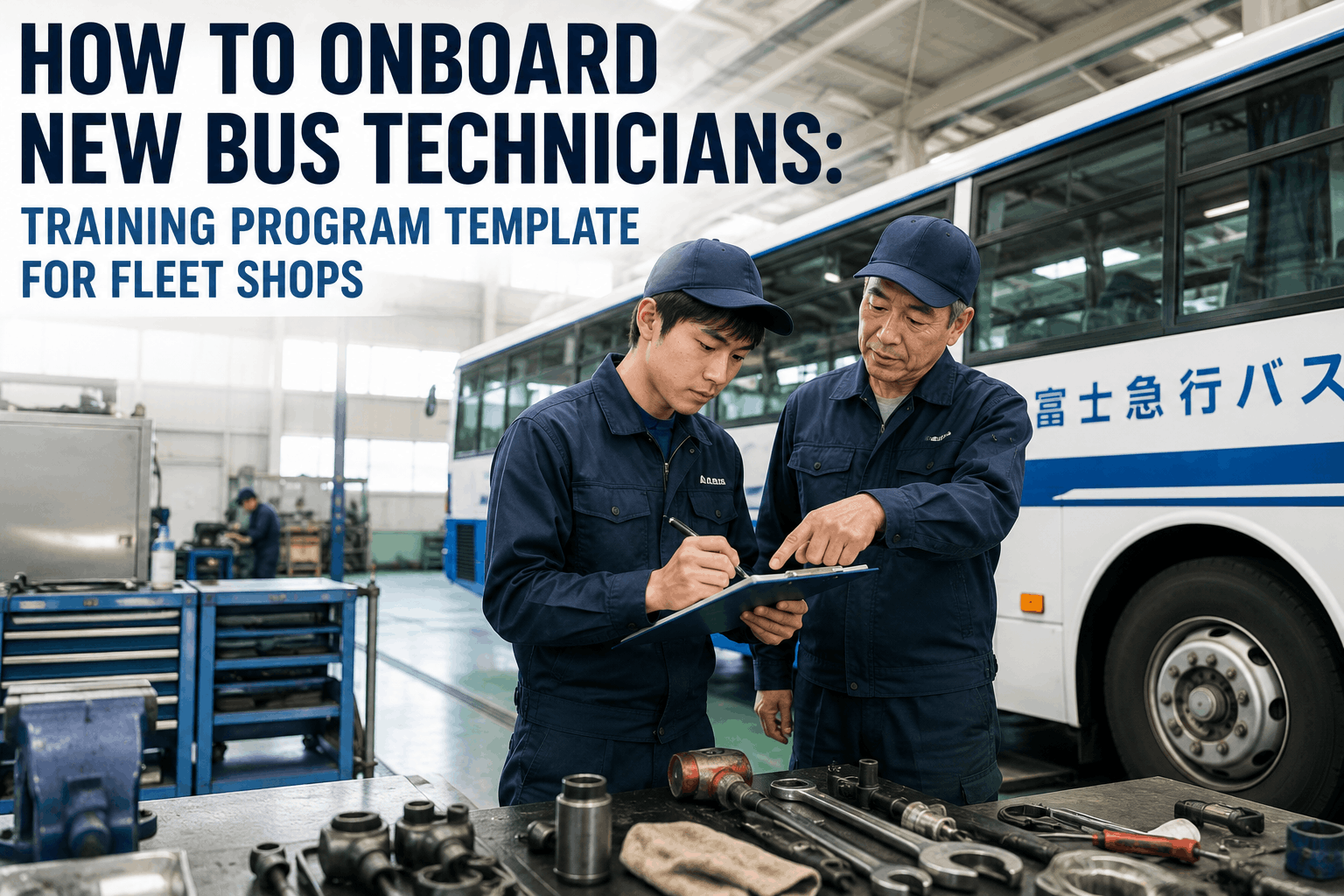
The most effective onboarding strategy is pairing the new technician with an experienced mentor for hands-on training. The mentor is not a formal trainer but an experienced technician who the new technician shadows and assists. This "learning by doing" approach is more effective than classroom training and builds the relationship between new technician and experienced technician faster than independent study.
Select a mentor who is: (1) technically skilled in the work types the new technician needs to learn, (2) patient and good at explaining procedures, (3) willing to slow down and let the new technician observe and help, (4) respected by other technicians (someone other technicians trust), (5) stable in the organization (not planning to retire or leave in next 1-2 years). Mentors should be compensated for training time: either $2-$3/hour premium for days spent mentoring, or a $200-$500 bonus per new technician trained successfully.
Week 1-2: New technician shadows mentor on 80-90% of work; mentor explains each step. Week 3-5: New technician assists mentor (helping hold tools, handing parts, preparing equipment); mentor demonstrates and new technician practices under supervision. Week 6-8: New technician performs repair while mentor observes and coaches from side; mentor steps in only if safety issue arises. Week 9-12: New technician works independently on routine repairs; mentor available for questions but not shadowing.
During mentorship, new technician should practice: (1) Preventive Maintenance service (fluid changes, filter changes, belt inspection), (2) Brake system repair and inspection, (3) Electrical diagnostics and repair (alternator, starter, lighting), (4) Fluid leak diagnosis and repair, (5) PM inspection checklist completion. Most important: by end of 8-week mentorship period, new technician should be able to perform routine PM and brake service independently.
Safety Certification & Compliance
Bus fleet maintenance involves hazardous work: high-pressure systems, electrical hazards, heavy equipment, and lifting. Within the first week, all new technicians must complete mandatory safety training covering: (1) Lockout-Tagout procedures (OSHA 1910.147), (2) Bloodborne pathogen training, (3) Hazard communication and SDS (Safety Data Sheets), (4) Electrical safety (OSHA 1910.303-307), (5) Lifting and ergonomics, (6) Respiratory protection (if applicable), (7) Fire safety and emergency procedures. Most of these trainings are 30-60 minutes each and can be completed during the first 2-3 days. Budget $1,000-$2,000 per technician for initial safety certifications (training materials, documentation, refresher training annually).
Performance Metrics: Measuring Onboarding Success
Track these metrics to validate that onboarding is effective and identify gaps:
% of work orders completed with accurate time/parts/diagnostics. Target: 95%+ by day 60. Measure: supervisor spot-checks 10-15 work orders per month and rates completeness (time logged, parts documented, diagnostics captured, notes clear).
% of repairs that do not result in callbacks or comebacks. Target: 98%+ (i.e., <2% of repairs have to be re-done). Measure: technician supervisor tracks comebacks monthly; if a technician has 3+ comebacks in a month, they get additional mentoring on that repair type.
Zero safety violations during first 90 days. Measure: mentor and supervisor document any safety deviations (improper lockout, electrical hazard exposure, lifting error). Target: 0 violations = successful onboarding on safety dimension.
Work orders completed per week over time. Target: week 1-4 = 5-8 WO/week, week 5-8 = 10-15 WO/week, week 9-12 = 15-20 WO/week (reaching ~80-90% of experienced technician pace). Measure: count work orders closed per technician per week using CMMS.
First ASE cert completed within 120 days. Target: 80%+ of new technicians pass first ASE attempt. Measure: track when technicians take ASE exams and pass/fail rate. High pass rate indicates mentoring and study program are effective.
% of new technicians still employed after 12 months. Target: 90%+ (i.e., <10% turnover in first year). Measure: track terminations and voluntary departures in first 12 months. Compare retention rate for technicians completing structured onboarding vs technicians hired without formal program.
Accelerate New Technician Productivity
Use BusCMMS technician onboarding module to streamline training. Role-based access, competency templates, and training dashboards speed onboarding from 4-6 months to 12 weeks. Proven with 150+ fleet shops.
We had no formal onboarding program; new technicians learned by osmosis and turned over in 12-18 months. We implemented this 90-day program with mentorship pairing and competency checkpoints. Now new technicians are productive by day 60, pass their first ASE cert within 120 days, and 92% are still with us after 2 years. The investment in structured training paid back within 6 months through reduced turnover and higher-quality work. Every maintenance manager should have this program.
FAQ: Bus Technician Onboarding Best Practices
How long does it actually take a new technician to become fully productive?
How much should I pay a mentor for training time?
What if a new technician is not meeting competency checkpoints?
How do I tailor this program to my specific fleet type?
What if I don't have an experienced technician to serve as mentor?
How do I know if onboarding program is working?
Can I use this program for technicians hired from outside the industry?
Should I require ASE certification as a condition of employment?
Conclusion: Structured Onboarding Drives Retention and Quality
The technicians in your fleet shop are your most valuable asset. A structured 90-day onboarding program that covers safety, CMMS training, hands-on mentorship, and competency checkpoints reduces productivity ramp time, improves work quality, and increases technician retention by 10-15%. The cost of structured onboarding (mentor time, training materials, ASE support) is $2,000-$4,000 per technician. The cost of replacing a technician who leaves due to poor onboarding is $8,000-$15,000 in recruiting and training. The ROI is clear: invest in good onboarding and you'll keep your best people longer and improve fleet maintenance quality. Start your free BusCMMS trial to access technician onboarding templates and training modules that accelerate new technician productivity. Or schedule a demo to customize this onboarding program for your fleet maintenance shop.