It is 6:10 AM, nine work orders are open, and you are handing jobs out by who is closest and who looks free — so the brake job lands on a tech not signed off on brakes and the CNG repair waits all day. That is a shop without a bus technician skill matrix, where work routes by proximity instead of qualification and the fleet pays in comebacks and delays. The fix is a simple grid that makes every assignment a deliberate call.
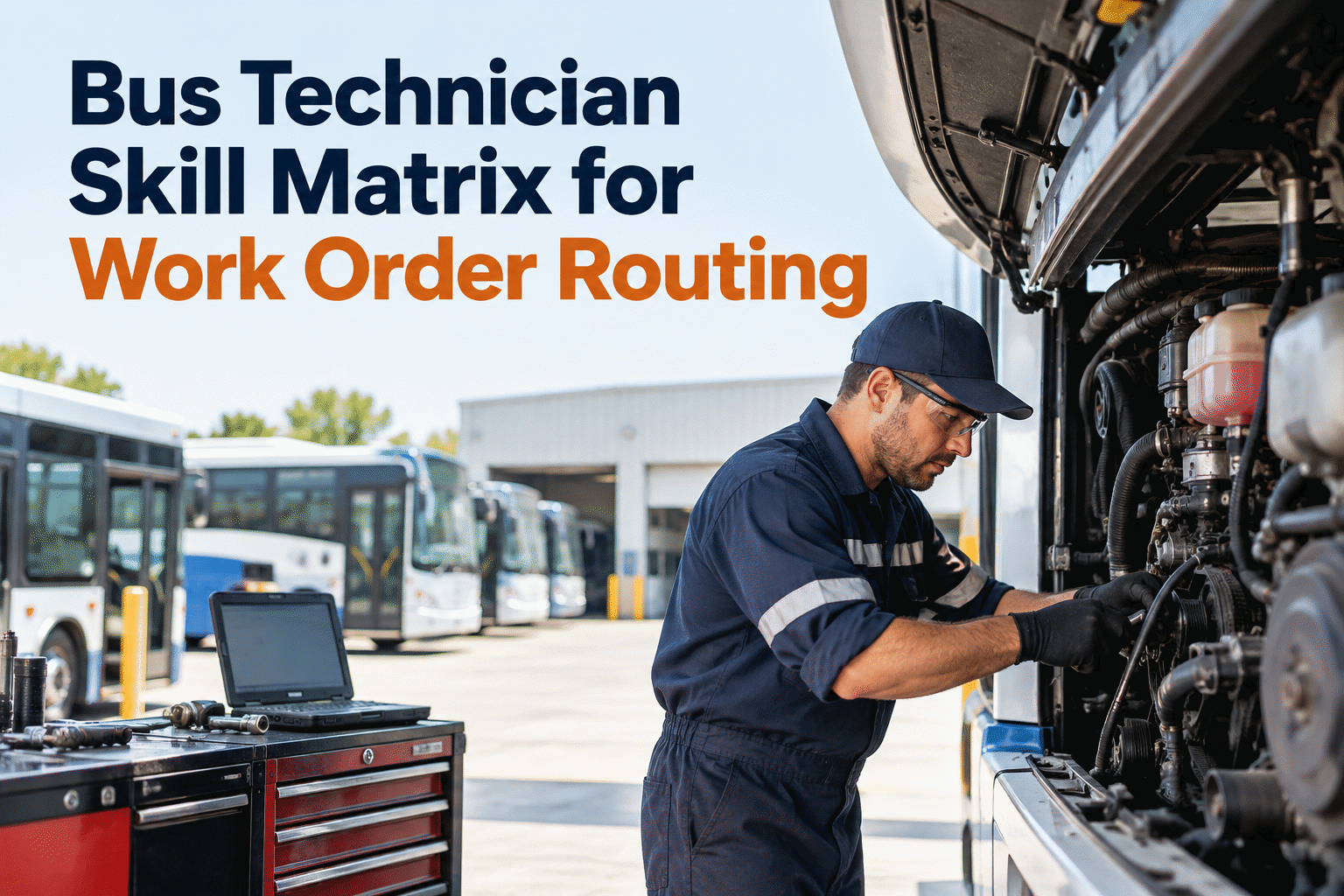
Bus Technician Skill Matrix for Work Order Routing
Map who is qualified for what, then route every work order to the right tech by skill and availability — so the brake job goes to someone signed off on brakes, and no single specialist becomes your whole fleet's bottleneck.
Illustrative. One grid answers the morning question instantly: who can take the CNG job, who is still in training on the lift, and where you are one sick day away from not being able to cover a skill at all.
Why “whoever's free” routing breaks down
Assigning work by who is available sounds efficient, and on a slow day it is fine. But a bus shop does not run on slow days. When a brake job goes to a tech who is quick but not signed off on brakes, you are not saving time — you are setting up a comeback, a re-inspection, and a bus that misses its afternoon route. Skill-based work order assignment flips that: the job finds the tech who can actually do it right the first time.
The matrix is what makes that possible. Without it, routing lives in the foreman's head, and when he is out, the whole system goes with him. With it, anyone covering the desk can see who is qualified and route the work the same way every time — the same discipline you built into a new hire's onboarding and sign-off, now applied across the whole team.
Illustrative. Same work order, same busy morning — the only difference is whether the assignment checked the matrix first. One path ends in a comeback; the other in a bus on the road.
Reading the matrix: coverage and skill gaps
The matrix does more than route today's work. Read it down the columns instead of across the rows and it becomes a skill gap analysis — it shows you exactly where you are thin. When only one tech is qualified for CNG fuel systems, EV high-voltage work, or the wheelchair-lift ADA inspection, that skill is a single point of failure. One vacation, one resignation, one sick day, and a whole category of work stops cold.
This is the view that turns a reactive shop into a planned one. The skills with one qualified tech are your cross-training priority list, written for you. You stop finding out you have a coverage gap the morning it strands a bus, and start closing it on purpose — something you can begin mapping the day you set up your technician qualifications.
Illustrative. Three skills sit at one qualified tech each — your cross-training list, ranked by risk, without a single meeting to produce it.
Route the right job to the right tech, automatically
BusCMMS holds each tech's qualifications and matches them to work orders by skill and availability — so routing is deliberate, not a guess. See it on your own shop, or start building your matrix today.
Routing a work order by skill and availability
A skill matrix answers “who can,” but routing needs a second answer: “who can right now.” The best CNG tech in the shop is no help if he is elbow-deep in a transmission. Good work order routing checks both — qualification first, then availability — and only then makes the assignment. When one skill has a single qualified tech, that check also tells you the moment you are about to overload him, which is the real cost of a thin matrix.
Done by hand, that is a lot to hold in your head at 6 AM. Done in the system, it is automatic: the work order knows what skill it needs, the matrix knows who has it, and the availability view knows who is open. Qualified technician assignment stops being a judgment call and becomes a lookup.
Illustrative. The order of the checks is the whole point: skill decides who can do the job, availability decides who does it today, and the system runs both in a second.
What belongs in your bus technician skill matrix
A matrix is only as useful as the skills it tracks, and for a bus shop those are specific. Generic “mechanic” is not a skill — the systems that decide whether a job is routed right are. Here is the backbone, tagged by how central each is to getting the assignment correct.
- Safety-critical systemsBrakes, steering, suspension — the work where a wrong hand means a comeback you cannot afford on a bus full of kids.CORE
- Fuel-type specialtiesDiesel, CNG, and EV high-voltage are different qualifications — CNG and high-voltage especially carry their own safety certs.CORE
- ADA lift & accessibilityWheelchair-lift service and its inspection cadence — a distinct skill tied directly to rider safety and compliance.CORE
- Diagnostics & electricalFault-code and electrical troubleshooting — the skill that separates a two-hour fix from a two-day guessing game.TRACK
- Certifications & expiry datesTrack not just who is qualified but whether the cert is current — an expired one should pull a tech off that routing.TRACK
How BusCMMS routes work by skill
A matrix on a whiteboard is a start, but it does not route anything — someone still has to read it and remember it. BusCMMS makes the matrix live: tech qualifications are stored, work orders carry the skill they need, and assignment checks both skill and availability so the right person gets the job. Because it is purpose-built for buses, the skills it tracks are the real ones, not a generic trade list. You can see the whole routing flow on a live demo.
Live technician skill matrix
Each tech's qualifications held in one grid — qualified, in-training, or not-yet — visible to whoever is routing work.
Skill-matched work orders
Each WO carries the skill it needs, so it routes to a qualified tech — not whoever happens to be closest.
Availability & workload
Routing sees who is free, so one specialist does not become the bottleneck while others sit idle.
Certification tracking
Current certs gate the routing and single-tech skills surface as gaps — your cross-training list, kept live.
I used to keep the whole shop's skills in my head, and on the days I was out, jobs went to whoever grabbed them. Half our comebacks traced right back to that. Once I had the matrix in the system, the work routed itself to the right hands — and it showed me I had exactly one guy who could do CNG. That was the cross-training decision I'd been putting off for a year.
Key takeaways on the bus technician skill matrix
A skill matrix turns routing from a guess into a lookup. Four things to hold onto.
Route by skill, not proximity
“Whoever's free” buys a comeback on a busy morning. Match the job to a qualified tech.
Check availability second
Qualified but buried helps no one — routing has to see who is free, not just who can.
Read the columns for gaps
One qualified tech on a skill is a single point of failure — and your cross-training list.
Keep the matrix live
A whiteboard goes stale; a system routes from current qualifications and cert dates every time.
Build a bus technician skill matrix and the morning scramble gets quieter: work finds the right hands, your specialists stop being bottlenecks, and the coverage gaps you used to discover the hard way show up on a grid instead. It is the difference between hoping the right person grabbed the job and knowing they did. You can start building your matrix this week, or walk the full routing flow with our team first on a bus fleet software demo.
Match every work order to a qualified, available tech
Put your whole team's skills in one live matrix and let BusCMMS route work by qualification and availability — fewer comebacks, no single-tech bottlenecks, gaps you can see. Start free, or see it on your fleet first.