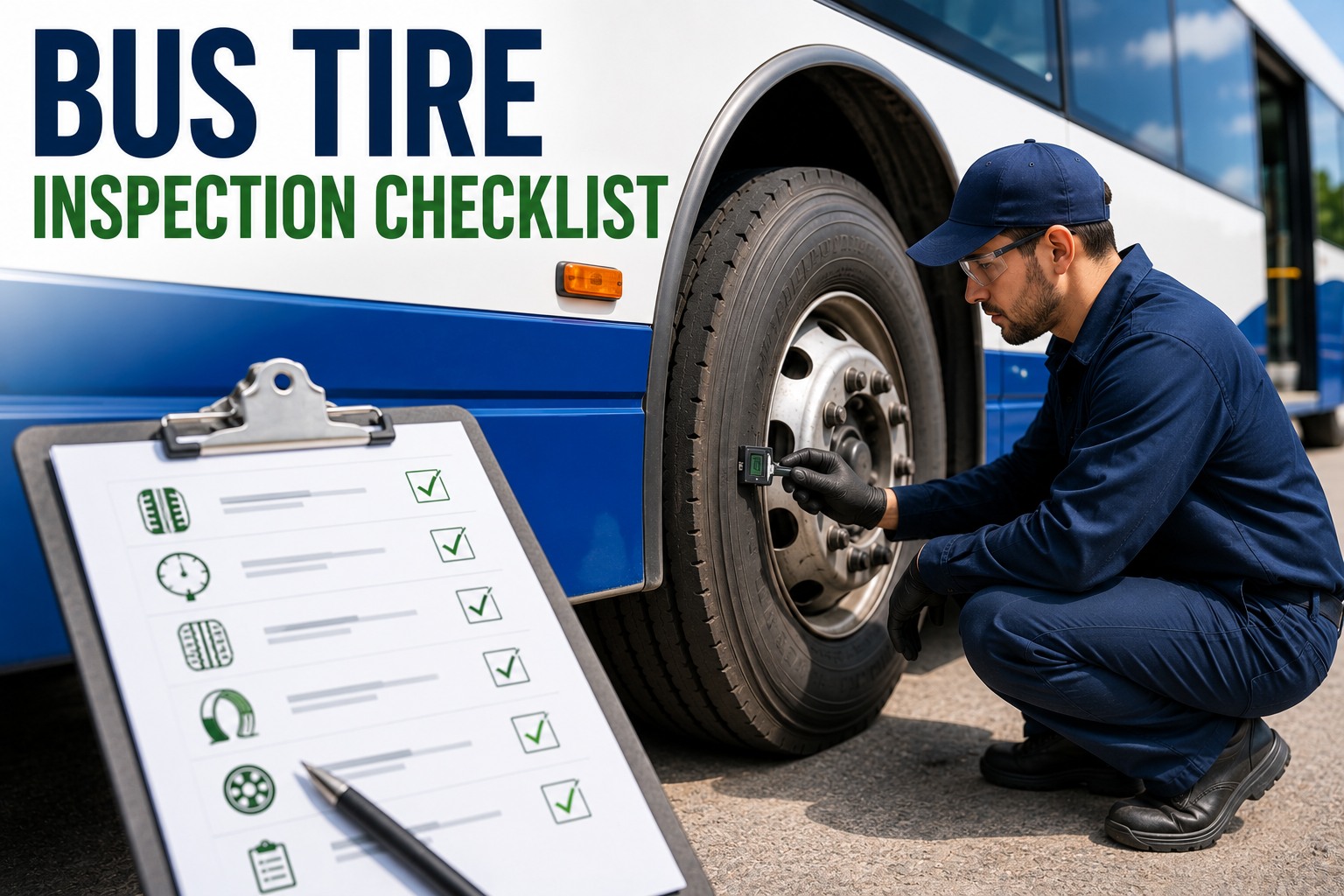
DOT inspector at the yard, 7:04 AM. He walks straight to the front driver-side tire on Bus #31 and pulls out a tread gauge. It reads 3/32 inch. That is 1/32 under the federal minimum for a bus steer tire. The bus is grounded before the driver even climbs in, the route is scrambled, and your Vehicle Maintenance BASIC score just picked up eight points. A real bus tire inspection checklist -- run consistently -- is what keeps that walk-up from ever ending in a red tag.
Bus Tire Inspection Checklist: Tread, Pressure & DOT Limits
The federal minimums, inspection items, and wear patterns every bus fleet needs -- keyed to 49 CFR 393.75 and the CVSA out-of-service criteria.
- Tread depth by position
- Cold pressure standards
- OOS trigger list
Why Bus Tires Rank Among the Top OOS Violations
Tire violations sit second only to brake violations in CVSA roadside statistics -- and unlike brakes, they are visible from six feet away with a $12 tread gauge. That is exactly why inspectors check them first. Every tire finding lands on your Vehicle Maintenance BASIC score, stays there for two years, and drives your insurance premium alongside it.
- #2 Most-cited CMV violation category behind brakes, every Roadcheck year
- 8 pts Added to CSA Vehicle Maintenance BASIC per tire violation
- $1K-$16K Federal penalty range per violation, plus insurance impact
- 24 mo A tire violation stays on your CSA safety record
On the other side of the ledger, proper tire pressure alone saves an estimated $680-$1,530 per bus per year in fuel and extends tire life from 350,000-450,000 miles up to 500,000-700,000 miles. The math on running a real tire program is not close. Book a demo to see automated tire tracking cut your OOS risk.
The 5 Federal OOS Triggers Every Inspector Checks
Under 49 CFR 393.75, these are the automatic out-of-service conditions. If any one of them is found at roadside, the bus does not move until it is fixed -- period.
-
01
393.75(a)(1)
Exposed Ply or Belt
Body ply or belt material visible through tread or sidewall.
-
02
393.75(a)(2)
Tread or Sidewall Separation
Any visible separation of tread or sidewall from the tire casing.
-
03
393.75(a)(3)
Flat or Audible Air Leak
Fully flat tire or a leak you can hear at the yard. One of the most-cited findings.
-
04
393.75(a)(4)
Cut Exposing Ply
Any cut deep enough to reach ply or belt material.
-
05
CVSA OOS
Cold PSI Under 50% of Max
CVSA automatic OOS. Underinflation this severe = casing damage risk.
Bus-only rule: Under 49 CFR 393.75(d), no bus may operate with regrooved, recapped, or retreaded tires on the front wheels. That is stricter than the rule for trucks -- and it exists because a steer blowout on a full bus is catastrophic. Book a demo to see per-position tire tracking in action.
The Complete Bus Tire Inspection Checklist
Below is the full checklist grouped by what actually gets inspected -- not just when. Every item ties to a specific federal requirement or wear failure mode. Sign up free and load this checklist into BusCMMS in minutes.
-
01 Any techTread Depth Measurement
Monthly · every position · ~10 min per bus
- Steer tires at or above 4/32" in every major groove
- Drive/rear tires at or above 2/32" in every major groove
- Measure at multiple points -- not just center
- Avoid tie bars, humps, fillets when measuring
-
02 Any techCold Air Pressure Check
Weekly · before first pull-out · ~5 min per bus
- Measure cold (before driving or after 3-hr rest)
- Within 5 PSI of manufacturer target for actual load
- Dual tires within 5 PSI of each other
- Use calibrated gauge (not cab dashboard reading)
-
03 DriverSidewall & Casing Inspection
Daily pre-trip visual · ~3 min
- No visible cuts exposing ply or belt material
- No bulges, blisters, or sidewall separation
- No audible air leaks at valve stem or bead
- Valve caps present and in place
-
04 Any techWear Pattern & Rotation
Monthly · log per position · ~15 min per bus
- Center wear check (over-inflation signal)
- Shoulder wear check (under-inflation signal)
- One-side wear (alignment signal)
- Rotation due? Log wheel position + hours/miles
-
05 ComplianceRecords & DOT Documentation
Every inspection · retained per 49 CFR 396
- DVIR completed and signed (retained 3 months)
- Tread and pressure logs (retained 12 months)
- Annual DOT inspection report (retained 14 months)
- Defect-corrected documentation for every OOS event
Reading Wear Patterns: What the Tire Is Telling You
A tire's wear pattern is a free diagnostic report the bus writes for you every day. Learn to read four patterns and you can catch pressure, alignment, and suspension issues before they cost you a tire.
-
Center Wear
Cause: Over-inflation. Tire crown carries the load.
Fix: Drop PSI to manufacturer spec for actual load weight.
-
Shoulder Wear
Cause: Under-inflation. Edges bear extra load and heat.
Fix: Inflate to spec. Test for slow leak if repeats.
-
One-Side Wear
Cause: Alignment out (camber or toe).
Fix: Full alignment. Check steering and suspension wear.
-
Cupping / Scalloping
Cause: Worn shocks, loose wheel bearings, or bad bushings.
Fix: Inspect suspension. Replace shocks or bearings.
A 20% underinflated tire looks normal on the yard but loses 15% of its tread life and burns 3-5% more fuel. Wear patterns catch that drift long before a gauge does. Book a demo to see wear pattern logging per wheel position.
How BusCMMS Automates Tire Tracking
Manual tire logs miss the trend. Per-position tracking over time reveals which buses drift and which run clean -- so replacements happen on real wear, not on the calendar.
-
01
Per-Position Tread Log
Measurements logged by wheel position over time. Wear rate visible per tire.
-
02
Pressure Trend Alerts
Slow leaks and dual-tire mismatches surface before they become CVSA violations.
-
03
Rotation Schedule Automation
Rotation triggers by miles or hours -- no more spreadsheet chasing.
-
04
DVIR-to-WO Auto-Link
Driver flags a tire on pre-trip -- work order lands on the tech queue instantly.
-
05
Federal-Compliant Records
3-month DVIR, 12-month PM, 14-month annual retention all enforced automatically.
-
06
Cost-Per-Mile Analytics
Tire spend broken out per bus and per position. Catch problem tires early.
Fleets on structured tire tracking typically report 25-40% longer tire life and near-zero tire-related roadside events after the first quarter. Book a demo to see tire analytics running on a bus like yours.
What Fleet Managers Actually Say
We used to buy tires on a fixed calendar. Once we started logging tread depth per position monthly, we realized three of our buses were burning through steer tires twice as fast as the fleet average. Turned out to be alignment. Fix cost us $180. Saved $2,400 in premature replacements the first year.
The pressure trend alert caught a slow leak on Bus 22 four days before it would have been a CVSA-level underinflation. Nobody on the yard had noticed. Now every bus gets a weekly cold-check log and I have not signed off on a tire violation since.
What is the minimum tread depth for bus tires?
Under 49 CFR 393.75, front (steer) tires on a bus must have a minimum tread groove depth of 4/32 inch measured at any point in a major tread groove. All other tires -- drive and rear positions -- must have a minimum of 2/32 inch in a major groove. Measurements cannot be taken where tie bars, humps, or fillets are located. Any tire below these minimums must be replaced before the bus can operate, and running one at or below the limit is an automatic roadside out-of-service violation.
Can a bus use retreaded or regrooved tires?
Only on drive and rear positions. Under 49 CFR 393.75(d), no bus may operate with regrooved, recapped, or retreaded tires on the front wheels. That rule is stricter for buses than for trucks -- because a steer-tire blowout on a full bus is catastrophic. Retreads and regrooves on rear positions are permitted, but every one still has to meet the 2/32 inch tread minimum and the general condition requirements (no exposed ply, no separation, no deep cuts).
What tire conditions trigger an automatic out-of-service order?
Five conditions place a bus tire immediately out of service under 49 CFR 393.75 and CVSA criteria. First, body ply or belt material exposed through the tread or sidewall. Second, any tread or sidewall separation. Third, a flat tire or audible air leak. Fourth, a cut deep enough to expose ply or belt material. Fifth, cold inflation pressure below 50% of the tire's maximum pressure rating. None of these require a citation from the officer -- they ground the bus on the spot until repaired.
How often should bus tire pressure be checked?
Weekly cold-pressure checks are the industry standard for commercial buses. Pressure must be measured cold -- before the bus has driven, or after at least a 3-hour rest -- because heat from operation adds 10-15 PSI. Target pressure should match the manufacturer's load chart for the actual bus weight, not a fleet-wide default. Dual tires on the same axle should be within 5 PSI of each other; mismatched duals cause uneven wear and can overload the higher-pressure tire. Underinflation is the leading cause of tire blowouts and the #1 preventable tire failure on commercial fleets.
How does a CMMS help pass a DOT tire inspection?
A bus-specific CMMS keeps you audit-ready in four ways. First, per-position tread depth logs across the fleet show tread trend per wheel over time -- catching drift before it hits a federal minimum. Second, cold-pressure logs and slow-leak alerts flag underinflation before it reaches the CVSA 50% OOS threshold. Third, driver DVIR items linked to work orders prove that defects were addressed. Fourth, records automatically retain per federal requirements: DVIRs for 3 months, PM records for 12 months, and annual inspections for 14 months. All produce a single audit-ready PDF export on demand.