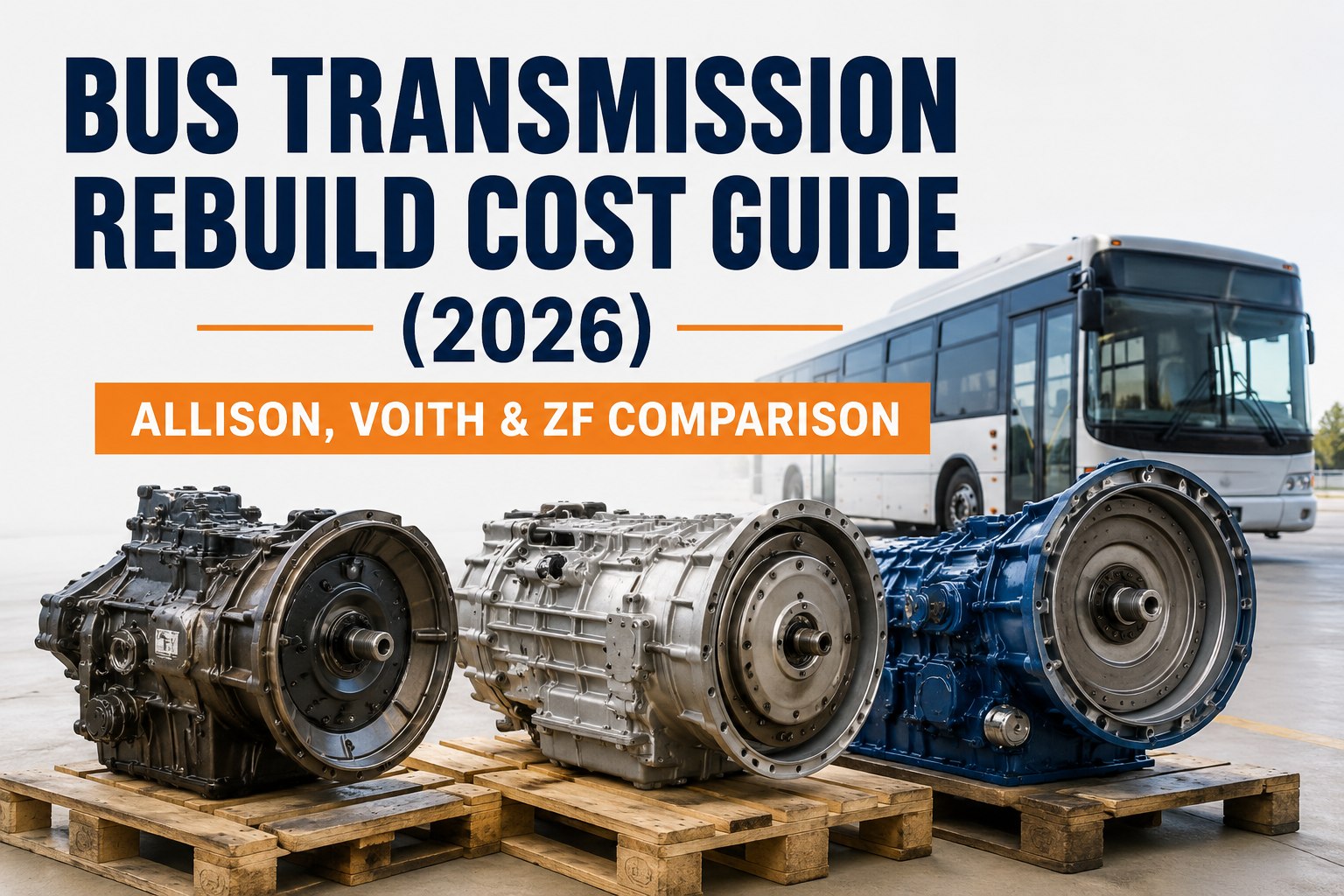
A bus transmission rebuild in 2026 lands somewhere between $6,000 and $20,000 depending on which unit you're pulling, but the more painful number is the one on the invoice you almost had -- the $600 fluid service you didn't schedule. This is the honest cost walkthrough for Allison 2000, 3000, 4000, and ZF EcoLife rebuilds, why the price varies as much as it does, and the interval math that decides whether you write the small check or the big one. See BusCMMS auto-apply severe-duty PM intervals per bus → book a 20-min demo.
Bus Transmission Rebuild Cost
Real 2026 rebuild ranges by unit, the anatomy of the invoice, and the PM math that turns $15K into $600.
Every bus is on one of two paths.
every 25K-60K miles
out-of-service
Same transmission. Different maintenance record. The path is decided long before the shift complaint shows up.
Rebuild Cost by Transmission
Four platforms cover 95% of the buses on U.S. roads.
Allison 2000 / 2500 Series
Allison 3000 Series
Allison 4000 Series / B-Series
ZF EcoLife / Voith DIWA
Every rebuild range above assumes core internal damage, not catastrophic failure. Catastrophic damage adds 15-30% to the high end. See how BusCMMS logs transmission history per VIN → book a demo.
Where the $15,000 Actually Goes
Cost anatomy on a typical Allison 3000 rebuild.
Rebuild vs Reman vs Component Repair
3 repair paths. Very different price tags. Very different timelines.
Component Repair
- Shift solenoid: $150-$300 each
- Speed sensor: $200-$450
- Valve body: $1,500-$3,000
- Torque converter: $2,000-$4,000
- TCM electronic control: $800-$2,500
DTC pulled early, no metal in pan, no internal damage. Diagnosis with Allison DOC or shop-level scan tool required.
Remanufactured Crate Unit
- Factory-rebuilt unit, core exchange
- Full 12-24 month warranty
- Original core sent back to Allison/ZF
- 20-30% cheaper than local rebuild
- Faster turnaround than shop rebuild
Multiple internal issues, high mileage, unknown history. Best cost-per-mile outcome for aging fleets and older cores.
Full Shop Rebuild
- Tear down, inspect, rebuild original core
- Full clutch pack + hard parts replacement
- New torque converter or rebuilt
- 12-month / 12,000-mile warranty typical
- Bus out of service the whole time
No reman core available in region, or fleet policy requires original serial number retention. Longer downtime is the trade-off.
Reman crate units are the smart middle ground for most bus fleets in 2026. Sign up free and log every transmission repair by path →
The Cost Multiplier: Catching Failures Early
Transmissions announce failures weeks before they happen. Every week you wait multiplies the bill.
Week 0 · Solenoid warning
DTC pulled. Shift solenoid replacement. Bus back in service same day.
Week 2 · Harsh shifting
Valve body wear from delayed engagement. Component-level fix still possible.
Week 4 · Metal in pan
Clutch pack material contaminates fluid. Torque converter now a candidate.
Week 6+ · Full rebuild
Internal damage catastrophic. Only path forward is teardown or reman swap.
The 50× multiplier
A $300 solenoid job at week 0 becomes a $15,000 rebuild by week 6 -- a 50-fold cost increase in six weeks. The transmission is telling you every step of the way. Fleets catch the week-0 signal when they have a system logging every fault code with severity per bus. Fleets miss it when the codes stream into a dashboard nobody in the shop opens.
Every Allison DTC logged, ranked by severity, delivered to the tech's phone. See BusCMMS catch week-0 warnings before they multiply → book a demo.
The Preventive Math: Why $600 < $15,000
Follow the interval. Skip the rebuild.
Correct Interval Service
- 25K severe / 50K normal mile fluid + filter change (Allison 3000)
- TES-295 or TranSynd fluid only
- Internal + external spin-on filter replacement
- Pan inspection: color, metal, gasket condition
- Cost per service: $400-$800
Wrong-Interval Service
- Servicing at 50K when the route is severe-duty
- Generic ATF instead of TES-295 (voids warranty)
- Skipping internal filter to save time
- No pan inspection between changes
- Cost per rebuild: $8,000-$15,000
Payback ratio: 25 to 1
A $600 correct-interval service saves a $15,000 rebuild. That is a 25:1 payback -- and it multiplies across every bus in the fleet. On 50 buses, running correct intervals versus wrong intervals saves roughly $200,000-$400,000 across a 5-year window.
The math is that lopsided. The only barrier is the system that keeps intervals correct per bus, per fuel type, per route. See BusCMMS auto-apply severe-duty per route type → book a demo.
Where BusCMMS Fits Your Transmission Program
The system that decides whether you write the $600 check or the $15,000 one.
Multi-Trigger PM Scheduler
Mileage, engine hours, and calendar triggers per bus. Whichever fires first generates the work order. Wrong-interval failures become impossible.
Severe-Duty Auto-Apply
Route profile (60+ stops/day = severe) tags the bus automatically. 25K severe-duty intervals fire on the correct buses without manual override.
Platform-Specific Intervals
Allison 2000/3000/4000, Voith DIWA, ZF EcoLife each on the correct schedule. One dashboard, correct intervals per unit.
Fault Code Logging Per VIN
Every Allison DTC (P0700, P0731 etc.) logged with severity and state (active / pending / historical) per bus. Week-0 signals never get missed.
Transmission History & Warranty
Rebuild dates, mileage at rebuild, warranty terms, and shop attribution tracked per VIN. Claim eligibility never expires quietly.
Cost Per Rebuild Reports
Board-ready reports: transmission dollars spent by unit type, by shop, by year. Justify PM budget with actual fleet outcomes.
We had 4 Allison 3000s rebuilt in one year -- $48,000. Every single one traced back to overdue fluid changes. The mechanics were checking the box at 50,000 miles, but our routes are 2+ stops per mile -- that's severe duty, which means 25,000-mile intervals. BusCMMS flagged it immediately when we set up the correct PM triggers. Eighteen months since, zero transmission failures. The software caught what our paper system missed for years.
Next fluid change coming up? Get the interval right the first time. See your fleet's correct intervals in 20 min →
Frequently Asked Questions
How much does it cost to rebuild a bus transmission in 2026?
Rebuild cost depends on the transmission platform. Allison 2000/2500 series (most school buses and shuttles) runs $6,000-$10,000. Allison 3000 series (Type C school buses and mid-size transit) runs $8,000-$15,000 -- the most-rebuilt bus transmission in America. Allison 4000 series and B400/B500 (full-size transit and motorcoach) runs $12,000-$20,000. ZF EcoLife and Voith DIWA European units on transit fleets run $10,000-$18,000, with higher parts cost due to import supply. Ranges assume core internal damage; catastrophic failure with metal contamination adds 15-30% to the high end. Add 5-7 days of out-of-service time plus $1,000-$1,500/day for substitute bus rental if needed.
What drives the price variation on the same transmission?
Five factors. Extent of internal damage -- a clutch pack replacement is different from full teardown. Torque converter condition -- rebuild ($2,000-$4,000) versus salvage. Shop labor rate -- $150-$225/hr across the country. Rebuild vs remanufactured crate unit -- reman is typically 20-30% cheaper. Parts availability -- ZF and Voith import parts drive cost higher than Allison domestic supply. Two Allison 3000 rebuilds on the same shop bay can vary by $4,000 based on how far the internal damage progressed before the bus came in. The rebuild caught at first DTC costs half of the rebuild caught after metal shows up in the pan.
Is it cheaper to rebuild or buy a remanufactured transmission?
Reman crate units are typically 20-30% cheaper and turn around in 2-3 days versus 5-7 for a full shop rebuild. Reman units come with factory warranty (12-24 months) and full core exchange, so the original bus core goes back to Allison, ZF, or Voith. Rebuilds keep the original serial number if fleet policy or asset tracking requires that. For most bus fleets in 2026, reman is the smart middle-ground choice: cheaper upfront, faster back in service, and warrantied more consistently than a local shop rebuild. Full rebuilds still make sense when reman cores aren't available in the region or when the bus is on a specific route that can't absorb the extra downtime.
How often should I service a bus transmission to prevent a rebuild?
Follow the manufacturer's severe-duty interval if your buses run stop-and-go routes -- and most school and transit routes qualify. Allison 2000/2500: 60,000 miles normal / 30,000-45,000 severe. Allison 3000: 50,000-75,000 normal / 25,000-50,000 severe. Allison 4000: 50,000 normal / 25,000 severe. ZF EcoLife and Voith DIWA: follow the 60,000-75,000 mile OEM spec. School bus routes with 60+ stops per day qualify as severe-duty even at low annual mileage. A correct-interval service costs $400-$800 and includes TES-295 fluid, internal and external filter replacement, and pan inspection. Skipping the correct interval is the single most common cause of rebuild failures on U.S. bus fleets.
How can BusCMMS help prevent transmission rebuild costs?
BusCMMS applies multi-trigger PM (mileage, engine hours, calendar) with platform-specific intervals for Allison 2000/3000/4000, Voith DIWA, and ZF EcoLife -- automatically. Route profiles with 60+ stops per day auto-tag as severe-duty so 25,000-mile intervals fire on the correct buses without manual override. Every fault code (P0700, P0731, and similar Allison DTCs) logs with active/pending/historical state per VIN, so week-0 solenoid warnings never get missed. Rebuild dates, mileages, warranty terms, and shop attribution track per VIN so future claims stay eligible. One Georgia transit customer reported $48,000 in preventable rebuilds traced to wrong PM intervals in a single year, then zero transmission failures in the 18 months after correct intervals were set in the system.