9:22 AM. Bus #47 pulls off Route 6 with the check engine light on and DTC P2263 on the scan tool -- turbo boost pressure not detected. The driver felt the power drop climbing the ramp onto the highway. Now you have 43 students waiting on a rescue bus and a work order that could end at $2,800 for a turbo replacement, or $18,000+ if turbo debris got into the engine. A real bus turbocharger inspection routine is what keeps that morning from ever happening.
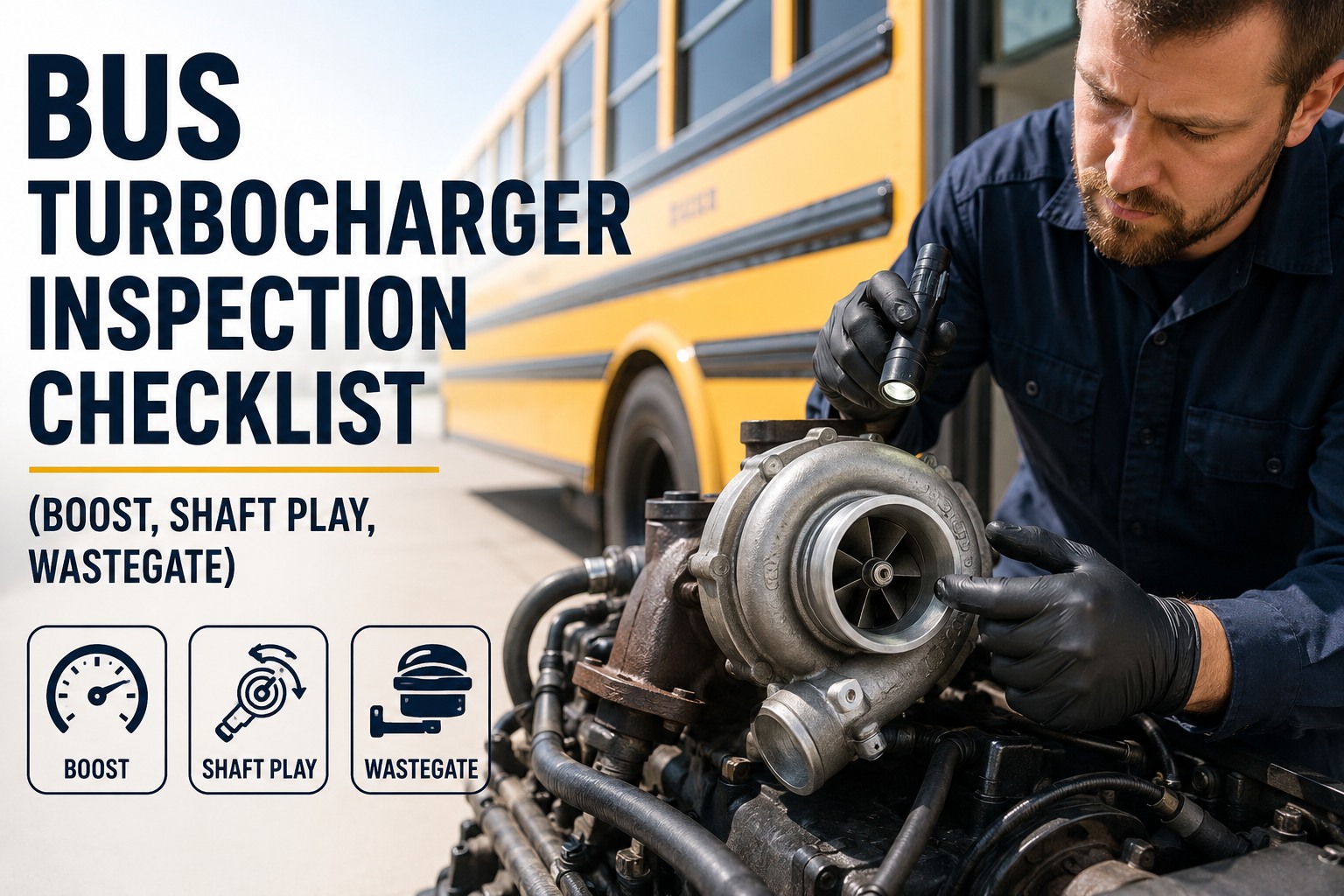
Bus Turbocharger Inspection Checklist: Boost, Shaft Play, Wastegate & VGT
The full PM checklist for diesel bus turbochargers -- boost pressure ranges, shaft play limits, wastegate and VGT function tests, oil supply, and charge-air-cooler integrity.
- Shaft play limits
- VGT actuator test
- CAC integrity
What a Missed Turbo Failure Actually Costs
A turbocharger on a modern diesel bus spins over 150,000 RPM on a film of oil about the width of a human hair. When it fails, it does not fail politely. Blades let go. Debris gets pulled into the intake. And what starts as a check engine light on Route 6 turns into an engine tear-down. This is why turbo inspection is not a nice-to-have on a bus PM schedule -- it is the single most consequential preventive check on a diesel drivetrain.
- $2K-$5K Typical turbo replacement cost on a commercial bus diesel
- $15K-$40K Engine damage from turbo debris ingestion into cylinders
- $300-$400 Cost of a preventive VGT cleaning -- caught in time
- 500K+ mi Turbo life on a PM'd bus vs 150K-200K without
The most under-appreciated number in that list is the third one. A $300 VGT vane cleaning at 75,000 miles prevents a $3,500 turbo replacement 100,000 miles later -- and a $40 air filter housing seal that gets missed prevents a $3,500 turbo repair when dirty air chews the compressor wheel. This is where your fleet either wins or loses on turbo cost. Book a demo to see turbo PM tracking automated across your fleet.
The 6 Inspection Points That Cover the Whole System
Turbo inspection is not one test -- it is six connected checks. Miss any one and the trend hides. Do all six on schedule and you catch failure modes weeks or months before they become road calls.
-
01
Boost Pressure Test
Actual boost vs commanded at multiple RPM points. First diagnostic step.
-
02
Shaft Play
Axial and radial movement measured against OEM wear limits.
-
03
Wastegate Actuator
Diaphragm, rod travel, opening pressure -- stuck open or closed matters.
-
04
VGT Vane Movement
Full sweep test. Sticking vanes = #1 modern turbo failure mode.
-
05
Oil Supply & Return
Pressure at idle, drain line unrestricted, no sludge or coking.
-
06
CAC Integrity
Charge Air Cooler pressure test -- leaks show up as low boost, high EGT.
The Complete Turbocharger Inspection Checklist
Below is the working checklist grouped by inspection point. Every item ties to a failure mode you have seen -- or will see -- if the bus runs long enough. Sign up free and load this as an auto-triggered turbo PM template.
-
01 Diesel techBoost Pressure Test
Quarterly · scan tool + hand gauge · ~20 min
- Commanded vs actual boost at 1200, 1600, 2000 RPM
- Peak boost within OEM spec (typical 20-35 PSI)
- Boost leak test with smoke or pressurized air
- Scan for P0299, P2262, P0234 codes -- log and clear
-
02 Diesel techShaft Play Check
Every PM-C · turbo cold · ~15 min
- Radial play measured with dial indicator
- Axial (end) play against OEM published limit
- Any blade-to-housing contact = replacement
- Compressor + turbine wheels rotate freely, no scoring
-
03 Diesel techWastegate Actuator
Semi-annual · engine off + engine running · ~15 min
- Diaphragm holds pressure (no vacuum bleed-down)
- Actuator rod moves smoothly through full range
- Boost control solenoid tests within spec
- Wastegate lever returns fully -- no seize
-
04 Diesel techVGT Vane & Actuator
Every 75,000 mi · sweep + calibration · ~30 min
- Electronic actuator position test -- full sweep
- Vane movement smooth, no sticking (P2263, P2564)
- Unison ring free of carbon binding
- Actuator calibration to ECM completed
-
05 Any techOil Supply & Return
Every oil change · ~10 min
- Oil pressure to turbo at idle within spec
- Drain line clear -- no restriction or sludge
- Oil analysis for metal or coolant contamination
- No oil weeping at turbo housing seams
-
06 CriticalCAC + Intake Integrity
Semi-annual · pressure test · ~20 min
- CAC pressure test -- hold 30 PSI for 60 seconds
- All charge hoses + clamps inspected, no cracks
- Air filter housing seal seated -- no dirt bypass
- Restriction indicator green (filter within life)
Wear Limits Quick Reference
Every OEM publishes exact shaft play and boost values for its engine. The ranges below are the industry-typical envelopes -- always verify against the specific service manual for your Cummins ISL, ISM, Detroit DD13, or International MaxxForce engine before condemning a turbo.
Industry-Typical Wear Limits
Diesel bus turbochargers · verify against OEM manual
- Axial (end) shaft play 0.003 - 0.005" Anything above = worn thrust bearing
- Radial shaft play 0.010 - 0.015" Above limit = journal bearing failure
- Peak boost pressure 20 - 35 PSI Engine-specific; verify at rated RPM
- Oil pressure at idle Min 15 PSI Below = starvation risk to bearings
- CAC pressure hold 30 PSI / 60 sec Any drop = leak in charge system
- VGT actuator sweep Full range, smooth Any hesitation = carbon on vanes
The exact numbers matter -- a Cummins ISX15 tolerates different shaft play than a Detroit DD13, and lumping them under one fleet PM is where measurement errors creep in. Book a demo to see engine-specific spec libraries built into the PM templates.
Warning Signs: Early → Critical
Turbos rarely die suddenly. They deteriorate over weeks and months. Learn the progression and you catch failures at Level 1 -- before they cost engines.
-
Level 1 Early · catch here
Subtle Drift Signals
- Slight power loss climbing hills
- Boost 2-3 PSI below commanded
- Longer turbo spool time
- Occasional low-severity DTC clears itself
-
Level 2 Mid · act this week
Visible Symptoms
- Blue or gray smoke on acceleration
- P0299, P2263, or VGT DTCs persistent
- Oil consumption trending up
- Whistle or unusual turbo note under load
-
Level 3 Critical · ground the bus
Imminent Failure
- Limp mode or ECM derate active
- Loud whine, siren, or grinding
- Oil visible in intercooler or intake
- Metallic debris in oil filter
The fleets that never see Level 3 are the fleets that catch Level 1 -- and that requires trending boost values, DTC frequency, and oil consumption per bus over time, not a single snapshot at each service. Book a demo to see turbo trend charts per bus.
A Shop Foreman's Take on Turbo Inspection
The number I actually track is boost delta -- commanded minus actual, week over week. If a bus is drifting 1 PSI a month below where it should be, that turbo has six months left if I do nothing. Twelve months ago I would have found that at limp mode. Now I find it at a quarterly PM and clean the VGT for three hundred bucks. That is the whole game right there.
That is what a real turbo PM program looks like: measurement, trending, and small corrections early. Not big-money interventions after the driver calls in.
How BusCMMS Tracks Turbo Health
A checklist on a shop wall gets photocopied and forgotten. A checklist that logs boost values per bus, alerts on drift, and routes work to a diesel tech -- that is a program that actually protects the engine. Book a demo to see turbo health tracked across your bus fleet.
-
01
Engine-Specific PM Templates
Cummins, Detroit, International, MaxxForce -- correct wear limits per engine.
-
02
Boost Trend Charts
Actual vs commanded plotted per bus. Drift surfaces before DTCs latch.
-
03
Fault Code Sync from Samsara/Geotab
P0299, P2263, VGT codes auto-create work orders in real time.
-
04
Oil Sample & Analysis Log
Metal traces trended per bus. Catch bearing wear early.
-
05
Diesel Tech Routing
Turbo work orders only go to certified diesel techs -- not any available mechanic.
-
06
Warranty-Grade Records
Every measurement timestamped and signed, retained per FMCSA 49 CFR 396.
How often should a bus turbocharger be inspected?
A full turbo inspection combines four intervals. Every oil change: verify oil pressure to the turbo, inspect the drain line, and check for external oil weep. Quarterly: full boost pressure test at 1200, 1600, and 2000 RPM with commanded vs actual comparison, plus scan for boost-related DTCs. Every 75,000 miles: VGT vane sweep test and actuator calibration -- this is the most common modern turbo failure mode and preventable with a $300-$400 cleaning. Every PM-C (36,000 mi) or annual: shaft play measurement, wastegate actuator function, and CAC pressure test. Miss the 75K VGT check and a $300 cleaning becomes a $2,000-$3,500 replacement.
What are the shaft play limits on a bus turbocharger?
Industry-typical limits are 0.003-0.005 inch for axial (end) play and 0.010-0.015 inch for radial play, but exact numbers must be verified against the specific engine service manual. A Cummins ISL, Detroit DD13, and International MaxxForce all publish different tolerances. Anything above the OEM limit -- or any evidence of blade-to-housing contact -- means the turbo needs replacement, not adjustment. Excessive shaft play is almost always a symptom of oil starvation, contaminated oil, or extended service intervals -- so replacement without addressing root cause guarantees the new turbo will fail on the same schedule.
What causes VGT vanes to stick on a diesel bus?
Carbon buildup, primarily from EGR gases combined with short-trip and heavy-idle duty cycles typical of school bus and urban transit operation. The unison ring that moves the vanes gets progressively bound by soot, and eventually the electronic actuator cannot move the vanes through their full range -- producing DTCs like P2263 (turbo boost pressure not detected) or P2564 (VGT position sensor circuit). Preventive VGT cleaning every 75,000 miles for urban duty catches this before it becomes a turbo replacement. A CMMS that tracks fault code frequency and mileage per bus makes the 75K trigger automatic instead of a shop foreman's memory.
What normal boost pressure should a bus diesel produce?
Modern diesel bus engines typically produce peak boost of 20-35 PSI under load, but the exact value depends on the specific engine, calibration, and altitude. What matters more than the number itself is the commanded-vs-actual differential -- when the ECM commands 28 PSI and the sensor reads 24 PSI, that 4 PSI gap is the diagnostic signal. Trend that delta over months and you catch drift long before a driver notices power loss. A CAC leak, a stuck wastegate, a sticking VGT, or a worn compressor wheel will all show up as commanded-vs-actual drift before they trigger a DTC.
How does a bus CMMS help catch turbo failures early?
A bus-specific CMMS solves four turbo problems automatically. First, engine-specific PM templates load the correct Cummins, Detroit, or International wear limits per bus so measurements are compared to the right spec. Second, boost trend charts plot actual vs commanded per bus over time -- surfacing drift weeks before a DTC. Third, telematics integration from Samsara or Geotab syncs turbo-related fault codes in real time and auto-creates prioritized work orders. Fourth, turbo work orders route only to certified diesel technicians. The result: fewer road calls, lower average repair cost per turbo event, and documentation that supports warranty claims when a turbo fails inside coverage.