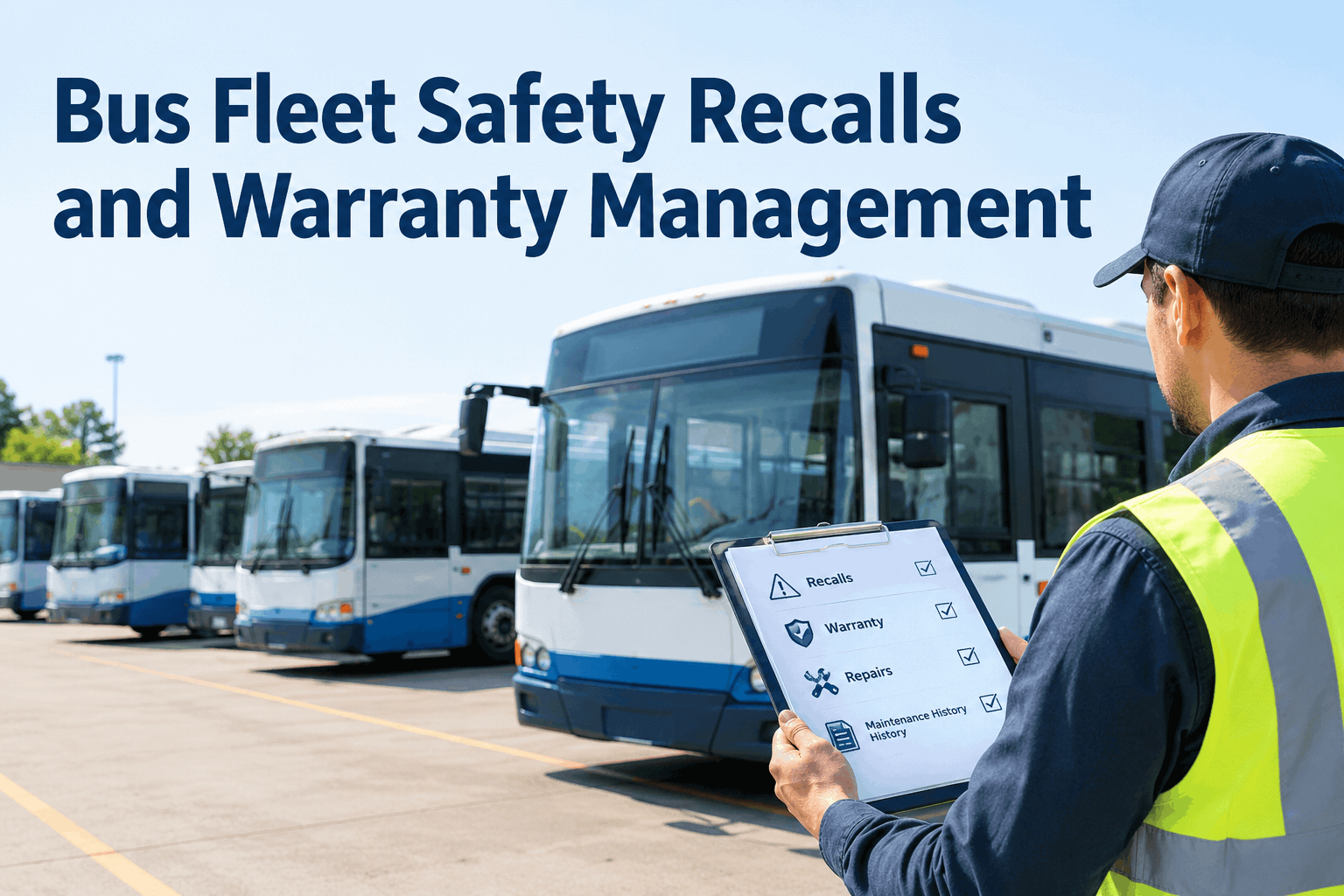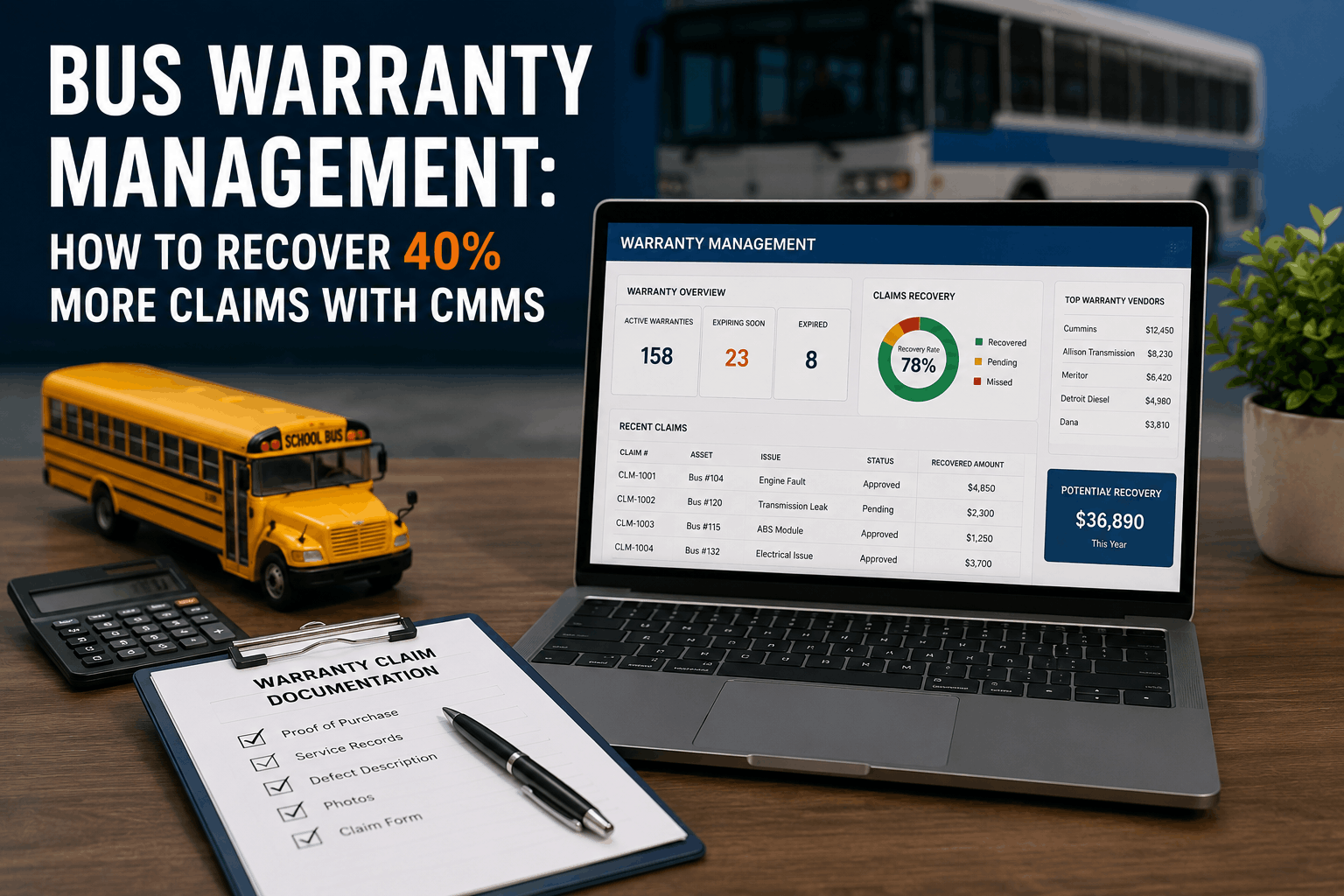
Most bus fleets leave 30-40% of valid warranty claims unclaimed simply because the warranty tracking and claim submission process is manual, disorganized, or unclear. A school district with a 40-bus fleet might be entitled to recover $15,000-$25,000 annually in warranty claim value, but due to missed warranty windows, inadequate documentation, or lack of follow-up, recovers only $9,000-$15,000. The gap is not because the fleet lacks warranty coverage -- it is because warranty management requires coordination across multiple systems (maintenance records, parts procurement, vendor communication, OEM warranty policies) and most fleets handle this coordination manually or not at all. A bus brake chamber fails at 40,000 miles; the OEM provides a 50,000-mile warranty. The technician replaces the part, documents it in the CMMS, and moves on. Eighteen months later, the fleet has not submitted a warranty claim because no one was responsible for tracking and submitting. The OEM warranty has expired. The claim is lost. CMMS-integrated warranty management eliminates this problem by: automatically tracking warranty windows for every part and system, flagging repairs that may be warranty-eligible when they occur, documenting defects with photos and diagnostics, and generating warranty claim submissions that include all required evidence. Fleets implementing structured warranty management recover 25-35% more in warranty claims annually compared to fleets without systems. This guide covers how warranty management works, which parts and systems represent the highest warranty recovery opportunity, how to integrate warranty tracking into BusCMMS, and the financial impact of systematic claim submission.
Bus Warranty Management: How to Recover 40% More Claims with CMMS
Most fleets miss 30-40% of valid warranty claims due to poor tracking and missed deadlines. Automated warranty windows, defect documentation, and claim generation in BusCMMS recover $15,000-$35,000 annually per 40-bus fleet.
The Warranty Opportunity: Why Fleets Lose Claims
A 40-bus school district purchasing vehicles with standard powertrain warranties (3 years/60,000 miles) is eligible to recover warranty claim value on: engine failures, transmission failures, differential failures, and associated components (alternators, starters, water pumps, fuel pumps) covered under powertrain warranty. Additionally, buses typically have 1-2 year warranties on body/frame components, electrical systems, HVAC, and lighting. For a fleet operating 15,000-20,000 miles per bus per year, approximately 40-50% of warranty-eligible repairs occur within the warranty window. This means a 40-bus fleet should be submitting 3-6 powertrain warranty claims per year plus 8-12 body/electrical claims per year, for a total of 11-18 warranty claims annually. At an average claim value of $1,200-$2,800 (covering parts, labor where eligible, and diagnostics), the annual warranty recovery opportunity is $13,200-$50,400 per 40-bus fleet.
In practice, most fleets recover only 40-60% of this opportunity. Reasons include: warranty windows are not tracked systematically, so by the time a claim is discovered the window has closed; repair documentation is incomplete or unclear, causing OEMs to deny the claim for insufficient evidence; multiple systems (maintenance scheduling, parts procurement, vendor communication) operate in silos, making it impossible to know when warranty-eligible work is performed; and there is no single person or process responsible for claim submission, so claims fall through the cracks. CMMS-based warranty management solves each of these problems by centralizing warranty tracking, automating documentation capture, and creating accountability for claim submission.
Warranty Types and Coverage Windows for Bus Fleets
Covers engine, transmission, differential, transfer case (if applicable), driveshaft, and related components. Exclusions: normal wear items (spark plugs, filters, fluids), owner neglect (poor maintenance), and aftermarket modifications. High-value claims: transmission failures ($4,000-$8,000), engine failures ($6,000-$12,000).
Covers alternator, starter, batteries (in some cases), wiring harnesses, control modules, and lighting components. Exclusions: damage from improper installation or electrical surge. Medium-value claims: alternator failure ($800-$1,200), lighting module failure ($400-$800).
Covers rust perforation (exterior panels), frame cracks or welds, door and window mechanisms, seals and weatherstripping, and interior trim. Exclusions: cosmetic damage, damage from accident or collision, rust from road salt exposure (varies by manufacturer). Medium-value claims: roof panel replacement ($1,200-$2,000), frame welding ($600-$1,200).
Covers air conditioning compressor, heater core, blower motor, and controls. Exclusions: refrigerant leaks from normal system use, contamination from debris. High-value claims: AC compressor failure ($1,800-$3,000), heater core replacement ($800-$1,500).
Some manufacturers offer collision coverage on structural components (frame, body panels) for the first 1-2 years. Coverage depends on fault determination and claim filing requirements. High-value claims: frame straightening ($4,000-$8,000), body panel replacement ($2,000-$4,000).
Covers passenger seat frames, foam degradation, fabric tears from manufacturing defect (not normal wear), and wheelchair lift upholstery. Exclusions: damage from passenger use, spills, or vandalism. Lower-value claims typically: $200-$600 per component.
Setting Up Warranty Tracking in BusCMMS
When a bus is added to BusCMMS, enter purchase date, original mileage (usually zero), and warranty details from the OEM paperwork: powertrain warranty (3 years/60,000 miles), body warranty (2 years/60,000 miles), electrical warranty (1-2 years). BusCMMS stores these details and automatically calculates warranty expiration dates based on actual vehicle mileage and age.
When a work order is created for a repair, the technician or supervisor tags it with the component type (engine, transmission, alternator, AC compressor, etc.). BusCMMS automatically checks whether that component is under warranty based on vehicle age and mileage. If yes, the work order is automatically flagged as "Warranty-Eligible" and routed to the warranty management workflow.
Require technicians to capture photos and diagnostic data for warranty-eligible repairs: photos of the failed component, OBD II fault codes (if applicable), technician notes on failure mode, and any evidence of defective design or manufacturing (rather than wear). This documentation is the evidence OEMs need to approve warranty claims. Without good documentation, claims are frequently denied.
On the work order, document part costs, labor hours, and any diagnostic/testing costs separately. This itemization is required by OEMs to calculate warranty reimbursement. Some manufacturers reimburse at 100% of parts and labor on warranty claims; others reimburse parts only. BusCMMS calculates the claim amount based on documented costs and warranty type.
Within 30 days of warranty-eligible repair completion, generate a warranty claim from the BusCMMS work order. The claim automatically includes: vehicle VIN, mileage at time of repair, warranty coverage status, photos of the failed component, diagnostic codes, repair documentation, and cost breakdown. BusCMMS can generate claim forms in the format required by specific OEMs (Blue Bird, Cummins, Allison, etc.).
BusCMMS maintains a warranty claim register showing: claim submitted date, claim amount, approval/denial status, amount recovered, and processing time. For claims that are denied, BusCMMS captures the denial reason (insufficient documentation, claim outside warranty window, coverage exclusion). Use denial reasons to improve future claim submissions and identify appeal opportunities.
High-Value Warranty Recovery Opportunities
While all warranty claims are valuable, some represent disproportionately high recovery amounts and should be prioritized for careful documentation and timely submission. The following components represent the highest-value warranty opportunities in U.S. bus fleet operations.
Covered under powertrain warranty (3 years/60,000 miles on most school buses). Failure mode must be documented: internal seal failure, bearing wear, shift solenoid failure. Requires: OBD II transmission fault codes, shop manual diagnostics proving defective component, and failed internal inspection photos if transmission was opened.
Covered under powertrain warranty (3 years/60,000 miles). Failure mode critical: head gasket leak, piston ring failure, valve seat recession, or crankshaft damage. Requires: maintenance records proving proper service, OBD II fault codes, failed engine block/head inspection photos, and evidence of manufacturing defect vs normal wear.
Air brake systems (S-cam brakes) are typically covered under powertrain warranty. Wheel cylinders, brake chambers, ABS modules, and air dryer failures are common. Requires: diagnostic documentation showing brake pressure loss or ABS module malfunction, failed component inspection, and service records showing proper brake maintenance.
Covered under air conditioning and cooling system warranty (1-2 years). Compressor failures are most common and highest-value. Requires: AC diagnostic report showing compressor failure (low pressure, high amp draw, bearing noise), failed compressor disassembly photos, and absence of contamination (which would indicate installer error rather than manufacturing defect).
Engine control module, aftertreatment control module, and body control module failures are covered under electrical/powertrain warranty. Requires: OBD II diagnostic codes specific to the failed module, bench testing proving module failure (not sensor failure), and original purchase documentation showing module was defective not damaged in field.
Covered under electrical system warranty (1-2 years). Alternator failures under load, starting system failures, and voltage regulation failures are typical. Requires: charging system diagnostic report showing regulator malfunction or internal alternator failure, failed component bench testing, and load test data.
ROI of Systematic Warranty Management
A 40-bus school district implementing systematic warranty management through BusCMMS will submit approximately 12-18 warranty claims per year (assuming average claim detection rate improves from 60% to 85% with systematic tracking). At an average claim value of $1,500-$2,200, annual warranty recovery value is $18,000-$39,600 versus the pre-system baseline of $9,000-$15,000. The incremental recovery is $9,000-$24,600 annually. The setup and ongoing management cost is approximately $3,000-$5,000 annually (staff time for documentation and claim submission). Net annual benefit: $4,000-$21,600. ROI on year 1: 80-400%.
Recover 40% More Warranty Claims
BusCMMS automates warranty tracking, documentation, and claim submission. Recover $15,000-$35,000 annually per 40-bus fleet with systematic warranty management. Set it up once, generate claims automatically.
We had no warranty tracking system and were missing claims because we didn't know which repairs were warranty-eligible or when the warranty window was closing. In one case, a $4,800 transmission failure happened on a bus that was still under powertrain warranty, but we didn't submit a claim until 8 months after repair. By then the warranty had expired. We implemented BusCMMS warranty tracking and in the first year recovered $28,000 in warranty claims. We now submit claims systematically within 30 days of repair. The module has paid for itself 5x over in the first year alone.
FAQ: Warranty Management and Claims
What documentation do OEMs require to approve warranty claims?
How long do I have to submit a warranty claim after a repair?
Can I appeal a denied warranty claim?
Do warranty claims affect manufacturer relationships or future support?
What if a repair is partially covered by warranty?
Can I use aftermarket parts and still claim warranty?
How does BusCMMS integrate with OEM warranty claim systems?
What is the typical warranty claim approval rate?
Conclusion: Warranty Claims as Revenue Recovery
Warranty claims are revenue recovery opportunities that many fleets overlook or handle passively. A systematic approach to warranty management -- tracking warranty windows, documenting repairs thoroughly, and submitting claims promptly -- recovers an average of 25-35% more in warranty value annually compared to unmanaged approaches. For a 40-bus fleet, this difference is $9,000-$24,600 annually. BusCMMS warranty management automates the tedious tracking and documentation work, allowing fleet managers to focus on claim strategy and appeals. Start your free trial to set up warranty tracking for your fleet and see the claims recovery potential. Or schedule a demo to discuss warranty strategy and claim submission processes for your specific fleet composition.