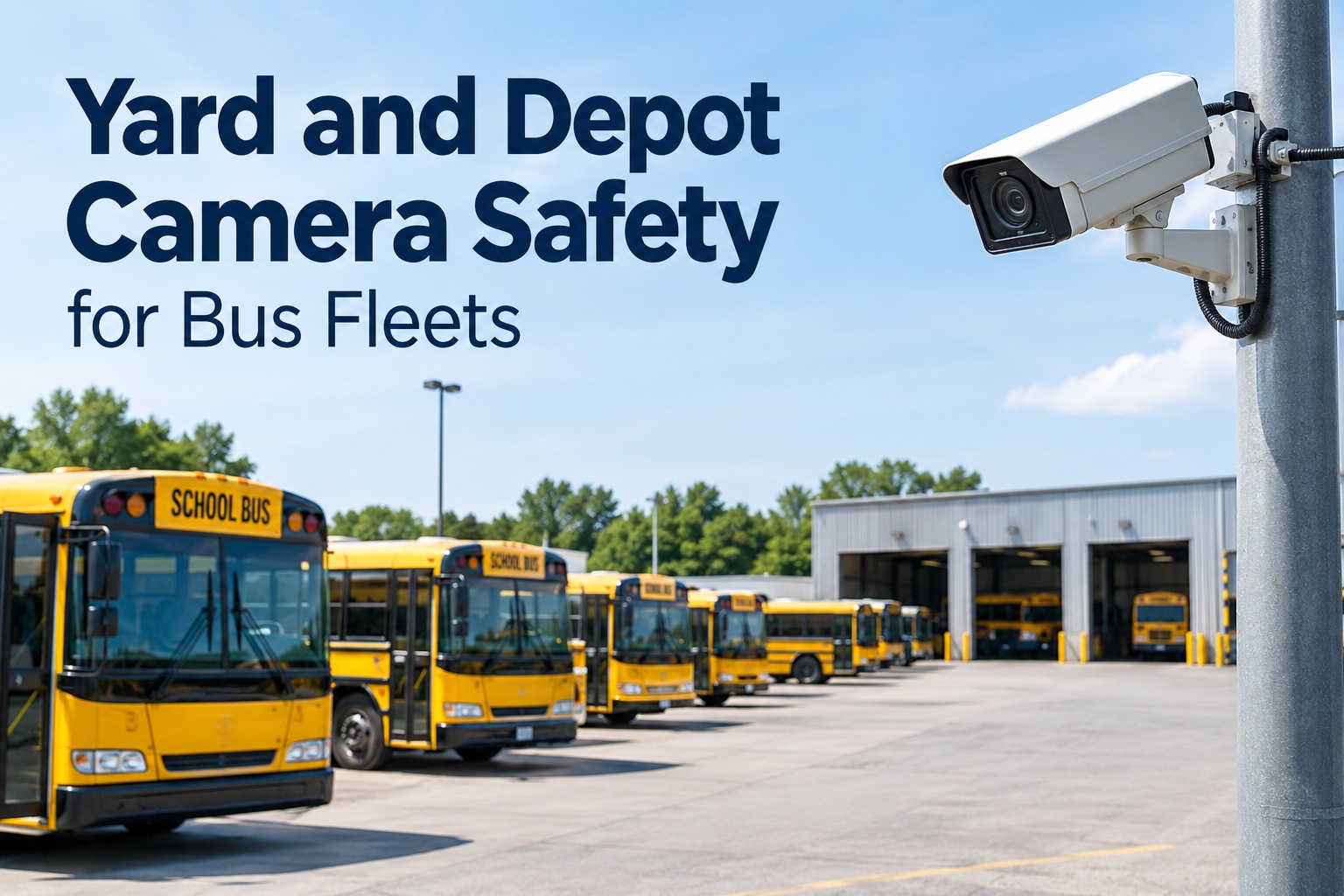
The yard is where the slow-speed accidents happen — the tight backing manoeuvre into a parking row, the blind-side turn near a fuel island, the pedestrian who steps behind a reversing bus at shift change. Fixed yard and depot cameras, paired with AI event detection, catch these near-misses and incidents where a moving-vehicle dash cam never looks: on your own property, at 5 miles an hour, where most preventable fleet damage actually starts.
Yard and Depot Camera Safety for Bus Fleets
Fixed cameras and AI video events catch slow-speed yard incidents — and BusCMMS turns each one into coaching and a maintenance work order, on the same bus record.
- SlowSpeed, high frequency
- Event→ coach → work order
- 1 recordPer bus, per incident
Why the Yard Is the Overlooked Safety Frontier
Onboard cameras watch the road. But a huge share of preventable fleet damage never happens on the road — it happens in the yard, at low speed, during parking, backing, fuelling, and shift-change congestion. These incidents are minor individually and invisible collectively, because nobody's watching the depot the way they watch the route.
That blind spot is expensive. A clipped mirror, a scraped panel, a near-miss with a technician on foot — without footage they're impossible to investigate or coach, and they quietly add up. Fixed yard cameras cover exactly the manoeuvres a moving-vehicle camera can't. See how those events connect to your records with a walkthrough of yard safety linked to maintenance.
The Yard Zones a Camera Programme Should Cover
A good depot camera layout isn't "cameras everywhere" — it's coverage of the specific zones where slow-speed risk concentrates. These four are where incidents cluster.
Parking rows
Tight backing into rows is the single most common source of yard damage — clipped mirrors, corner scrapes, bus-to-bus contact. Cameras give the angle a driver can't.
Fuel & wash lanes
Narrow lanes with fixed infrastructure — pumps, wash arches, bollards. Low-speed contact here is frequent and, on camera, easy to review and coach.
Gate & entry points
Pinch points where buses queue and cross paths on entry and exit. Coverage here documents both incidents and unauthorised access after hours.
Pedestrian walkways
Where drivers and technicians on foot mix with moving buses — the highest-stakes zone. A near-miss caught here is a coaching moment that prevents a tragedy.
The theme across all four: these are people-and-property pinch points at low speed, invisible to onboard cameras. Cover them and you can finally see, investigate, and coach the incidents that were previously just unexplained repair bills. That's where a yard programme starts paying off — and you can start free to connect yard events to bus records.
What AI Adds to a Fixed Camera
A fixed camera records everything — which means someone has to watch hours of empty yard to find the ten seconds that matter. AI event detection flips that: it surfaces the moments worth reviewing and leaves the rest alone.
Flags events, not footage
Instead of continuous recording nobody reviews, AI surfaces a manoeuvre, a near-miss, or contact — the clip that actually needs a human.
Catches pedestrian near-misses
The highest-stakes yard events — a person too close to a moving bus — are exactly what you want surfaced automatically, not found by luck.
Builds a reviewable pattern
Repeated events at one zone or from one driver form a trend — the signal that tells you where to fix layout or focus coaching.
The shift is from surveillance to intelligence. A wall of monitors nobody watches becomes a short queue of events that matter, each one a chance to coach a driver or fix a hazard before it repeats. That's the difference between owning cameras and running a yard-safety programme.
From Yard Event to Work Order: The Loop That Matters
Detecting a yard incident is only useful if something happens next. The value is in the loop — event to coaching to repair — all tied to the specific bus. Here's how it runs.
- 1
AI flags the event
A backing contact in the parking rows is detected and clipped — time-stamped and tied to the bus involved, no manual scrubbing needed.
- 2
Coach the driver
The clip becomes a specific, factual coaching moment — not a vague warning. Objective footage protects good drivers and corrects real habits.
- 3
Open a work order
If the contact caused damage — a cracked mirror, a scraped panel — a maintenance work order opens on that bus's record, straight from the event.
- 4
Track the pattern
The event joins the bus's history. Recurring incidents at a zone or from a driver surface as a trend to act on, not a pile of forgotten clips.
That loop is the whole point. A yard camera that only records leaves you with evidence after the fact; one wired into coaching and maintenance turns each near-miss into a corrected habit and each contact into a tracked repair. The clip, the coaching, and the work order all live on one bus record — which is exactly what a demo shows on your own fleet.
Coaching That Sticks — and Records That Protect You
Yard footage does two jobs at once: it makes coaching land, and it protects the district when a claim or dispute arises. Both come from the same clip, tied to the same bus and moment.
Coaching that lands
- Specific footage beats a vague "be careful"
- Objective evidence clears the driver who did it right
- Patterns show who needs training and on what
- Near-misses coached before they become incidents
Records that protect
- Time-stamped evidence for damage disputes
- A documented safety programme, not just cameras
- Incident history tied to each bus
- Support for insurance and liability questions
The combination is what makes a yard programme worth running. Coaching reduces the incidents; the records defend you on the ones that still happen. And because everything is tied to the bus and the moment, both hold up — whether you're training a driver or answering a claim. It's a documented programme, not a box of footage.
How BusCMMS Runs Your Yard-Safety Programme
Cameras capture the yard; BusCMMS turns what they capture into fewer incidents and cleaner records. It's the layer that connects the event to the action.
Yard events on the bus record
Depot camera events land on the specific bus's record, alongside its inspections, defects, and maintenance — one timeline, not four portals.
Event-to-coaching workflow
A flagged incident routes into a coaching record with the clip attached — making driver coaching specific, documented, and repeatable.
Damage to a work order
Contact that caused damage becomes a maintenance work order on that bus — so the repair is tracked, not lost between safety and the shop.
Hardware-agnostic
Works with the fixed and AI cameras you already run at the depot — no lock-in, no rip-and-replace to connect your yard.
That's the role BusCMMS plays. The AI-native, hardware-agnostic platform connects yard and depot camera events to driver coaching and maintenance work orders on one bus record — so a near-miss becomes a coached habit and a scrape becomes a tracked repair. It works with your existing depot cameras. To see it on your yard, book a walkthrough of yard events linked to coaching and work orders.
The Bottom Line on Yard and Depot Camera Safety
Most preventable fleet damage starts in the yard, at low speed, where onboard cameras never look. Fixed depot cameras plus AI event detection finally make those manoeuvres visible — and the real payoff comes when each event flows into driver coaching and a maintenance work order instead of a forgotten clip.
Cover the risk zones, let AI surface what matters, and connect every event to coaching and repair on the bus record. That's a yard-safety programme — fewer incidents, cleaner records, and a story you can show the board. It's exactly what BusCMMS is built to run. If you're ready to see it on your depot, start free, and verify the requirements that apply to your operation before you build.
Why do bus fleets need yard and depot cameras?
Because a large share of preventable fleet damage happens in the yard at low speed, during parking, backing, fuelling, and shift-change congestion, not on the road where onboard cameras look. These slow-speed incidents, like clipped mirrors, scraped panels, and pedestrian near-misses, are minor individually but add up to real repair cost and safety risk. Fixed yard and depot cameras cover exactly the manoeuvres a moving-vehicle dash cam can't, making those incidents visible so they can be investigated, coached, and prevented.
Which areas of a bus depot should cameras cover?
Focus on the zones where slow-speed risk concentrates rather than blanketing the whole site. The four priority areas are parking rows (the most common source of backing damage), fuel and wash lanes (narrow spaces with fixed infrastructure), gate and entry points (pinch points where buses queue and cross paths, and where after-hours access matters), and pedestrian walkways where drivers and technicians on foot mix with moving buses. Walkways are the highest-stakes zone, since a near-miss caught there is a coaching moment that can prevent a serious injury.
What does AI add to fixed depot cameras?
A fixed camera records continuously, which means someone has to review hours of empty yard to find the moments that matter. AI event detection surfaces the manoeuvres, near-misses, and contact events worth reviewing and leaves the rest alone, turning surveillance into intelligence. It's especially valuable for catching pedestrian near-misses automatically rather than by luck, and for building a reviewable pattern, since repeated events at one zone or from one driver reveal where to fix layout or focus coaching. The result is a short queue of events that matter instead of a wall of monitors nobody watches.
How do yard camera events connect to maintenance?
In a connected system, a detected yard incident does more than record. When AI flags a backing contact, the clip is tied to the specific bus, becomes a factual coaching moment for the driver, and, if it caused damage, opens a maintenance work order on that bus's record straight from the event. The clip, the coaching, and the work order all live on one bus timeline, so a near-miss becomes a corrected habit and a scrape becomes a tracked repair rather than damage discovered later with no explanation.
Are bus yard cameras required by regulation?
There is no single federal mandate governing every bus yard and depot camera programme. For certain large urbanized-area transit providers, 49 CFR 673.25, which covers Safety Risk Management under the Public Transportation Agency Safety Plan rule, may apply, and a yard camera programme can be one mitigation an agency documents for identified hazards. Requirements otherwise vary by federal, state, local, and district rules, so verify what governs your specific operation before building a programme rather than assuming a universal requirement exists.