When managing a bus fleet in 2026, you're facing a critical decision: which software platform will help you reduce maintenance costs, pass DOT audits, and keep your buses on the road? Two names dominate the conversation: BusCMMS and Samsara. But they're fundamentally different solutions built for different problems.
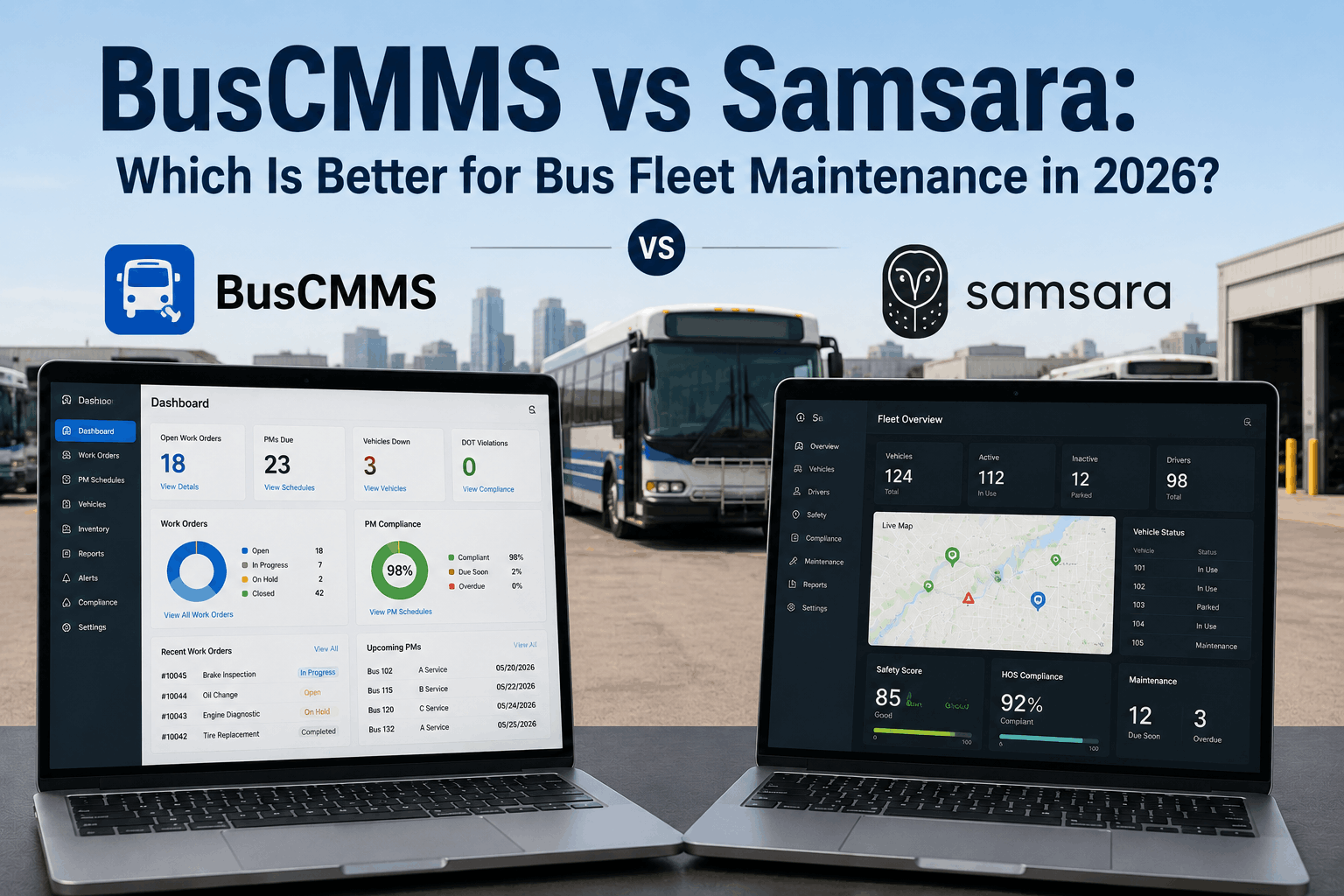
Samsara is a telematics and fleet operations platform—it excels at real-time vehicle tracking, driver safety monitoring, and GPS-based analytics. BusCMMS is a computerized maintenance management system (CMMS) specifically engineered for bus fleet maintenance scheduling, work order management, and DOT compliance. Think of Samsara as your fleet's "eyes on the road" and BusCMMS as your fleet's "maintenance brain."
This comparison will show you exactly what each platform does, where they excel, and most importantly, which one solves your specific bus maintenance challenges. We've analyzed pricing, features, ease of use, compliance reporting, and total cost of ownership across both platforms. If you're a school district maintenance director, transit agency operations manager, or fleet coordinator, this guide will save you weeks of research.
What Each Platform Actually Does
Samsara: Fleet Operations & Telematics
Samsara is a comprehensive fleet operations platform that focuses on three core areas: (1) real-time vehicle tracking and GPS analytics, (2) driver behavior monitoring and safety coaching, and (3) compliance reporting for HOS (Hours of Service) and vehicle inspections. Samsara connects to your vehicles' telematics hardware, collecting data on location, fuel consumption, harsh braking events, speeding, and driver seatbelt usage.
For bus fleets specifically, Samsara excels at monitoring route adherence, driver safety, and fuel efficiency. If you need to know where your buses are at any moment, how your drivers are performing, and whether they're following safety protocols, Samsara delivers. However, Samsara is primarily an operations and monitoring tool—it's not built to manage your maintenance workflow.
BusCMMS: Maintenance Management & DOT Compliance
BusCMMS is a computerized maintenance management system (CMMS) built specifically for bus fleets. It manages your entire maintenance lifecycle: preventive maintenance scheduling, work order generation, parts inventory tracking, labor cost management, and DOT compliance documentation. BusCMMS integrates with your DVIR (Daily Vehicle Inspection Report) process, tracks maintenance history by vehicle, and generates automated compliance reports for state regulators.
BusCMMS is built for maintenance teams who need to schedule PMs, assign technicians, track parts costs, and prove to auditors that vehicles have been properly maintained. It's your maintenance department's operational system of record. School districts and transit agencies use BusCMMS to reduce emergency breakdowns, lower maintenance costs, and pass DOT audits on the first attempt.
Feature-by-Feature Comparison: BusCMMS vs Samsara
| Feature Category | BusCMMS | Samsara |
|---|---|---|
| Preventive Maintenance Scheduling | ✓ Specialized for PM by mileage/hours | ✗ Not a core feature |
| Work Order Management | ✓ Complete lifecycle (create, assign, complete, close) | △ Basic task assignment only |
| Parts Inventory & Cost Tracking | ✓ Full inventory management with cost allocation | ✗ Not included |
| DOT Compliance Reporting | ✓ Automated DOT audit-ready reports | △ Basic DVIR collection only |
| Real-Time Vehicle Tracking | △ Mileage/hours tracking only | ✓ Full GPS and telematics integration |
| Driver Safety Monitoring | ✗ Not included | ✓ Comprehensive driver behavior analytics |
| Fuel & Route Optimization | △ Basic fuel tracking | ✓ Advanced route analytics |
| Mobile Technician App | ✓ Offline-capable work order management | △ Basic form submission |
| School Bus Specific Features | ✓ Pre-route inspection workflows, student safety integration | △ General telematics only |
| Predictive Maintenance Alerts | ✓ AI-driven failure prediction | △ Basic threshold alerts |
Total Cost of Ownership: BusCMMS vs Samsara
Software pricing isn't just about the subscription fee—it's about total implementation cost, training, ongoing support, and the financial impact of the platform on your operations. Let's break down the real cost of each solution.
Monthly Software: $8–15 per vehicle = $800–1,500/month
Hardware: $300–500 per vehicle (one-time) = $30K–50K
Implementation & Training: $10K–20K
Year 1 Total: $50K–80K
Annual Recurring: $10K–18K
Monthly Software: $3–7 per vehicle = $300–700/month
Hardware: Minimal (uses existing devices)
Implementation & Training: $5K–10K
Year 1 Total: $9K–18K
Annual Recurring: $3.6K–8.4K
ROI Reality Check: A 100-bus school district implementing BusCMMS typically reduces maintenance costs by 20–32% in the first year through better PM scheduling and reduced emergency repairs. At an average of $4,500 per bus in annual maintenance costs ($450K total), a 25% reduction saves $112,500 annually. After implementation costs of $10K, the ROI is 1,025% in Year 1.
Samsara's ROI is harder to quantify in maintenance cost reduction alone. You get fuel savings (typically 5–8% through better route optimization), improved driver safety (reduced insurance claims), and operational efficiency (real-time visibility). But if your primary pain point is reducing maintenance costs and passing DOT audits, BusCMMS delivers faster, more measurable ROI.
DOT Compliance & Audit Readiness
Every school district and transit agency faces annual DOT audits. Non-compliance can result in fines, vehicle out-of-service orders, and reputational damage. Here's how each platform handles compliance:
BusCMMS DOT Compliance Features
- Automated DVIR workflow integration with compliance tracking
- Maintenance history audit trail by vehicle VIN with timestamps
- Required maintenance completion verification and documentation
- Open/closed defect tracking with resolution proof
- Annual inspection scheduling and pass/fail documentation
- NTD (National Transit Database) reporting for transit agencies
- One-click DOT audit report generation
Samsara DOT Compliance Features
- HOS (Hours of Service) tracking and logging
- Electronic DVIR collection and digital signature capture
- Vehicle inspection records (basic)
- No automated maintenance history or compliance reporting
Compliance Advantage: BusCMMS by a significant margin. If you're preparing for a DOT audit, BusCMMS generates your compliance documentation automatically. Samsara requires you to manually connect DVIR data to maintenance records—a process that's error-prone and time-consuming during audits.
User Experience & Implementation Timeline
Great software is useless if your team won't use it. Let's compare ease of use, implementation complexity, and time-to-productivity for each platform.
BusCMMS Implementation Process
Timeline: 4–8 weeks from signup to full deployment. BusCMMS is designed for quick implementation because it focuses on a narrow, well-defined problem: bus maintenance management. Your fleet data imports in week 1, technicians get trained in week 2, work order workflows go live in week 3, and you're producing reports by week 4.
Mobile-First Design: Technicians work in the field, not in an office. BusCMMS's mobile app works offline—your techs can scan barcodes, assign work orders, and capture photos with zero internet connection. Data syncs when they regain connectivity.
Samsara Implementation Process
Timeline: 8–16 weeks. Samsara requires hardware installation on every vehicle (GPS/telematics units), cellular connectivity setup, driver training on in-cab devices, and integration with your dispatch/routing system. More features = longer implementation.
Operational Complexity: Samsara's power comes from integrating multiple data streams (GPS, telematics, driver inputs, vehicle sensors). This requires more IT involvement and ongoing system administration. BusCMMS requires zero IT infrastructure—it works on any smartphone or tablet with internet access.
Customer Testimonial
"We were running our 120-bus school district on spreadsheets and paper DVIRs. We couldn't pass our DOT audit without hiring an external consultant. After implementing BusCMMS, we cut our maintenance costs by 28%, automate our DVIR collection, and passed our next DOT audit with zero violations—on our first attempt. The software paid for itself in 3 months through maintenance savings alone."
Which Platform Should You Choose?
Choose BusCMMS If...
- Your #1 priority is reducing maintenance costs and emergency breakdowns
- You need to pass DOT audits with documented proof of proper maintenance
- You want to eliminate paper DVIRs and automate compliance workflows
- You're a school district or transit agency with 50+ buses
- You need faster ROI and lower implementation costs
- Your technicians work primarily in the field with limited office time
Choose Samsara If...
- Real-time vehicle tracking and driver safety are your top priorities
- You need comprehensive fuel and route optimization analytics
- You want a single platform to manage operations AND compliance
- You have a large, dispersed fleet and need live dispatch visibility
- Driver behavior monitoring and safety coaching are critical
- You're willing to invest in hardware infrastructure for advanced features
Choose Both (Integrated) If...
Some large transit agencies run both platforms in parallel: Samsara for operations, driver safety, and route optimization, and BusCMMS for maintenance management and DOT compliance. They work in different domains and don't conflict. However, this doubles software costs and requires IT integration work.
Frequently Asked Questions About BusCMMS vs Samsara
No. Samsara is a telematics and operations platform—it tracks vehicles and drivers, not maintenance workflows. BusCMMS is a specialized CMMS built for work order management, parts tracking, and DOT compliance. Samsara cannot generate maintenance schedules or automated compliance reports.
BusCMMS typically delivers 20–32% maintenance cost reduction through better PM scheduling and predictive maintenance. Samsara saves 5–8% on fuel through route optimization, but doesn't directly reduce maintenance spending. For a 100-bus fleet at $450K annual maintenance, BusCMMS saves $90K–144K/year while Samsara saves $22.5K–36K/year on fuel.
BusCMMS is significantly easier. It requires no hardware installation and goes live in 4–8 weeks. Samsara requires GPS/telematics hardware on every bus, cellular setup, and 8–16 weeks implementation. For school districts with limited IT staff, BusCMMS is the faster choice.
Samsara collects DVIRs and HOS data, but doesn't generate automated DOT compliance reports. You'll need BusCMMS or a separate compliance system to create audit-ready documentation. Samsara alone is insufficient for DOT audit preparation.
BusCMMS: ~$7.2K–12.6K annually. Samsara: ~$15K–27K annually (hardware included in Year 1). Over 5 years, BusCMMS costs $36K–63K total while Samsara costs $65K–105K. BusCMMS is substantially cheaper for maintenance-focused fleets.
Yes. They serve different functions—Samsara handles operations/tracking, BusCMMS handles maintenance/compliance. Many large transit agencies run both. However, you'll need to manage data integration between systems and train staff on both platforms.
Both are USA-based companies. BusCMMS is specifically built for US school district and transit agency compliance (DOT, NTD reporting). Samsara serves global clients but works for US fleets too. For strict DOT/transit compliance, BusCMMS's US-specific compliance features are superior.
The Bottom Line: Which Platform Wins?
If you're asking "BusCMMS vs Samsara," you're actually asking two different questions:
For Maintenance Cost Reduction & DOT Compliance: BusCMMS wins decisively. It's built specifically for bus fleet maintenance management and delivers measurable cost savings (20–32%) in the first year. ROI is fast, implementation is simple, and compliance reporting is automated.
For Operations, Driver Safety & Real-Time Visibility: Samsara wins. It's the superior platform for fleet operations, driver monitoring, and route optimization. If your fleet operations team needs live GPS tracking and driver analytics, Samsara is your choice.
For the Typical School District or Small Transit Agency: BusCMMS is the clear winner. Most budget-conscious fleets can't justify the $30K–50K hardware investment for Samsara when a $10K BusCMMS implementation saves $90K–144K annually in maintenance costs alone.