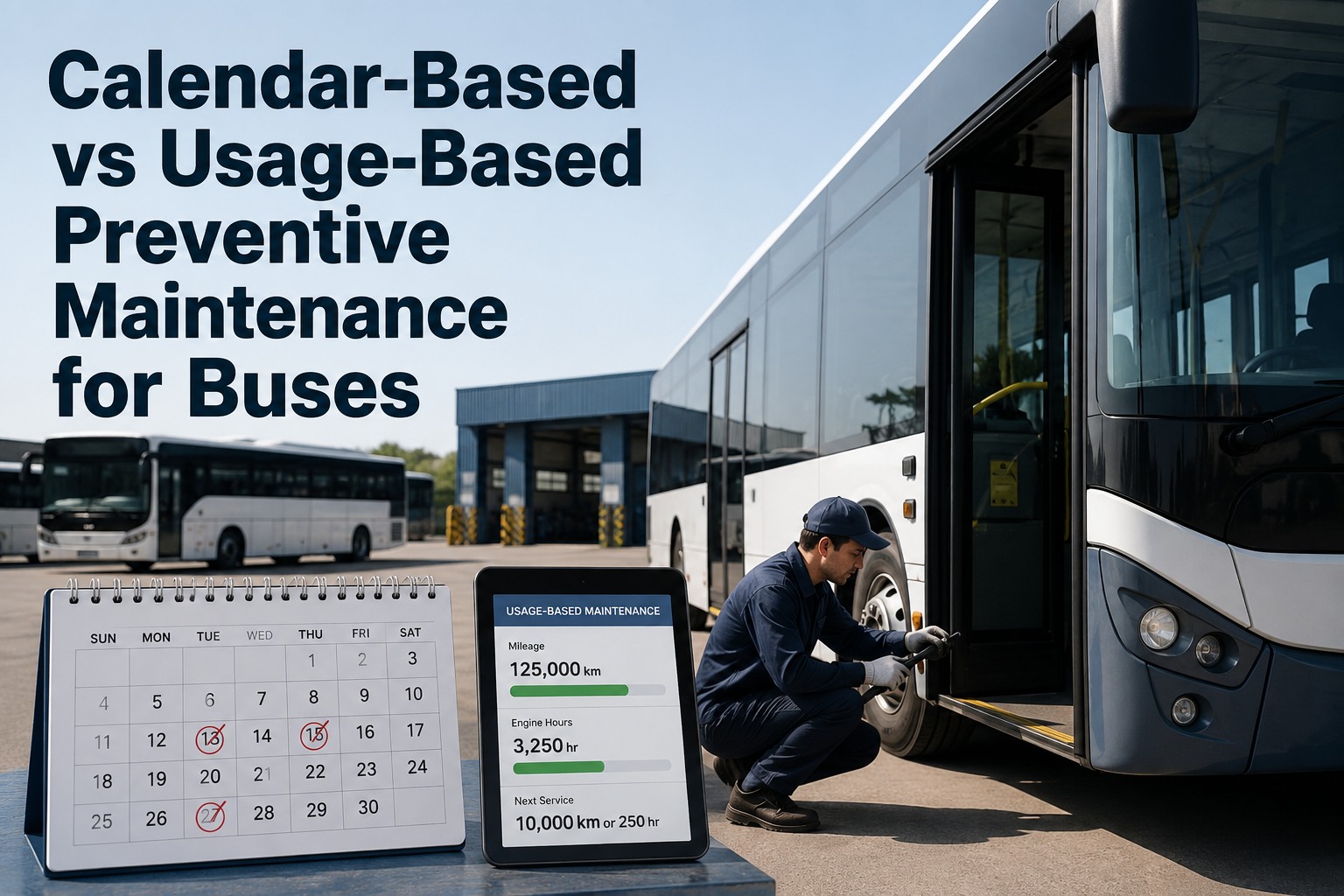
Every bus PM schedule runs on a trigger. That trigger is either the calendar (do this every 90 days) or usage (do this every 5,000 miles). Choose wrong and you either over-service low-mileage buses or run high-mileage buses to failure. This guide breaks down both approaches, when each wins, and how the hybrid model outperforms either one alone.
Calendar-Based vs Usage-Based Preventive Maintenance for Buses
Two PM philosophies, one hybrid approach that beats both -- and how to know which one your fleet needs
- 2Trigger models
- 7Decision factors
- 1Hybrid winner
Calendar-Based
Trigger: Time interval
- Every 90 days
- Every quarter
- Every year
Usage-Based
Trigger: Miles or hours
- Every 5,000 miles
- Every 200 engine hours
- Every 500 hours
How Calendar-Based PM Works
Calendar-based PM triggers maintenance work at fixed time intervals regardless of how much a bus has been driven. If your schedule says brake inspection every 90 days, that inspection happens 90 days after the last one whether the bus ran 20,000 miles or sat in the yard the whole quarter. It is the oldest form of scheduled maintenance, still widely used, and legitimately the right answer for certain categories of work.
Calendar-based PM works well when the underlying wear happens whether the bus moves or not -- corrosion, rubber degradation, coolant chemistry, fluid oxidation, seasonal shifts. It also fits regulated inspections that must happen at fixed intervals: annual DOT inspections, safety equipment checks, fire extinguisher certifications, HVAC seasonal service. When compliance rules define the interval, the calendar defines the trigger. Simple, defensible, easy to schedule labor around. Book a demo to see calendar-triggered PM running per bus.
How Usage-Based PM Works
Usage-based PM triggers maintenance work when actual wear thresholds are hit -- measured in either miles driven or engine hours accumulated. A bus running 40,000 miles a year hits its 5,000-mile oil change roughly every six weeks. A bus running 15,000 miles a year hits the same oil change every four months. Same PM item, different frequencies, driven by actual use rather than a calendar page.
Usage-based PM works well for anything that wears from actual operation -- oil, transmission fluid, brake pads, tires, engine hours accumulating on injectors and turbos. It aligns cost with use, which prevents the two failure modes calendar PM causes: over-servicing buses that barely move (wasted labor and parts) and under-servicing buses running hard schedules (accelerated wear that leads to breakdowns). It does require accurate data -- either odometer readings entered at each PM, or preferably a telematics feed pulling miles and hours automatically. Book a demo to see usage-based PM triggers auto-pull from telematics.
Head-to-Head: 7 Dimensions Compared
Neither approach is universally better. Each wins on some dimensions and loses on others. Here is the direct comparison across the seven factors that actually matter when choosing a PM trigger model for a specific system on a specific fleet.
| Dimension | Calendar | Usage |
|---|---|---|
| Predictability of workload | High | Variable |
| Data requirements | Minimal | Odometer / hours |
| Cost efficiency | Medium | High |
| Alignment with actual wear | Weak | Strong |
| Regulatory / compliance fit | Excellent | Requires justification |
| Low-mileage fleet fit | Good | Under-triggers PM |
| High-mileage fleet fit | Over-triggers PM | Excellent |
Calendar wins on predictability and regulatory fit. Usage wins on cost efficiency and wear alignment. The real answer for most fleets is that neither approach should be applied to every PM item -- different systems belong on different triggers. That is what the next section covers. Book a demo to see mixed-trigger PM configurations for real fleets.
Which PM Trigger for Which System
The right answer is almost never "pick one and use it for everything." Different bus systems have different wear patterns, and each PM task belongs on the trigger model that matches its actual wear mechanism. Here is how the most common bus PM tasks map to their best-fit trigger.
Engine Oil & Filter Change
USAGEOil degrades with miles and engine hours, not time. Every 5,000-7,500 mi or 250-300 engine hrs.
Annual DOT Safety Inspection
CALENDARFederal regulation defines the interval. Every 12 months regardless of miles driven.
Transmission Fluid Service
USAGEWear is mileage-driven. Every 60,000-100,000 mi or per fluid analysis results.
HVAC Seasonal PM
CALENDARRefrigerant and heat cycle demands are season-driven. Pre-summer April, pre-winter October.
Brake Inspection
BOTHSafety-critical: quarterly calendar check plus wear-triggered replacement (every ~40K mi for pads).
Tire Rotation
USAGETread wear is mileage-driven. Every 6,000-8,000 mi. Combine with DVIR daily visual check.
Coolant Flush
BOTHChemistry degrades with time AND heat cycles. Every 2 years OR 100,000 mi -- whichever comes first.
Cabin Air Filter
BOTHLoads up from mileage AND time-based airborne accumulation. Quarterly or every 25K mi.
Notice how often "BOTH" wins. Any system where wear happens through both time and use deserves a hybrid trigger -- and that describes most of the bus. This is why modern PM programs almost never run purely calendar or purely usage. They run a matrix, and the CMMS handles the logic per PM item. Sign up free to see the pre-loaded PM matrix for common bus systems.
The Hybrid Approach: Whichever Comes First
The best-practice PM model for modern bus fleets is not calendar OR usage -- it is calendar AND usage, with the earliest trigger winning. "Change oil every 6 months or 5,000 miles, whichever comes first" captures both wear mechanisms simultaneously. The high-mileage bus gets serviced at the mileage threshold. The low-mileage bus gets serviced at the calendar threshold. Neither one runs to failure. Neither one gets over-serviced.
The hybrid model requires a system that can watch both triggers at once. Spreadsheets cannot do this reliably at scale. Paper systems certainly cannot. A CMMS reads mileage from telematics or manual odometer entry, watches the calendar clock, and fires the work order at whichever threshold arrives first. This is the biggest single reason fleets moving from paper-based PM to a CMMS see PM compliance jump 25-40 percentage points -- the software watches both triggers on every bus, every day. Book a demo to see hybrid PM triggers firing across a mixed fleet.
Implementation: Rolling Out a Mixed-Trigger PM Program
Moving from single-trigger PM (usually calendar-only, from years of paper tracking) to a mixed-trigger program is straightforward when broken into phases. Most fleets complete this in 6-8 weeks with no service disruption. Here is the phased sequence that works.
WEEK 1-201 Audit Current PM Triggers
List every PM task in your current schedule. Note the current trigger (calendar/usage/none). Identify gaps and overlaps. This becomes the baseline.
WEEK 302 Categorize by Wear Mechanism
For each PM task, decide: time-driven, use-driven, or both. Compliance items go calendar. Wear items go usage. Everything else goes hybrid.
WEEK 403 Verify Data Sources
Confirm each bus has reliable odometer and engine-hour data flowing. Telematics feed is ideal. Manual odometer capture at each PM is the minimum.
WEEK 504 Set Thresholds Per Task
Use OEM PM schedules as starting thresholds. Adjust based on your fleet's duty cycle. Document the reasoning behind each threshold.
WEEK 605 Configure CMMS & Train Techs
Load PM matrix into the CMMS. Train the shop team on how triggers fire and how to close work orders. Confirm alerting flows work end-to-end.
WEEK 7+06 Monitor and Refine
Track PM compliance percentage weekly for the first 90 days. Refine thresholds where actual wear patterns differ from OEM assumptions.
Fleets that complete this rollout properly see PM compliance climb from typical paper-based levels of 60-70% to 90%+ within 6 months. The CMMS holds the schedule so the shop team can focus on the work itself. Book a demo to see the full 6-week rollout playbook.
How BusCMMS Handles Calendar, Usage, and Hybrid PM
Every PM approach requires a system that can enforce the rules per bus, per task, per interval. BusCMMS ships with all three trigger models pre-configured for common bus PM tasks, including fuel-type-specific schedules for diesel, CNG, and electric buses. Techs see one dashboard. The logic per PM task runs underneath automatically.
Calendar Triggers
Pre-loaded intervals for annual DOT, seasonal HVAC, compliance inspections. Fire on the date regardless of miles.
Usage Triggers
Miles and engine hours from telematics or manual entry. Trigger PM at OEM-specified wear thresholds.
Hybrid Whichever-First
Configure calendar AND usage thresholds per PM item. Software fires whichever arrives first, per bus.
Fuel-Type-Aware PM
Diesel, CNG, and electric buses run different PM schedules on the same dashboard. Templates ship pre-loaded.
Telematics Integration
Pre-built connectors for Samsara, Geotab, and other platforms. Odometer and hours feed usage triggers automatically.
PM Compliance Dashboard
Real-time PM completion rate per bus, per shop, per technician. Overdue PMs surface before they cascade.
The one-line takeaway: a bus-specific CMMS lets you stop choosing between calendar and usage. You configure each PM item on its correct trigger and let the software watch every bus every day. Nothing overdue slips. Nothing over-serviced wastes money. Book a demo to see mixed-trigger PM on your fleet's real data.
The Bottom Line on PM Triggers
Neither calendar nor usage PM is inherently correct. Each is correct for the right PM item on the right bus. Calendar wins for compliance and seasonal items. Usage wins for wear-driven service. Hybrid wins for everything in between -- which is most of the bus. The decision your fleet actually needs to make is not calendar vs usage. It is what system holds those triggers per bus, and enforces them without the shop team having to remember. That is what a CMMS does.
What is the difference between calendar-based and usage-based preventive maintenance?
Calendar-based PM triggers maintenance at fixed time intervals (every 90 days, every quarter, annually) regardless of how much a bus has been driven. Usage-based PM triggers maintenance when actual wear thresholds are hit, measured in miles driven or engine hours accumulated (every 5,000 miles, every 500 engine hours). Calendar PM fits compliance-driven inspections and time-degraded items like coolant chemistry. Usage-based PM fits wear-driven items like oil, transmission fluid, brake pads, and tires. Most modern fleets use both, matched to the wear mechanism of each specific PM task.
Which PM approach is better for bus fleets?
Neither approach wins universally. Calendar-based PM is better for regulated inspections (annual DOT, safety equipment), seasonal work (HVAC pre-summer and pre-winter), and time-degraded items. Usage-based PM is better for wear-driven items where actual operation drives failure -- oil changes, brake wear, transmission service, tire rotation. The strongest PM programs use hybrid triggers: calendar AND usage thresholds set per PM item, with the software firing the work order at whichever threshold arrives first. This eliminates both over-servicing low-mileage buses and under-servicing high-mileage buses.
What is hybrid or "whichever comes first" preventive maintenance?
Hybrid PM combines calendar and usage triggers on the same PM task. Example: "change engine oil every 6 months or 5,000 miles, whichever comes first." A bus running 40,000 miles annually will hit the mileage threshold first (approximately every 6 weeks). A bus running 15,000 miles annually will hit the calendar threshold first (every 6 months). Both buses receive PM at the right time for their actual duty cycle. Hybrid PM is the industry-standard best practice for wear-driven items that also degrade with time -- which describes most bus systems.
Do I need telematics to run usage-based PM?
Not strictly, but it helps significantly. Usage-based PM requires knowing current mileage and engine hours per bus. Telematics feeds provide this automatically and continuously (Samsara, Geotab, and similar platforms are common). Without telematics, fleets capture odometer readings at each PM visit and manually enter them into the CMMS. This works but relies on shop discipline and can lag between PMs. Any fleet running usage-based PM at scale eventually moves to telematics-fed data because it eliminates the manual step and enables real-time PM alerting.
How does BusCMMS support both calendar and usage-based PM?
BusCMMS ships with all three PM trigger models pre-configured: calendar-only for compliance inspections and seasonal HVAC, usage-only for oil changes and mileage-driven wear items, and hybrid whichever-first for anything in between. Fuel-type-aware templates ship for diesel, CNG, and electric buses on the same dashboard. Telematics integration pulls miles and engine hours from Samsara, Geotab, and other platforms automatically. Real-time PM compliance dashboards show completion percentage per bus, per shop, and per technician so overdue PMs surface before they cascade into unscheduled repairs.