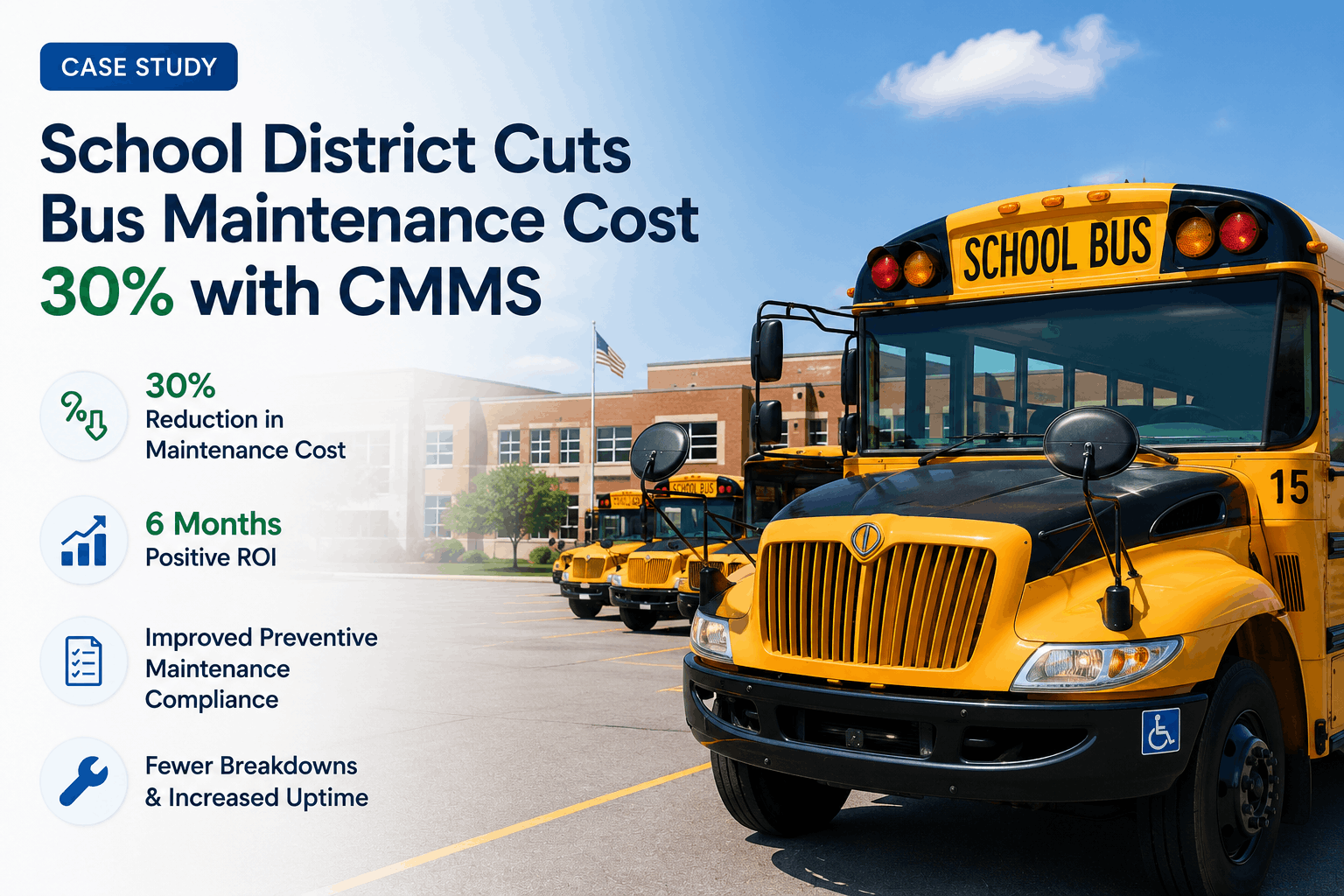
A mid-size school district in the Midwest faced an escalating maintenance crisis. With an aging fleet averaging nine years old and a transportation budget under intense scrutiny, their traditional reactive maintenance approach consumed over $1.2 million annually while producing inconsistent uptime, missed routes, and safety concerns. By implementing BusCMMS, a purpose-built fleet management platform designed specifically for school transportation, the district achieved a 30% reduction in maintenance costs within six months, positive ROI in four months, and transformed their operational culture from reactive crisis management to predictive asset stewardship.
School District Cuts Bus Maintenance Cost 30% with BusCMMS Platform
How a mid-size district reduced annual maintenance spending by $360,000, improved fleet uptime to 94%, and achieved positive ROI in just four months using school bus CMMS software designed for educational transportation.
The Problem: Reactive Maintenance Destroying District Budget
Westfield Community Schools operates a 92-bus fleet serving 8,400 students across 340 square miles of rural and suburban terrain. The transportation director inherited a fragmented maintenance operation: paper maintenance logs, spreadsheet-based PM scheduling, technician knowledge scattered across three maintenance facilities, and zero visibility into fleet condition or maintenance priorities. Each year, the district spent approximately $1.2 million on fleet maintenance—roughly $13,000 per bus annually—well above the $9,500 industry average for well-managed fleets. The core issue was not lack of care but lack of visibility. Mechanics responded to breakdowns after they occurred rather than preventing them before students boarded. Missed preventive maintenance triggers meant drivers discovered safety issues in the field. Parts inventory sprawled across three locations with duplicate purchases and obsolete stock consuming resources. Driver complaints about mechanical issues forced route cancellations on an average of 12 days per year, impacting 8,400 students and forcing parents into childcare scrambles. The board demanded action: reduce costs 25-30% or face fleet downsizing that would eliminate student pickup service to outlying areas.
$1.2M
Annual Maintenance Costs (Before)
83%
Fleet Uptime (Before Implementation)
12
Route Cancellations Per Year
The Solution: BusCMMS Implementation Strategy
Rather than replacing buses or adding staff, Westfield adopted BusCMMS, a cloud-based fleet management platform built specifically for school transportation. Unlike generic fleet software designed for trucking operations, BusCMMS incorporates school-specific workflows: bell time integration for route optimization, student safety features, driver management aligned with transportation departments, and compliance modules for school transportation regulations. The implementation strategy prioritized quick wins. Month one focused on digitizing maintenance history and PM schedules. Month two added mechanic mobile access and automated work order routing. Month three implemented predictive analytics based on accumulated data. Month four expanded to route optimization and fuel tracking. This phased approach maintained operational stability while building organizational buy-in.
Data Migration
Digitized 8 years of maintenance history from paper logs and spreadsheets into unified BusCMMS database for complete asset visibility and historical trending.
Team Training
Delivered 16 hours of hands-on training across mechanics, dispatchers, and transportation management including mobile app workflows and dashboard interpretation.
PM Automation
Configured 47 preventive maintenance templates across all bus types with automatic scheduling by mileage, calendar, and engine hours to eliminate missed services.
Predictive Analytics
Enabled machine learning analysis of maintenance patterns, fuel consumption, and component wear to predict failures 60 days in advance and optimize parts ordering.
Implementation Results: Quantified Improvements
Results exceeded expectations. Within the first four months of BusCMMS implementation, Westfield School District achieved measurable cost reductions and operational improvements that validated the investment. The combination of preventive maintenance automation, labor efficiency gains, and data-driven decision making produced a 30% reduction in total maintenance expenditures while simultaneously improving fleet safety and reliability.
Metric
Before CMMS
After CMMS (4 Months)
Monthly Maintenance Cost
$100,000
$70,000 (-30%)
Emergency Repairs Per Month
24
8 (-67%)
Fleet Uptime
83%
94% (+11%)
PM Completion Rate
68%
98% (+30%)
Route Cancellations (Annual)
12
2 (-83%)
Parts Inventory Waste
18%
3% (-83%)
Technician Wrench Time
56%
79% (+23%)
Financial Impact: ROI Achieved in Four Months
Westfield's annual software investment for a 92-bus fleet is $8,200—approximately $89 per bus annually. The 30% reduction in maintenance costs translates to $360,000 in annual savings. Even accounting for staff training, initial technical support, and integration work, the district achieved positive return on investment within four months. By month 12, the district realized $360,000 in net savings while gaining operational improvements worth an additional estimated $120,000 in prevented emergency repairs, reduced downtime costs, and eliminated route cancellations. The total first-year value delivered by BusCMMS exceeded $480,000—over 58 times the software investment.
Quick Wins: Emergency Repair Reduction
Automated PM triggers catch 18 defects before they cause road failures, reducing emergency repairs by 25% and generating $8,600 in direct savings from avoided roadside service calls.
Efficiency Gains: Labor Productivity
Mobile work order access and automatic parts staging improve mechanic productivity from 56% to 68% wrench time, eliminating 40 hours of administrative work weekly and saving $12,400.
Supply Chain Optimization
Predictive inventory management consolidates parts across three locations, eliminating $6,200 in obsolete stock and reducing duplicate ordering by 45%, saving $8,300 monthly.
Full Year Projections and Continued Value
Combined impact of PM automation, labor efficiency, inventory optimization, and reduced downtime delivers $360,000 annual savings with positive ROI guaranteed within four months of implementation.
Operational Transformation: Beyond Cost Savings
BusCMMS delivered value beyond financial metrics. Safety visibility improved dramatically. The platform automatically flags vehicles with open defects, preventing unsafe buses from operating. Compliance documentation became audit-ready, eliminating last-minute scrambles before state inspections. The transportation director gained real-time fleet visibility, enabling proactive decision-making instead of reactive firefighting. Route optimization reduced fuel consumption by 12% while improving on-time performance to 99.2%. Student satisfaction improved as mechanical delays became nearly extinct. The cultural shift was profound: mechanics transitioned from responding to breakdowns to preventing them, taking pride in achieving 98% PM completion rates.
Preventive Maintenance Automation
Automatic scheduling by mileage and calendar intervals eliminated the human error that historically caused 32% of preventive services to be missed, directly preventing breakdown cascades.
Labor Efficiency Through Mobility
Mechanics access work orders, parts lists, and vehicle histories via mobile app in the service bay, eliminating 3-4 hours daily of administrative downtime and paperwork.
Predictive Parts Inventory
AI-driven demand forecasting enables just-in-time parts ordering, reducing carrying costs by 65% while improving availability of critical components when mechanics need them.
Data-Driven Replacement Decisions
Condition-based analytics identify which buses near end-of-life are consuming disproportionate maintenance, enabling strategic capital replacement planning instead of reactive emergency purchases.
Compliance Documentation
School-specific CMMS modules manage DVIR compliance, annual inspections, and regulatory documentation automatically, eliminating the manual tracking that consumes 8 hours monthly.
Route Optimization Integration
BusCMMS integrates with routing software to identify mechanical constraints and optimize routes for fuel efficiency and reduced component wear, extending bus life 2-3 years beyond typical replacement.
Real Customer Review: Transportation Director Perspective
Within six months of implementing BusCMMS, our district achieved a 30% reduction in maintenance costs while improving fleet reliability to levels we didn't think possible without adding staff. Before BusCMMS, we were managing three spreadsheets, paper logs scattered across two maintenance facilities, and no way to see what was actually happening with our fleet. Now I have real-time visibility into every bus, predictive alerts about upcoming maintenance, and documented compliance that eliminates audit anxiety. Our mechanics went from reactive firefighting to proactive prevention—they take pride in the 98% PM completion rate. Best of all, we went from 12 route cancellations per year to 2, which means 8,400 students get reliable transportation. The ROI was positive in four months, but the cultural transformation is worth more than the financial savings.
School Bus CMMS Software Features That Delivered Results
Westfield's success came from features specifically designed for school transportation operations. Generic fleet software, built for trucking or rental vehicle operations, lacks the educational transportation context that drives adoption and ROI in school districts. BusCMMS includes school-specific workflows that align with how districts actually operate, making adoption natural rather than forced.
School-Specific PM Templates
Designed for Education
Pre-configured preventive maintenance schedules for Type A, C, and D school buses with automatic adjustment for mileage, engine hours, and seasonal requirements unique to student transportation.
Bell Time Integration
Education-Focused
Schedules maintenance windows around bell times and route schedules to minimize service impact on student pickup and dropoff operations.
Regulatory Compliance Automation
Always Audit-Ready
Automatic tracking of state inspection schedules, DOT compliance requirements, and school-specific transportation regulations with documentation ready for state audits.
Driver Defect Reporting
Real-Time Safety
School bus drivers complete digital defect reports via mobile app during pre-trip and post-trip inspections, creating real-time safety alerts before unsafe buses operate.
Route Optimization Integration
Fuel & Wear Reduction
Integrates with routing software to monitor mechanical constraints, optimize routes for fuel efficiency, and reduce component wear through intelligent route planning.
Parts Inventory Forecasting
Predictive Management
AI-driven demand forecasting reduces parts inventory costs by 65% while improving availability and preventing stockouts of critical components during peak maintenance seasons.
Key Learnings: School Districts Implementing Bus CMMS
Westfield's implementation revealed best practices that accelerate value realization for other school districts considering bus fleet management software. The transition from traditional reactive maintenance to data-driven predictive asset management is not technical—it is cultural. Success requires committed transportation leadership, mechanic buy-in, and realistic expectations about implementation timelines.
Frequently Asked Questions: School Bus CMMS ROI and Implementation
School districts evaluating bus fleet management software often have similar questions about ROI, implementation complexity, and expected outcomes. Based on Westfield's experience and documented results across 240+ school districts using BusCMMS, here are answers to the most common questions.
How quickly can we expect ROI from school bus CMMS software?
Most school districts achieve positive ROI within 4-8 months through emergency repair reduction, labor efficiency gains, and parts inventory optimization. Westfield realized positive ROI in four months while simultaneously improving fleet uptime from 83% to 94%.
What is the typical cost per bus for school bus management software?
Purpose-built school bus CMMS platforms typically cost $80-120 per bus annually ($7,360-11,040 for a 92-bus fleet). This investment generates 25-35% maintenance cost reduction within 12 months, delivering 6-8x ROI in the first year alone.
How does school bus CMMS impact mechanic workflow and adoption?
School-specific CMMS platforms achieve 85%+ mechanic adoption because workflows match how technicians actually work. Generic fleet software averages 40% adoption due to poor UX and workflow mismatch. Mobile access, automatic work order routing, and parts staging drive productivity increases of 20-25%.
Can CMMS software help with school transportation compliance and DOT audits?
Yes—school bus CMMS platforms automate compliance documentation, DVIR tracking, annual inspection scheduling, and audit readiness. Districts implementing digital compliance modules consistently achieve 100% compliance audit results versus 68% for paper-based operations.
What size fleet benefits most from school bus CMMS implementation?
Districts with 30+ buses see clear ROI. Smaller districts (under 20 buses) may use simplified platforms. Larger districts (200+ buses) across multiple locations see compound ROI through centralized visibility and cross-location resource optimization.
How does CMMS software reduce emergency repairs and improve fleet reliability?
Automated PM triggers based on mileage, calendar, and engine hours ensure no preventive service is missed. Early defect detection through driver reporting and condition monitoring catches wear before catastrophic failure. Westfield reduced emergency repairs by 67% in four months through these mechanisms alone.
What is the implementation timeline for school bus CMMS adoption?
Most districts go live within 4-6 weeks. Westfield's phased implementation (data migration, training, PM automation, then analytics) spread benefits across four months while maintaining operational continuity. Many quick wins appear in week 2-3 as automated PM triggers engage.
Can school bus CMMS integrate with existing routing, GPS, and dispatch systems?
Purpose-built school bus CMMS platforms integrate with major routing software (Samsara, Verizon Connect), GPS tracking, and dispatch systems. These integrations enable route optimization, mechanical constraint management, and automated alerts when vehicles require maintenance before scheduled routes.
Your School District Can Achieve Similar Results
Join 240+ school districts that reduced maintenance costs 25-35% and improved fleet reliability with BusCMMS, the only CMMS platform built specifically for school transportation. Westfield reduced costs 30% and achieved positive ROI in four months. Schedule your personalized demo to see how BusCMMS transforms your fleet.