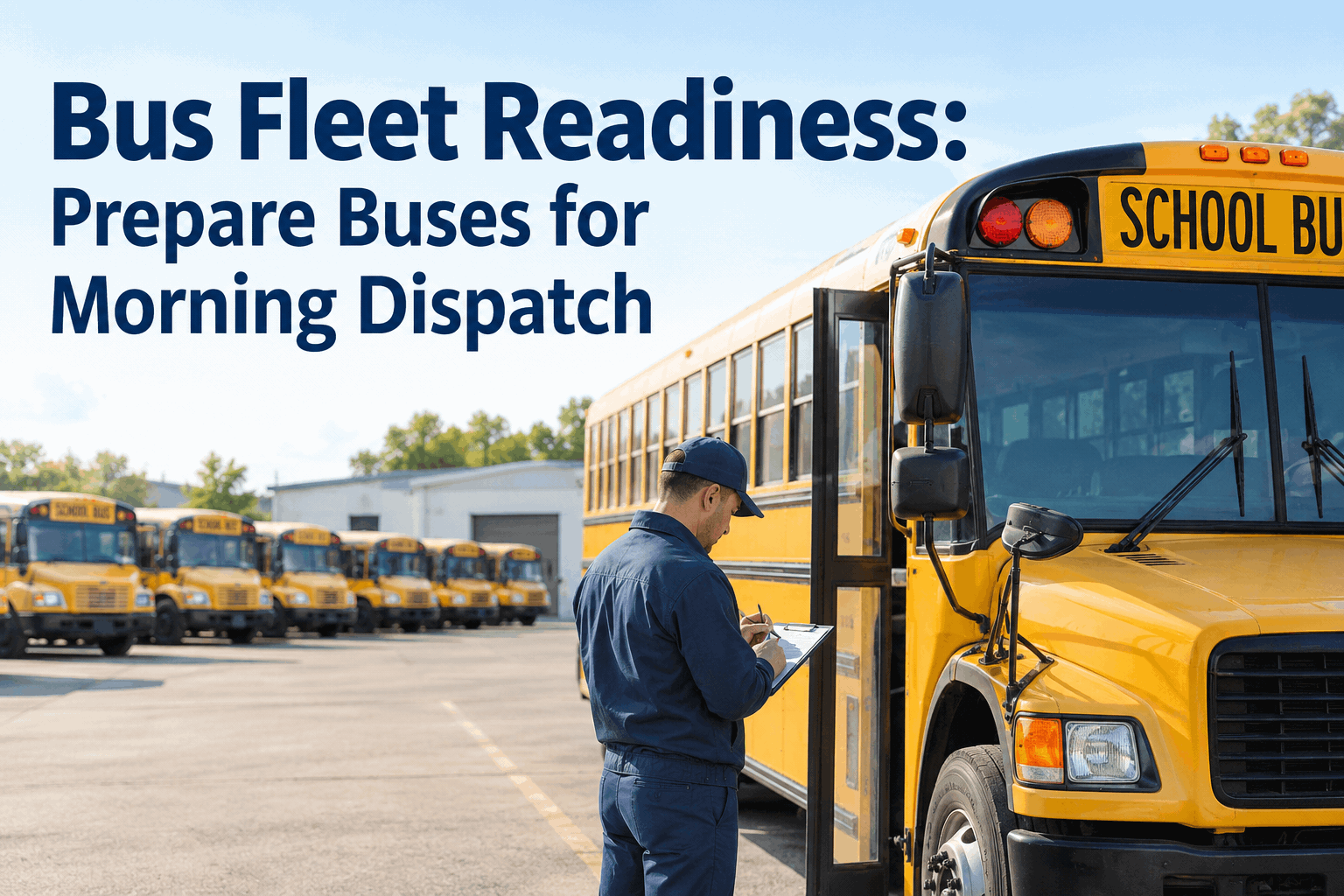
A CDL Class B pre-trip inspection isn't just a test requirement — it's the single most important safety ritual a school bus driver performs every day. Miss one item and you risk a roadside failure, a DOT violation, or worse, student safety. Yet most drivers either memorize a generic list or rely on outdated paper forms that skip critical items. This 2026-updated checklist covers every DOT-required inspection point, organized in the exact walkthrough sequence examiners expect — so you pass the test and protect your passengers every single trip.
CDL Class B Pre-Trip School Bus Inspection Checklist — Free 2026 Template
Every DOT test-required item for drivers and trainers. Use digitally or download as PDF — covers the full walkthrough sequence.
Full Walkthrough
DOT Compliant
2026 Updated
Why the CDL Class B Pre-Trip Inspection Matters More Than You Think
The FMCSA reports that mechanical failures contribute to over 30% of large-vehicle crashes. For school buses carrying children, that statistic isn't abstract — it's a liability. A thorough pre-trip inspection catches 85% of mechanical defects before they become road hazards.
The Real Cost of Skipping Pre-Trip Inspections
$16,000
Average fine for critical DOT violations on school buses
30%
Of large-vehicle crashes involve a mechanical failure factor
85%
Of mechanical defects caught during proper pre-trip inspections
Beyond fines, a failed roadside inspection means an out-of-service order — your bus is grounded, your route is disrupted, and your district faces reputational damage. A 10-minute walkthrough prevents all of it.
The Complete CDL Class B School Bus Walkthrough Sequence
CDL examiners expect you to follow a logical, consistent path around and through the vehicle. Here's the exact sequence, broken into the seven zones inspectors evaluate — in the order you should perform them.
Oil level — check dipstick, look for leaks beneath engine
Coolant level — reservoir between MIN/MAX, no leaks at hoses
Power steering fluid — proper level, no leaks at pump or lines
Belts and hoses — no cracks, fraying, or excessive wear
Wiring — no loose or exposed wires, secure connections
Water pump — no leaks, pulley aligned and secure
Air compressor — mounted securely, lines intact
Parking brake — applied, holds vehicle on grade
Service brake — test pedal firmness, no excessive travel
Steering wheel — no more than 2" free play (power steering on)
Gauges — oil pressure, coolant temp, voltmeter, air pressure normal
Mirrors — all mirrors present, properly adjusted, clean
Windshield — no cracks in wiper sweep area, wipers functional
Horn — operational, audible
Emergency equipment — fire extinguisher charged, first aid kit, reflective triangles
Headlights — low beam and high beam functional
Turn signals — front and rear, left and right
Hazard/4-way flashers — all functioning
Brake lights — all illuminate when pedal pressed
Clearance/marker lights — amber front, red rear, all working
School bus amber & red loading lights — alternating flash pattern correct
Stop arm — extends fully, lights flash, retracts properly
Tire pressure — meets manufacturer spec (check with gauge)
Tread depth — minimum 4/32" front steer, 2/32" drive axle
Tire condition — no cuts, bulges, exposed cords, or foreign objects
Lug nuts — all present, no rust streaks indicating looseness
Rims — no cracks, bends, or weld repairs
Springs/shocks — no broken leaves, leaking shocks, or sagging
Air pressure build-up — 85–100 psi within 45 seconds at idle
Low-air warning — buzzer/light activates at 60 psi
Air leak test — with full pressure, loss no more than 3 psi/min (single) or 4 psi/min (combination)
Spring brakes — engage automatically between 20–45 psi
Brake chambers — no cracks, secure mounting, proper pushrod travel
Slack adjusters — less than 1" travel when pulled by hand
Drain air tanks — release moisture from all tanks
Emergency exits — all doors/windows open freely, buzzers work
Student entry door — opens/closes fully, interlock with brakes functional
Crossing arm — extends when door opens, retracts on close
Interior — seats secured, aisle clear, floor clean and dry
Mirrors — crossover mirrors adjusted to see 200 ft ahead, 12 ft to side
Child check system — rear walk-to-back buzzer/button operational
Body condition — no major dents, loose panels, or protruding metal
Fuel tank — secure mounting, cap tight, no leaks
Exhaust system — no leaks, secure hangers, pipe not pointing at wiring/fuel
Frame — no cracks, bends, or missing bolts
Drive shaft — secure U-joints, no play or looseness
Fluid leaks — check ground under vehicle for any fresh puddles
Want a digital version you can complete on a tablet each morning? Access the interactive pre-trip checklist free.
Top 10 CDL Pre-Trip Fail Points — What Examiners Catch Most
Knowing the checklist is half the battle. Knowing where drivers actually fail is the other half. Here are the items examiners flag most often during CDL Class B school bus pre-trip tests — ranked by fail frequency.
Rank
Inspection Item
Why Drivers Fail
1
Air brake tests
Wrong pressure thresholds cited
2
Steering components
Free play not checked properly
3
Tire tread depth
Steer vs. drive minimums confused
4
Emergency exits
Rear exit buzzer skipped
5
Loading lights sequence
Amber/red flash order not verified
6
Slack adjusters
Travel distance not manually tested
7
Coolant level
Only visual — didn't check reservoir
8
Stop arm operation
Didn't verify full extension
9
Child check system
Walk-to-back buzzer not tested
10
Emergency equipment
Extinguisher charge not verified
Pro tip: Practice verbalizing each item out loud. CDL examiners require you to name the component, state what you're checking, and describe the acceptable condition — in that order.
Training new drivers? See how digital checklists guide drivers through every step.
Digitize Your Pre-Trip Inspections Today
Replace clipboards with a guided digital walkthrough. Every item tracked, time-stamped, and stored for DOT audits automatically. Your drivers stay compliant — your fleet stays on the road.
Paper Checklists vs. Digital Pre-Trip Inspections
Paper forms have been the standard for decades. But they create gaps that cost fleets time, money, and compliance standing. Here's how the two approaches compare across every dimension that matters.
Factor
Paper Checklist
Digital (BusCMMS)
Completion time
15–20 min (writing)
8–10 min (tap & go)
Missed items
Common (no enforcement)
Impossible (required fields)
Defect follow-up
Manual — if it happens
Auto work order created
Audit readiness
Filing cabinets, manual retrieval
Instant search, digital archive
Handwriting legibility
Often illegible
Clean digital records
Real-time fleet visibility
None until forms collected
Live dashboard for all buses
Ready to upgrade from paper? Try the digital pre-trip checklist with your fleet — free.
Expert Review: What DOT Inspectors Really Look For in 2026
"The biggest misconception drivers have is that pre-trip is about memorizing a list. It's not. DOT examiners want to see that you understand why each component matters and what a defect looks like in the real world. A driver who can explain that worn brake linings increase stopping distance by 30% will pass every time — even if they forget the exact order. But a driver who rattles off items without touching, looking, or testing anything? That's an automatic fail. The best fleets I inspect are the ones using digital checklists that force the driver to actually engage with each item — photo capture, pass/fail selection, and defect notes. Those records also make my job easier during audits."
Pre-Test Preparation Checklist for Drivers
Need structured driver training materials? Book a walkthrough of our driver training tools.
Pass the Test. Protect Your Passengers. Every Trip.
A CDL Class B pre-trip inspection is 10 minutes that prevent 10 hours of problems — DOT fines, roadside breakdowns, route disruptions, and the one outcome no driver wants to think about. This checklist gives you every item, in the right order, with the specific thresholds examiners require.
But a checklist on paper is only as good as the driver who fills it out. Digital inspection tools ensure every item is completed, every defect is documented with photos, and every failed component automatically generates a work order — so nothing falls through the cracks between the driver's seat and the maintenance shop.
Explore more fleet compliance resources: Access all free inspection checklists and see how automated DVIRs keep your fleet DOT-ready.
Make Every Pre-Trip Count — Go Digital
Guided checklists. Auto-generated work orders for defects. Instant audit-ready records. See how 200+ school bus fleets replaced paper inspections in under a week.
Frequently Asked Questions
What items are on a CDL Class B pre-trip inspection for a school bus?
A CDL Class B school bus pre-trip covers seven zones: engine compartment (fluids, belts, hoses), cab/driver area (brakes, steering, gauges, mirrors, emergency equipment), lights and signals (headlights, turn signals, school bus loading lights, stop arm), tires/wheels/suspension, air brake system (pressure build-up, leak test, spring brakes), school-bus-specific items (emergency exits, crossing arm, child check system), and exterior walkaround (body, fuel, exhaust, frame). Each zone has specific pass/fail thresholds that must be verbalized during the test.
How long does the CDL Class B pre-trip inspection test take?
The CDL pre-trip inspection portion of the skills test typically takes 30–45 minutes during the exam, as you must verbally explain each item to the examiner. In daily practice, an experienced driver completes a thorough pre-trip in 10–15 minutes. Digital checklists reduce this to 8–10 minutes by guiding drivers through each zone with tap-to-complete fields. Try the timed digital walkthrough.
What are the air brake test pressure thresholds for the CDL pre-trip?
Three critical thresholds: (1) Air pressure build-up — the compressor must build from 85 to 100 psi within 45 seconds at governed RPM. (2) Low-air warning — the buzzer or light must activate at approximately 60 psi. (3) Spring brakes — must engage automatically between 20–45 psi. Additionally, the air leak rate must not exceed 3 psi per minute for a single vehicle. These numbers are the most commonly tested items on the CDL exam.
What school-bus-specific items are checked during the pre-trip that regular Class B vehicles don't have?
School buses add several unique inspection items: the stop arm (must extend fully with flashing lights), alternating amber and red loading lights (correct flash sequence), crossing arm (extends when entry door opens), emergency exit doors and windows (all must open freely with functioning buzzers), the child check/walk-to-back system (rear buzzer that requires the driver to walk to the back of the bus after each route), and crossover mirrors (must provide visibility 200 feet ahead and 12 feet to each side).
Can I use a digital checklist instead of paper for daily pre-trip inspections?
Yes. The FMCSA allows electronic Driver Vehicle Inspection Reports (DVIRs) as long as they capture the same information as paper forms and are stored in a retrievable format. Digital checklists actually exceed paper requirements because they include timestamps, GPS location, photo documentation, and automatic defect routing. BusCMMS digital inspections are accepted by DOT inspectors nationwide and provide instant audit access to your full inspection history. See the digital DVIR in action.