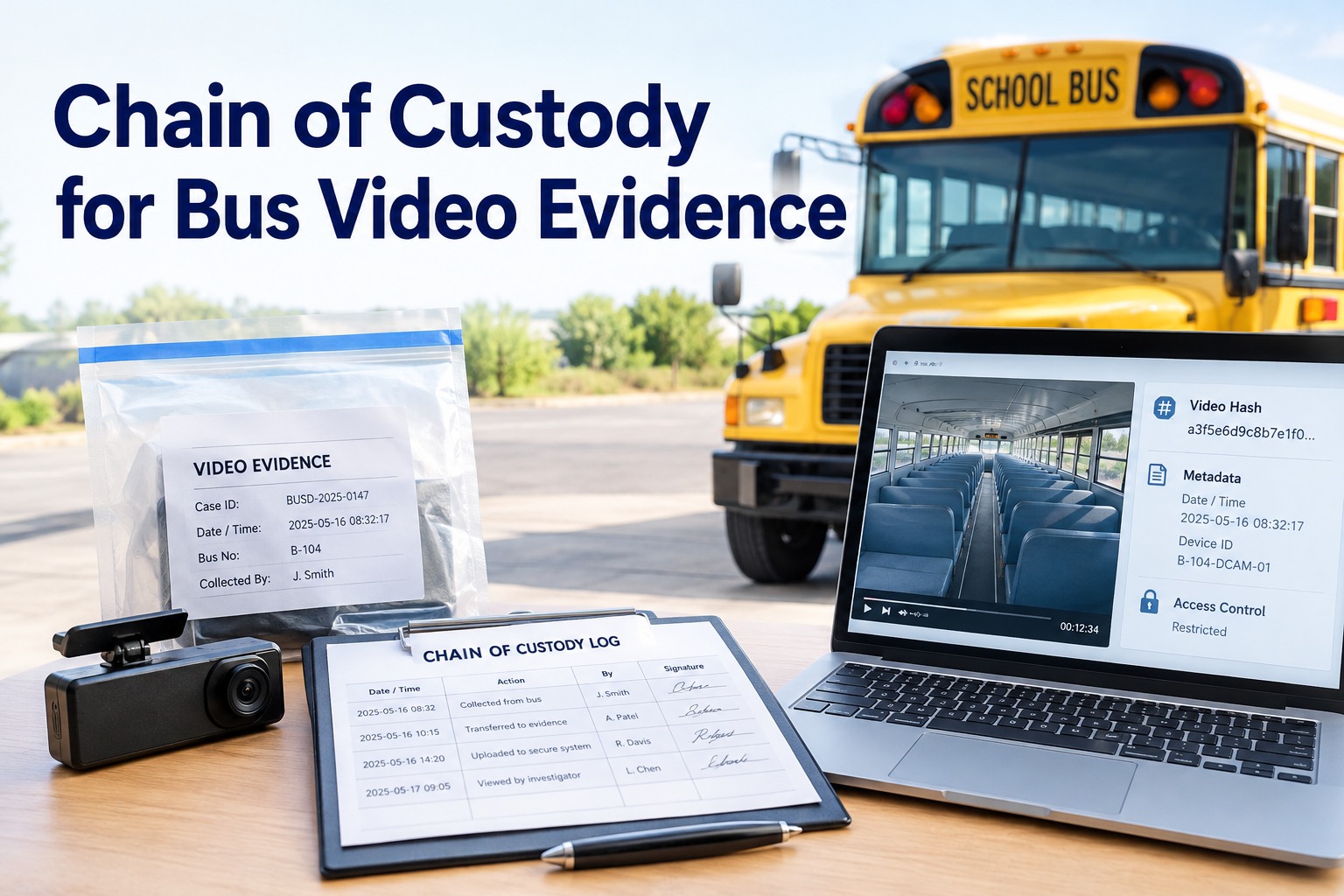
Footage is only as good as your ability to prove it's the real, unaltered clip. In a dispute, the other side won't just ask what the video shows — they'll ask who touched it, when, and how you know it wasn't edited. Chain of custody is the documented, unbroken trail that answers those questions from the moment a clip is captured to the moment it's presented. Break the chain, and even genuine footage can be challenged or excluded.
Chain of Custody for Bus Video Evidence
Prove your bus footage is authentic and unaltered — with hashes, metadata, access logs, and secure exports — all tied to the right bus record in BusCMMS.
- 5 linkUnbroken custody chain
- 4 toolIntegrity toolkit
- AuditReady trail
- Captured
- Preserved
- Accessed
- Exported
- Presented
What Chain of Custody Means for Bus Video
Chain of custody is the documented history of a piece of evidence — who had it, when, and what they did with it — that proves it hasn't been altered or tampered with. For bus video, it's the answer to the question every dispute eventually asks: how do you know this is the original clip, unedited, from that bus, on that day?
Without that trail, a clear video can still be undermined. Opposing counsel doesn't have to prove you edited it — they only have to show you can't prove you didn't. A solid chain of custody flips that: it demonstrates the footage is exactly what you say it is, from capture to presentation. Seeing that trail built automatically per bus is worth a walkthrough of evidence handling.
The Integrity Toolkit: How You Prove a Clip Is Real
Four tools do the heavy lifting of proving footage is authentic. Together, they turn "trust us" into "here's the proof" — the difference between evidence that holds and evidence that gets challenged.
Hash values
A cryptographic fingerprint of the file. If a single frame changes, the hash changes — so a matching hash proves the clip is bit-for-bit the original.
Metadata
Time, date, GPS, bus ID, and camera channel embedded with the footage — the context that ties a clip to a specific bus, place, and moment.
Access logs
A record of every view, download, and export — who accessed the clip and when — so the custody trail is complete and no handling is unexplained.
Secure export
Producing the clip in a controlled, documented way — with its hash and metadata intact — so what you hand over is verifiably the preserved original.
Each tool answers a specific challenge: the hash proves it wasn't altered, the metadata proves where and when it's from, the access log proves who handled it, and the secure export proves what you produced matches what you preserved. Miss any one and there's a gap someone can push on. Capturing all four automatically is what makes the chain defensible — start free to see the audit trail per bus.
The Five Links — and What Breaks Each One
A chain is only as strong as its weakest link. Each stage from capture to presentation has a way it can break — and knowing them is how you keep the chain intact.
Notice how many breaks come from informal handling — a clip emailed to a colleague, a download nobody logged, an original that quietly overwrote. Most broken chains aren't sabotage; they're process gaps. Closing them is exactly what a connected evidence workflow does, and it's what a demo shows on your own fleet.
Privacy Runs Alongside Custody
Handling evidence well isn't only about integrity — it's about privacy too. Bus footage often shows students, so the same access controls that protect the chain of custody also protect the people in the frame. The two goals reinforce each other.
FERPA, where it applies
If footage is a student education record, FERPA (20 U.S.C. 1232g) shapes who may access and how it's disclosed — access logging supports that, not just custody.
Public-records & state law
State public-records and privacy laws govern what's produced and what's protected, and vary by state — a documented trail helps you respond defensibly.
Least-privilege access
Only defined roles should view or export a clip. That both keeps the custody log clean and limits exposure of the students in the footage.
Retention discipline
A written retention schedule — with preserved clips exempt until released — keeps footage no longer than needed while protecting what matters.
The point is that custody and privacy aren't competing chores — the same access-controlled, logged, retention-governed system serves both. Who-touched-what protects the evidence and the students at once. There's no single federal rule covering all of this, so your counsel and records team decide how the pieces apply to your matter — the platform's job is to make the trail exist.
Building an Audit-Ready Evidence Process
A defensible chain of custody isn't something you assemble in a panic when a clip is requested — it's a process running quietly all the time. A few principles make it audit-ready by default.
Log automatically, not manually
The custody trail should build itself as people view, preserve, and export — a log you have to remember to fill in is a log with gaps.
Tie everything to the bus record
Footage, metadata, access, and the incident on one record — so scoping and proving the right clip is fast and consistent.
Control access by role
Define who can view and export before anything happens, so the log reflects a policy, not a free-for-all.
Preserve originals, export copies
Keep the untouched original with its hash; produce controlled copies. Never let the working file become the evidence.
The unifying idea is that audit-readiness is a default state, not a scramble. When logging is automatic, everything's tied to the bus, access is role-based, and originals are preserved, the chain of custody simply exists whenever you need it — no reconstruction required.
How BusCMMS Keeps the Chain Intact
BusCMMS isn't legal counsel — it's the operational layer that makes a defensible chain of custody the natural result of daily work. Here's where it fits.
Footage tied to the bus record
Each clip sits on its bus record with metadata — time, bus, camera — so it's scoped and identified without guesswork.
Access logging
Every view and export is recorded, so the custody trail builds automatically and no handling is left unexplained.
Controlled export
Produce footage in a documented way with metadata intact, so what you hand over is verifiably the preserved clip.
Hardware-agnostic
Works with the cameras and MDVRs you already run, so evidence handling improves your existing setup without a swap.
That's the role BusCMMS plays. The AI-native, hardware-agnostic platform keeps footage tied to the bus record, logs every access, and supports controlled export with metadata intact — so a defensible chain of custody is a by-product of normal work, not a reconstruction. It's an operational tool, not legal advice; your counsel and records team decide how evidence is handled for any matter. To see the audit trail on your fleet, book a walkthrough of evidence handling.
The Bottom Line on Video Chain of Custody
Genuine footage can still fail if you can't prove it's genuine. Chain of custody is the documented, unbroken trail — backed by hashes, metadata, access logs, and secure export — that shows a clip is the real, unaltered original from capture to presentation. Most broken chains aren't tampering; they're informal handling that left gaps.
Close those gaps with automatic logging, role-based access, preserved originals, and everything tied to the bus record — and privacy and custody get protected together. That's what BusCMMS is built to support, on the cameras you already own. To make audit-ready evidence handling your default, start free, and work every actual matter with your district counsel and records team.
What is chain of custody for bus video?
Chain of custody is the documented history of a piece of evidence, showing who had it, when, and what they did with it, which proves the footage hasn't been altered or tampered with. For bus video it answers the question every dispute asks: how do you know this is the original clip, unedited, from that bus, on that day? Without that trail, even a clear video can be undermined, because opposing counsel only has to show you can't prove it wasn't altered. This is general information, not legal advice; work with your district counsel on any actual matter.
How do you prove a video clip hasn't been altered?
Four tools work together. A hash value is a cryptographic fingerprint of the file, so if a single frame changes the hash changes, and a matching hash proves the clip is bit-for-bit the original. Metadata such as time, date, GPS, bus ID, and camera channel ties the clip to a specific bus, place, and moment. Access logs record every view, download, and export, showing who handled it and when. And secure export produces the clip in a controlled way with its hash and metadata intact, so what you hand over is verifiably the preserved original. Missing any one leaves a gap someone can challenge.
What commonly breaks a chain of custody?
Most broken chains come from informal handling rather than tampering. The capture link breaks when the source, time, or bus can't be verified. Preservation breaks when the clip overwrites or is copied loosely. Access breaks when anyone can view or pull footage untracked. Export breaks when a copy is emailed around with no record. And presentation breaks when you can't show the produced clip matches the original. The fixes are metadata at capture, preserving the original with its hash, role-based logged access, controlled export, and verifying the hash at presentation.
How do privacy rules like FERPA relate to chain of custody?
Custody and privacy reinforce each other. Bus footage often shows students, so the same access controls that keep the custody log clean also protect the people in the frame. If footage is a student education record, FERPA (20 U.S.C. 1232g) shapes who can access it and how it's disclosed, and access logging supports that. State public-records and privacy laws govern what's produced and what's protected and vary by state. Least-privilege access and a written retention schedule serve both integrity and privacy at once. There's no single federal rule covering all of it, so your counsel decides how the pieces apply.
How does BusCMMS support chain of custody?
BusCMMS is an operational tool, not legal counsel. It keeps footage tied to the bus record with metadata such as time, bus, and camera so clips are scoped and identified without guesswork, logs every view and export so the custody trail builds automatically, and supports controlled export with metadata intact so what you produce is verifiably the preserved clip. Role-based access keeps the log reflecting policy rather than a free-for-all. Because it's hardware-agnostic, it works with the cameras and MDVRs you already run. It doesn't make legal decisions; your counsel and records team decide how evidence is handled.