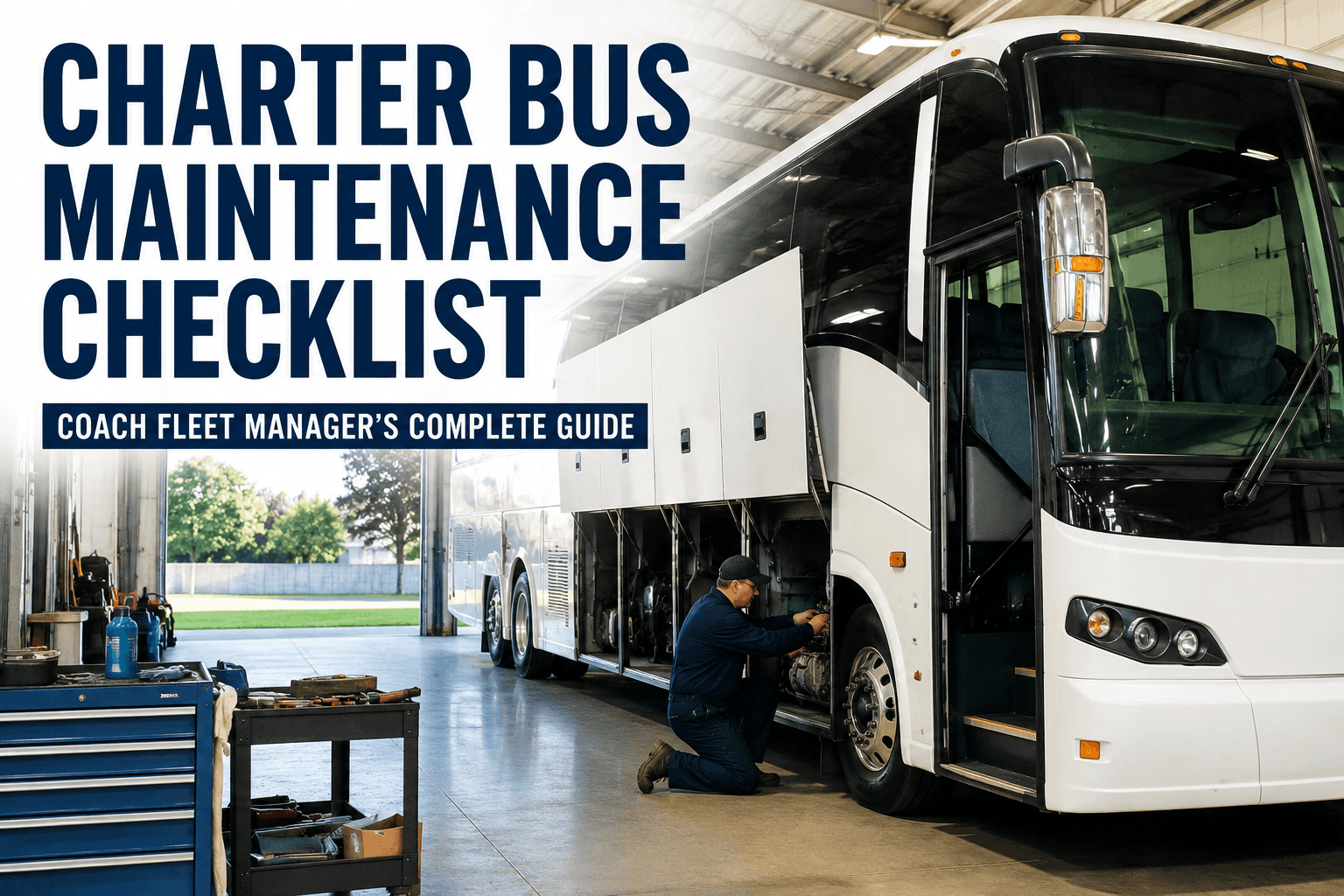
A Prevost H3-45 or MCI J4500 sitting idle at a terminal in Dallas, Phoenix, or Atlanta is not just a logistics inconvenience — it is a revenue hemorrhage. Charter bus operators in the United States lose an average of $1,200 to $2,800 per day per coach when an unplanned breakdown pulls a vehicle from service. With motorcoach fleets running corporate shuttles, casino runs, college athletics charters, and cross-country tour packages, every missed departure is a contract at risk and a reputation on the line. The solution is not reactive repair — it is a structured, documented, systematic motorcoach maintenance program built around manufacturer specifications, FMCSA 49 CFR 396 compliance requirements, and a modern CMMS that tracks every interval automatically. This guide delivers the complete charter bus maintenance checklist that American motorcoach operators need to keep coaches road-ready, DOT-compliant, and profitable across a 10-to-15-year service life.
Charter & Motorcoach Fleet Operations
Charter Bus Maintenance Checklist: Coach Fleet Manager's Complete Guide
The authoritative motorcoach PM checklist for U.S. charter and tour operators. Covers engine, transmission, HVAC, brake systems, emergency exits, driver amenities, and full DOT annual inspection items for Prevost, MCI, Van Hool, and all major coach brands. Track every inspection interval, stay FMCSA-compliant, and protect your revenue-generating assets.
Overall Checklist Progress
0% Complete
$8,500
Avg. unplanned breakdown cost per incident
$23,048
Max FMCSA out-of-service violation fine (2025)
35%
Maintenance cost reduction with structured PM program
98%+
DOT pass rate for fleets using digital inspection checklists
Motorcoach PM Interval Compliance: Planned vs. Reactive Operations
Based on U.S. charter fleet data — percentage of PM tasks completed on schedule
Pre-Trip Daily Inspection: Your First Line of Defense
Under FMCSA 49 CFR 396.11, every commercial motorcoach must complete a Driver Vehicle Inspection Report (DVIR) at the end of each day's operation. But for charter operators running premium services — corporate accounts, wedding charters, sports team travel, and casino shuttles — the pre-trip inspection the morning of departure is equally critical. A driver who boards a 45-foot Prevost H3-45 carrying 55 passengers across 400 miles of Texas interstate deserves to know that every system has been checked and certified before departure. The pre-trip inspection is not paperwork. It is the operational contract between your maintenance program and passenger safety.
The daily DVIR must capture defects affecting safe operation or regulatory compliance. If a defect is found, the vehicle cannot depart until the defect is corrected and a qualified mechanic certifies the repair. Fleets using digital DVIR platforms through BusCMMS complete this process in under 8 minutes per coach, with photos attached, timestamped, and automatically stored for the 14-month retention period required by FMCSA 49 CFR 396.21. Paper DVIRs average 22 minutes and frequently contain incomplete entries that create audit exposure.
For charter-specific operations, the pre-trip must cover passenger amenity systems — entertainment, WiFi, restroom, climate control — that DOT minimum standards do not require but your charter contracts absolutely do. A failed overhead monitor system or broken reclining seat discovered after passenger boarding on a 12-hour casino run creates an immediate customer service crisis. Catch it at the depot before the passengers arrive.
Mechanical & Safety Systems
Passenger & Emergency Systems
Engine and Powertrain PM: Cummins, Detroit, and Scania Intervals
The powertrains in American motorcoaches — Cummins ISX12, Detroit DD13, Scania DC9 — are engineered for 1,000,000-mile service lives when maintained correctly. The operative phrase is "when maintained correctly." Engine and powertrain maintenance is the highest-stakes section of any charter bus PM program because failures here are never cheap. An in-frame engine overhaul on a Cummins ISX runs $18,000 to $28,000. A transmission rebuild on an Allison B500 series runs $6,000 to $10,000. These are costs you absorb entirely when manufacturer-specified maintenance intervals are missed, because every engine manufacturer conditions their warranty on documented adherence to service schedules.
For charter operations running high-mileage routes — think 150,000 to 200,000 miles annually on interstate corridors — oil analysis programs are not optional equipment. They are essential diagnostic tools. Sending oil samples to a laboratory at every oil change interval tells you the exact wear metal concentrations in your engine oil before failure occurs. Elevated iron indicates cylinder liner wear. Elevated copper indicates bearing or bushing wear. Elevated silicon indicates air filter bypass or turbocharger seal failure. This data, tracked in your CMMS maintenance history, lets you schedule engine component replacements proactively rather than reactively.
Transmission service on Allison automatics — the standard in MCI J4500 and Prevost H3-45 coaches — follows Allison's TES 389 fluid specification. Using non-approved transmission fluid voids the Allison warranty entirely and accelerates clutch pack wear measurably. Document every fluid change with the brand, specification, and quantity used. When your FMCSA safety audit arrives, this documentation proves systematic maintenance adherence and protects you from out-of-service exposure on powertrain components.
Engine Service (Every 15,000–25,000 Miles or Per OEM)
Transmission & Driveline (Every 25,000–50,000 Miles)
Air Brake System: FMCSA's Most-Cited Violation Category
Air brake defects are the single most common reason commercial buses receive out-of-service orders during FMCSA roadside inspections. The federal fine for a brake-related out-of-service violation now reaches $23,048 per incident. Beyond the financial penalty, a bus pulled from service mid-route creates operational chaos — stranded passengers, emergency driver dispatch, customer refunds, and reputational damage that follows your company on safety review websites used by corporate travel managers booking future charters.
Motorcoaches use full air brake systems, not hydraulic systems. Air brake maintenance requires specific expertise and tooling. S-cam foundation brakes on rear axles, drum brakes on steer axles, and tag axle configurations each have manufacturer-specified wear limits that must be measured and documented. Brake lining thickness, drum diameter, and slack adjuster stroke are all measurable, objective data points that determine whether a coach is safe to operate or must be taken out of service. Document these measurements in your BusCMMS maintenance records at every brake inspection so you can track wear progression over time and predict replacement intervals before failure occurs.
Automatic slack adjusters are standard on all modern motorcoaches. A common misconception among charter fleet operators is that automatic slack adjusters eliminate the need for manual inspection. This is incorrect and dangerous. Automatic slack adjusters can stick, wear out, or fail to maintain proper adjustment. FMCSA inspectors check manual brake stroke on every annual inspection. A slack adjuster that is out of adjustment — regardless of whether it's automatic or manual — is an immediate out-of-service defect.
Air Brake Inspection (Every 90 Days and Annual DOT)
HVAC System: The Revenue-Critical Comfort System
A charter bus operator who loses air conditioning on a July afternoon in Phoenix or Miami is not just facing a passenger discomfort complaint — they are facing a potential breach of contract, a lost client, and a negative review that circulates among corporate travel managers for years. HVAC system failure is the most common charter-specific complaint that appears in carrier review databases. And it is almost entirely preventable with scheduled maintenance. Motorcoach HVAC systems — typically Thermo King, Carrier Transicold, or OEM-integrated systems — have specific maintenance requirements that differ substantially from residential or light commercial HVAC.
Refrigerant charge levels, condenser coil cleanliness, evaporator drain line condition, and blower motor belt tension are the four most common root causes of motorcoach HVAC failures. Refrigerant loss over a season is normal and expected — but if your PM program is not checking charge levels before peak summer season, you will discover the problem at the worst possible time. Clean condenser coils — using compressed air or low-pressure water — before summer months dramatically improves system efficiency and reduces compressor wear. An evaporator drain blocked by debris or algae causes water intrusion into the passenger compartment, which creates immediate passenger complaints and can damage electrical systems and flooring materials. Schedule your seasonal HVAC service through BusCMMS to ensure nothing falls through the cracks.
HVAC Service (Seasonal and Annual)
Suspension, Steering, and Chassis: Highway Safety Foundations
Motorcoach suspension systems — kneeling air suspension, multi-link rear axle suspension, and independent front suspension on premium Prevost models — experience enormous stress on American highway infrastructure. Potholes on I-40 in Oklahoma, expansion joints on aging bridges in the Northeast, and rough secondary roads on rural casino routes all transmit shock loads through suspension components continuously. Worn shock absorbers, loose tie rod ends, and cracked air bags do not announce themselves loudly before they fail. They degrade gradually until either a roadside inspection finds the defect or a handling problem during emergency maneuvering at highway speed exposes the weakness with catastrophic consequences.
Steering system inspection on 45-foot motorcoaches requires particular attention because the mechanical disadvantage of a long wheelbase amplifies any looseness in the steering linkage. A tie rod end with 1/8-inch play that would be unremarkable on a sedan creates meaningful steering imprecision on a 45-foot coach carrying 55 passengers at 70 mph. Charter fleet operators should add steering play measurement as a documented, quantified inspection item — not just a qualitative "feels okay" assessment from the driver. Measure it with a steering wheel play gauge and record the measurement in your CMMS maintenance records at every chassis service.
Suspension & Steering (Every 25,000 Miles)
Charter Passenger Amenities: Protecting Your Revenue Contracts
Corporate charter contracts, sports team agreements, and premium tour packages often specify amenity performance as a contract term. A charter agreement that specifies "working WiFi, functional entertainment system, and functioning restroom" is a binding contract. When any of those systems fails during service, you are in breach — legally and reputationally. Passenger amenity maintenance is where charter fleet operators differ most significantly from transit or school bus operators, and it is where reactive maintenance is most damaging to client relationships.
Motorcoach restrooms are a particularly high-maintenance amenity. The holding tank capacity on a 45-foot coach is typically 25 to 40 gallons — insufficient for a full coach on a 12-hour tour without servicing. Flush mechanism failures, odor control breakdowns, and toilet paper holder detachments are all addressable through regular inspection and scheduled servicing. Entertainment systems — satellite television, individual seat monitors, PA systems, and USB charging ports — have failure modes driven primarily by vibration and moisture exposure. Inspect connectors, cable routing, and mounting security at every service interval. Log every amenity defect in BusCMMS so you can track recurring issues and identify components that are failing systematically across your fleet.
Passenger Amenity Systems
Annual DOT Inspection: Full FMCSA 49 CFR 396 Compliance
Every commercial motorcoach operating in the United States must pass a comprehensive annual inspection covering all items in FMCSA 49 CFR 396 Appendix A. The inspection certificate must be carried on the vehicle and available for review by enforcement officers. Records must be retained for 14 months per 49 CFR 396.21. Failing this inspection — or operating with an expired inspection certificate — subjects your company to out-of-service orders, fines up to $23,048 per incident, and placement in FMCSA's Safety Measurement System (SMS) database, which directly affects your CSA score and visibility to DOT safety auditors.
The most operationally effective approach to annual DOT inspection is a pre-inspection using this checklist 30 to 60 days before the official inspection date. This gives your maintenance team time to address any deficiencies found without the pressure of an official inspector on the property. Charter operators who use this approach consistently achieve pass rates above 98%. Those who walk their coach into an annual inspection without a pre-inspection typically find defects during the official inspection that require same-day repair under enormous scheduling pressure. Use BusCMMS auto-scheduling to trigger a pre-inspection work order 45 days before each coach's annual inspection due date automatically.
Annual DOT Inspection Items (49 CFR 396 Appendix A)
"We run 22 coaches out of our Nashville terminal — Prevost H3-45s and MCI J4500s. Before BusCMMS, we were tracking PM intervals on spreadsheets and missing brake inspections two, three times a year. After our DOT audit came back with three brake-related violations, we knew we had to change our process. BusCMMS automated every service reminder, every DVIR, every annual inspection pre-check. We went from a 76% DOT pass rate to 100% in less than eight months. The platform paid for itself in the first year just in avoided fines and emergency repair costs."
Charter Fleet PM Compliance Scorecard
Engine Service On-Time
94%
Brake Inspection Compliance
89%
Annual DOT Pass Rate
98%
HVAC Uptime (Summer Season)
91%
Amenity System Availability
86%
DVIR Completion Rate
99%
Industry benchmark data for U.S. charter motorcoach fleets using digital CMMS platforms
Charter Bus Maintenance: Questions & Answers
How often does a charter bus need a full PM service?
Most motorcoach OEMs specify major PM service every 15,000 to 25,000 miles for engine and drivetrain systems. High-mileage charter operations running 150,000+ miles annually should perform quarterly comprehensive inspections regardless of mileage as a best practice.
What is the most common reason charter buses fail DOT roadside inspections?
Air brake defects — specifically improper slack adjuster stroke and brake lining below minimum thickness — are the leading cause of out-of-service orders for charter and motorcoach operators across all FMCSA inspection districts in the United States.
Do Prevost and MCI coaches have different PM requirements?
Yes. Each OEM publishes distinct service manuals with specific intervals for their powertrain and chassis components. MCI J4500 and Prevost H3-45 share the Cummins ISX or Detroit DD13 powertrains but have different suspension, steering, and HVAC service requirements documented in their respective service publications.
How long must we retain maintenance records for a charter bus fleet?
FMCSA 49 CFR 396.21 requires inspection reports be retained for 14 months. However, complete maintenance history records — work orders, PM completions, and repair documentation — should be retained for the vehicle's entire service life and transferred with the asset upon sale.
Is the 90-day emergency exit inspection required for charter buses?
Yes. FMCSA 49 CFR 396.3 requires inspection of emergency exits, including roof hatches, rear emergency doors, and window emergency exits, at least every 90 days for buses. This is separate from and in addition to the annual DOT inspection requirement.
What happens to our CSA score if we receive a brake violation during a roadside inspection?
Brake violations are scored under the Vehicle Maintenance BASIC in FMCSA's Safety Measurement System. Out-of-service brake violations carry the highest severity weights — typically 10 to 12 points — and remain on your SMS record for 24 months, directly affecting DOT audit frequency and insurance premiums.
Can BusCMMS track multiple coach brands in a single fleet?
Yes. BusCMMS supports unlimited vehicle profiles with brand-specific PM templates for Prevost, MCI, Van Hool, Setra, and other major motorcoach manufacturers, allowing fleet managers to track each coach against its OEM-specific maintenance schedule in a single dashboard.
What is the typical ROI timeline for implementing a CMMS in a charter fleet?
U.S. charter operators typically achieve positive ROI within four to eight months of full BusCMMS deployment, driven by reductions in emergency repair costs, avoided compliance fines, and labor efficiency gains in maintenance scheduling and documentation. The 2025 Verizon Connect Fleet Technology Trends Report confirmed 47% of fleets achieve positive ROI in under 12 months.
Stop Managing Charter Fleet Maintenance on Spreadsheets
BusCMMS is the only fleet maintenance platform built exclusively for bus and motorcoach operators. Automated PM scheduling, digital DVIR, DOT compliance tracking, warranty management, and real-time cost analytics — all in one platform designed for the way U.S. charter fleets actually operate. Every coach. Every interval. Every inspection. Documented and compliant.