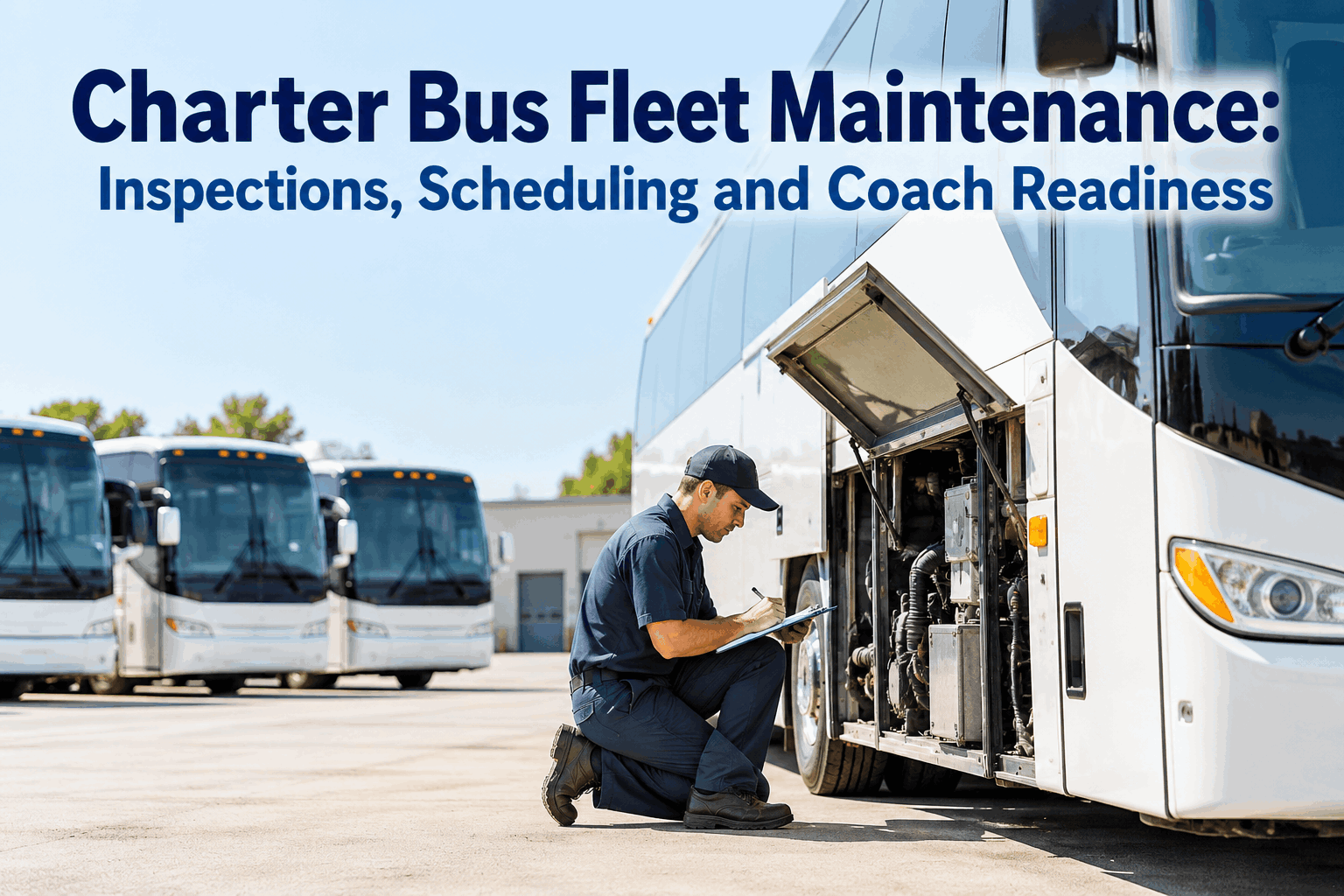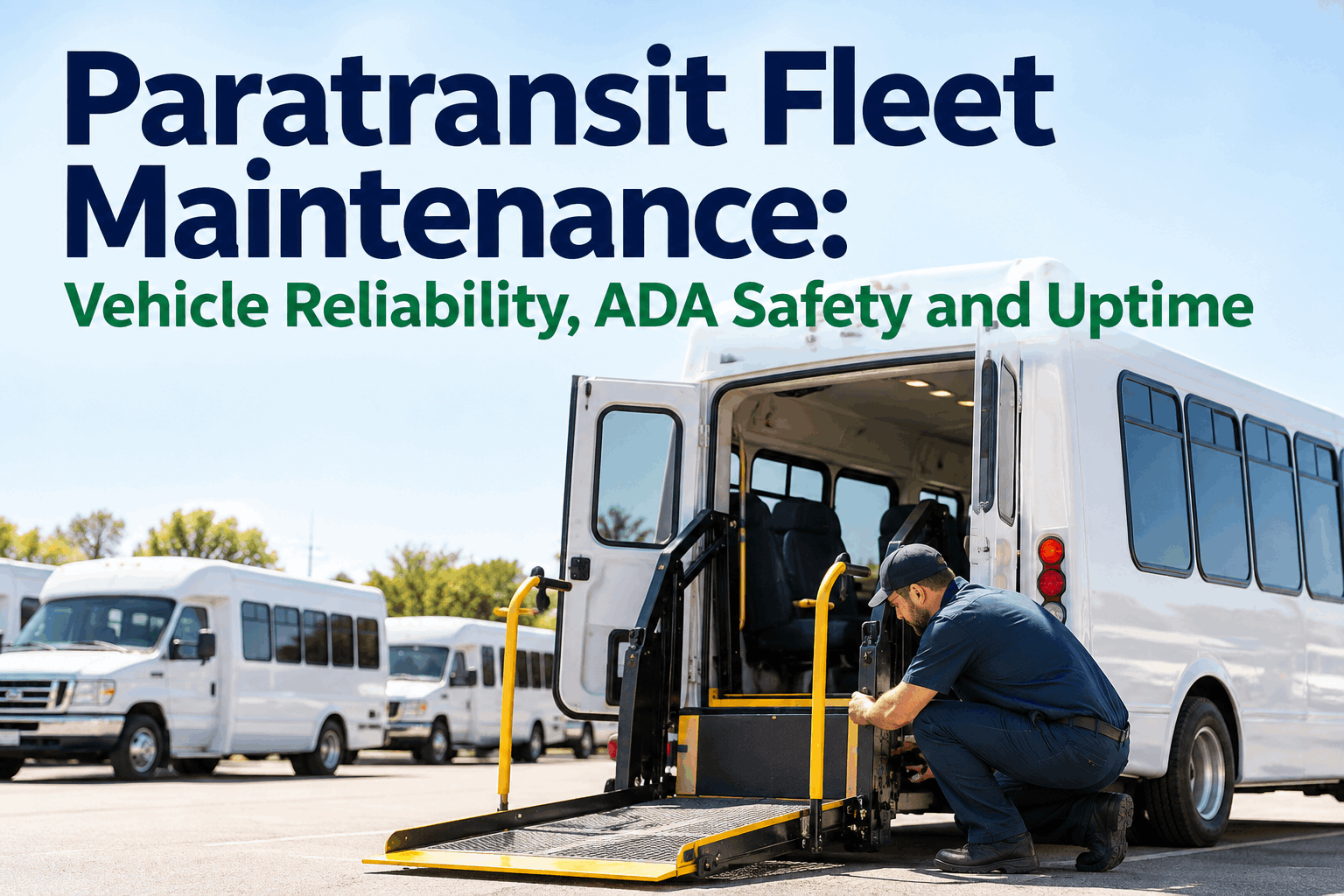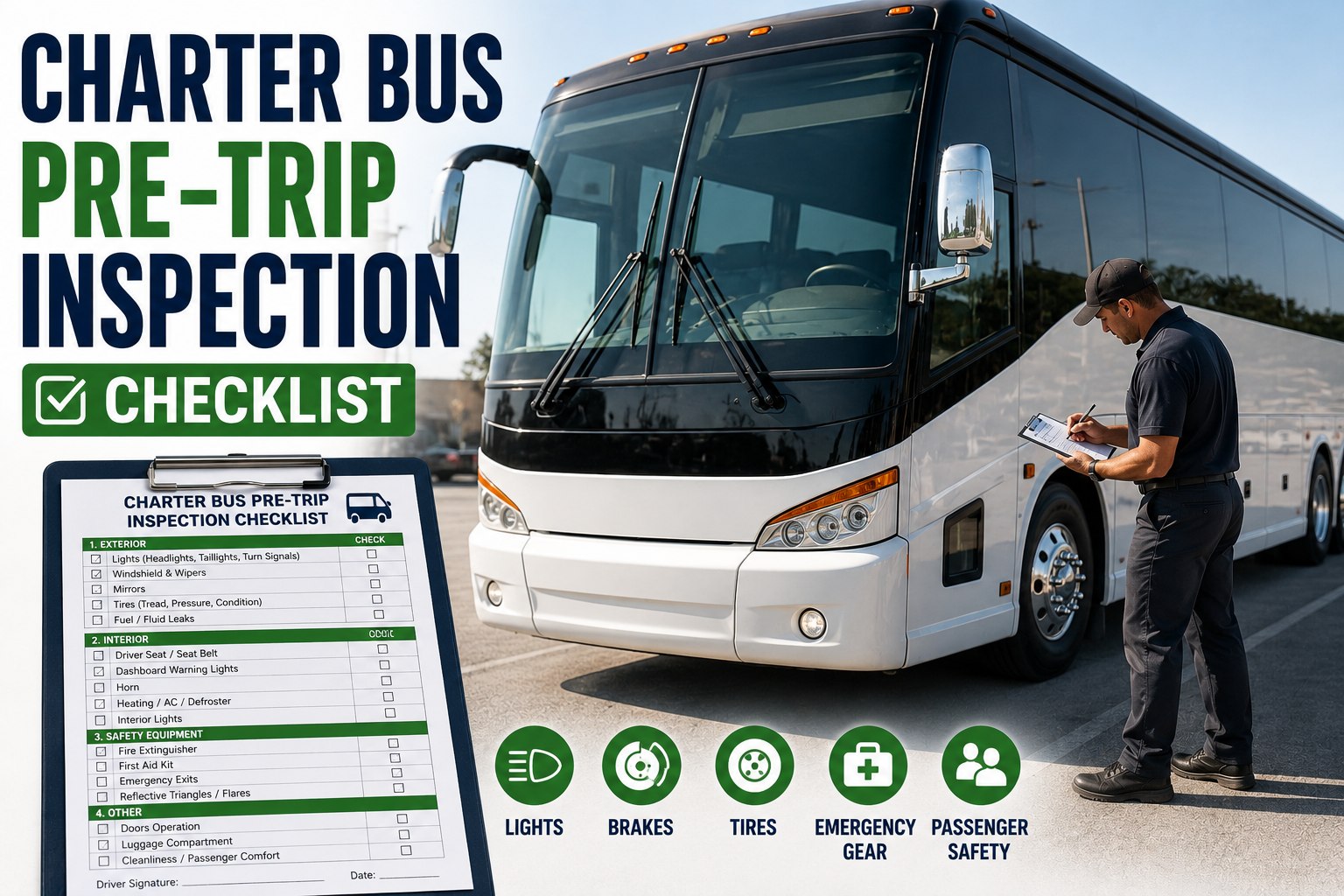
It is 5:40 AM and your driver is standing next to a 45-foot Prevost H3-45 that is about to carry 55 passengers 380 miles across two states for a corporate retreat. In 20 minutes, those passengers will board. In 40 minutes, that coach will merge onto I-95. Everything that could go wrong mechanically on that trip -- a brake failure at highway speed, a tire blowout in the left lane, a steering problem in a construction zone -- is either going to be caught right now during this charter bus pre-trip inspection or discovered at 70 mph with 55 people on board. FMCSA estimates that proper pre-trip inspections prevent approximately 14,000 accidents every year. During the 2025 CVSA International Roadcheck, 22.6% of vehicles inspected were placed out of service -- the majority for defects a thorough pre-trip would have caught before the coach ever left the lot. This is the complete charter bus pre-trip inspection checklist covering every FMCSA-mandated component plus motorcoach-specific items that generic fleet checklists miss entirely.
Charter Bus & Motorcoach Pre-Trip Inspection Checklist
The complete 7-zone walk-around for charter operators -- FMCSA items, motorcoach-specific safety, DVIR compliance, and how to go digital
- 22.6%vehicles OOS at 2025 roadcheck
- $23,048max fine per OOS violation
- 14,000accidents prevented/yr by DVIRs
Why Charter Operators Face Higher Inspection Stakes Than Any Other Bus Segment
Charter and motorcoach operators sit at the intersection of the highest regulatory exposure and the highest passenger expectations in the bus industry. Your coaches carry fare-paying adults on long-distance, high-speed routes -- often across state lines, often through multiple DOT jurisdictions, often with corporate clients whose contracts include safety documentation requirements. A roadside out-of-service order does not just ground one bus. It strands 55 passengers, triggers an emergency dispatch, generates refund requests, and follows your company on every safety review and insurance renewal for years.
The 2026 CSA overhaul makes this worse. FMCSA now splits Vehicle Maintenance into two scoring categories: standard maintenance violations and "Driver Observed" violations -- defects your driver should have caught during the walk-around. A burned-out marker light, a bald tire, a leaking air line -- these now score in a separate bucket tied directly to your pre-trip quality. Book a demo to see how BusCMMS tracks Driver Observed compliance for charter fleets.
Brake Defects
Slack adjuster stroke, lining thickness, air leaks. Single largest OOS category.
Tire Defects
Tread depth below 4/32", sidewall damage, improper inflation. 53.5% of all roadside breakdowns.
Lighting Failures
Headlights, brake lights, turn signals, clearance lights, reflectors inoperative.
Other Equipment
Windshield, wipers, mirrors, emergency equipment, coupling devices.
The Complete 7-Zone Charter Bus Pre-Trip Inspection Checklist
Follow this clockwise walk-around route before every departure. Each zone covers the FMCSA-mandated components under 49 CFR 396 plus motorcoach-specific items that generic truck checklists miss. Budget 15-20 minutes for a thorough inspection. Sign up free to get this complete checklist as a digital walk-around on your driver's phone.
Engine Compartment
- Oil level -- dipstick on level ground, engine off
- Coolant level -- check expansion tank, no leaks
- Power steering fluid level adequate
- Belts -- no cracks, proper tension, no fraying
- Hoses -- no leaks, bulges, or soft spots
Driver Side Exterior
- Tires -- tread above 4/32", no cuts or bulges, proper PSI
- Wheels/rims -- no cracks, lug nuts tight, no rust streaks
- Mirrors clean, adjusted, brackets secure
- Luggage bay doors latch and seal properly
- Body panels secure, no protruding damage
Rear of Coach
- Brake lights, turn signals, hazards operational
- Clearance and marker lights all functional
- Reflectors clean and intact
- Exhaust system -- no leaks, secure mounting
- Rear emergency exit -- opens freely, alarm sounds
Passenger Side Exterior
- Tires, wheels, rims -- same check as driver side
- Passenger entry door -- opens/closes, steps secure
- Luggage bay doors latch and seal properly
- Side emergency exits open, alarms functional
- ADA wheelchair lift/ramp operational (if equipped)
Front of Coach
- Headlights high/low beam operational and aligned
- Front turn signals and clearance lights working
- Windshield -- no cracks in wiper sweep area
- Wipers clear effectively, washer fluid functional
- License plate visible and illuminated
Cab & Driver Area
- Service brakes -- pedal firm, no pull, no noise
- Parking brake holds vehicle on grade
- Steering -- no excess play or looseness
- Air pressure builds 85-100 PSI in 2 min, governor cuts
- Horn operational, gauges normal, no warning lights
Passenger Cabin & Motorcoach-Specific
- All emergency exits open freely, alarms sound
- Fire extinguisher charged, mounted, pin in place
- First aid kit stocked and accessible
- Three reflective warning triangles present
- Passenger HVAC -- heating and cooling operational
- PA system and entertainment system functional
- Overhead storage bins secure, latches hold
- Passenger seatbelts functional (if equipped)
- Onboard restroom clean and operational (if equipped)
- Interior lighting, reading lights, aisle lights working
The 3-Signature DVIR Chain for Charter Fleets
Under 49 CFR 396.11, charter bus drivers must prepare a DVIR at the end of every operating day -- and because motorcoaches are passenger-carrying CMVs, a DVIR is required even when no defects are found. The DVIR creates a 3-step accountability chain that auditors check first and plaintiff attorneys subpoena second. Book a demo to see how BusCMMS enforces the complete 3-signature chain digitally.
Driver Files DVIR
End of trip: documents condition and all defects discovered. Signs the report.
49 CFR 396.11Mechanic Certifies Repairs
Reviews defects, completes repairs, certifies on original DVIR. Coach cannot dispatch until signed.
49 CFR 396.11(c)Next Driver Reviews & Signs
Before operating, reviews prior DVIR and confirms repairs were made and coach is safe.
49 CFR 396.13All three documents -- original DVIR, repair certification, and next-driver acknowledgment -- must be retained for 90 days minimum. FMCSA's March 23, 2026 final rule explicitly authorizes electronic DVIRs, making digital signatures, mobile submission, and cloud storage fully compliant. Book a demo to see DVIR records searchable by coach, date, or driver in seconds.
Paper vs. Digital Inspections: What Charter Fleets Actually Experience
The FMCSA's March 2026 eDVIR rule removed all ambiguity about digital inspections. But for charter operators, the real argument is operational -- the difference between a coach that passes a roadside Level 1 and one that gets pulled off I-95 with 55 passengers aboard. Book a demo to see the digital walk-around on a driver's phone.
Paper Clipboard
- 73% DOT audit pass rate
- 95% report "no defects"
- 3-signature chain breaks often
- Defects reach shop 1-2 days late
- Completion time: 90 seconds
Digital Walk-Around
- 96% DOT audit pass rate
- 8-12% realistic defect rate
- 3-signature chain auto-enforced
- Defects alert shop in real time
- Completion time: 4-5 minutes
What Charter Operators Say About Digital Pre-Trip Inspections
"We run 22 MCI J4500 coaches across three states. Before BusCMMS, our pre-trip was a laminated card on a clipboard. After one roadside OOS for a brake issue the driver should have caught, we went digital. Defect rate went from 1% to 9%. Our DOT violation rate dropped 62% in the first year."
Operations Manager -- 22-coach charter fleet, Virginia
"Charter clients now ask for safety documentation before they sign a contract. We export our DVIR completion rates and PM compliance charts directly from BusCMMS. It has won us two corporate accounts this year that specifically cited our documented safety program."
Fleet Safety Director -- 38-coach motorcoach company, Texas
These outcomes are consistent across charter fleets transitioning from paper to digital. The tool change drives the behavior change. Book a demo to see how BusCMMS generates charter-ready safety reports.
How BusCMMS Digitizes Pre-Trip Inspections for Charter Fleets
BusCMMS ships with motorcoach-specific inspection templates covering all 11 FMCSA-mandated items plus charter extras -- luggage bay doors, passenger HVAC, PA systems, onboard restrooms, ADA equipment, and entertainment systems -- pre-loaded on day one. No building forms from scratch. No adapting a trucking checklist to fit a 45-foot Prevost. Book a demo to see motorcoach templates in action.
7-Zone Guided Walk-Around
Sequential zones from engine compartment to passenger cabin. Pass/fail gates prevent skipping critical items.
Photo-Verified Defects
Timestamped, GPS-tagged photos for every defect found. Audit-grade documentation from the driver's phone.
Auto-Generated Work Orders
Any defect flagged on a pre-trip instantly creates a prioritized work order. Your shop knows before the coach leaves the lot.
3-Signature Chain Enforcement
Digital signatures with timestamps. Coach cannot be marked "available" until driver, mechanic, and next driver all sign.
90+ Day Cloud Retention
Every DVIR searchable by coach, date, driver, or defect. Produce any record in seconds for FMCSA's 48-hour audit window.
Charter Safety Reports
Export DVIR completion rates, PM compliance, and defect trends to win corporate contracts and lower insurance premiums.
BusCMMS reports that charter fleets using digital inspections reduce DOT violation rates by up to 68% and cut emergency roadside breakdowns by half within the first year. Sign up free and run your first digital pre-trip inspection in under 5 minutes.
The Bottom Line for Charter Bus Pre-Trip Inspections in 2026
Whether you run 5 coaches or 200, the pre-trip inspection is your first and last line of defense against the violations that ground coaches, cancel contracts, and drive up insurance premiums. Make every walk-around count. Book a demo to see how BusCMMS makes pre-trip compliance the default for charter fleets.
What items must be on a charter bus pre-trip inspection checklist?
Under 49 CFR 396, every charter bus pre-trip must cover the 11 FMCSA-mandated components: service brakes, parking brake, steering mechanism, lighting devices and reflectors, tires, horn, windshield wipers, mirrors, coupling devices, wheels and rims, and emergency equipment. Charter operators should also add motorcoach-specific items: luggage bay doors, passenger HVAC, PA system, passenger entry door and steps, ADA wheelchair lift, onboard restroom, overhead storage bins, and interior lighting. A thorough charter bus pre-trip takes 15-20 minutes.
Is a DVIR required for charter buses even with no defects found?
Yes. Charter buses and motorcoaches are passenger-carrying CMVs, which means a DVIR must be filed at the end of every operating day regardless of whether any defects are found. This requirement has been in place since 2020. The 2014 "no defect, no DVIR" exemption applies only to property-carrying trucks, not passenger vehicles. Many charter operators who came from freight backgrounds mistakenly apply the wrong rule.
Are electronic DVIRs legal for charter and motorcoach fleets?
Yes, fully. FMCSA published a final rule on February 19, 2026 (effective March 23, 2026) explicitly authorizing electronic DVIRs under 49 CFR 396.11 and 396.13. Digital signatures, mobile submission, and cloud storage are all compliant. Electronic DVIRs were already permissible since 2018 under 49 CFR 390.32, but the 2026 rule removes all remaining ambiguity. FMCSA actively encourages carriers to adopt electronic methods.
How long should a proper charter bus pre-trip inspection take?
A thorough charter bus pre-trip inspection should take 15-20 minutes for an experienced CDL driver. FMCSA does not specify a minimum time, but inspectors evaluate completeness, not speed. Drivers who rush through in 5 minutes typically miss critical items like brake pressure tests, emergency exit verification, and luggage bay door checks. Budget the full 15-20 minutes before every departure and build it into your dispatch schedule.
What is the fine for a charter bus out-of-service violation?
FMCSA penalties for out-of-service violations reach up to $23,048 per occurrence for operating under an out-of-service order. Missing DVIR records cost $1,584 per day. Dispatching with an unrepaired defect costs $15,420 per occurrence. Beyond fines, a roadside OOS order for a charter bus strands passengers, triggers emergency dispatch costs, generates refund requests, and damages your safety rating on every future insurance renewal and contract bid.