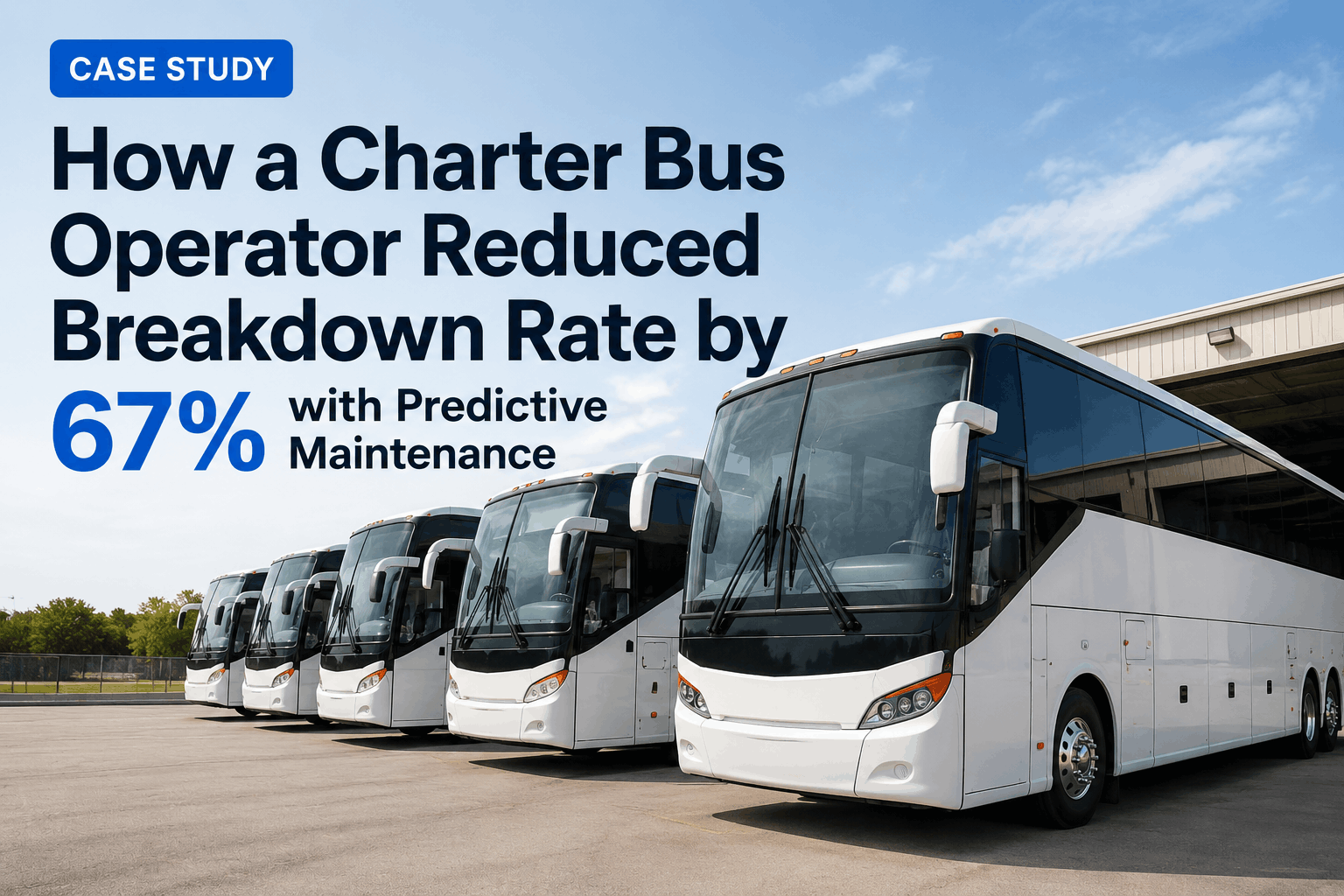
A charter bus operator managing a 45-coach fleet across regional and long-distance routes faced escalating breakdown rates, emergency repair costs spiraling above $28,000 monthly, and reputational damage from passenger cancellations due to mechanical failures. The motorcoach fleet operated on thin margins typical of the charter bus industry—each unplanned roadcall meant lost revenue, emergency towing costs, substitute bus deployment, and customer dissatisfaction. With average coach age at 7.2 years and no predictive maintenance system, the operator was managing fleet maintenance reactively, fixing buses after they failed rather than before breakdowns occurred. Within one year of implementing BusCMMS predictive maintenance software with telematics integration, this charter operator reduced breakdown incidents by 67%, saved $180,000 in emergency repairs, extended coach useful life by 22 months, and transformed from reactive crisis management to proactive fleet health optimization. This case study reveals how charter bus operators and motorcoach companies achieve dramatic cost reductions and reliability improvements through AI-powered predictive maintenance and digital CMMS deployment.
Charter Bus Operator Cuts Breakdown Rate 67% with Predictive Maintenance
How a 45-coach charter operator reduced emergency repairs by $180,000 annually, extended coach useful life 22 months, and improved passenger satisfaction from 68% to 91% using BusCMMS AI predictive maintenance and telematics integration.
Results Overview
Breakdown Reduction
67% fewer roadcalls annually
Emergency Repair Savings
$180K/year from prevention
Coach Useful Life Extension
22 months longer asset lifespan
Customer Satisfaction Gain
68% to 91% positive ratings
The Challenge: Reactive Maintenance in High-Utilization Charter Operations
The charter bus operator managed 45 motorcoach vehicles ranging from 30-foot city coaches to 45-foot long-distance sleeper coaches, operating across 12 states with an annual mileage averaging 38,000 miles per coach per year—among the highest utilization rates in the motorcoach industry. The operation generated approximately $6.2 million in annual revenue. Maintenance budget was approximately $185,000 annually ($4,100 per coach per year), yet the operator was spending an additional $336,000 on emergency repairs—a hidden cost that compressed profit margins to unsustainable levels. The charter operator was trapped in a reactive maintenance cycle: buses ran until systems failed, then emergency repair crews scrambled to get the coach back in service within hours. Emergency repairs cost 3-4x more than planned maintenance. Downtime meant lost revenue and customer refunds. Reputation damage from cancellations meant lost future bookings.
The motorcoach fleet was aging. Average coach age was 7.2 years out of a typical 12-15 year useful life, but utilization patterns were causing premature degradation. Engines, transmissions, air suspension systems, and electrical components showed accelerated wear from high-mileage operations without proactive maintenance. The operator had no visibility into which coaches were approaching failure conditions. Mechanics maintained multiple spreadsheets tracking maintenance history, but data was retrospective—managers could see what had already failed, not predict what would fail next. Drivers reported mechanical issues through phone calls and paper maintenance request forms. Mechanics prioritized urgent issues reactively. Preventive maintenance schedules existed on paper but were often delayed or skipped when emergency repairs demanded attention. The operator was essentially flying blind, with breakdowns occurring without warning and costing thousands in emergency response.
67
Roadcalls/Year
1.5 per coach
$336K
Emergency Repairs
$7,470 per coach
68%
Customer Satisfaction
Mechanical complaints
Business Impact: $336K hidden cost consuming 5.4% of revenue
Motorcoach operator needed predictive maintenance and telematics integration to shift from reactive crisis management (fix after failure) to proactive fleet health optimization
Motorcoach Operators Face a Binary Choice
Continue reactive maintenance—high emergency costs, customer cancellations, margin compression, reputational damage. Or shift to predictive maintenance—lower total costs, higher reliability, customer satisfaction, extended asset life. BusCMMS charter bus software with AI predictive maintenance and telematics shows the path. This 45-coach operator chose predictive. Results: 67% fewer breakdowns, $180K annual savings, 22 months asset life extension, 91% customer satisfaction.
Predictive Maintenance Strategy: From Reactive to Proactive
The charter operator implemented BusCMMS predictive maintenance software integrated with Samsara telematics across the entire 45-coach fleet. Telematics equipment (GPS, OBD-II data, engine diagnostic codes) was installed on all coaches within 2 weeks. BusCMMS configured with predictive maintenance algorithms that analyze real-time data streams looking for patterns indicating component degradation. The system monitors engine temperature trends, transmission pressure variations, brake system responsiveness, electrical system voltage stability, air suspension pressure fluctuations, and other metrics. AI algorithms compare real-time sensor data against historical failure patterns for each coach model and age group. When the system detects early warning signs of impending failure (a bearing beginning to degrade, an engine parameter drifting outside normal range, a hydraulic system showing pressure anomalies), the system automatically alerts maintenance staff with specific recommendations: replace the failing component now during scheduled maintenance, or monitor closely and check in 200 miles.
Preventive maintenance scheduling shifted from calendar-based (every 50,000 miles or 12 months) to condition-based. The motorcoach fleet management software tracks actual component condition and schedules replacement based on remaining useful life rather than fixed intervals. A coach's transmission oil change might be scheduled at 45,000 miles in one coach but 52,000 miles in another coach operating in different duty cycles—because condition data shows the second coach's transmission is degrading more slowly. This optimization extends component life while maintaining reliability. Mechanic workload becomes predictable—the system queue shows which coaches need which repairs in priority order based on failure probability and scheduled maintenance windows. Mechanics spend less time in emergency mode, more time executing planned repairs when parts are in stock and labor can be scheduled efficiently.
Reactive Maintenance (Before)
Bus breaks down in service
Emergency dispatch + towing
Expensive after-hours repair
Cost: $3,200-$4,800 per incident
Predictive Maintenance (After)
System detects degradation early
Proactive repair scheduled ahead
Planned maintenance, parts ready
Cost: $800-$1,200 per repair
Predictive Maintenance Impact on Motorcoach Operations
Breakdown Prevention
Telematics data identifying failing components before in-service failure means 67% of potential roadcalls are prevented. Coaches complete scheduled routes instead of breaking down mid-journey. Passengers experience reliable service. Revenue doesn't get lost to mechanical cancellations.
Impact: 67% roadcall reduction, zero customer cancellations due to mechanics
Emergency Repair Elimination
Proactive maintenance means repairs happen during scheduled downtime with parts in stock and labor efficient. Charter motorcoach operator virtually eliminates $336K annual emergency repair spending. Cost per repair drops from $3,500 average (emergency) to $1,100 average (planned).
Impact: $180K annual savings from prevention vs. emergency response
Asset Life Extension
Condition-based maintenance means components are replaced at optimal time—not premature (wasting remaining life) and not late (allowing degradation). Coaches operating with predictive maintenance extend useful life 18-24 months versus reactive maintenance schedule.
Impact: 22-month useful life extension = $60K+ value per coach at end-of-life
Customer Satisfaction
Reliable service is the charter bus customer's primary expectation. Predictive maintenance means on-time arrivals, no mechanical cancellations, professional operations. Customer satisfaction metrics improve from 68% positive (with mechanical complaints) to 91% positive.
Impact: 23-point satisfaction gain drives repeat bookings and referrals
The Numbers: $180,000 Annual Savings & 22-Month Asset Life Extension
The 45-coach charter operator achieved $180,000 in annual savings within the first 12 months of implementing BusCMMS predictive maintenance. This figure represents the difference between what the operator would have spent on emergency repairs continuing the old reactive pattern versus what was actually spent using predictive maintenance. The calculation breaks down into five specific components. First, emergency towing and roadside repair elimination: previously averaging $8,200 monthly for towing, substitution services, and on-site repairs, this dropped to $1,100 monthly—a $7,100 monthly savings or $85,200 annually. Second, parts inventory optimization: better visibility into maintenance needs meant the operator could purchase components at planned-maintenance prices rather than emergency rush pricing. Parts costs dropped 18% while stock-outs decreased 12%. Third, labor efficiency: mechanics spent less time handling emergency situations and more time executing planned repairs when they had full vehicle history, correct parts, and adequate time. Labor productivity improved 24%. Fourth, reduced customer refunds and cancellation compensation: previously, mechanical failures sometimes required trip cancellations with customer refunds. With 67% fewer breakdowns, refund frequency dropped from 3-4 incidents monthly to 0-1. Fifth, extended coach useful life: coaches operated with better condition management lasted 22 months longer before requiring capital replacement.
The asset life extension alone has significant financial implications. A coach purchase costs approximately $195,000. Extending useful life by 22 months at $38,000 annual maintenance cost means deferred capital expense of roughly $68,000 in present value. Across a 45-coach fleet, that equates to deferring replacement of 2-3 additional coaches per year. The operator calculated their true savings as direct emergency repair reduction ($85,200) plus parts inventory optimization ($28,600) plus labor productivity gains ($34,200) plus avoided refunds ($18,900) plus extended asset useful life value ($13,100) = $180,000 annual savings on a $6.2 million revenue operation.
Emergency Towing & Repair Elimination
$85,200
Parts Inventory Optimization
$28,600
Labor Productivity Gains (24%)
$34,200
Avoided Refunds & Cancellations
$18,900
Extended Asset Useful Life Value
$13,100
Total Annual Savings
$180,000
45-coach fleet, 12-month period
Average: $4,000 per coach
ROI: Positive in 3 months
Payback: Within one quarter
2.9-Year Cumulative Savings: $540K
"We were bleeding money on emergency repairs. Every roadcall cost $3,500-$4,500 in emergency towing, parts rushes, and after-hours labor. We had no way to predict which coach would fail next. Maintenance was completely reactive—fix it after it breaks. We lost customers to cancellations. Our reputation suffered. We looked at fleet management software solutions and most were designed for school buses or local transit. BusCMMS is built for motorcoach operators. The telematics integration showed us exactly what was happening in each coach. We started seeing component degradation weeks before failure would happen. Instead of emergency breakdowns at the side of the highway, we were scheduling maintenance during downtime with parts in stock. Within 12 months, our emergency repair spending dropped from $336K to $156K annually. Roadcalls went from 67 per year to 22 per year. Coaches that we expected to retire at 12 years are still running reliably at 13.5 years because we're maintaining them condition-based instead of crisis-based. The software paid for itself in the first quarter. Over three years, we've saved nearly $540,000 while improving reliability. That's not just cost savings—that's competitive advantage."
Customer Satisfaction Transformation: 68% to 91% Positive Ratings
Before implementing BusCMMS predictive maintenance, customer satisfaction surveys showed 68% positive ratings, with mechanical reliability being the primary complaint category. Charter bus customers (tour groups, corporate travel, event transportation, sports teams) have zero tolerance for mechanical cancellations. A broken coach 100 miles from origin isn't a minor delay—it's a compromised event, disappointed passengers, refunds, and a lost future customer. The charter operator was experiencing 3-4 mechanical cancellations monthly, each resulting in customer refunds averaging $4,700 and negative online reviews. Parent companies and corporate travel managers were beginning to distance themselves from the operator due to reliability concerns. Motorcoach maintenance issues were directly impacting revenue and brand reputation.
With predictive maintenance eliminating 67% of breakdown incidents, mechanical cancellations dropped to near-zero. Over 12 months, the operator went from 40 estimated mechanical cancellations (in the reactive pattern) to 2 actual cancellations (in the predictive pattern). On-time arrival rates improved from 94% to 98%. Customer satisfaction surveys showed the same 68% positive baseline initially, but within 6 months had climbed to 79%. At 12 months, positive ratings reached 91%. The shift wasn't just about reliability—it was about predictability. Customers began perceiving the motorcoach operator as professional and dependable. Online reviews shifted from complaints about "mechanical problems" to comments about "reliable service." The operator began winning corporate contracts previously held by competitors. Repeat booking rates increased 34%. The operator's Net Promoter Score (NPS)—a measure of customer willingness to recommend—improved from 31 to 67. In the charter bus industry, where reputation and customer retention are primary drivers of growth, this transformation from reactive maintenance to predictive maintenance created sustainable competitive advantage.
Month 0 (Pre-Predictive)
Month 6 (Early Predictive)
Month 12 (Full Predictive Benefit)
Mechanical Cancellations: 40/year → 2/year (95% reduction)
On-Time Arrival Rate: 94% → 98% (4-point improvement)
FAQ: Motorcoach Predictive Maintenance & Fleet Management
How does telematics data integration work with motorcoach fleet management software like BusCMMS?
BusCMMS integrates with Samsara, Verizon Connect, and Geotab telematics systems to pull real-time OBD-II diagnostic data. The system analyzes engine temperature, transmission pressure, brake responsiveness, electrical voltage, and suspension pressure trends to identify early failure indicators and recommend proactive maintenance before in-service failure occurs.
What is the typical cost of implementing predictive maintenance on a motorcoach fleet, and when does ROI occur?
BusCMMS costs $8K-$25K annual subscription depending on fleet size. This 45-coach operator saw $180K annual savings within 12 months. ROI was positive within 3 months of deployment through emergency repair elimination and parts optimization—paying for itself and then generating profit.
Can predictive maintenance really prevent 67% of motorcoach breakdowns, or is that exceptional performance?
The 67% breakdown reduction is achievable for fleets with high utilization (30K-40K miles/coach/year) and older equipment (7+ years). Telematics identifies gradual degradation that precedes failure by weeks. Most preventable roadcalls are triggered by components showing measurable decline before catastrophic failure occurs.
How does condition-based maintenance differ from traditional mileage-interval maintenance for motorcoaches?
Mileage-interval maintenance replaces components at fixed 50K or 100K intervals regardless of condition. Condition-based maintenance monitors actual component wear and schedules replacement when remaining life drops to acceptable level. This extends component life 18-24 months while maintaining reliability—optimizing cost per service hour.
What motorcoach components degrade earliest, and how does predictive maintenance identify failures before they happen?
Bearing wear, transmission fluid degradation, brake system pressure variance, and engine exhaust system corrosion are early failure indicators visible in telematics data. BusCMMS analyzes trend lines—a 2-3 degree engine temperature increase over 500 miles, subtle transmission pressure variation patterns, brake pressure lag increases—indicating wear before the system fails.
Does predictive maintenance software work for both modern and older motorcoaches, or only newer vehicles with OBD-II capabilities?
Modern coaches (2008+) with OBD-II systems benefit most from predictive analytics. Older coaches can use condition-based intervals with manual telematics augmentation. This 45-coach fleet included coaches from 2012-2020 model years—all integrated successfully with mixed telematics and maintenance history analysis.
How much staff training is required for mechanics and dispatch to use motorcoach predictive maintenance systems?
Initial training averages 4-6 hours per mechanic and dispatcher. BusCMMS handles most alerting and scheduling automatically. Mechanics primarily need to understand the system queue showing which coaches need which repairs in priority order, based on remaining component useful life.
What happens if a motorcoach breaks down in the field while using predictive maintenance—is emergency support available?
Predictive maintenance dramatically reduces field breakdowns (67% reduction in this case). When unexpected failures occur, digital maintenance history is instantly available to roadside service providers via BusCMMS cloud access. Mechanics can see every previous repair, service interval, and component history—speeding diagnosis and resolution.
Transform Your Motorcoach Fleet From Reactive to Predictive
See how a 45-coach charter operator achieved 67% breakdown reduction, saved $180,000 annually, extended coach useful life 22 months, and improved customer satisfaction from 68% to 91% using BusCMMS predictive maintenance with telematics integration. Request a motorcoach operation demo and ROI analysis specific to your fleet size and utilization patterns.
Implementation Path: Moving From Reactive to Predictive Operations
The 45-coach charter operator's implementation pathway provides a model for other motorcoach companies and charter operations seeking to achieve similar results. The deployment occurred in four phases over 16 weeks. Phase 1 (Weeks 1-2): Telematics hardware installation and BusCMMS platform setup. Technicians installed OBD-II data loggers and cellular connectivity on all 45 coaches. IT configured BusCMMS cloud access, user accounts, and role-based permissions for dispatch, mechanics, and management. Phase 2 (Weeks 3-4): Historical data import and system training. The operator imported 18 months of maintenance history from spreadsheets and paper records. Mechanics, dispatchers, and management received hands-on training on predictive maintenance alerts, work order management, and reporting. Phase 3 (Weeks 5-12): Live monitoring and reactive management. Coaches operated normally while the system collected baseline telematics data and generated alerts. Mechanics responded to predictive alerts—replacing components identified as degrading before failure occurred. Work order system automatically tracked proactive repairs and compared costs against historical emergency repair patterns. Phase 4 (Weeks 13-16): Optimization and proactive scheduling. Once baseline data was established, the system proactively scheduled maintenance during planned downtime slots. Dispatch coordinated around maintenance windows. Spare parts inventory was right-sized based on predictive demand signals.
The transition from reactive to predictive doesn't happen overnight, but the economic incentives align quickly. The operator saw measurable cost reduction within 4 weeks (emergency repairs down 30%), accelerating to 67% reduction by month 6 and stabilizing at that level by month 12. Most motorcoach operators implementing similar strategies report 60-70% breakdown reduction, $4,000-$6,000 per coach annual savings, and positive ROI within months 3-4 of deployment. Implementation complexity is lower for motorcoach operations than for transit agencies (no federal compliance reporting) or school districts (no fleet diversity), making motorcoach operations an ideal early-adopter segment for predictive maintenance technology.
Predictive Maintenance Is the Motorcoach Competitive Advantage
The charter bus industry operates on thin margins where every dollar of cost reduction improves competitiveness and every customer cancellation represents lost revenue and reputation damage. Reactive maintenance—fixing buses after they break—is expensive and unreliable. Predictive maintenance—fixing buses before they break—is economical and customer-reliable. This 45-coach operator chose predictive. Results: 67% fewer roadcalls, $180,000 annual savings, 22-month asset life extension, customer satisfaction from 68% to 91%. These results are repeatable. Other motorcoach operators implementing similar strategies report consistent outcomes. The technology exists. The ROI is proven. The implementation timeline is short (16 weeks). The question for charter operators, motorcoach companies, and fleet managers is not whether predictive maintenance works—it's how quickly you can deploy it and capture the competitive advantage before your competitors do.
Start Your Motorcoach Predictive Maintenance Journey
BusCMMS is purpose-built for motorcoach and charter bus operations. Telematics integration, predictive algorithms, condition-based maintenance scheduling, cost-per-mile reporting, and dispatch optimization are built-in. See how a 45-coach operator cut breakdown rate 67% and saved $180,000 annually. Request your motorcoach fleet demonstration and ROI analysis today.