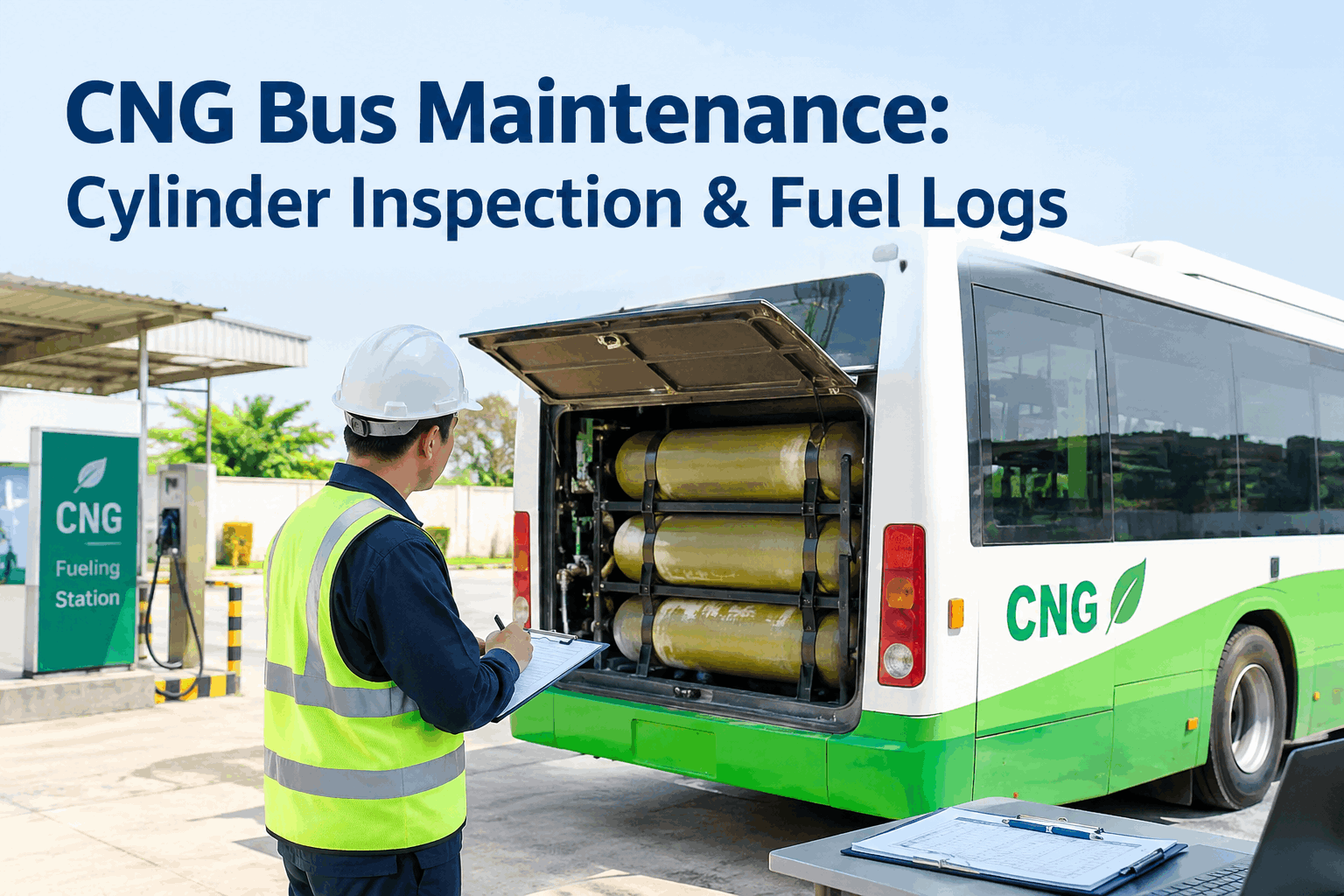
Every CNG bus in your fleet carries decals near the fill receptacle listing the last cylinder inspection date, inspector cert number, and next-due date. When a state DOT or FTA auditor walks in, that is the first thing they check — and any bus past due goes out of service on the spot. This guide covers CNG bus maintenance the way an experienced fleet actually runs it: cylinder inspections, fueling logs, PM cadence, and audit prep.
CNG Bus Maintenance: Cylinder Inspections, Fueling Logs & Audit-Ready Records
The three-tier inspection cadence, the damage classification every tech should know, the fueling log requirements, and the audit records auditors actually ask for.
- 3 yrDetailed Interval
- 36K miMileage Trigger
- 5Damage Levels
Why CNG Compliance Is Its Own Discipline
Diesel buses do not have federally-mandated fuel-tank inspections at fixed calendar intervals. CNG buses do. Every high-pressure cylinder on every CNG bus must be inspected on a defined cadence, by a certified inspector, using an approved methodology, with records retained for the life of the cylinder. That is the baseline federal requirement under FMVSS 304, ANSI/NGV-2, and NFPA 52 — and state DOT and FTA auditors verify it. A missed inspection is not a paperwork problem; it is a bus that is out of service until the inspection happens.
An expired cylinder inspection sticker will pull a CNG bus off the road faster than almost any other compliance defect. Add in that inspectors must be CSA-certified and cylinders have a maximum service life (typically 15-20 years, cylinder-dependent), and CNG fleets have a compliance overhead diesel fleets never touch.
The real risk is not the inspection itself — it is the visibility. Fleets that track cylinder inspection due dates on a spreadsheet miss them. Fleets that treat CNG the same way as diesel discover the gap during an audit. The system that works is the one that treats cylinder inspection as a scheduled event on the same timeline as the bus's PM — auto-scheduled, alerted 90 days out, and locked to a work order that captures the inspector's cert number. Book a walkthrough to see cylinder inspection tracked on the same PM timeline as your bus scheduled maintenance.
The Three-Tier CNG Inspection Cadence
CNG cylinder inspection is not one thing. Under FMVSS 304 and ANSI/NGV-2, three distinct inspection tiers run at three distinct intervals. Each tier catches different things, and each is required. Skipping any one leaves a compliance gap.
Visual Check
Driver-level visual scan for obvious external cylinder damage during pre-trip and each fill. Look for impact damage, missing shielding, or exposed cylinder surface. Anything abnormal triggers a Tier 2 inspection.
Detailed Inspection
Full high-pressure fuel system inspection per CGA C-6.4 or cylinder manufacturer methodology. Covers cylinder surface, mounting brackets, piping, PRDs (pressure relief devices), and fuel system integrity. Also required after any accident or fire.
Recertification / End-of-Life
Cylinders have a manufacturer-stamped maximum service life (typically 15-20 years). At end-of-life the cylinder must be decommissioned and replaced — no re-certification extends this. Track cylinder DOT date-stamp per bus.
The 3-year / 36,000-mile trigger is the one that catches most fleets off guard. It is a whichever-comes-first rule, and school bus routes with heavy annual mileage can hit 36K well inside 24 months. The CMMS has to trigger on both calendar and mileage simultaneously, or the mileage bus falls through the crack. Sign up free and set the dual-trigger cylinder inspection alerts for your CNG fleet.
CNG Cylinder Damage Classification: The 5 Levels
Not every scratch on a CNG cylinder is a condemnation. The industry uses a five-level classification (per CGA C-6.4 and cylinder manufacturer guidance) that tells the inspector what to do with each finding. Learning the classification is what separates a shop that condemns cylinders unnecessarily from one that knows when a defect can be released back to service.
No Damage
Cylinder shows no defects. Cleared for continued service.
Minor / Superficial
Cosmetic damage to outer surface. Overwrap material intact, no exposed fibers.
Moderate
Exposed but intact fibers, minor cuts within manufacturer limits. Requires re-inspection at shortened interval.
Major
Broken or cut fibers exceeding manufacturer limits, deep gouges, evidence of chemical exposure, or heat damage below the condemnation threshold.
Condemnation
Fire exposure, impact rupture risk, structural damage, stress corrosion cracking. Cylinder must be decommissioned per manufacturer defueling procedure and destroyed.
The classification matters for records. Every finding above Level 0 gets documented, photographed, and attached to the cylinder's permanent history file. Auditors and investigators will follow the damage-history trail if there is ever an incident. The photo and defect record from a Level 2 finding three years ago becomes evidence one way or the other. Book a walkthrough to see damage photos and inspector notes attached to each cylinder record.
The CNG Fueling Log: What Belongs on Every Fill
CNG fueling logs are not just for cost tracking. They double as the daily record of who fueled the bus, what the fill pressure looked like, and any anomalies observed at the receptacle. When a cylinder incident is investigated, the fueling log is one of the first records pulled. Six fields belong on every fill.
The GGE-dispensed field is the most important one operationally — a sudden drop in fuel economy per mile is often the first indication of a slow leak, a cylinder cycling problem, or a regulator issue. The fill pressure field is the second — if a bus consistently comes in below 3,600 PSI, the station or the bus's pressure-management system needs to be looked at. Neither of these is visible if the fueling log lives in a fuel-card spreadsheet nobody reviews.
CNG vs Diesel PM: What Actually Differs
Most bus PM tasks are the same regardless of fuel type — brakes, tires, steering, suspension, lighting, HVAC, wheelchair lift certification. What differs is the fuel-system side. The table below shows only the items that change when the bus is CNG rather than diesel. Everything else is the same.
The reason most bus CMMS platforms handle CNG poorly is that they treat fuel type as a metadata field, not as a driver of the PM template. In a system built for buses, "CNG" as a bus attribute triggers a different PM checklist and a different set of scheduled compliance events — automatically. In a generic system, the tech has to remember. The tech who remembers today is not the tech who inspects the bus in 26 months.
The 6 Records an FTA / State DOT Auditor Will Ask For
When an audit lands, the auditor's records request for a CNG fleet is predictable. Six categories of records get pulled every time. The fleets that survive audits cleanly are the ones that can produce all six in under an hour, per bus, on request.
Cylinder Inspection Records
Every Tier 2 inspection completed, per cylinder, with date, mileage, inspector cert number, findings, photos of any Level 1+ defects, and next-due date.
Inspector Certification Records
CSA CNG Fuel System Inspector certification for every person who has signed off a cylinder inspection. Certifications must be current at the time of each inspection.
CNG PM Compliance
Documented completion of CNG-specific PM items — leak checks, filter changes, PRD inspections — on the manufacturer's interval, per bus.
Fueling Logs
Continuous fill history per bus, with GGE dispensed, odometer, pressure, and fueler ID. Any anomaly entries with follow-up work order references.
Cylinder Service-Life Tracking
DOT date-stamp per cylinder and end-of-life date. Buses approaching cylinder EOL flagged with decommissioning plan.
Incident & Damage History
Any accident, fire exposure, or Level 2+ damage finding, with the post-incident inspection record showing return-to-service or condemnation decision.
Every one of these six lives naturally in a CMMS built for bus fleets. In a generic fleet system, most of them live in three or four separate places — and that is where audit findings come from. Not from the fleet doing bad work, but from the fleet not being able to produce the records that prove the good work happened. Book a walkthrough to see all six audit record categories exported from BusCMMS in one click.
How BusCMMS Handles CNG Fleet Maintenance
Because BusCMMS ships with fuel-type-aware PM scheduling out of the box, running a CNG fleet does not mean building custom workflows from scratch. Every CNG-specific requirement — cylinder inspections, fueling logs, PRD checks, inspector certification tracking — is a first-class feature, not a workaround.
-
CNG-Specific PM Templates
Fuel-type awareness triggers a different PM checklist for CNG buses — leak checks, PRD inspection, coalescing filter service, spark plug intervals — preloaded per hardware.
-
Cylinder Inspection Scheduler
Dual-trigger scheduling on 3-year calendar and 36,000-mile odometer — whichever comes first, with 90-day advance alerts.
-
Inspector Certification Tracking
CSA cert numbers, issue dates, expiration dates per inspector. Expired certifications block work-order sign-off until renewed.
-
Fueling Log Capture
Fill records per bus with GGE, pressure, odometer, and fueler ID. Fuel-card system reconciliation and MPG-drop alerts flag potential leaks early.
-
Cylinder Service-Life Alerts
DOT date-stamp per cylinder tracked from install. Alerts fire at 24, 12, and 6 months from end-of-life so decommissioning is planned, not reactive.
-
Audit-Ready Export
One-click export of all six CNG audit record categories per bus — formatted for FTA, state DOT, and NTD reporting requirements.
The design principle is that CNG is a fleet configuration, not a workaround. Set a bus's fuel type to CNG on the asset record, and every downstream template, schedule, and alert adjusts. No custom fields, no side-spreadsheet, no extra software.
The Practitioner View: What Audit-Ready Actually Feels Like
Nobody wants to fail an audit. Everyone with a CNG fleet has stared at a records request and hoped the paperwork was complete. What audit-ready buys is the removal of that hope from the process. Records exist because they were captured at the point of work, in one system, and they can be produced on request because there is only one place they live. Sign up free and get your first CNG fleet's audit records loaded within two weeks.
The Bottom Line on CNG Bus Maintenance
Running a CNG bus fleet well is not harder than running a diesel one. It is different. The compliance layer is real, the inspection cadence is fixed, and the records burden is continuous. Fleets that treat CNG as a bus with a different fuel line struggle. Fleets that treat it as a distinct compliance discipline — with the right PM templates, the right inspection scheduling, the right fueling log capture, and the right audit-ready records — run just as smoothly as a diesel fleet, and often more efficiently because CNG's cleaner burn extends some intervals. The system underneath is what makes the difference. Book a walkthrough to see BusCMMS running a CNG fleet's full compliance stack.
How often do CNG bus cylinders need inspection?
CNG cylinder inspection runs on three tiers. Tier 1 is a driver-level visual scan at every pre-trip and fueling. Tier 2 is a detailed inspection required every 3 years or 36,000 miles — whichever comes first — and after any accident or fire, per FMVSS 304 and ANSI/NGV-2. Tier 3 is decommissioning at the cylinder's manufacturer-stamped end of service life (typically 15-20 years, cylinder-specific). The dual calendar-and-mileage trigger is what catches most fleets off guard, because heavy-mileage school routes can hit 36,000 miles well before three years.
Who is allowed to inspect a CNG bus cylinder?
Tier 2 detailed inspections must be performed by a CSA-certified CNG Fuel System Inspector holding current certification. Training is available through CSA Group and the Natural Gas Vehicle Institute (NGVi). Fleets typically either train and certify at least one in-house tech or contract with a certified inspector. Inspector certification must be current at the time of each inspection — expired certs invalidate the inspection and require re-inspection.
What are the damage levels on a CNG cylinder?
Industry practice uses a five-level classification per CGA C-6.4 and manufacturer guidance. Level 0 is no damage; Level 1 is minor cosmetic damage with overwrap intact — both return to service. Level 2 is moderate damage requiring shortened re-inspection interval. Level 3 is major damage exceeding manufacturer limits — remove from service. Condemnation applies to fire exposure, impact rupture risk, structural damage, or stress corrosion cracking — the cylinder must be decommissioned per manufacturer defueling procedure and destroyed. Every finding above Level 0 is documented and photographed for the cylinder's permanent history file.
What records does an FTA or state DOT audit request for a CNG fleet?
Auditors typically request six categories of records per bus. Cylinder inspection records with date, mileage, inspector cert, findings, and next-due date. Inspector certification records showing valid CSA cert at the time of each inspection. CNG-specific PM completion for leak checks, PRD inspections, and coalescing filter service. Fueling logs with GGE, odometer, pressure, and fueler ID for the audit period. Cylinder service-life tracking including DOT date-stamp per cylinder and end-of-life date. Incident and damage history including any post-accident inspection with return-to-service or condemnation decision documented.
How does BusCMMS support CNG bus maintenance and compliance?
BusCMMS ships with fuel-type-aware PM scheduling as a core feature, so setting a bus's fuel type to CNG triggers the CNG-specific PM templates automatically — leak checks, PRD inspection, coalescing filters, spark plug intervals. Cylinder inspections are scheduled on dual calendar-and-mileage triggers with 90-day advance alerts. CSA inspector certifications are tracked with expiration handling that blocks work-order sign-off if the cert has lapsed. Fueling logs capture per-fill data with MPG-drop alerts for potential leak detection. Cylinder service-life alerts fire at 24, 12, and 6 months from end-of-life. And all six audit record categories export in one click, formatted for FTA, state DOT, and NTD requirements.