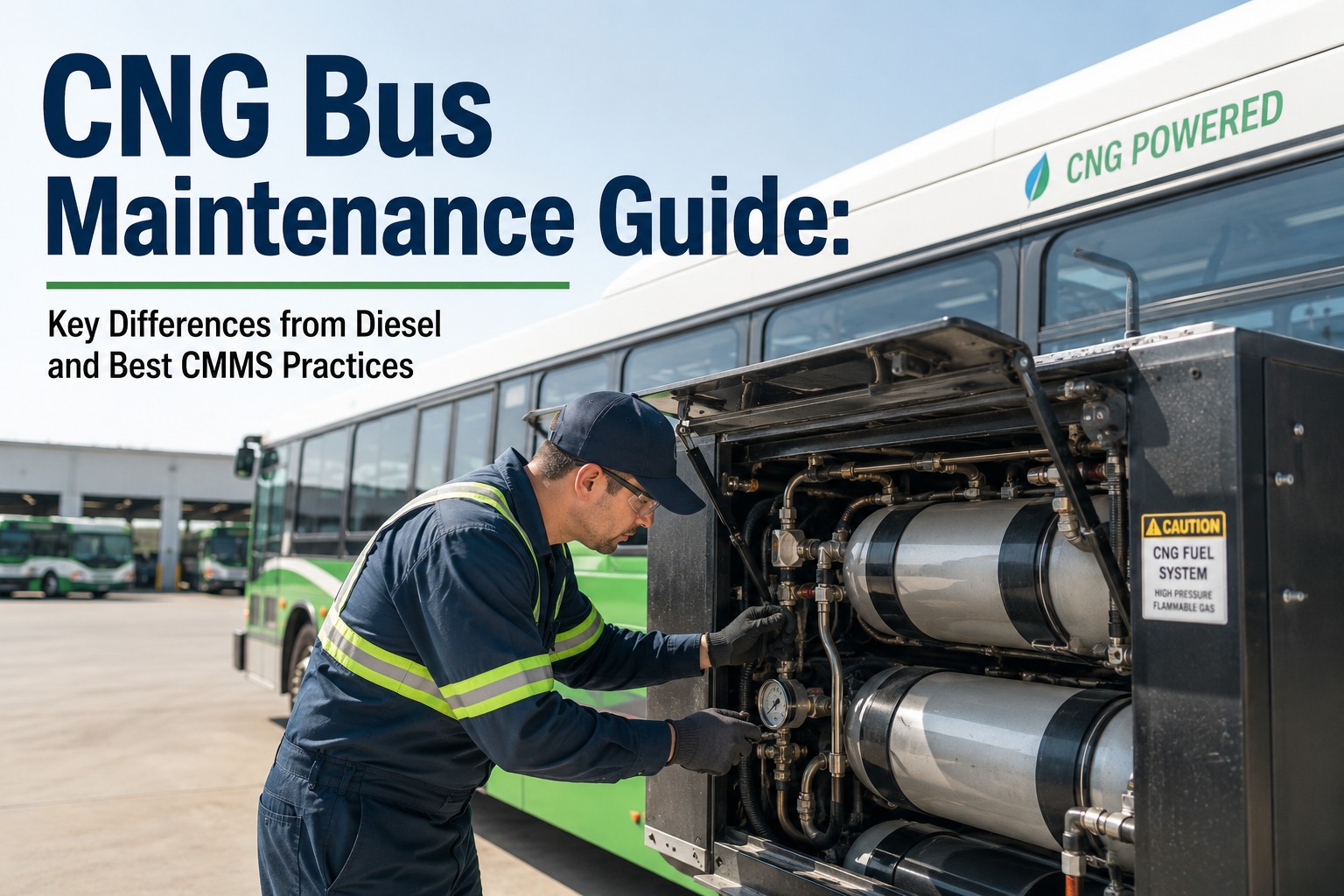
Your transit agency just took delivery of 15 CNG buses. Your shop has maintained diesel for 20 years. Your mechanic opens the hood — same block, same oil pan, same cooling system. So he runs the same PM schedule. Six months later, a CNG fuel cylinder on Bus #208 has an undetected gouge from road debris. Nobody checked it because cylinder inspection wasn't on the diesel PM template. That cylinder holds gas at 3,600 PSI — 245 atmospheres. At those pressures, a weakened cylinder doesn't leak. It ruptures. The inspection takes 15 minutes and costs nothing. CNG buses share 80% of their maintenance with diesel. The 20% that's different can kill someone .
CNG Bus Maintenance Guide: Key Differences from Diesel and Best CMMS Practices
Same engine block. Different fuel system. Different PM schedule. Different safety risks. Here's what changes when you add CNG buses — and how to track both fuel types in one system.
CNG vs Diesel Maintenance
PSI
That 20% needs its own PM schedule
How CNG Changes Your Maintenance Workflow — A Visual Guide
Most CNG engines use the same block, oil system, and cooling as diesel. But the fuel delivery, ignition, exhaust, and storage are fundamentally different. Here's how the maintenance path splits:
New Bus Arrives
What fuel type?
Diesel
Fuel injectors
DPF + DOC + SCR
DEF fluid system
Standard diesel oil
Ambient fuel tank
CNG
Spark plugs + coils
Three-way catalyst
PRD safety devices
Low-ash CNG oil
3,600 PSI cylinders
BusCMMS loads correct PM template automatically
BusCMMS handles this split at the moment you add a bus. Select "CNG" as fuel type and the system auto-loads cylinder inspections, spark plug intervals, coalescent filter replacements, PRD checks, and low-ash oil requirements. Both fuel types run on one dashboard. Your mechanic always sees the right checklist.
See diesel + CNG PM templates running side by side — book a demo
8 CNG Maintenance Differences That Change Your PM Schedule
Ignition
Diesel: Compression
CNG: Spark plugs + coils
Fuel Storage
Diesel: Ambient tank
CNG: 3,600 PSI cylinders
Exhaust
Diesel: DPF+DOC+SCR+DEF
CNG: Three-way catalyst
Engine Oil
Diesel: Standard oil
CNG: Low-ash only ($3,500 risk)
Fuel Filter
Diesel: Standard filter
CNG: Coalescent — drain + replace
Cooling
Diesel: Standard cooling
CNG: Runs hotter — extra checks
Safety Devices
Diesel: None fuel-specific
CNG: PRDs — vent lines critical
Leak Detection
Diesel: Visual + smell
CNG: Methane detector required
See all 8 differences built into the CNG PM template — book a demo
CNG-Specific Inspection — The Items Your Diesel Template Misses
CNG Fuel Cylinders — 3,600 PSI
Annual detailed inspection by certified inspector. General visual every PM.
CNG Engine-Specific Items
Spark-ignited engine with unique consumables and intervals
CNG Cylinder Lifecycle — The Timeline That Saves Lives
Over 50,000 CNG cylinders are on transit buses in North America — 4 to 8 per bus. Each has a 15–20 year life. There is no requalification. When it expires, it must be removed and destroyed. At least one agency was found operating expired cylinders because nobody tracked the dates.
Every Pre-Trip
Cursory visual — shields intact, no obvious damage, no gas smell, fill cap in place
Every PM Service
General visual — cylinder surface, mounting brackets, PRD vent lines, debris removal
Every 12 Months
Detailed inspection by CSA-certified inspector. Full shields-off exam with depth gauge. Required for 10K+ lb vehicles.
After Any Accident or Fire
Immediate detailed inspection. Bus OOS until cleared by certified inspector. Even minor incidents require verification.
At Cylinder Expiration Date
Defuel, decommission, dispose. No requalification exists. No extensions. No exceptions. Replace or retire the bus.
BusCMMS tracks cylinder expiration dates per bus with 90/60/30-day alerts before each "Do Not Use After" date. Annual certified inspections auto-schedule 60 days before due. Post-accident flags trigger immediate cylinder inspection work orders. You never operate expired cylinders because the system won't let you forget.
See cylinder lifecycle tracking with expiration alerts — book a demo
Your Diesel PM Template Can't Inspect a 3,600 PSI Fuel Cylinder.
BusCMMS runs separate PM templates for diesel, CNG, propane, and electric on one dashboard. Mark a bus as CNG and the system loads cylinder inspections, spark plug intervals, PRD checks, and low-ash oil tracking automatically. The right checklist for the right fuel type. Every time. No manual switching. No missed items.
"We added 18 CNG buses to our 40-bus diesel fleet. Our old system didn't have CNG templates — same PM on every bus. BusCMMS let us set up fuel-specific schedules in one afternoon. First annual cylinder inspection caught 2 cylinders with road debris damage that would have been invisible on the diesel checklist. At 3,600 PSI, that's not a maintenance issue — that's a safety issue we caught because the right checklist existed."
Every CNG bus on a diesel PM template has unchecked 3,600 PSI fuel cylinders, uninspected PRDs, unverified spark plugs, and untracked expiration dates. The consequences aren't fines — they're catastrophic. The fix is one fuel-type setting per bus. Takes 10 minutes to configure.
Stop running CNG buses on diesel checklists — sign up and fix it today
The biggest CNG mistake: agencies treat CNG buses like diesel with different nozzles. The engine block looks the same, so the PM looks the same. But diesel stores fuel at ambient pressure in a steel tank. CNG stores fuel at 3,600 PSI in composite cylinders with 15–20 year lifespans requiring certified inspections. That's not a PM item you skip or estimate.
The second mistake: using standard diesel oil. CNG requires low-ash oil because the ash contaminates the three-way catalyst — destroying a $3,500 component in 12–18 months. BusCMMS tracks oil type per bus so the work order always reads "CNG — Low Ash Oil Only." One line on a digital template prevents a $3,500 mistake.
CNG buses share 80% of maintenance with diesel — but the 20% that's different involves 3,600 PSI fuel cylinders with expiration dates, spark-ignited engines with unique consumables, and safety devices diesel buses don't have. Running them on a diesel template misses every CNG-specific item. BusCMMS loads fuel-type-specific PM schedules automatically — diesel, CNG, propane, electric — on one dashboard. Configure once. The system handles it forever.
Diesel, CNG, Propane, Electric — One Dashboard. Right PM for Every Bus.
Fuel-type-specific PM templates load automatically. CNG buses get cylinder inspections and PRD checks. Diesel buses get DPF and DEF schedules. Every fuel type tracked. Every bus covered. One system. Set up in one afternoon.