For decades, commercial bus fleets have relied on static, calendar-based or mileage-driven preventive maintenance schedules to keep their assets rolling. While checking a vehicle every 45 days or changing oil exactly every 10,000 miles is better than operating reactively, it introduces an incredibly costly paradox: you are either replacing perfectly healthy components too early or entirely missing hidden, rapidly developing failures until a bus breaks down mid-route. Modern transit systems operate under vastly different stressors—a bus idling in gridlock for six hours undergoes completely different wear than one running a continuous regional highway loop, even if their odometers match. By transitioning to Condition-Based Maintenance (CBM), fleets stop guessing and start reacting to live asset data. Driven by real-time telematics, onboard diagnostics, and advanced sensor arrays, CBM allows maintenance teams to intercept failures right as they begin, optimizing technician labor and maximizing part lifespans. This comprehensive guide details the real-world limitations of calendar tracking, maps out primary condition-monitoring zones, and provides an actionable blueprint to establish a data-driven CBM framework inside your garage.
Preventive Maintenance
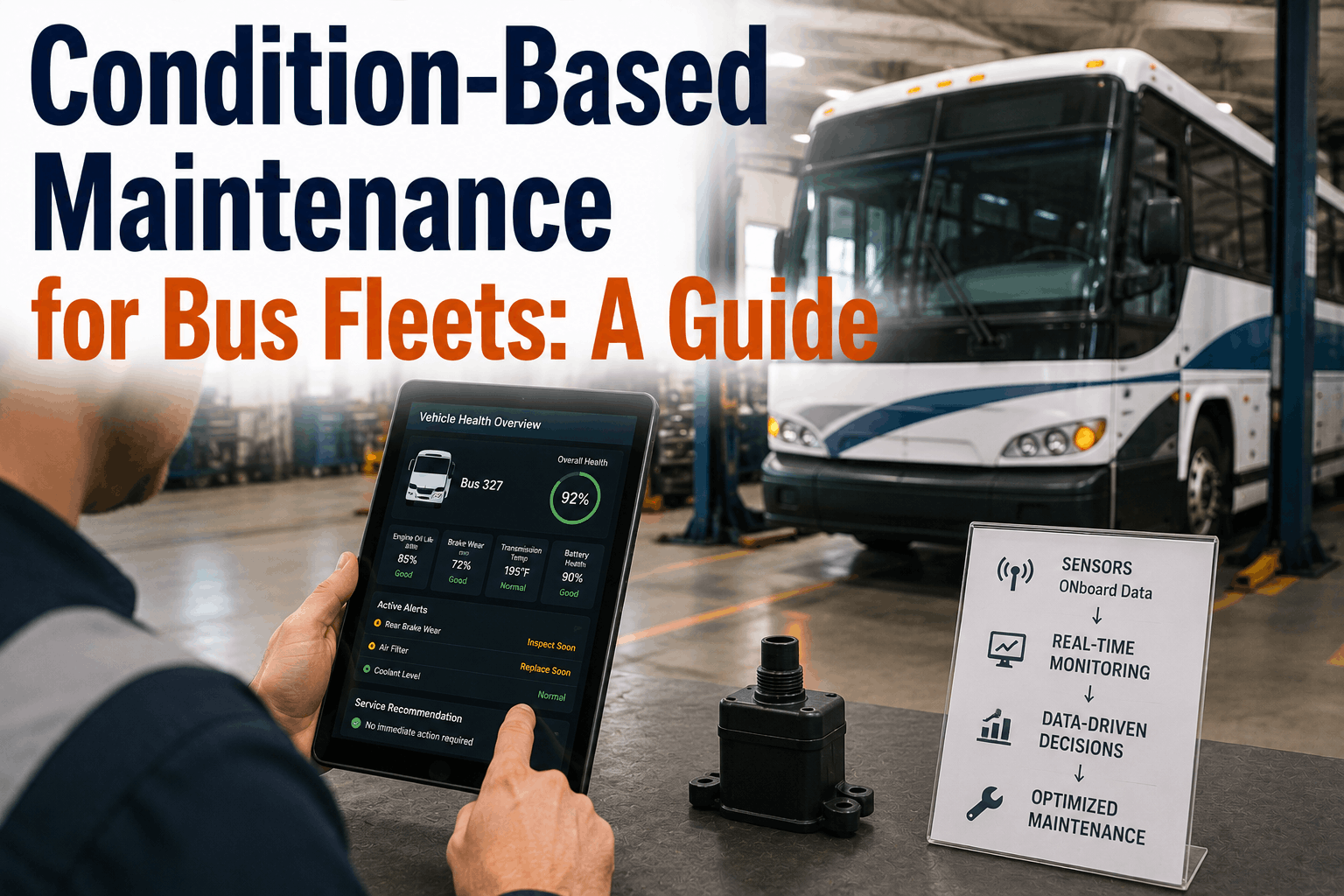
Condition-Based Maintenance for Bus Fleets: A Guide
Service when the data says so, not just the calendar. Learn how condition-based maintenance uses sensors and telematics to optimize bus service, maximize uptime, and cut unnecessary shop costs.
Why Rigid Calendar and Odometer Schedules Damage Fleet Budgets
Treating every asset identically based on generic intervals creates major maintenance blind spots. Without real-time insight into actual component degradation, fleet operations inherently lose efficiency in four distinct ways:
Reason 1: Substantial Waste of High-Value Consumables
Discarding expensive lubricants, filters, and parts purely because a calendar date arrived forces high-quality resources out of service prematurely, significantly driving up operating costs.
Reason 2: Missing Extreme, Accelerated Component Wear
If a coolant line develops a pinhole or a wheel bearing suffers unexpected damage early in a PM cycle, a mileage-based schedule won't catch it before it turns into an expensive roadside failure.
Reason 3: Failure to Account for Intense Idle Time and Duty Cycles
Buses stuck in heavy urban traffic endure massive thermal stress and engine cycles that mileage counters completely ignore. This often leads to over-extended, dirty engine oil.
Reason 4: Over-Servicing Leading to Human Error Risks
Every time an asset is torn down for unnecessary teardowns or invasive visual checks, technicians risk stripping threads, pinching wire harnesses, or introducing dirt into sealed environments.
The Strategic Monitoring Metrics of a Modern CBM Architecture
To build a reliable condition monitoring framework, maintenance operations must monitor four core technical markers directly tied to vehicle health and reliability.
Real-Time Sensor Inputs vs. Critical Asset Health Conditions
Zone: Fluid Viscosity and Dielectric Properties
Onboard oil quality sensors monitor real-time changes in fluid chemistry and contamination levels. Tracking these metrics helps catch engine oil dilution or transmission fluid breakdown early, stopping damage before it hits internal gear sets.
Zone: Battery State of Health (SoH) and Voltage Drop
Monitoring starter motor current draw and resting battery voltages identifies failing cells before a bus gets stranded. Catching weak electrical trends early ensures buses start reliably every morning.
Zone: Brake Pad Thickness and Sensor Thresholds
Electronic wear indicators track pad material thickness continuously. This eliminates the need for manual wheel-off garage inspections while protecting expensive brake rotors from accidental metal-on-metal scoring.
Zone: Engine Exhaust and Thermal Differential Profiles
Comparing temperature sensor readings across the cooling loops and exhaust networks flags early clogging in the Diesel Particulate Filter (DPF) or exhaust issues before they trigger a forced, over-the-road engine derating.
The Playbook: Launching a Condition-Based Strategy
Transitioning your garage to data-driven service doesn't have to be overwhelming. Integrate live vehicle tracking directly into your centralized CMMS platform with these core steps:
1
Establish Live Telematics and J1939 CAN-Bus Hooks
Connect your existing vehicle telematics devices directly to your fleet management platform to automatically capture diagnostic trouble codes, fuel burn metrics, and engine temperatures in real time.
2
Define Technical Deviation Thresholds and Rules
Establish clear parameters for when an asset needs attention. For example, instruct your system to flag an asset for inspection if tire pressures drop more than 5% or coolant temperatures spike above normal baselines.
3
Automate Condition-Triggered Work Orders
Program your system to bypass traditional schedulers entirely when anomalies pop up. When a sensor crosses a critical threshold, the platform instantly creates a high-priority work order and routes it right to a technician's screen.
4
Refine Fleet Lifespan Models Using Historical Sensor Logs
Review past asset data logs to identify recurring wear patterns. Spotting exactly when and why certain components fail helps you continually adjust your maintenance triggers for even greater accuracy.
"Operating an urban bus fleet across tight daily schedules meant we were constantly fighting a losing battle against unexpected diesel particulate filter blockages and cooling system line snaps. Our standard calendar-driven approach simply couldn't keep up with the intense stop-and-go driving patterns our assets deal with every day. Moving to a true condition-based model via a modern connected CMMS changed everything for our shop. Now, we pull live sensor updates directly from the engine networks, meaning we pull buses into the service bays based on actual component degradation rather than generic odometers. We've dropped road calls by 62%, extended our standard oil change lifespans by nearly 25% without sacrificing reliability, and saved our mechanical team hundreds of hours of manual diagnostic work."
— Director of Asset Reliability, Metro Transit Transit Authority, Ohio
Take Control of Your Fleet Metrics with Precise Condition Monitoring
Stop basing your vehicle's health on standard calendars. Safeguard daily uptime, eliminate breakdown patterns, and optimize labor allocation across your garage using an advanced fleet management engine.